Results by title
131 books match the query 'Baseball' and 27 start with t
Team Chemistry
The History of Drugs and Alcohol in Major League BaseballNathan Corzine
University of Illinois Press, 2016
- In 1889, Pud Galvin tried a testosterone-derived "elixir" to help him pile up some of his 646 complete games.
- Sandy Koufax needed Codeine and an anti-inflammatory used on horses to pitch through his late-career elbow woes.
- Players returning from World War II mainstreamed the use of the amphetamines they had used as servicemen.
- Vida Blue invited teammates to cocaine parties, Tim Raines used it to stay awake on the bench, and Will McEnaney snorted it between innings.
The 1937 Newark Bears
A Baseball LegendMayer, Ronald A
Rutgers University Press, 1994
The Bears' finest hour, however, came in 1937 with a team that many experts consider the greatest in the history of the minor leagues. This book captures all the thrilling moments of that memorable season--action-packed Spring training at Sebring, Florida, the day-to-day excitement of the pennant race, the vivid play-by-play action of the semifinal playoff against the Syracuse Chiefs, the final playoof against the Baltimore Orioles, and finally, the spellbinding, unforgettable Little World Series against the powerful Columbus Red Birds.
This book is packed with photos and colorful profiles of Babe Dahlgren, Atley Donald, Joe Gordon, Charley Keller, George McQuinn, manager Oscar Vitt, and the rest of the great Newark players. It's all here, in the most comprehensive and thoroughly researched book every published about the Newark Bears.
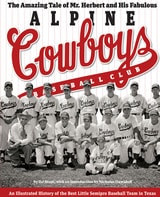
The Amazing Tale of Mr. Herbert and His Fabulous Alpine Cowboys Baseball Club
An Illustrated History of the Best Little Semipro Baseball Team in TexasBy DJ Stout
University of Texas Press, 2010
Back in the 1940s and 1950s, almost every small town in America had a baseball team. Most players were simply local heroes with a local following, but a few teams achieved fame far beyond their region. The Alpine Cowboys—despite being based in Texas's remote, sparsely populated Big Bend country—became a star in the firmament of semi-pro baseball. Lavishly underwritten by a wealthy rancher with a passion not only for baseball but even more for helping young men get a good start in life, the Cowboys played on a "field of dreams" whose facilities rivaled those of professional ballparks. Many Cowboys went on to play in the big leagues, and several pro teams, including the Pittsburgh Pirates, Chicago White Sox, and St. Louis Browns, came to play exhibition games at Kokernot Field.
The story of Herbert Kokernot Jr. and his Alpine Cowboys is a legend among baseball aficionados, but until now it has never been the subject of a book. DJ Stout, son of former Cowboys player Doyle Stout, presents a hall-of-fame-worthy collection of photographs, memorabilia, and reminiscences from Alpine Cowboys players, family members, and fans to capture fifteen years (1946–1961) of baseball at its finest. Nicholas Dawidoff's introduction, originally published in Sports Illustrated, tells the fascinating tale of "Mr. Herbert" and his determination to build a baseball team and ballpark that deserved to carry his ranch's 06 brand.
One of the most heartwarming episodes in the annals of the game, The Amazing Tale of Mr. Herbert and His Fabulous Alpine Cowboys is a fitting tribute to a man, a team, and a ballpark.
The American Dream and the National Game
Leverett T. Smith, Jr.
University of Wisconsin Press, 1975
First paperback edition
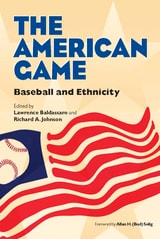
The American Game
Baseball and EthnicityEdited by Lawrence Baldassaro and Richard A. Johnson. Foreword by Allan (Bud) Selig
Southern Illinois University Press, 2002
These nine essays selected by Lawrence Baldassaro and Richard A. Johnson present for the first time in a single volume an ethnic and racial profile of American baseball. These essayists show how the gradual involvement by various ethnic and racial groups reflects the changing nature of baseball—and of American society as a whole—over the course of the twentieth century.
Although the sport could not truly be called representative of America until after Jackie Robinson broke the color line in 1947, fascination with the ethnic backgrounds of the players began more than a century ago when athletes of German and Irish descent entered the major leagues in large numbers. In the 1920s, commentators noted the influx of ballplayers of Italian and Slavic origins and wondered why there were not more Jewish players in the big leagues. The era following World War II, however, saw the most dramatic ethnographic shift with the belated entry of African American ballplayers. The pattern of ethnic succession continues as players of Hispanic and Asian origin infuse fresh excitement and renewal into the major leagues.
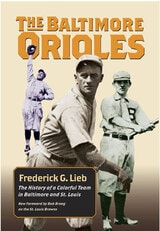
The Baltimore Orioles
The History of a Colorful Team in Baltimore and St. LouisFrederick G. Lieb Foreword by Bob Broeg
Southern Illinois University Press, 2005
With a legacy that spans two fiercely loyal baseball towns a half-nation apart, the Baltimore Orioles—originally the St. Louis Browns—rank among baseball’s most storied teams. One of the fifteen celebrated team histories commissioned by G. P. Putnam’s Sons in the 1940s and 1950s, The Baltimore Orioles: The History of a Colorful Team in Baltimore and St. Louis chronicles the club’s early history and is reissued on the fiftieth anniversary of their first season in Baltimore.
Hall of Fame sportswriter Frederick G. Lieb begins with the history of baseball in Baltimore from its pre-Civil War beginnings and its major-league debut as the Lord Baltimores in 1872 to the championship seasons of the National League Orioles in 1894, ’95, and ’96 when the roster included Willie Keeler, Joe Kelley, Kid Gleason, Roger Bresnahan, Joe McGinnity, and John McGraw. After the turn of the century, Baltimore was briefly home to the Orioles of the American League in 1901-02, then, after losing its franchise to New York, had to settle for the AAA International League Orioles until 1954. Under the leadership of Jack Dunn, the minor-league Orioles, while developing the talents of Babe Ruth, Lefty Grove, and other future major-league stars, won seven straight International League pennants from 1919 to 1926.
Here, too, is the colorful history of the precursors to the current Orioles, the lovable and luckless St. Louis Browns, augmented for this edition with a new foreword from St. Louis sportswriter Bob Broeg on the escapades of the Brownies. Though they lost more than a thousand games and captured only a single pennant in fifty-three seasons, the Browns remain a legendary part of national lore. Taking their lead in different eras from larger-than-life figures such as Branch Rickey, Rogers Hornsby, Urban Shocker, and the Barnum of Baseball, Bill Veeck, the Browns “boasted a one-armed outfielder, a hired hypnotist, the mighty midget [Eddie Gaedel] and—even the best ballplayer in the land—George Sisler,” as Broeg recalls in his foreword. In 1944, the Browns also played in the only all-St. Louis World Series, losing to the Cardinals.
Originally published in 1955 and featuring twenty-two photographs, The Baltimore Orioles history concludes with the new American League team’s first season in Baltimore, finishing seventh in the league but garnering the lasting adoration of their new hometown.
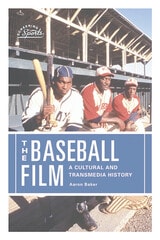
The Baseball Film
A Cultural and Transmedia HistoryAaron Baker
Rutgers University Press, 2022
This study offers an extensive look at nearly one hundred years of baseball-themed movies, documentaries, and TV shows. Film and sports scholar Aaron Baker examines works like A League of their Own (1992) and Sugar (2008), which dramatize the underrepresented contributions of female and immigrant players, alongside classic baseball movies like The Natural that are full of nostalgia for a time when native-born white men could use the game to achieve the American dream. He further explores how biopics have both mythologized and demystified such legendary figures as Ty Cobb, Babe Ruth, Lou Gehrig, Jackie Robinson and Fernando Valenzuela.
The Baseball Film charts the variety of ways that Hollywood presents the game as integral to American life, whether showing little league as a site of parent-child bonding or depicting fans’ lifelong love affairs with their home teams. Covering everything from Bull Durham (1988) to The Bad News Bears (1976), this book offers an essential look at one of the most cinematic of all sports.
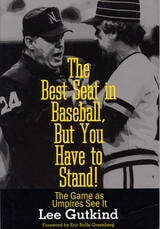
The Best Seat in Baseball, But You Have to Stand
The Game as Umpires See ItLee Gutkind. Foreword by Eric Rolfe Greenburg
Southern Illinois University Press, 1999
To provide this unique—if controversial—look at major league baseball as umpires see it, Lee Gutkind spent the 1974 season traveling with the umpiring crew of Doug Harvey (crew chief), Nick Colosi, Harry Wendelstedt, and Art Williams, the first black umpire in the National League. The result is an honest, realistic, insightful study of the private and professional world of major league umpires: their prejudices and petty biases, their unbending pride in their performance, their inside perspectives on the game, and their bitter criticism of the abuse often directed at their profession and at their conduct. As relevant today as it was in 1974, this illustrated chronicle shows how little has changed in the lives and duties of umpires in the last quarter century.
Guided by his passionate love for the game as he wrote The Best Seat in Baseball, But You Have to Stand!, Gutkind attempted to present the umpires in a positive but realistic light: "I portrayed them as real people, honorable, hard-working and dedicated, but with warts and flaws like the rest of us. But they didn't want to be compared with real people; they wanted to be umpires—on a plateau above most everyone else." Since the publication of this book in 1975, neither Harvey nor Wendelstedt have communicated with Gutkind, with Wendelstedt even denying that Gutkind traveled with the crew.
The Burden of Over-representation
Race, Sport, and PhilosophyGrant Farred
Temple University Press, 2018
The Burden of Over-representation artfully explores three curious racial moments in sport: Jackie Robinson’s expletive at a Dodgers spring training game; the transformation of a formality into an event at the end of the 1995 rugby World Cup in South Africa; and a spectral moment at the 2010 FIFA World Cup. Grant Farred examines the connotations at play in these moments through the lenses of race, politics, memory, inheritance and conciliation, deploying a surprising cast of figures in Western thought, ranging from Jacques Derrida and Friedrich Nietzsche to Judith Butler, William Shakespeare, and Jesus-the-Christ. Farred makes connection and creates meaning through the forces at play and the representational burdens of team, country and race.
Farred considers Robinson’s profane comments at black Dodgers fans, a post-match exchange of “thank yous” on the rugby pitch between white South African captain François Pienaar and Nelson Mandela, and being “haunted” by the ghost of Derrida on the occasion of the first FIFA World Cup on African soil. In doing so, The Burden of Over-representation provides a passionate, insightful analysis of the social, political, racial, and cultural consequences of conciliation at key sporting events.
The Detroit Tigers Reader
Tom Stanton, Editor
University of Michigan Press, 2010
The story of the Tigers---like the story of Detroit itself---is one of resilience and endurance. For baseball fans it's also an intensely personal one: Detroit Tigers baseball has flowed through the veins of generations of families.
The essays, articles, and letters in The Detroit Tigers Reader capture those stories and the essence of the Tigers' spirit, tracing the history of the team from its first game on April 25, 1901, up through the arrival of "Pudge" Rodriguez in 2004. With contributions from some of the greatest sportswriters and athletes, as well as local journalists and fans, The Detroit Tigers Reader charts the highs and lows of one of the most extraordinary and celebrated teams in baseball history.
Includes contributions from
Mitch Albom
Dave Anderson
Joseph Durso
Joe Falls
Hank Greenberg
Ernie Harwell
Al Kaline
Mike Lupica
Grantland Rice
Damon Runyon
Babe Ruth
Neal Shine
The Great Encyclopedia of Nineteenth-Century Major League Baseball
David Nemec
University of Alabama Press, 2006
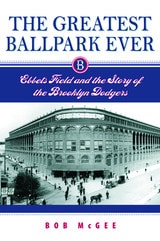
The Greatest Ballpark Ever
Ebbets Field and the Story of the Brooklyn DodgersMcGee, Bob
Rutgers University Press, 2005
In this lively story of sports, politics, and the talented, hilarious, and charming characters associated with the Brooklyn Dodgers, Bob McGee chronicles the ballpark's vibrant history from the drawing board to the wrecking ball, beginning with Charley Ebbets and the heralded opening in 1913, on through the eras that followed. McGee weaves a story about how Ebbets Field's architectural details, notable flaws, and striking facade brought Brooklyn and its team together in ways that allowed each to define the other.
Drawing on original interviews and letters, as well as published and archival sources, The Greatest Ballpark Ever explores the struggle of Charley Ebbets to build Ebbets Field, the days of Wilbert Robinson's early pennant winners, the eras of the Daffiness Boys, Larry MacPhail, and Branch Rickey, the tumultuous field leadership of Leo the Lip, the fiery triumph of Jackie Robinson, the golden days of the Boys of Summer, and Walter O'Malley's ignominious departure.
With humor and passion, The Greatest Ballpark Ever lets readers relive a day in the raucous ballpark with its quirky angles and its bent right-field wall, with the characters and events that have become part of the nation's folklore.
The Hidden Game of Baseball
A Revolutionary Approach to Baseball and Its StatisticsJohn Thorn, Pete Palmer, with David Reuther
University of Chicago Press, 2015
The new gospel promulgated by Thorn and Palmer opened the door for a flood of new questions, such as how a ballpark’s layout helps or hinders offense or whether a strikeout really is worse than another kind of out. Taking questions like these seriously—and backing up the answers with data—launched a new era, showing fans, journalists, scouts, executives, and even players themselves a new, better way to look at the game.
This brand-new edition retains the body of the original, with its rich, accessible analysis rooted in a deep love of baseball, while adding a new introduction by the authors tracing the book’s influence over the years. A foreword by ESPN’s lead baseball analyst, Keith Law, details The Hidden Game’s central role in the transformation of baseball coverage and team management and shows how teams continue to reap the benefits of Thorn and Palmer’s insights today. Thirty years after its original publication, The Hidden Game is still bringing the high heat—a true classic of baseball literature.
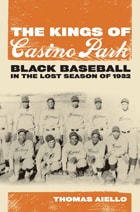
The Kings of Casino Park
Black Baseball in the Lost Season of 1932Thomas Aiello
University of Alabama Press, 2011
The Money Pitch
Baseball Free Agency and Salary ArbitrationRoger I. Abrams
Temple University Press, 2000
Why are baseball players paid so much money? In this insightful book, legal scholar and salary arbitrator Roger Abrams tells the story of how a few thousand very talented young men obtain their extraordinary riches. Juggling personal experience and business economics, game theory and baseball history, he explains how agents negotiate compensation, how salary arbitration works, and how the free agency "auction" operates. In addition, he looks at the context in which these systems operate: the players' collective bargaining agreement, the distribution of quality players among the clubs, even the costs of other forms of entertainment with which baseball competes.
Throughout, Dean Abrams illustrates his explanations with stories and quotations -- even an occasional statistic, though following the dictum of star pitcher, club owner, and sporting goods tycoon Albert Spalding, he has kept the book as free of these as possible. He explains supply and demand by the cost of a bar of soap for Christy Mathewson's shower. He illustrates salary negotiation with an imaginary case based on Roy Hobbs, star of The National. He leads the reader through the breath-taking successes of agent Scott Boras to explain the intricacies of free agent negotiating.
Although studies have shown that increases in admissions prices precede rather than follow the rise in player salaries, fans are understandably bemused by skyrocketing salaries. Dean Abrams does not shy away from the question of whether it is "fair" for an athlete to earn more than $10,000,000 a year. He looks at issues of player (and team) loyalty and player attitudes, both today and historically, and at what increased salaries have meant for the national pastime, financially and in the eyes of its fans. The Money Pitch concludes that "the money pitch is a story of good fortune, good timing, and great leadership, all resulting from playing a child's game -- a story that is uniquely American."
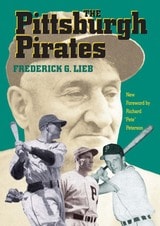
The Pittsburgh Pirates
Frederick G. Lieb. Foreword by Richard "Pete" Peterson
Southern Illinois University Press, 2003
An admirer of Pirate president Barney Dreyfuss, prolific baseball writer Frederick G. Lieb consorted with the club’s biggest stars, christened the legendary Dreyfuss “the first-division man,” and produced The Pittsburgh Pirates, one of the fifteen celebrated histories of major league teams commissioned by G. P. Putnam’s Sons in the 1940s and 1950s. Originally published in 1948, Lieb’s history ranges from the ball club’s earliest professional days in the late nineteenth century as the Pittsburgh Alleghenies to its spring training session in preparation for the 1948 season, a span that included six National League pennants and two World Series championships, as well as a loss to the Boston Red Sox, then the Pilgrims, at the inaugural World Series a century ago.
“This reprint of Fred Lieb’s The Pittsburgh Pirates is an invitation for baseball readers to enjoy Lieb’s wonderful stories of the great Pirate teams of the first half of the twentieth century,” writes Richard “Pete” Peterson in the new foreword to this edition. “Lieb’s book is rich with accounts of World Series triumphs and disappointments, of epic encounters on the playing field, like that between Wagner and Cobb, of mutinies in the clubhouse, of courageous comebacks, and of devastating defeats, including the infamous ‘homer in the gloaming.’”
In Lieb’s personable and anecdotal prose, honed over the course of his sustained sportswriting career, the book conveys “baseball drama of the highest order,” including the pre-Dreyfuss days of Captain Kerr, Ned Hanlon, and Connie Mack; Dreyfuss’s dynasty in the early twentieth century; the dramatic World Series triumphs of 1909 and 1925; the end of the Dreyfuss era and the sale of the club to a syndicate headed by John Galbreath and Bing Crosby; and the purchase of Hank Greenberg and the emergence of slugger Ralph Kiner. Aided by twenty-five black-and-white photographs, this rare history revisits the glories and stories of “fabulous old Pirates” such as Honus Wagner, Tommy Leach, Fred Clarke, Babe Adams, Max Carey, Kiki Cuyler, Pie Traynor, Paul and Lloyd Waner, and Arky Vaughan.
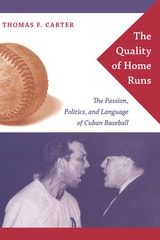
The Quality of Home Runs
The Passion, Politics, and Language of Cuban BaseballThomas F. Carter
Duke University Press, 2008
As an avid baseball fan, Carter draws on his experiences listening to and participating in discussions of baseball in Cuba (particularly in Havana) and among Cubans living abroad to describe how baseball provides the ground for negotiations of national, masculine, and class identities wherever Cubans gather. He considers the elaborate spectacle of Cuban baseball as well as the relationship between the socialist state and the enormously popular sport. Carter provides a detailed history of baseball in Cuba, analyzing players, policies, rivalries, and fans, and he describes how the sport has forged connections (or reinforced divisions) between Cuba and other nations. Drawing on insights from cultural studies, political theory, and anthropology, he maintains that sport and other forms of play should be taken seriously as crucibles of social and cultural experience.
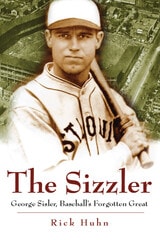
The Sizzler
George Sisler, Baseball's Forgotten GreatRick Huhn
University of Missouri Press, 2013
During his illustrious career he was a .340 hitter, twice achieving the rare feat of hitting more than .400. His 257 hits in 1920 is still the record for the “modern” era. Considered by many to be one of the game’s most skillful first basemen, he was the first at his position to be inducted into the National Baseball Hall of Fame. Yet unlike many of his peers who became household names, Sisler has faded from baseball’s collective consciousness.
Now in The Sizzler, this “legendary player without a legend” gets the treatment he deserves. Rick Huhn presents the story of one of baseball’s least appreciated players and studies why his status became so diminished. Huhn argues that the answer lies somewhere amid the tenor of Sisler’s times, his own character and demeanor, the kinds of individuals who are chosen as our sports heroes, and the complex definition of fame itself.
In a society obsessed with exposing the underbellies of its heroes, Sisler’s lack of a dark side may explain why less has been written about him than others. Although Sisler was a shy, serious sort who often shunned publicity, his story is filled with its own share of controversy and drama, from a lengthy struggle among major-league moguls for his contractual rights—a battle that helped change the structure of organized baseball forever—to a job-threatening eye disorder he developed during the peak of his career and popularity.
By including excerpts from Sisler’s unpublished memoir, as well as references to the national and international events that took place during his heyday, Huhn reveals the full picture of this family man who overcame great obstacles, stood on high principles, and left his mark on a game he affected in a positive way for fifty-eight years.
The St. Louis Baseball Reader
Richard Peterson
University of Missouri Press, 2022
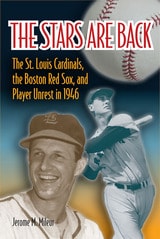
The Stars Are Back
The St. Louis Cardinals, the Boston Red Sox, and Player Unrest in 1946Jerome M. Mileur
Southern Illinois University Press, 2013
But while the nation was riveted by the return of its beloved baseball heroes, the game behind the scenes was just as dramatic. As the threat of unionization loomed and the Mexican League continued to lure players away from the United States with lucrative contracts, tensions between players and team owners mounted. The result was a standoff for control of the game that would culminate in the Magna Carta of baseball and the creation of standard contracts for players, ushering in the modern era of baseball.
Set against the backdrop of a country recovering from war, facing the new adversary of Communism, and absorbing the emotional impact of the atomic bomb, The Stars Are Back tells the story of a nation hungry for a return to normalcy and a game poised on the brink of new horizons.
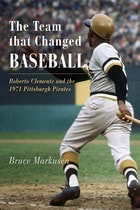
The Team That Changed Baseball
Roberto Clemente and the 1971 Pittsburgh PiratesBruce Markusen
Westholme Publishing, 2006
The Inspiring Story of Roberto Clemente's Greatest Season and One of the Most Important Teams in Sport History
In 1947, major league baseball experienced its first measure of integration when the Brooklyn Dodgers brought Jackie Robinson to the National League. While Robinson's breakthrough opened the gates of opportunity for African Americans and other minority players, the process of integration proved slow and uneven. It was not until the 1960s that a handful of major league teams began to boast more than a few Black and Latino players. But the 1971 World Championship team enjoyed a full and complete level of integration, with half of its twenty-five-man roster comprised of players of African American and Latino descent. That team was the Pittsburgh Pirates, managed by an old-time Irishman.
In The Team That Changed Baseball: Roberto Clemente and the 1971 Pittsburgh Pirates, veteran baseball writer Bruce Markusen tells the story of one of the most likable and significant teams in the history of professional sports. In addition to the fact that they fielded the first all-minority lineup in major league history, the 1971 Pirates are noteworthy for the team's inspiring individual performances, including those of future Hall of Famers Roberto Clemente, Willie Stargell, and Bill Mazeroski, and their remarkable World Series victory over the heavily favored Baltimore Orioles. But perhaps their greatest legacy is the team's influence on the future of baseball, inspiring later championship teams such as the New York Yankees and Oakland Athletics to open their doors fully to all talented players, regardless of race, particularly in the new era of free agency.
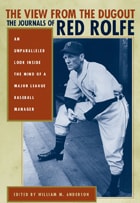
The View from the Dugout
The Journals of Red RolfeEdited by William M. Anderson
University of Michigan Press, 2006
-Bill James, in The New Bill James Historical Baseball Abstract, on the journals of Red Rolfe
"Red Rolfe's journal for his years as manager of the Detroit Tigers is the kind of precious source researchers yearn for. In combination with William M. Anderson's well-done text, The View from the Dugout will be of great interest to general readers and of immense value to students of baseball history."
-Charles C. Alexander, author of Breaking the Slump: Baseball in the Depression Era
"Red Rolfe was one of baseball's most astute observers. This is 'inside' baseball from the inside."
-Donald Honig, author of Baseball America, Baseball When the Grass Was Real, and other books in the Donald Honig Best Players of All Time series
"In his lucid journals Red Rolfe has provided an inside look at how an intelligent baseball manager thinks and prepares."
-Ray Robinson, Yankee historian and author of Iron Horse: Lou Gehrig in His Time
Baseball players as a rule aren't known for documenting their experiences on the diamond. Red Rolfe, however, during his time as manager of the Detroit Tigers from 1949 to 1952, recorded daily accounts of each game, including candid observations about his team's performance. He used these observations to coach his players and to gain an advantage by recording strengths, weaknesses, and tendencies of opposing players and managers. Rolfe's journals carry added value considering his own career as an All-Star Yankee third baseman on numerous world champion teams, where he was a teammate of Lou Gehrig and Joe DiMaggio.
Today, in the era of televised broadcasts, networks often wire a manager so that viewers can listen to his spontaneous comments throughout the game. Red Rolfe's journals offer an opportunity to find out what a manager is thinking when no one is around to hear.
William M. Anderson is Director of the Department of History, Arts and Libraries for the State of Michigan. His books include The Detroit Tigers: A Pictorial Celebration of the Greatest Players and Moments in Tigers' History.
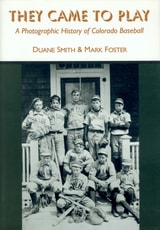
They Came to Play
A Photographic History of Colorado BaseballDuane A. Smith
University Press of Colorado, 2012
In They Came To Play: A Photographic History of Colorado Baseball, historians and avid baseball fans Duane Smith and Mark Foster have collected the finest historic baseball photographs of teams, players, and games from around the state. They are all here, the town teams, company teams, early professional clubs, and the ethnic teams that made baseball an integral part of the life and times in Colorado's mountain towns, prairie hamlets, and bustling frontier cities. Combined with the wonderful photographs and captions is an essay that brings baseball's rich heritage in Colorado to life for the reader.
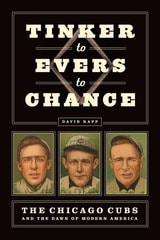
Tinker to Evers to Chance
The Chicago Cubs and the Dawn of Modern AmericaDavid Rapp
University of Chicago Press, 2018
Tinker to Evers to Chance examines this pivotal moment in American history, when baseball became the game we know today. Each man came from a different corner of the country and brought a distinctive local culture with him: Evers from the Irish-American hothouse of Troy, New York; Tinker from the urban parklands of Kansas City, Missouri; Chance from the verdant fields of California’s Central Valley. The stories of these early baseball stars shed unexpected light not only on the evolution of baseball and on the enthusiasm of its players and fans all across America, but also on the broader convulsions transforming the US into a confident new industrial society. With them emerged a truly national culture.
This iconic trio helped baseball reinvent itself, but their legend has largely been relegated to myths and barroom trivia. David Rapp’s engaging history resets the story and brings these men to life again, enabling us to marvel anew at their feats on the diamond. It’s a rare look at one of baseball’s first dynasties in action.
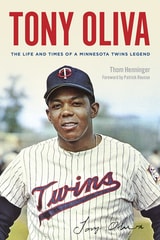
Tony Oliva
The Life and Times of a Minnesota Twins LegendThom Henninger
University of Minnesota Press, 2019
If not for the botched Bay of Pigs invasion, Minnesota might never have known one of its most popular baseball players, Twins three-time batting champion and eight-time All-Star Tony Oliva. In April 1961, the twenty-two-year-old Cuban prospect failed to impress the Twins in a tryout, but the sudden rupture in U.S.–Cuba relations made a return visa all but impossible. The story of how Oliva’s unexpected stay led to a second chance and success with the Twins—as well as decades of personal and cultural isolation—is told for the first time in this full-scale biography of the man the fans affectionately call “Tony O.”
With unprecedented access to the very private Oliva, baseball writer Thom Henninger captures what life was like for the Cuban newcomer as he adjusted to major league play and American culture—and at the same time managed to earn Rookie of the Year honors and win the American League batting title in his first two seasons, all while playing with a knuckle injury. Packed with never-before-published photographs, the book follows Oliva through the 1965 season, all the way to the World Series, and then, with repaired knuckle and knee, into one of the most dramatic pennant races in baseball history in 1967. Through the voices of Oliva, his family, and his teammates—including the Cuban players who shared his cultural challenges and the future Hall of Famers he mentored, Rod Carew and Kirby Puckett—the personal and professional highs and lows of the years come alive: the Gold Glove Award in 1966, a third batting title in 1971, the devastating injury that curtailed his career, and, through it all, the struggle to build a family and recover the large and close-knit one he had left behind in Cuba.
Nearly forty years after Oliva’s retirement, the debate continues over whether his injury-shortened career was Hall of Fame caliber—a question that gets a measured and resounding answer here.
Touching Base
Professional Baseball and American Culture in the Progressive EraSteven A. Riess
University of Illinois Press, 1999
Touching Home
Baseball and the Liberal-Republican Tradition in AmericaMary Craig
University of Missouri Press, 2025
2026 Society for American Baseball Research Seymour Medal finalist
Baseball’s relationship to American ideals has long been an object of study across disciplines. In Touching Home, Mary Craig contributes to this ongoing study by relating issues of class, race, and gender to America’s theoretical tradition of liberalism and republicanism established during the nation’s founding era. Specifically, Touching Home traces theories of individualism and civic virtue from the founding era through baseball’s place in American society at the end of the twentieth century.
The work also examines the mythologizing of baseball’s pastoralism, racial equality, and inculcation of manliness as a civic virtue. These myths became ingrained in baseball in significant ways, including, for example, the Supreme Court’s granting of an antitrust exemption to Major League Baseball; MLB’s promotion of Jackie Robinson’s career as proof of its leadership in and commitment to desegregation; and the short-lived All-American Girls Professional Baseball League (1943-1954) and subsequent relegation of women to softball.
Through the exploration of these and other societal issues, Craig’s work highlights baseball’s development from accessible hobby to multi-billion-dollar corporation, exploring the ways in which the sport has helped shape how individual Americans engage with politics. Indeed, in the pages of Touching Home readers will find a demythologizing of baseball that helps them better understand the results of their efforts to form community through engaging with teams at both the local and national levels. Scholars of American politics, particularly American political thought, will be intrigued to find baseball used as a case study of the effectiveness of the founders’ project of crafting a jointly liberal-republican framework capable of directing Americans toward responsible citizenship.
In all of these ways, Touching Home upholds the value of studying popular culture, presenting baseball as a unique and highly interesting lens through which to help us appreciate how individual Americans relate to politics and parties in their respective communities and nationally.