Results by title
55 books match the query 'Biomedical' and 8 start with t
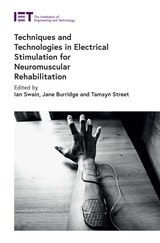
Techniques and Technologies in Electrical Stimulation for Neuromuscular Rehabilitation
Ian Swain
The Institution of Engineering and Technology, 2025
In its simplest form, electrical stimulation is the application of electrical impulses to nerves via electrodes placed over the nerve or muscle or implanted within the body. The aim is to evoke a muscle contraction. People may not be able to activate their own muscles sufficiently to execute effective movement due to damage to the nervous system preventing the signals from the brain reaching the muscles, for example, after a stroke or spinal cord injury, or due to disuse, often because of pain. Electrical stimulation can be used to restore or improve impaired function by initiating or complementing muscle activity. Stimulation can be used either to provide exercise and so improve strength and endurance or timed to a physical activity such as walking to improve quality of movement and function.
[more]
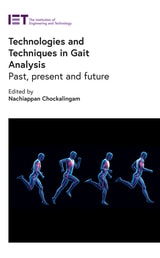
Technologies and Techniques in Gait Analysis
Past, present and futureNachiappan Chockalingam
The Institution of Engineering and Technology, 2022
Gait analysis is the study of the walking or running pattern of an individual. This can include spatial and temporal measurements such as step length, stride length and speed along with angular measurements of various joints and the interplay between various parts like the foot, hip, pelvis or spine when walking. Gait analysis can be used to assess clinical conditions and design effective rehabilitation; for example, following limb injury or amputation, or other disorders such as a stroke or Parkinson's diagnosis. It can be used to influence intervention decisions, such as whether a patient should undergo surgery, further physiotherapy, or begin a particular treatment regime. Gait analysis can also be used in sports science to monitor and review performance and technique.
[more]
Technologies for Healthcare 4.0
From AI and IoT to blockchainKarthik Ramamurthy
The Institution of Engineering and Technology, 2023
There are a growing number of challenges in handling medical data in order to provide an effective healthcare service in real-time. Bridging the gap between patient expectations and their experiences needs effective collaboration and connectivity across the healthcare ecosystem. The success of joined-up care relies on patient data being shared between all active stakeholders, including hospitals, outreach workers, and GPs. All these needs and challenges pave the way for the next trend of development in healthcare - healthcare 4.0.
[more]
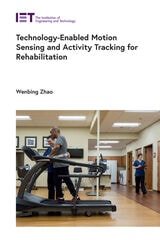
Technology-Enabled Motion Sensing and Activity Tracking for Rehabilitation
Wenbing Zhao
The Institution of Engineering and Technology, 2022
Documenting how technology has been increasingly facilitating rehabilitation both for physical and mental health, this book focuses on sensing and measurement technologies for rehabilitation applications.
[more]

Telemedicine Systems for Unreached Communities
Context, challenges and opportunitiesMehdi Hasan
The Institution of Engineering and Technology, 2026
Telemedicine - broadly defined as the use of electronic information and communication technologies to deliver healthcare services at a distance - offers an opportunity to create more equitable healthcare provision for unreached communities. Through the integration of telecommunications technologies, remote diagnostics, electronic health systems, mobile health platforms, and virtual consultation models, telemedicine enables healthcare providers to deliver clinical services across significant geographic and socioeconomic divides.
[more]
The Chronopolitics of Life
Rethinking Temporalities in Health and Biomedicine Beyond the Life CourseEdited by Nolwenn Bühler, Nils Graber, Victoria Boydell, and Cinzia Greco
University College London, 2025
An examination of the links between power, inequality, and time in health governance.
This interdisciplinary collection examines the role of time in inequalities within biomedicine, technology, and healthcare. How is time wielded as a tool of power through its valuation, standardization, and allocation? How has time become an unequally distributed resource in health and biomedicine, and how has it contributed to medical discrimination for patients at different stages of life? To answer these questions, The Chronopolitics of Life draws on real-world examples from across the globe, spanning from reproductive health to chronic disease, and sensitive to both local variations in medicine and the wider forces shaping temporalities in health.
This interdisciplinary collection examines the role of time in inequalities within biomedicine, technology, and healthcare. How is time wielded as a tool of power through its valuation, standardization, and allocation? How has time become an unequally distributed resource in health and biomedicine, and how has it contributed to medical discrimination for patients at different stages of life? To answer these questions, The Chronopolitics of Life draws on real-world examples from across the globe, spanning from reproductive health to chronic disease, and sensitive to both local variations in medicine and the wider forces shaping temporalities in health.
[more]
The Connector
Living with Experimental NeuroprostheticsAlexandra Middleton
Duke University Press, 2026
In The Connector, Alexandra Middleton examines how the frontiers of experimental medical science are always the everyday lived experiences for patients and their families and communities. Drawing on fieldwork and interviews conducted in Swedish labs and clinics that develop neuromusculoskeletal protheses, as well as in the homes of patients enrolled in clinical trials as they live with these new forms of prosthetics, Middleton shows how patients’ sensory experiences and domestic worlds become key spaces of scientific knowledge production that extend well beyond their visits to the lab. Through storytelling that centers the patients’ embodied knowledge and labor, along with the scientists who work closely with them, Middleton depicts how “connection” entails inhabiting the liminal space between ideation and materialization, a space punctuated not only by breakthroughs and breakdowns, but the slow work of the everyday. The Connector critically examines where biomedical innovation, scientific discovery, and the “cutting edge” come from in ways that foreground the importance of the domestic spaces in which experimental science take place.
[more]
The Social Life of Biometrics
George C Grinnell
Rutgers University Press, 2020
In The Social Life of Biometrics, biometrics is loosely defined as a discrete technology of identification that associates physical features with a legal identity. Author George Grinnell considers the social and cultural life of biometrics by examining what it is asked to do, imagined to do, and its intended and unintended effects. As a human-focused account of technology, the book contends that biometrics needs to be understood as a mode of thought that informs how we live and understand one another; it is not simply a neutral technology of identification. Placing our biometric present in historical and cultural perspective, The Social Life of Biometrics examines a range of human experiences of biometrics. It features individual stories from locations as diverse as Turkey, Canada, Qatar, Six Nations territory in New York State, Iraq, the skies above New York City, a university campus and Nairobi to give cultural accounts of identification and look at the ongoing legacies of our biometric ambitions. It ends by considering the ethics surrounding biometrics and human identity, migration, movement, strangers, borders, and the nature of the body and its coherence. How has biometric thought structured ideas about borders, race, covered faces, migration, territory, citizenship, and international responsibility? What might happen if identity was less defined by the question of “who’s there?” and much more by the question “how do you live?”
[more]