Results by title
235 books match the query 'Books and reading' and 42 start with t
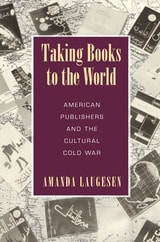
Taking Books to the World
American Publishers and the Cultural Cold WarAmanda Laugesen
University of Massachusetts Press, 2017
In Taking Books to the World, Amanda Laugesen tells the story of this purposeful enterprise, demonstrating the mix of goodwill and political drive behind its efforts to create modern book industries in developing countries. Examining the project through a clarifying lens, she reveals the ways Franklin's work aligned with cultural currents, exposing the imperial beliefs, charitable hopes, and intellectual reasoning behind this global experiment.
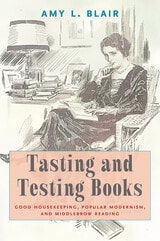
Tasting and Testing Books
Good Housekeeping, Popular Modernism, and Middlebrow ReadingAmy L. Blair
University of Massachusetts Press, 2024
A CHOICE 2025 Outstanding Academic Title
Honorable Mention, 2023-2024 Research Society of American Periodicals Book Prize
In its February 1926 issue, Good Housekeeping magazine introduced a column for its approximately one million subscribers called “Tasting and Testing Books.” The column’s author, Emily Newell Blair, would go on to produce ninety-one reading advice columns for the magazine between 1926 and 1934. During this period, Good Housekeeping became the most widely circulated periodical in the United States, doubling its circulation to over two million copies. Much of its popularity stemmed from its intensive promotion of its Seal of Approval for a variety of products, which brought consumers to it for utilitarian purposes. With her focus on regular books, Blair distinguished herself from highbrow literary critics, many of whom have been objects of study as High Modernists. She offered advice to help middle-class women readers make their own choices about the best books in which to invest time and money, rather than dictating what they should or should not read. She aligns herself with the average subscriber, outside the book publishing and reviewer industries, focusing on books that would now be termed middlebrow reading.
Blair’s time at Good Housekeeping covers the era from the heights of the “Roaring Twenties” to the depths of the Great Depression, and her recommendations offer a window into the uses of middlebrow reading during this period of dramatic economic and social shifts. Tasting and Testing Books argues that the consumer-first message of Good Housekeeping infused Blair’s advice column and validated a new attitude of proudly middlebrow pleasure reading in the mid-twentieth century. These columns shed new light on the reading lives of too-often overlooked women, often living outside of urban centers and away from elite literary circles, and present Emily Newell Blair, who strongly identified with her readers as a truly democratic tastemaker.

Teaching Banned Books
12 Guides for Young ReadersPat R. Scales
American Library Association, 2001
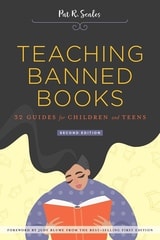
Teaching Banned Books
32 Guides For Children And TeensPat R. Scales
American Library Association, 2019
As standard-bearers for intellectual freedom, school and children’s librarians are in ideal positions to collaborate with educators to not only protect the freedom to read but also ensure that valued books which touch upon important topics are not quarantined from the readers for whom they were written. In this best-selling classroom- and library-ready book of discussion guides, thoroughly updated and expanded to include genres such as graphic novels and nonfiction, award-winning champion of children's literature Scales shows that there is a way to teach these books while respecting all views. Also freshened to include only books that are in print, this resource
- reprints Judy Blume's stirring introduction from the first edition;
- aids educators and librarians in stimulating the critical thinking skills of young readers aged 9-18 while also encouraging freedom of thought and expression, in either classroom or book club settings;
- spotlights titles dealing with sensitive but vital issues such as bullying, racism, bigotry, making tough choices, other cultures, and our uncertain future;
- offers tips for introducing each book and its associated topics;
- provides open-ended questions for discussion which explore the book as a whole rather than simply its "controversial" aspects, along with research and writing activities; and
- includes short summaries of each book, plus a read-alikes section to keep the conversation going.
Teens and Libraries
Getting It RightElaine Meyers
American Library Association, 2003

The Best in Children's Books
The University of Chicago Guide to Children's Literature, 1973-78Zena Sutherland
University of Chicago Press, 1980
The Best in Children's Books
The University of Chicago Guide to Children's Literature, 1979-84Zena Sutherland
University of Chicago Press, 1986
This volume carries on the tradition established by Zena Sutherland's two earlier collections covering the periods from 1966 to 1972 and 1973 to 1978. Her 1973 edition of The Best in Children's Books was cited by the American School Board Journal as one of the outstanding books of the year in education.
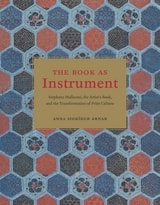
The Book as Instrument
Stéphane Mallarmé, the Artist's Book, and the Transformation of Print CultureAnna Sigrídur Arnar
University of Chicago Press, 2011
Stéphane Mallarmé (1842–98) was a French Symbolist poet, theorist, and teacher whose ideas and legendary salons set the stage for twentieth-century experimentation in poetry, music, theater and art. A canonical figure in the legacy of modernism, Mallarmé was also a lifelong champion of the book as both a literary endeavor and a carefully crafted material object.
In The Book as Instrument, Anna Sigrídur Arnar explores how this object functioned for Mallarmé and his artistic circle, arguing that the book became a strategic site for encouraging a modern public to actively partake in the creative act, an idea that informed later twentieth-century developments such as conceptual and performance art. Arnar demonstrates that Mallarmé was invested in creating radically empowering reading experiences, and the diverse modalities he proposed for both reading and looking anticipate interactive media prevalent in today’s culture. In describing the world of books, visual culture, and mass media of the late nineteenth century, Arnar touches upon an array of themes that continues to preoccupy us in our own moment, including speculations on the future of the book. Enhanced by gorgeous illustrations, The Book as Instrument is sure to fascinate anyone interested in the ever-vibrant experiment between word and image that makes the page and the multi-sensory pleasures of reading.
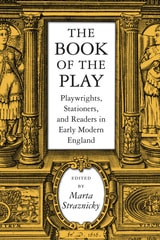
The Book of the Play
Playwrights, Stationers, and Readers in Early Modern EnglandMarta Straznicky
University of Massachusetts Press, 2006
The Book of the Play is a collection of essays that examines early modern drama in the context of book history. Focusing on the publication, marketing, and readership of plays opens fresh perspectives on the relationship between the cultures of print and performance and more broadly between drama and the public sphere. Marta Straznicky's introduction offers a survey of approaches to the history of play reading in this period, and the collection as a whole consolidates recent work in textual, bibliographic, and cultural studies of printed drama.
Individually, the essays advance our understanding of play reading as a practice with distinct material forms, discourses, social settings, and institutional affiliation. Part One, “Real and Imagined Communities,” includes four essays on play-reading communities and the terms in which they are distinguished from the reading public at large. Cyndia Clegg surveys the construction of readers in prefaces to published plays; Lucy Munro traces three separate readings of a single play, Edward Sharpham's The Fleer; Marta Straznicky studies women as readers of printed drama; and Elizabeth Sauer describes how play reading was mobilized for political purposes in the period of the Civil War.
In Part Two, “Play Reading and the Book Trade,” five essays consider the impact of play reading on the public sphere through the lens of publishing practices. Zachary Lesser offers a revisionist account of black-letter typeface and the extent to which it may be understood as an index of popular culture; Alan Farmer examines how the emerging news trade of the 1620s and 1630s affected the marketing of printed drama; Peter Berek traces the use of generic terms on title pages of plays to reveal their intersection with the broader culture of reading; Lauren Shohet demonstrates that the Stuart masque had a parallel existence in the culture of print; and Douglas Brooks traces the impact print had on eclipsing performance as the medium in which the dramatist could legitimately lay claim to having authored his text.
The individual essays focus on selected communities of readers, publication histories, and ideologies and practices of reading; the collection as a whole demonstrates the importance of textual production and reception to understanding the place of drama in the early modern public sphere.

The Cowboy Hero & Its Audience
Popular Culture As Market Derived ArtAlf H. Walle
University of Wisconsin Press, 2000
Using the history of the cowboy story from 1820 to 1970 as an extended example, Alf H. Walle combines popular culture scholarship with marketing theory to provide a hybrid analysis. Wall examines major authors and genres of Western American literature and film; he also explores why certain respected authors were unable to significantly impact the cowboy story even though their innovations were embraced by later generations. Finally Wall provides a hybrid analysis combining business and popular culture theory in an overarching analysis.
The Daughter as Reader
Encounters between Literature and LifePaula Marantz Cohen
University of Michigan Press, 1996
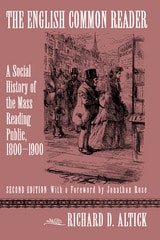
The ENGLISH COMMON READER
A Social History of the Mass Reading Public, 1800–1900, Second EditionRichard D. Altick
The Ohio State University Press, 1998
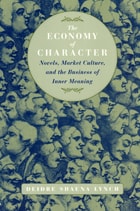
The Economy of Character
Novels, Market Culture, and the Business of Inner MeaningDeidre Shauna Lynch
University of Chicago Press, 1998
Although the story of this shift is usually told in terms of the "rise of the individual," Deidre Shauna Lynch proposes an ingenious alternative interpretation. Elaborating a "pragmatics of character," Lynch shows how readers used transactions with characters to accommodate themselves to newly commercialized social relations. Searching for the inner meanings of characters allowed readers both to plumb their own inwardness and to distinguish themselves from others. In a culture of mass consumption, argues Lynch, possessing a belief in the inexpressible interior life of a character rendered one's property truly private.
Ranging from Defoe and Smollett to Burney and Austen, Lynch's account will interest students of the novel, literary historians, and anyone concerned with the inner workings of consumer culture and the history of emotions.
The Empire's Old Clothes
What the Lone Ranger, Babar, and Other Innocent Heroes Do to Our MindsAriel Dorfman
Duke University Press, 2010
The Fallen Angel
Chastity, Class and Women's Reading, 1835–1880Sally Mitchell
University of Wisconsin Press, 1981
This book discusses the figure of the unchaste woman in a wide range of fiction written between 1835 and 1880; serious novels by Dickens, Mrs. Gaskell, Meredith, and George Eliot; popular novels that provided light reading for middle-class women (including books by Dinah Craik, Rhoda Broughton, and Ouida); sensational fiction; propaganda for social reform; and stories in cheap periodicals such as the Family Herald and the London Journal, which reached a different and far wider audience than either serious or popular novels.
The Feeling of Reading
Affective Experience and Victorian LiteratureEdited by Rachel Ablow
University of Michigan Press, 2010
"A terrifically engaging collection of essays, which exemplifies the very best recent work in the history of reading and affect. The distinguished contributors explore ‘the feeling of reading' throughout Victorian literature, showing how a broad range of works---novels, lyrics, critical essays---not only represent but also analyze and evoke the surprisingly varied experience of immersing oneself in a book. It's rare to encounter a collection of such consistently high quality: the feeling of reading it is one of rich and manifold pleasure."
---James Eli Adams, Columbia University
"This gathering of state-of-the-art work generates a convincing and compelling vision of the emerging state of the field."
---Daniel Hack, University of Michigan
The Feeling of Reading is the first collection to address how we think of reading today through a focus on Victorian reading practices and the individual experience of reading in the nineteenth century. It brings together essays from some of the most established writers in the field with contributions from younger scholars to provide new ways of thinking about this definitive moment. The collection moves from the general to the particular: from excavations of the material and intellectual conditions of Victorian reading to the consequences of such excavations in readings of individual texts. All of the contributors engage the crucial critical question of the shaping of readerly feeling. In addition, they address a set of interlocking issues central to understanding Victorian reading: Kate Flint explores the material and social settings of reading; Nicholas Dames and Leah Price consider the concrete realities of books and periodicals; and the consequences of the mass circulation of texts are explored by Flint, John Plotz, and Rachel Ablow. The temporality of consumption appears in the contribution of Dames as well as those of Catherine Robson and Herbert F. Tucker, who also address the implications of meter; and Ablow, Plotz, Stephen Arata, and Garrett Stewart investigate the notion of identification.
Rachel Ablow is Associate Professor at the University at Buffalo, State University of New York.
Cover design and art by Julian Montague
The Female as Subject
Reading and Writing in Early Modern JapanP. F. Kornicki, Mara Patessio, and G. G. Rowley, Editors
University of Michigan Press, 2010
The Harlem Renaissance and the Idea of a New Negro Reader
Shawn Anthony Christian
University of Massachusetts Press, 2016
Many scholars have written about the white readers and patrons of the Harlem Renaissance, but during the period many black writers, publishers, and editors worked to foster a cadre of African American readers, or in the poet Sterling Brown's words, a “reading folk.” Black newspapers featured columns that reviewed the latest African American fiction. Magazines held writing contests to urge black readers to participate in the literary culture. Through newspapers, journals, and anthologies, writers such as James Weldon Johnson, Jessie Fauset, and Gwendolyn Bennett spoke directly to their fellow African Americans to cultivate interest in literature and the intellectual tools for reading it.
In The Harlem Renaissance and the Idea of a New Negro Reader, Shawn Anthony Christian argues that print-based addresses to African Americans are a defining but understudied component of the Harlem Renaissance. Especially between 1919 and 1930, these writers promoted diverse racial representation as a characteristic of “good literature” both to exhibit black literacy and to foster black readership. Drawing on research from print culture studies, histories of racial uplift, and studies of modernism, Christian demonstrates the importance of this focus on the African American reader in influential periodicals such as The Crisis and celebrated anthologies such as The New Negro. Christian illustrates that the drive to develop and support black readers was central in the poetry, fiction, and drama of the era.
The History and Power of Writing
Henri-Jean Martin
University of Chicago Press, 1994
Traversing four millennia, Martin offers a chronicle of writing as a cultural system, a means of communication, and a history of technologies. He shows how the written word originated, how it spread, and how it figured in the evolution of civilization. Using as his center the role of printing in making the written way of thinking dominant, Martin examines the interactions of individuals and cultures to produce new forms of "writing" in the many senses of authorship, language rendition, and script.
Martin looks at how much the development of writing owed to practical necessity, and how much to religious and social systems of symbols. He describes the precursors to writing and reveals their place in early civilization as mnemonic devices in service of the spoken word. The tenacity of the oral tradition plays a surprisingly important part in this story, Martin notes, and even as late as the eighteenth century educated individuals were trained in classical rhetoric and preferred to rely on the arts of memory. Finally, Martin discusses the changes to writing wrought by the electronic revolution, offering invaluable insights into the influence these new technologies have had on children born into the computer age.
The Limits of Familiarity
Authorship and Romantic ReadersLindsey Eckert
Bucknell University Press, 2022
What did Wordsworth wear, and where did he walk? Who was Byron’s new mistress, and how did his marriage fare? Answers—sometimes accurate, sometimes not—were tantalizingly at the ready in the Romantic era, when confessional poetry, romans à clef, personal essays, and gossip columns offered readers exceptional access to well-known authors. But at what point did familiarity become overfamiliarity? Widely recognized as a social virtue, familiarity—a feeling of emotional closeness or comforting predictability—could also be dangerous, vulgar, or boring. In The Limits of Familiarity, Eckert persuasively argues that such concerns shaped literary production in the Romantic period. Bringing together reception studies, celebrity studies, and literary history to reveal how anxieties about familiarity shaped both Romanticism and conceptions of authorship, this book encourages us to reflect in our own fraught historical moment on the distinction between telling all and telling all too much.
The Making of The Wind in the Willows
Peter Hunt
Bodleian Library Publishing, 2018
Peter Hunt explores the unusual trajectory of The Wind in the Willows through previously unpublished archival materials, original drawings, and fan letters (including one from Theodore Roosevelt). He identifies the colleagues and friends on whom Grahame is thought to have based the characters of Mole, Rat, Badger, and Toad, and explores the literary genres of boating, caravanning, and motoring on which the author drew. He also recounts the extraordinary correspondence surrounding the book’s first publication and the influence of two determined women—publisher’s agent Constance Smedley and the author’s wife, Elspeth Grahame—who helped turn the book into the classic for children we know and love today. Generously illustrated throughout, this book celebrates one of the most beloved works of children’s literature ever published.
The Neal-Schuman Guide to Recommended Children's Books and Media for Use with Every Elementary Subject
American Library Association, 2010
The Networked Wilderness
Communicating in Early New EnglandMatt Cohen
University of Minnesota Press, 2009
In The Networked Wilderness, Matt Cohen examines communications systems in early New England and finds that, surprisingly, struggles over information technology were as important as theology, guns, germs, or steel in shaping the early colonization of North America. Colonists in New England have generally been viewed as immersed in a Protestant culture of piety and alphabetic literacy. At the same time, many scholars have insisted that the culture of the indigenous peoples of the region was a predominantly oral culture. But what if, Cohen posits, we thought about media and technology beyond the terms of orality and literacy?
Reconceptualizing aural and inscribed communication as a spectrum, The Networked Wilderness bridges the gap between the history of the book and Native American systems of communication. Cohen reveals that books, paths, recipes, totems, and animals and their sounds all took on new interactive powers as the English negotiated the well-developed informational trails of the Algonquian East Coast and reported their experiences back to Europe. Native and English encounters forced all parties to think of each other as audiences for any event that might become a kind of "publication."
Using sources ranging from Thomas Morton's Maypole festival to the architecture of today's Mashantucket Pequot Museum and Research Center, Cohen shows that the era before the printing press came to New England was one of extraordinary fertility for communications systems in America.
The Official YALSA Awards Guidebook
American Library Association, 2008
The Part and the Whole in Early American Literature, Print Culture, and Art
Matthew Pethers
Bucknell University Press, 2024
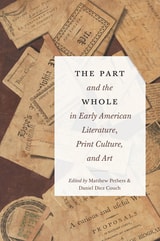
The essays in this pathbreaking collection consider the significance of varied early American fragmentary genres and practices—from diaries and poetry, to almanacs and commonplace books, to sermons and lists, to Indigenous ruins and other material shards and fragments—often overlooked by critics in a scholarly privileging of the “whole.” Contributors from literary studies, book history, and visual culture discuss a host of canonical and non-canonical figures, from Edward Taylor and Washington Irving to Mary Rowlandson and Sarah Kemble Knight, offering insight into the many intellectual, ideological, and material variations of “form” that populated the early American cultural landscape. As these essays reveal, the casting of the fragmentary as aesthetically eccentric or incomplete was a way of reckoning with concerns about the related fragmentation of nation, society, and self. For a contemporary audience, they offer new ways to think about the inevitable gaps and absences in our cultural and historical archive.
The Politics of Common Reading
Vernacular Knowledge and Everyday Technics in China, 1894–1954Joan Judge
University of Chicago Press, 2025
Examines the transformation of vernacular knowledge during a pivotal period of modern Chinese history, 1894 to 1954.
What did common readers read in the midst of the revolutions that punctuated China’s long Republic (1894–1954)? How did they manage the often-unprecedented challenges of the era? What did they know and how did they know it?
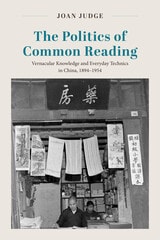
In The Politics of Common Reading, Joan Judge traces the unfolding of a consequential politics of accommodation that engaged commoners as knowers rather than as an unenlightened mass. A response to the institutional failures of the era, this politics was enacted through an informal knowledge infrastructure comprised of low-budget publishers, rustic bookstalls, and a piecemeal national network. As yet unstudied, this infrastructure produced and circulated up to ten times the number of books as official, mainstream channels.
A corpus of some five hundred of these cheap collections of recipes and techniques serves as the basis for this book. Judge focuses on four challenges common readers faced: how to cure an opium addiction, avoid an electric shock, prevent a cholera infection, and graft a plant. She further draws on government, archival, periodical, and fiction materials in devising composites of individual common readers so that we can better know them: details of the crises they faced, the remedies they tried, and the knowledge they relied on as they decocted cures and applied technologies. She argues that the acts of conciliation and assemblage these readers engaged in shaped the broader epistemic terrain from which historical change was actualized in China’s century of revolution.
The Pooh Perplex
Frederick Crews
University of Chicago Press, 2003
The Power to Name
A History of Anonymity in Colonial West AfricaStephanie Newell
Ohio University Press, 2013
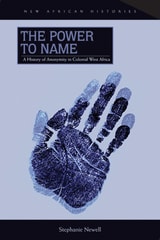
Between the 1880s and the 1940s, the region known as British West Africa became a dynamic zone of literary creativity and textual experimentation. African-owned newspapers offered local writers numerous opportunities to contribute material for publication, and editors repeatedly defined the press as a vehicle to host public debates rather than simply as an organ to disseminate news or editorial ideology. Literate locals responded with great zeal, and in increasing numbers as the twentieth century progressed, they sent in letters, articles, fiction, and poetry for publication in English- and African-language newspapers.
The Power to Name offers a rich cultural history of this phenomenon, examining the wide array of anonymous and pseudonymous writing practices to be found in African-owned newspapers between the 1880s and the 1940s, and the rise of celebrity journalism in the period of anticolonial nationalism. Stephanie Newell has produced an account of colonial West Africa that skillfully shows the ways in which colonized subjects used pseudonyms and anonymity to alter and play with colonial power and constructions of African identity.
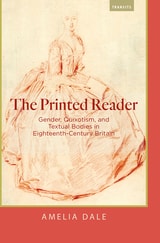
The Printed Reader
Gender, Quixotism, and Textual Bodies in Eighteenth-Century BritainAmelia Dale
Bucknell University Press, 2019
The Printed Reader explores the transformative power of reading in the eighteenth century, and how this was expressed in the fascination with Don Quixote and in a proliferation of narratives about quixotic readers, readers who attempt to reproduce and embody their readings. Through intersecting readings of quixotic narratives, including work by Charlotte Lennox, Laurence Sterne, George Colman, Richard Graves, and Elizabeth Hamilton, Amelia Dale argues that literature was envisaged as imprinting—most crucially, in gendered terms—the reader’s mind, character, and body. The Printed Reader brings together key debates concerning quixotic narratives, print culture, sensibility, empiricism, book history, and the material text, connecting developments in print technology to gendered conceptualizations of quixotism. Tracing the meanings of quixotic readers’ bodies, The Printed Reader claims the social and political text that is the quixotic reader is structured by the experiential, affective, and sexual resonances of imprinting and impressions.
Published by Bucknell University Press. Distributed worldwide by Rutgers University Press.
The Readers' Advisory Guide to Genre Fiction
Neal Wyatt
American Library Association, 2018
Everyone’s favorite guide to fiction that’s thrilling, mysterious, suspenseful, thought-provoking, romantic, and just plain fun is back—and better than ever in this completely revamped and revised edition. A must for every readers’ advisory desk, this resource is also a useful tool for collection development librarians and students in LIS programs. Inside, RA experts Wyatt and Saricks
- cover genres such as Psychological Suspense, Horror, Science Fiction, Fantasy, Romance, Mystery, Literary and Historical Fiction, and introduce the concepts of Adrenaline and Relationship Fiction;
- include everything advisors need to get up to speed on a genre, including its appeal characteristics, key authors, sure bets, and trends;
- demonstrate how genres overlap and connect, plus suggestions for guiding readers among genres; and
- tie genre fiction to the whole collection, including nonfiction, audiobooks, graphic novels, film and TV, poetry, and games.
Both insightful and comprehensive, this matchless guidebook will help librarians become familiar with many different fiction genres, especially those they do not regularly read, and aid library staff in connecting readers to books they’re sure to love.
The Readers' Advisory Guide to Nonfiction
Neal Wyatt
American Library Association, 2007
The Readers' Advisory Guide to Teen Literature
Angela Carstensen
American Library Association, 2018
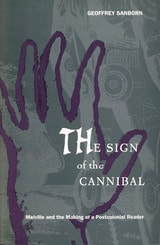
The Sign of the Cannibal
Melville and the Making of a Postcolonial ReaderGeoffrey Sanborn
Duke University Press, 1998
Sanborn focuses on the representations of cannibalism in three of Melville’s key texts—Typee, Moby-Dick, and “Benito Cereno.” Drawing on accounts of Pacific voyages from two centuries and virtually the entire corpus of the post-Enlightenment discourse on cannibalism, he shows how Melville used his narratives to work through the ways in which cannibalism had been understood. In so doing, argues Sanborn, Melville sought to move his readers through stages of possible responses to the phenomenon in order to lead them to consider alternatives to established assumptions and conventions—to understand that in the savage they see primarily their own fear and fascination. Melville thus becomes a narrator of the postcolonial encounter as he uncovers the dynamic of dread and menace that marks the Western construction of the “non-savage” human.
Extending the work of Slavoj Zizek and Homi Bhabha while providing significant new insights into the work of Melville, The Sign of the Cannibal represents a breakthrough for students and scholars of postcolonial theory, American literary history, critical anthropology, race, and masculinity.
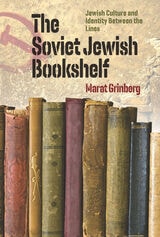
The Soviet Jewish Bookshelf
Jewish Culture and Identity Between the LinesMarat Grinberg
Brandeis University Press, 2022
In The Soviet Jewish Bookshelf, Marat Grinberg argues that in an environment where Judaism had been all but destroyed, and a public Jewish presence routinely delegitimized, reading uniquely provided many Soviet Jews with an entry to communal memory and identity. The bookshelf was both a depository of selective Jewish knowledge and often the only conspicuously Jewish presence in their homes. The typical Soviet Jewish bookshelf consisted of a few translated works from Hebrew and numerous translations from Yiddish and German as well as Russian books with both noticeable and subterranean Jewish content. Such volumes, officially published, and not intended solely for a Jewish audience, afforded an opportunity for Soviet Jews to indulge insubordinate feelings in a largely safe manner. Grinberg is interested in pinpointing and decoding the complex reading strategies and the specifically Jewish uses to which the books on the Soviet Jewish bookshelf were put. He reveals that not only Jews read them, but Jews read them in a specific way.
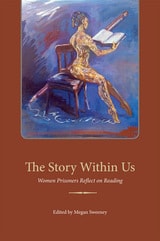
The Story Within Us
Women Prisoners Reflect on ReadingEdited by Megan Sweeney
University of Illinois Press, 2012
Framing the narratives within an analytic introduction and reflective afterword, Megan Sweeney highlights the crucial intellectual work that the incarcerated women perform despite myriad restrictions on reading and education in U.S. prisons. These women use the limited reading materials available to them as sources of guidance and support and as tools for self-reflection and self-education. Through their creative engagements with books, the women learn to reframe their own life stories, situate their experiences in relation to broader social patterns, deepen their understanding of others, experiment with new ways of being, and maintain a sense of connection with their fellow citizens on both sides of the prison fence.
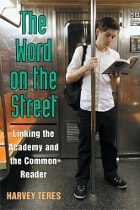
The Word on the Street
Linking the Academy and the Common ReaderHarvey Michael Teres
University of Michigan Press, 2010
"The Word On the Street invites humanities scholars to move beyond the classroom and the monograph to share the pleasures of art in ways that engage the intelligence of the common reader, cultivating the critical imagination so vital to American cultural democracy. Lively and thought-provoking, Teres lays out contemporary debates and wades into them with gusto."
---Nancy Cantor, Syracuse University
"At a moment when questions about the literary, 'bookishness,' and the future of print are being urgently raised, with incessant national attention to the perceived crises of literacy and reading, Teres' thoughtful, broadly democratic, but also tough-minded examination of both 'common readers' and academic readers makes a real contribution to the debate."
---Julie Ellison, University of Michigan
Despite significant changes since the mid-twentieth century in American critical culture---the culture emanating from the serious review of books, ideas, and the arts---it attracts only a small and declining minority of Americans. However productive this culture has been, American society has not approached the realization of Emerson's or Dewey's vision of a highly participatory American cultural democracy. Such a culture requires critics who are read by the average citizen, but the migration of critics and intellectuals from the public to the academy has resulted in fewer efforts to engage with ordinary citizens. The Word on the Street investigates this disjunction between the study of literature in the academy and the interests of the common reader and society at large, arguing the vital importance of publicly engaged scholarship in the humanities. Teres chronicles how the once central function of the humanities professorate---to teach students to appreciate and be inspired by literature---has increasingly been lost to literary and cultural studies in the last thirty years.
The Word on the Street argues for a return to an earlier model of the public intellectual and a literary and cultural criticism that is accessible to ordinary citizens. Along the way, Teres offers an illuminating account of the current problem and potential solutions, with the goal of prompting a future vision of publicly engaged scholarship that resonates with the common reader and promotes an informed citizenry.
Harvey Teres is Associate Professor of English at Syracuse University.
Cover image: Ruth Fremson/The New York Times/Redux
The New Public Scholarship
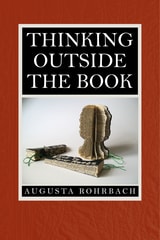
Thinking Outside the Book
Augusta Rohrbach
University of Massachusetts Press, 2014
In Thinking Outside the Book, Augusta Rohrbach works through the increasing convergences between digital humanities and literary studies to explore the meaning and primacy of the book as a literary, material, and cultural artifact. Rohrbach assembles a rather unlikely cohort of nineteenth-century women writers—Jane Johnston Schoolcraft, Sojourner Truth, Hannah Crafts, Augusta Evans, and Mary Chesnut—to consider the publishing culture of their period from the perspective of our current digital age, bringing together scholarly concepts from both print culture and new media studies.
In nineteenth-century America, women from a variety of racial and class affiliations were bombarding the print market with their literary productions, taking advantage of burgeoning rates of literacy and advances in publishing technology. Their work challenged prevailing modes of authorship and continues to do so today. Each chapter of Thinking Outside the Book positions a focal figure as both paradigmatic and problematic within the context of key terms that define the study of the book. In lieu of terms such as literacy, authorship, publication, edition, and editor, Rohrbach develops an alternate typology that includes mediation, memory, history, testimony, and loss. Recognizing that the field spans radio, cinema, television, and the Internet, she draws comparisons to the present day, when Web 2.0 allows writers from varying backgrounds and positions to seek out readers without “gatekeepers” limiting their exposure.
More than a literary history, this book takes up theories of recovery, literacy, authorship, narrative, the book, and new media in connection with race, gender, class, and region.
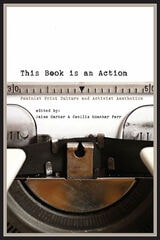
This Book Is an Action
Feminist Print Culture and Activist AestheticsEdited by Jaime Harker and Cecilia Konchar Farr
University of Illinois Press, 2016
This Book is Free and Yours to Keep
Notes from the Appalachian Prison Book ProjectConnie Banta
West Virginia University Press, 2024
This Book Is Free and Yours to Keep presents a captivating collection of letters and artwork by people in prison that highlights the crucial work done by the Appalachian Prison Book Project (APBP), a nonprofit that provides books to incarcerated people in West Virginia, Virginia, Tennessee, Kentucky, Ohio, and Maryland. Through the words of people directly impacted by the criminal punishment system, the collection provides uncommon insight into reading practices and everyday life in prisons and jails while being an inspiration for prison book projects, prison reform, and abolition.
Simultaneously communicating the vital importance of access to books and education, and conveying the power of community, the letters sent to APBP by incarcerated people spark conversations about race, poverty, and incarceration and shed light on the movement for accountability for state violence. This Book Is Free and Yours to Keep elucidates the violence and neglect perpetuated by carceral systems and offers a way forward based on solidarity and collaboration.
Tirana Modern
Biblio-Ethnography on the Margins of EuropeMatthew Rosen
Vanderbilt University Press, 2022
Drawing on material collected through fieldwork with a community of readers, writers, and translators attached to the independent Albanian publisher Pika pa sipërfaqe (Point without Surface), Tirana Modern provides a tightly focused ethnography of literary culture in Albania that brings into relief the more general dialectic between social imagination and social reality as mediated by reading and literature.
To Make Negro Literature
Writing, Literary Practice, and African American AuthorshipElizabeth McHenry
Duke University Press, 2021
Turned Inside Out
Reading the Russian Novel in PrisonSteven Shankman
Northwestern University Press, 2017
Turned Inside Out will appeal to readers with interests in the classic novels of Russian literature, in prisons and pedagogy, or in Levinas and phenomenology. At a time when the humanities are struggling to justify the centrality of their mission in today’s colleges and universities, Steven Shankman by example makes an undeniably powerful case for the transformative power of reading great texts.