89 books match the query 'Building' and 6 start with t
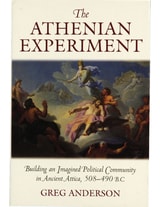
cover of The Athenian Experiment: Building an Imagined Political Community in Ancient Attica, 508-490 B.C.

The Athenian Experiment

Building an Imagined Political Community in Ancient Attica, 508-490 B.C.

Greg Anderson

University of Michigan Press, 2003

This book shows how, in barely the space of a generation, Athens was transformed from a relatively conventional city-state into a very new kind of polity, a region-state on a previously unthinkable scale. This bold experiment in political community laid the foundations for the world's first complex, stable democracy and, ultimately, allowed the Athenians to shape the political and cultural destiny of the Greek world. The author sets out to answer a simple question. How and when did the Athenian state acquire the anomalous size that made possible its remarkable influence on Greek politics and culture in the classical period? The standard answer is that the Athenian incorporation of the surrounding region of Attica was a gradual development, albeit a process which was largely complete some two or more centuries before the classical era. This new study proposes a very different solution: it is not until the very end of the sixth century that we see the first systematic attempt to integrate all of Attica within the polis of Athens, thus explaining why there are so few signs of impending Athenian greatness in earlier times. In supporting this claim, the book substantially rewrites the history of politics and public life in pre-classical Athens.Greek historians and other classicists will find here the most complete account of all the evidence, documentary and material, yet assembled for this transformation, along with extensive discussion of pertinent developments in earlier times. The reader will find a way of looking at the history of archaic Athens that is refreshingly novel, unusually synoptic and, in many ways, more coherent than the standard narratives.
[more]
cover of The Building of Castle Howard

The Building of Castle Howard

Charles Saumarez Smith

University of Chicago Press, 1990
This book is the first complete study of the circumstances which led to the building of Castle Howard, one of the greatest and best-known English country houses. It describes how and why Charles Howard, third earl of Carlisle, decided to build it; how the architect Sir John Vanbrugh received his first commission; how the building was paid for and where the money came from; what the original interiors looked like; how the gardens and park were laid out; and the decision taken to build the first classical mausoleum in England, designed by Nicholas Hawksmoor. It relates the physical appearance of the architecture to the hopes, desires and personalities of those involved in the building and makes it possible to look at the house in the way that it was intended to be seen by visitors in the eighteenth century. The Building of Castle Howard should appeal to anyone who is interested in eighteenth-century architecture, in the history of gardens, in country houses, and in a historical detective story of a house which Sir John Vanbrugh was determined should be 'the top seat and garden of England.'
[more]
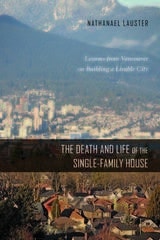
cover of The Death and Life of the Single-Family House: Lessons from Vancouver on Building a Livable City

The Death and Life of the Single-Family House

Lessons from Vancouver on Building a Livable City

Nathanael Lauster

Temple University Press, 2016

Vancouver today is recognized as one of the most livable cities in the world as well as an international model for sustainability and urbanism. Single-family homes in this city are “a dying breed.” Most people live in the various low-rise and high-rise urban alternatives throughout the metropolitan area.

The Death and Life of the Single-Family House explains how residents in Vancouver attempt to make themselves at home without a house. Local sociologist Nathanael Lauster has painstakingly studied the city’s dramatic transformation to curb sprawl. He tracks the history of housing and interviews residents about the cultural importance of the house as well as the urban problems it once appeared to solve.

Although Vancouver’s built environment is unique, Lauster argues that it was never predestined by geography or demography. Instead, regulatory transformations enabled the city to renovate, build over, and build around the house. Moreover, he insists, there are lessons here for the rest of North America. We can start building our cities differently, and without sacrificing their livability.
[more]
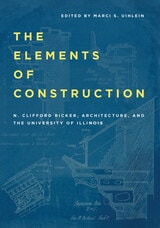
cover of The Elements of Construction: N. Clifford Ricker, Architecture, and the University of Illinois

The Elements of Construction

N. Clifford Ricker, Architecture, and the University of Illinois

N. Clifford Ricker. Edited by Marci S. Uihlein

University of Illinois Press, 2025

A pioneer of architecture education in the United States, N. Clifford Ricker notably taught with an emphasis on construction and shop practice in his teaching. Marci S. Uihlein edits and elaborates on The Elements of Construction, the text on building materials that Ricker wrote and used in his teaching, but never published. The book is a window into the expanding possibilities of the late nineteenth-century, as Ricker continually revised The Elements of Construction to keep up with advances taking place in architecture, materials, and construction technology.

In addition to providing the full text, Uihlein and the contributors trace Ricker’s career and delve into his practice of teaching. Subject experts explore specific topics. Thomas Leslie surveys contemporary construction practices in Chicago. Tom F. Peters considers Ricker’s writings in the context of the time while Rachel Will looks at masonry know-how and testing. Donald Friedman examines the teaching of iron and steel construction.

An illuminating look at a field and a legacy, The Elements of Construction rediscovers a figure that shaped the teaching of architecture and trained a generation that forever changed Chicago.

[more]
cover of The History of Development of Building Construction in Chicago

The History of Development of Building Construction in Chicago

Frank A. Randall

University of Illinois Press, 1999

Long regarded as the definitive catalog of Chicago architecture, The History of the Development of Building Construction in Chicago is a treasure trove of architectural and engineering information about buildings in Chicago's central business and residential district.
 
Generations have relied on the Randall book as the most authoritative and comprehensive guide to buildings in the Chicago central area. This edition is updated with information about fifty additional buildings from the time frame of the original text, 1830-1949; new data for four hundred buildings from the period 1950-98; and a number of additional plates from the rare Rand McNally Views of Chicago.
 
The second edition of The History of the Development of Building Construction in Chicago is a tribute to Frank Randall's vision and an indispensable resource to Chicago area architects, engineers, preservation specialists, and other members of the building industry.
 
[more]
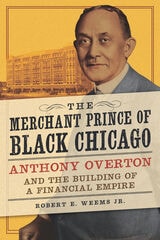
cover of The Merchant Prince of Black Chicago: Anthony Overton and the Building of a Financial Empire

The Merchant Prince of Black Chicago

Anthony Overton and the Building of a Financial Empire

Robert E. Weems Jr.

University of Illinois Press, 2020

Born to enslaved parents, Anthony Overton became one of the leading African American entrepreneurs of the twentieth century. Overton's Chicago-based empire ranged from personal care products and media properties to insurance and finance. Yet, despite success and acclaim as the first business figure to win the NAACP's Spingarn Medal, Overton remains an enigma.

Robert E. Weems Jr. restores Overton to his rightful place in American business history. Dispelling stubborn myths, he traces Overton's rise from mentorship by Booker T. Washington, through early failures, to a fateful move to Chicago in 1911. There, Overton started a popular magazine aimed at African American women that helped him dramatically grow his cosmetics firm. Overton went on to become the first African American to head a major business conglomerate, only to lose significant parts of his businesses—and his public persona as ”the merchant prince of his race&#8221—in the Depression, before rebounding once again in the early 1940s.

Revealing and panoramic, The Merchant Prince of Black Chicago weaves the fascinating life story of an African American trailblazer through the eventful history of his times.

[more]