Results by title
99 books match the query 'Censorship' and 15 start with t
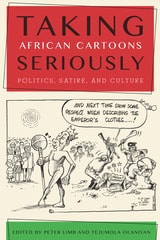
Taking African Cartoons Seriously
Politics, Satire, and CulturePeter Limb
Michigan State University Press, 2018
The Artistic Censoring of Sexuality
Fantasy and Judgment in the Twentieth Century NovelSusan Mooney
The Ohio State University Press, 2008
Through the twentieth century, from colonial Ireland to the United States, and from Franco's Spain to late Soviet Russia, to include sexuality in a novel signaled social progressiveness and artistic innovation, but also transgression. Certain novelists—such as James Joyce, Vladimir Nabokov, Luis Martín-Santos, and Viktor Erofeev—radicalized the content of the novel by incorporating sexual thoughts, situations, and fantasies and thus portraying repressed areas of social, cultural, political, and mental life.
In The Artistic Censoring of Sexuality: Fantasy and Judgment in the Twentieth-Century Novel, Susan Mooney extensively examines four modernist and postmodernist novels that prompted in their day harsh external censorship because of their sexual content—Ulysses, Lolita, Time of Silence, and Russian Beauty. She shows how motifs of censorship, with all its restrictions, pressures, rules, judgments, and forms of negation, became artistically embedded in the novels' plots, characters, settings, tropes, and themes. These novels contest censorship's status quo and critically explore its processes and power. This study reveals the impact of censorship on literary creation, particularly in relation to the twentieth century's growing interest in sexuality and its discourses.
The Fearful Steelpen
Russian Translations of "Ulysses," 1920–1930sNatalia Kamovnikova
University of Massachusetts Press, 2026
Examining how a single book inspired devotion, dread, and lasting superstition in Russian letters
When James Joyce first published Ulysses in 1922, the book enjoyed a hearty welcome in the Soviet Union. In fact, Russian was the second language into which excerpts were translated. However, the early enthusiasm soon gave way to apprehension, and then to public condemnation. The Russian literary community found itself at the epicenter of the political repression of the 1930s, suffering enormous losses among writers and translators, who died en masse through executions and exile. In the context of Ulysses, the numerous violent deaths of its Soviet translators and editors gave rise to rumors, which then developed into superstitious beliefs that managed to outlive their own time. Russian translation scholar Natalia Kamovnikova examines the struggles faced by those who attempted early translations, including death and imprisonment, and how both this translation work and the text itself became sources of fear.
Alongside important background on these early translation attempts, including information on the translators themselves, The Fearful Steelpen unpacks the literary approaches to rendering Joyce’s aesthetics in Russian and traces the socio-political beliefs behind translation and publishing decisions. Kamovnikova goes further, to examine why Ulysses in particular aroused fears in both in its contemporaries and in subsequent generations of Russian writers, as if the text held a dangerous power that could harm those working on it. This fascinating publishing case study reveals the complicated cultural and political dynamics at work behind a seemingly simple translation from one language to another that still resonates in the contemporary moment.
The First Amendment Lives On
Conversations Commemorating Hugh M. Hefner's Legacy of Enduring Free Speech and Free Press ValuesStuart N. Brotman
University of Missouri Press, 2022
Hugh M. Hefner’s legacy of enduring free speech and free press values is embodied in the Hugh M. Hefner First Amendment Awards, established in 1979, which honor leading First Amendment scholars and advocates. Hefner also had a lifelong interest in film censorship issues and supported teaching about them at the University of Southern California for 20 years. His deep commitment to these values was confirmed when the author was granted unrestricted access to over 3,000 personal scrapbooks, which Hefner had kept in order to track free speech and press issues during his lifetime.
The format of the book is an homage to the in-depth conversational interviews Hefner pioneered as the editor and publisher of Playboy magazine. Stuart Brotman conducted in-person conversations with eight persons who in their lifetimes have come to represent a “greatest generation” of free speech and free press scholars and advocates. Notably, these conversations include:
Geoffrey R. Stone
Floyd Abrams
Nadine Strossen
Burt Neuborne
David D. Cole
Lucy A. Dalglish
Bob Corn-Revere
Rick Jewell
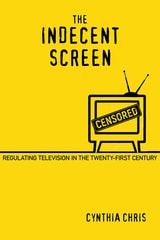
The Indecent Screen
Regulating Television in the Twenty-First CenturyChris, Cynthia
Rutgers University Press, 2019
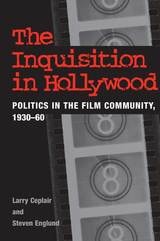
The Inquisition in Hollywood
Politics in the Film Community, 1930-60Larry Ceplair and Steven Englund
University of Illinois Press, 1979
The definitive work on the Hollywood blacklist era
The Inquisition in Hollywood examines the suppression of radical political activity in the film industry from the days of the Great Depression through the tumultuous House Un-American Activities Commission era to the waning days of the infamous blacklist.
Although this thirty-year period of American history is marked by widespread targeting of leftists in all areas of life, those in the film industry–-predominately screenwriters–-were considered to be in positions of great potential indoctrinating power, and found themselves under intense scrutiny as the Cold War hysteria mounted.
Ceplair and Englund trace the history of political struggle in Hollywood back to the formation of the Screen Writers Guild in 1933. Many of the blacklisted filmmakers were members of the Communist Party and all of the graylisted filmmakers had expressed their sympathy with progressive (mainly anti-fascist) causes.
Although no Hollywood Communist has ever been linked to espionage or sabotage, and charges of subversive indoctrination have no basis in documented fact, this book powerfully shows how devastating a mere suspicion or insinuation of guilt could be during the era of the Red Menace.
Twenty-two years after its initial publication, The Inquisition in Hollywood remains the definitive work on the blacklist era, and this new edition features a new introduction by the authors.
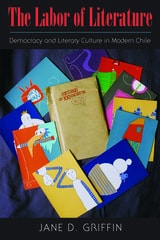
The Labor of Literature
Democracy and Literary Culture in Modern ChileJane D. Griffin
University of Massachusetts Press, 2016
By examining alternative literary publications, Griffin recasts the seventeen-year Pinochet dictatorship as a time of editorial experimentation despite widespread cultural oppression and shows how grassroots cultural activism has challenged government-approved corporate publishing models throughout the postdictatorship period. Griffin's work also points to the growing importance of autogestión, or do-it-yourself cultural production, where individuals combine artisanal forms with new technologies to make and share creative work on a global scale.
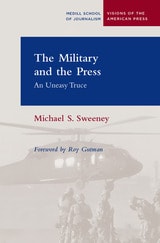
The Military and the Press
An Uneasy TruceMichael Sweeney
Northwestern University Press, 2006
Author Michael S. Sweeney takes a chronological approach, considering freedoms and restraints such as the First Amendment, court decisions, and government and military directives that have affected the press during World Wars I and II, the Korean War, the Vietnam War, and the more recent conflicts. He explores the ongoing themes of wartime censorship and propaganda, as well as operational security in the battle zone. In chapters addressing the recent shift in military strategy in dealing with the press, Sweeney discusses new forms of control--from embedding journalists and discouraging unaccredited "unilaterals" to developing the news agenda through a barrage of briefings, sound bites, and visuals and appeals to patriotism that border on domestic propaganda. With profiles of a few specific journalists--from Richard Harding Davis covering the Spanish-American War to Christiane Amanpour reporting from the conflicts in Bosnia and Iraq--this deft blend of journalistic history and analysis should serve as a call-to-arms to a public not always well served by a military-press standoff.

The New Censors
Movies and the Culture WarsCharles Lyons
Temple University Press, 1997
The New Censors, the first study of the complex ways movies have been shaped in the years since the demise of the Code, covers a wide range of movies, protests, and government actions. From feminists against "Dressed to Kill," to religious campaigns against "The Last Temptation of Christ," to homosexuals ire over "Basic Instinct," Lyons links a study of public outrage against movies to the broader culture wars over "family values," pornography, and various lifestyle issues.
This book provides a contemporary history of controversial movies and a timely discussion of how cultural politics continues to affect the movie industry.
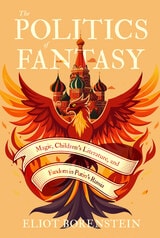
The Politics of Fantasy
Magic, Children's Literature, and Fandom in Putin's RussiaEliot Borenstein
University of Wisconsin Press, 2025
With crisp, engaging prose, Eliot Borenstein leaps from Harry Potter into an exploration of the culture wars and moral panics sparked in Russia by Western-inspired children’s literature, extending back into the Soviet period and through the invasion of Ukraine. As cultural products pitched ostensibly to children, the Harry Potter books and films became the perfect objects for criticism, translation, adaptation, parody, attack, mimicry, and meme-making, allowing Russians to carve out their own space in the worldwide market of magical multiverses.
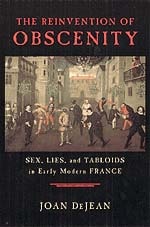
The Reinvention of Obscenity
Sex, Lies, and Tabloids in Early Modern FranceJoan DeJean
University of Chicago Press, 2002
The Reinvention of Obscenity casts a fresh light on the mythical link between sexual impropriety and things French. Exploring the complicity between censorship, print culture, and obscenity, DeJean argues that mass market printing and the first modern censorial machinery came into being at the very moment that obscenity was being reinvented—that is, transformed from a minor literary phenomenon into a threat to society. DeJean's principal case in this study is the career of Moliére, who cannily exploited the new link between indecency and female genitalia to found his career as a print author; the enormous scandal which followed his play L'école des femmes made him the first modern writer to have his sex life dissected in the press.
Keenly alert to parallels with the currency of obscenity in contemporary America, The Reinvention of Obscenity will concern not only scholars of French history, but anyone interested in the intertwined histories of sex, publishing, and censorship.
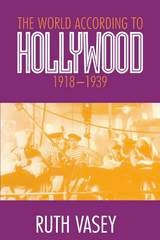
The World According to Hollywood, 1918–1939
Ruth Vasey
University of Wisconsin Press, 1997
Ruth Vasey shows how the Motion Picture Producers and Distributors of America (MPPDA), by implementing such strategies as the industry’s Production Code, ensured that domestic and foreign distribution took place with a minimum of censorship or consumer resistance. Drawing upon MPPDA archives, studio records, trade papers, and the records of the U.S. Department of Commerce, Vasey reveals the ways the MPPDA influenced the representation of sex, violence, religion, foreign and domestic politics, corporate capitalism, ethnic minorities, and the conduct of professional classes.
Vasey is the first scholar to document fully how the demands of the global market frequently dictated film content and created the movies’ homogenized picture of social and racial characteristics, in both urban America and the world beyond. She uncovers telling evidence of scripts and treatments that were abandoned before or during the course of production because of content that might offend foreign markets. Among the fascinating points she discusses is Hollywood’s frequent use of imaginary countries as story locales, resulting from a deliberate business policy of avoiding realistic depictions of actual countries. She argues that foreign governments perceived movies not just as articles of trade, but as potential commercial and political emissaries of the United States. Just as Hollywood had to persuade its domestic audiences that its products were morally sound, its domination of world markets depended on its ability to create a culturally and politically acceptable product.
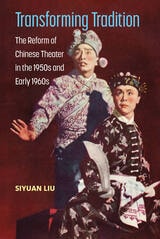
Transforming Tradition
The Reform of Chinese Theater in the 1950s and Early 1960sSiyuan Liu
University of Michigan Press, 2021
Shortly after the establishment of the People’s Republic of China in 1949, the PRC launched a reform campaign that targeted traditional song and dance theater encompassing more than a hundred genres, collectively known as xiqu. Reformers censored or revised xiqu plays and techniques; reorganized star-based private troupes; reassigned the power to create plays from star actors to the newly created functions of playwright, director, and composer; and eliminated market-oriented functionaries such as agents. While the repertoire censorship ended in the 1980s, major reform elements have remained: many traditional scripts (or parts of them) are no longer in performance; actors whose physical memory of repertoire and acting techniques had been the center of play creation, have been superseded by directors, playwrights, and composers. The net result is significantly diminished repertoires and performance techniques, and the absence of star actors capable of creating their own performance styles through new signature plays that had traditionally been one of the hallmarks of a performance school. Transforming Tradition offers a systematic study of the effects of the comprehensive reform of traditional theater conducted in the 1950s and ’60s, and is based on a decade’s worth of exhaustive research of official archival documents, wide-ranging interviews, and contemporaneous publications, most of which have never previously been referenced in scholarly research.
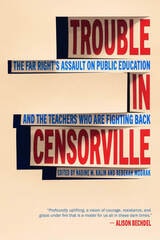
Trouble in Censorville
The Far Right's Assault on Public Education and the Teachers Who are Fighting BackNadine M. Kalin and Rebekah Modrak
Disobedience Press, 2024
Now, for the first time, K-12 educators from across the nation give readers a teacher’s-eye view of the radical right crusade to take down public education, coordinated by well-funded, well-connected far-right political interests. Christian nationalists hell-bent on erasing the line between church and state, white supremacists opposed to a curriculum that teaches the enduring effects of anti-Black racism, political action committees, such as Moms for Liberty, calling for the banning of novels featuring LGBTQ+ people, and profiteers eager to divert taxpayer dollars into private schools are mounting a relentless attack on teachers, the students they serve, and the commitment to public education that is a cornerstone of democracy. “It’s a phenomenal, unprecedented moment that we’re in,” says a librarian, recently retired from her Texas school. “It’s surprising how many people don’t know what’s going on. I talk to reporters who have no idea. And they’re reporters.”
In Trouble in Censorville, public school teachers from states as far-flung as Florida, Texas, Kentucky, New Jersey, Tennessee, Wisconsin, and Washington describe, in their own words, being threatened, stalked, doxxed, ostracized, smeared as “pedophiles" and "Marxists," placed on leave, and fired for teaching historical truth and racial justice, supporting LGBTQ+ students and, in one case, for wearing "insufficiently" feminine attire. Their stories bring readers face-to-face with the human cost of these attacks, which range from social isolation to pent-up anger over institutional betrayal to the terrible toll on teachers’ mental and physical health.
And yet, teachers are fighting back. They’re mobilizing colleagues, parents, and community members who share their faith in the freedom to read, the freedom to think critically, the freedom to challenge small-minded provincialism. Their stories of frontline resistance, collected here, provide a battle plan for confronting censorship, rallying support, and mobilizing a grassroots defense of public schools.
Their gripping testimonials are enhanced by a timeline that situates today’s far-right war on public education in the context of American history, moving briskly from Reconstruction to the anti-left and anti-gay fearmongering of the McCarthy era to the Black Lives Matter movement to the Trump presidency.
Terrifying, infuriating, and inspiring, Trouble in Censorville sounds the alarm for a democracy on fire.
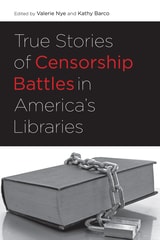
True Stories of Censorship Battles in America's Libraries
Valerie Nye
American Library Association, 2012
Intellectual freedom is a core value of librarianship, but fighting to keep controversial materials on the shelves can sometimes feel like a lonely battle. And not all censorship controversies involve the public objecting to a book in the collection—libraries are venues for displays and meetings, and sometimes library staff themselves are tempted to preemptively censor a work. Those facing censorship challenges can find support and inspiration in this book, which compiles dozens of stories from library front lines. Edifying and enlightening, this collection
- Tells the stories of librarians who withstood difficult circumstances to champion intellectual freedom
- Touches on prickly issues such as age-appropriateness, some librarians' temptation to preemptively censor, sensitive cultural expressions, and criminality in the library
- Presents case studies of defenses that were unsuccessful, so librarians facing similar challenges can learn from these defeats
There are fewer situations more stressful in a librarian's professional life than being personally confronted with a demand to remove a book from the shelves or not knowing how to respond to other kinds of censorship challenges. Reading this book will help fortify and inform those in the fray.