Results by title
66 books match the query 'Challenges' and 12 start with t

Teaching Literary Research
Challenges in a Changing EnvironmentKathleen A. Johnson
Assoc of College & Research Libraries, 2011
Teaching Literary Research
Challenges in a Changing EnvironmentKathleen A. Johnson
Assoc of College & Research Libraries, 2011

Telemedicine Systems for Unreached Communities
Context, challenges and opportunitiesMehdi Hasan
The Institution of Engineering and Technology, 2026

The Challenges of Sovereignty
Essays on Israel and ZionismDavid Ellenson
Brandeis University Press, 2026
Key essays by a notable scholar address some of the most pressing questions facing Israel today.
Over the course of his rich career, David Ellenson—one of the most outstanding Jewish scholars, intellectuals, and thinkers of our time—probed the tension between tradition and modernity, especially as reflected in the ceaseless reinterpretation of liturgical and halakhic texts. Alongside that scholarly interest, largely centered on European Jewry, Ellenson produced an impressive body of work on Zionism and Israel.
This volume follows the arc of this body of work from Ellenson’s early articles on the Zionism of American rabbis to his last essay on the struggle between Jewish and democratic impulses in Israeli society. He draws on familiar sources of inquiry—Jewish prayers and legal sources—to chart changes in Israeli religious life and to excavate its theological-political foundation. What emerges is a profound meditation on some of the most important questions that Israel faces today: what does it mean to be Jewish in the state? What role should Halakhah play in a self-defined Jewish state? How should the state treat its non-Jewish minority? How deeply rooted is democracy in the state and its foundational texts? And can the state ever escape seemingly irrepressible internal and external conflict?

The Challenges of Sustained Development
The Role of Socio-cultural Factors in East-central EuropeBorut Roncevic
Central European University Press, 2004
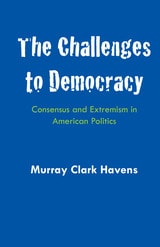
The Challenges to Democracy
Consensus and Extremism in American PoliticsBy Murray Clark Havens
University of Texas Press, 1965
Threats to American unity are not unique to modern times. In the 1960s, the assassination of President Kennedy, the tension of racial strife, the political extremes of the Radical Right with its John Birchers and the Radical Left with its threat of Communism all raised critically urgent questions relative to our national unity, to our political stability, and to our vaunted respect for the rule of law. The Challenges to Democracy is an assessment of the foundations of political unity in the United States.
The American consensus, as Murray Clark Havens defines it, emphasizes a set of values and procedures that most Americans, since the adoption of the Constitution, have accepted in principle: religious tolerance, individual freedom in intellectual and cultural matters, the importance of education and intellectual effort, settlement of internal conflict through peaceful and political processes, the supremacy of law, a high and generally rising standard of living, and, since the Civil War, racial compatibility.
Never in our history have the ideals of this consensus been fully achieved, but as long as the majority of our citizens accept the validity of those ideals and the democratic procedures for realizing them, the basic American political unity is not threatened. However, when citizens who cannot accept the elements of the American consensus become influential enough to block the democratic process, then that consensus is threatened.
Havens shows how such threats have come to us all through our history—the Civil War, racial and religious bigotry, the Ku Klux Klan, Huey Long, Father Coughlin and other extremists of the desperate thirties, McCarthyism. He discusses contemporary dangers to American unity such as those connected with the acceptance of the African American, religious friction in politics and government, the Radical Right and the Radical Left, and our foreign policy as an expression of the American consensus.
The broad conclusions of this study are that our national unity is continuously in jeopardy, with frequent recurrences of serious questions as to the permanence of some of the patterns we have always associated with American government, but that our democracy is possessed of considerable potential for survival because of our deep national commitment to democracy and because of our even deeper nationalism.

The Danish Voter
Democratic Ideals and ChallengesRune Stubager, Kasper M. Hansen, Michael S. Lewis-Beck, and Richard Nadeau
University of Michigan Press, 2021
The authors of The Danish Voter investigate a series of interesting questions concerning voters’ reactions to these macrosocial challenges and how their reactions affect the foundations for the ideal. Indeed, due to an electoral system open to new influences, the Danish case is an important test case for theories about political development of contemporary Western societies.

The Digital Twin Handbook
Challenges, opportunities and future research directionsDhaval Thakker
The Institution of Engineering and Technology, 2025

The Dysfunctional Library
Challenges and Solutions to Workplace RelationshipsJo Henry
American Library Association, 2017
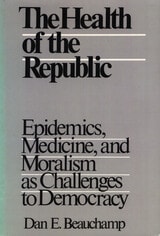
The Health Of The Republic
Epidemics, Medicine, and Moralism as Challenges to DemocracyDan Beauchamp
Temple University Press, 1990
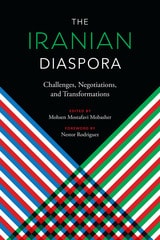
The Iranian Diaspora
Challenges, Negotiations, and TransformationsEdited by Mohsen Mostafavi Mobasher
University of Texas Press, 2018
The Iranian revolution of 1978–1979 uprooted and globally dispersed an enormous number of Iranians from all walks of life. Bitter political relations between Iran and the West have since caused those immigrants to be stigmatized, marginalized, and politicized, which, in turn, has discredited and distorted Iranian migrants’ social identity; subjected them to various subtle and overt forms of prejudice, discrimination, and social injustice; and pushed them to the edges of their host societies. The Iranian Diaspora presents the first global overview of Iranian migrants’ experiences since the revolution, highlighting the similarities and differences in their experiences of adjustment and integration in North America, Europe, Australia, and the Middle East.
Written by leading scholars of the Iranian diaspora, the original essays in this volume seek to understand and describe how Iranians in diaspora (re)define and maintain their ethno-national identity and (re)construct and preserve Iranian culture. They also explore the integration challenges the Iranian immigrants experience in a very negative context of reception. Combining theory and case studies, as well as a variety of methodological strategies and disciplinary perspectives, the essays offer needed insights into some of the most urgent and consequential issues and problem areas of immigration studies, including national, ethnic, and racial identity construction; dual citizenship and dual nationality maintenance; familial and religious transformation; politics of citizenship; integration; ethnic and cultural maintenance in diaspora; and the link between politics and the integration of immigrants, particularly Muslim immigrants.

The Politics and Challenges of Achieving Health Equity
Alan B. Cohen, Colleen M. Grogan, and Jedediah Horwitt, special issue editors
Duke University Press, 2017
Articles in this issue address the historical, legal, and political contexts of health equity in the United States. Contributors examine the role of the courts in shaping health equity; document the importance of political discourse in framing health equity and establishing agendas for action; look closely at particular policies to reveal current challenges and the potential to achieve health equity in the future; and examine policies in both health and nonhealth domains, including state Medicaid programs, the use of mobile technology, and education and immigration policies. The issue concludes with a commentary on the future of health equity under the Trump administration and an analysis of how an ACA repeal would impact health equity.
Contributors. Alan B. Cohen, Keon L. Gilbert, Daniel Q. Gillion, Colleen M. Grogan, Mark A. Hall, Jedediah N. Horwitt, Tiffany D. Joseph, Alana M.W. LeBron, Julia F. Lynch, Jamila D. Michener, Vanessa Cruz Nichols, Francisco Pedraza, Isabel M. Perera, Rashawn Ray, Jennifer D. Roberts, Sara Rosenbaum, Sara Schmucker, Abigail A. Sewell, Deborah Stone, Keith Wailoo