208 books match the query 'Christian Church' and 59 start with t
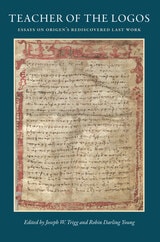
cover of Teacher of the Logos: Essays on Origen's Rediscovered Last Work

Teacher of the Logos

Essays on Origen's Rediscovered Last Work

Joseph W. Trigg

Catholic University of America Press, 2025
In 2012 Marina Molin Pradel, an archivist at the Bavarian State Library discovered that CMG 314, a long-neglected Byzantine manuscript , contained twenty-nine homilies by Origen, the most important and most talented genius of early Christianity. He delivered these homilies around 259 CE, shortly before arrest and torture during the Decian persecution would put an end to his work. Thus, along with the Contra Celsum, Origen’s lengthy defense of Christianity, written after 248, when that persecution was clearly impending, they enable readers to appreciate Origen’s fully-developed thought. Except for the four of these homilies that had been translated into Latin in the fifth century, scholars of Origen thought that all the homilies on the Psalms had been lost. In 2015 Lorenzo Perrone of the University of Bologna, an eminent Origen scholar, assisted by a team including Dr. Pradel, produced a magnificent critical edition of the text. In 2017 the editors of this volume organized a colloquium in Washington, DC, generously hosted by the program in Early Christian Studies. The authors of this volume, a group of American and Canadian scholars, invited Professor Perrone to address the discovery of the homilies and his edition, and to join their discussion of their interpretation. This volume represents the group’s energetic investigations and discussion over the two days of the conference. The essays address Origen’s use of language, his philosophical interests, his relationship with Judaism, and his scholarly patrimony in the next century.
[more]
cover of That Which Is Just in the Church: An Introduction to Canon Law: Volume 1

That Which Is Just in the Church

An Introduction to Canon Law: Volume 1

Carlos José Errázuriz

St. Augustine's Press, 2021

Consonant with its commitment to publish seminal works in the field of canon law, St. Augustine's Press is pleased to make available the first volume in a series that will undoubtedly endure as a masterpiece of scholarship. Carlos José Errázuriz, Professor of Canon Law at the Pontifical University of the Holy Cross (Rome) has provided a comprehensive and insightful treatment of rights, justice, and law in the Catholic Church, beginning with the most basic questions regarding the essence of these realities. His responses exhibit the perspective of that which is just in the Church, which consists of ecclesial juridical goods: the Word of God, the sacraments, the freedom of the children of God, and sacred potestas. This work vindicates the institution of law, but also addresses the "spontaneity" of just freedom proper to what has been instituted by Christ.
 
Errázuriz presents more than the current Code of Canon Law. He instills a realistic perspective of right and law in the Church, and in so doing fills a massive gap in English scholarship. No introduction to canon law available in English rivals Errázuriz's description of justice in the Church and its relationship with communion and sacramentality.
 
Volume I is comprised of the first three chapters of the original, Corso fondamentale sul diritto nella Chiesa (in two volumes, Giuffrè: Milan, 2009 and 2017): "Rights, Justice and Law in the Church," "Canon Law in History," and "The Configuration of Rights and Law in the Church."
[more]
cover of That Which Is Just in the Church: Volume 2: The Human Person in the Church

That Which Is Just in the Church

Volume 2: The Human Person in the Church

Carlos José Errázuriz

St. Augustine's Press, 2023

Volume one of Prof. Carlos J. Errázuriz's monumental treatment of canon law establishes that law in the Catholic Church is properly understood as that which is just. In the second volume, he moves to the foremost protagonist in this arena––namely, the human person. The human person is the primary holder of rights and obligations in the Church, destined for the salvation merited by Christ. The salvific goods constituted by the Word of God and the sacraments are fundamental aspects of juridical relationships and life in the Church.

Being subject to law, Errázuriz observes, does not undermine the freedom and dignity of the person. Rather, ecclesial law intends to confront the human person with his true supernatural inheritance, while preserving him in the mystery of communion within which the Church herself exists. Indeed, the human person has both natural and supernatural dignity, and likewise responsibilities that bear upon the seen and unseen realms of communion.

Prof. Errázuriz examines the practical applications of personhood and law, as well as the perspectives of the human subject that derive from his ontological status. This is further drawn across various states of life that occur within the Church and the differing juridical relations encountered.  Also considered is the nature of association in the Church, and Errázuriz breaks down the concepts and particular realities pertaining to this natural tendency and the legal discipline. 
 
[more]
cover of The Ancient Martyrdom Accounts of Peter and Paul

The Ancient Martyrdom Accounts of Peter and Paul

David L. Eastman

SBL Press, 2015

New English translations based upon the most up-to-date critical editions

This book for the first time collects the various ancient accounts of the martydoms of Peter and Paul, which number more than a dozen, along with more than forty references to the martyrdoms from early Christian literature. At last a more complete picture of the traditions about the deaths of Peter and Paul is able to emerge.

Features:

  • Greek, Latin, and Syriac accounts from antiquity translated into English
  • Introductions and notes for each text
  • Original texts are produced on facing pages for specialists
[more]
cover of The Apostolic Penitentiary in Local Contexts

The Apostolic Penitentiary in Local Contexts

Gerhard Jaritz

Central European University Press, 2007
The volume investigates the registers of fifteenth-century supplications to the Apostolic Penitentiary of the Holy See and presents an analysis of a multiplicity of issues in which a context of the local needs of Western Christians and the central power of the Pope occurred. The contributions make it clear that local and individual factors and the Christian faith and religion in practice must not be seen as separate from the global power of the Roman curia. The latter's influence could become directly important for any individual in any local space, even ...et usque ad ultimum terrae (Acts 1:8), in the utmost peripheries of the Christian world. It is shown that the assistance of the Apostolic Penitentiary was indispensable in a large variety of cases. Such cases were dealt with both in the local, regional space and in the globalized centre of the Holy See.
[more]
cover of The Art of Preaching: A Theological and Practical Primer

The Art of Preaching

A Theological and Practical Primer

Daniel Cardo

Catholic University of America Press, 2021
The growing awareness of the importance of preaching is a sign of our times. In the past decades, conscious that a renewal of preaching is essential for a renewed evangelization, many seminaries have implemented homiletic courses. However, there is still a real limitation of good and systematic resources in order to learn the theological depth and practical elements of the art of preaching. The Art of Preaching: A Theological and Practical Primer aims to fill that gap. It explores the theological understanding of the homily, lessons from classical and contemporary rhetoric, the relevance of preaching for the life of the Church, highlighting recent teachings of the Magisterium, and it presents the incarnation as the foundation for preaching, understood as an essential aspect of the priestly life and mission. This primer also offers a simple and effective method for the preparation and delivery of homilies, illustrating this by the example of brilliant preachers and exploring the idea of preaching as locus theologicus, i.e., the privileged place for the exercise of theology today. It is in deepening in the value and importance of preaching that theology can be renewed as a living and essential part of the daily life of priests. Seeing the homily not as a burden but as an occasion to fulfill the priestly identity will offer the opportunity to embrace the preparation for preaching as a key for unity among the many tasks and demands of pastoral life. In the homily prayer, study, and work come together. The Art of Preaching will also provide a selection of homilies from the great preachers of the Church, organized chronologically, with brief introductions and commentaries that highlight what those homilies teach us for our preaching today. Only learning from the best preachers can we hope to preach effectively in our times.
[more]
cover of The Bible as Christian Scripture: The Work of Brevard S. Childs

The Bible as Christian Scripture

The Work of Brevard S. Childs

Christopher R. Seitz

SBL Press, 2013

This memorial volume both displays and evaluates the canonical approach of Brevard S. Childs, whose attention to history through time animated his interest in the Bible’s use in the church through the ages up to and including the present. Just as Childs wrote on a wide range of topics canonical and theological—both Testaments, Isaiah and Exodus, the Pauline letters, the history of biblical interpretation, biblical theology, and historical, theological, and methodological questions—the contributors to this volume, seasoned colleagues as well as younger scholars who studied with Childs, offer an international collection of historical, theological, and New Testament essays as well as contributions focused on the Old Testament. The contributors are Stephen B. Chapman, Brevard S. Childs, Don Collett, Daniel R. Driver, Mark W. Elliott, Leonard G. Finn, Mark Gignilliat, Bernd Janowski, Jörg Jeremias, Leander E. Keck, Neil B. MacDonald, David L. Petersen, Murray A. Rae, C. Kavin Rowe, and Christopher R. Seitz.
[more]
cover of The Catholic Church and the Genesis of the Arab-Israeli Conflict: Vatican Diplomacy and Interfaith Relations During the Interwar Period, 1918-1939

The Catholic Church and the Genesis of the Arab-Israeli Conflict

Vatican Diplomacy and Interfaith Relations During the Interwar Period, 1918-1939

Bernhard Kronegger

Catholic University of America Press, 2026
This book delves into the history of how the Catholic Church’s leadership, both in the Vatican and in the Latin Patriarchate of Jerusalem, responded to the emerging conflict between Zionism and Palestinian nationalism for the future of the Holy Land. Beginning with the Balfour Declaration of 1917 and the conquest of Jerusalem by the Allied forces, it traces how the popes, Benedict XV (1914-1922) as well as Pius XI (1922-1939), anxiously and skeptically regarded British designs for what would become Mandatory Palestine. Through the economic crisis of the late 1920s, the violent clashes of the Arab Revolt, and ending with the outbreak of the Second World War, it examines how the relationship between the local Catholic community and British government officials developed, from evictions and expropriations following wartime upheavals to a careful co-operation filled with mistrust and tensions. Likewise, it investigates how the escalating hostility and violence between the Jewish and Muslim sections of the population influenced the interreligious relations between them and Catholics. Based on research in the Vatican Archives, it offers novel perspectives on the shifting policies of the Vatican, the maneuvrings of European governments and the schemes of the Latin Patriarch of Jerusalem, Luigi Barlassina, to further their interests in the struggle for the future of the Holy Land.
[more]
cover of The Christ Party in the Corinthian Community

The Christ Party in the Corinthian Community

Ferdinand Christian Baur

SBL Press, 2021
The Christ Party in the Corinthian Community by Ferdinand Christian Baur (1792–1860), one of the founders of modern New Testament scholarship, is now available in English for the first time. In this ground-breaking work, Baur argued for a diversity of views in the earliest strata of the Christian tradition that shaped the modern study of Paul in lasting ways. Baur's work revealed a tension between Pauline, gentile Christianity, on the one hand, and Petrine, Judaizing Christianity. In addition to Baur’s essay, this edition includes the first English translation of Ernst Käsemann's introduction to Baur's Historisch-kritische Untersuchungen zum Neuen Testament. Even if some of Baur's concrete historical results have been surpassed by subsequent scholarship, this book offers a compelling glimpse of the critical method and piercing insight into one of the shapers of modern biblical study.
[more]
cover of The Church and the Land: The National Catholic Rural Life Conference and American Society, 1923–2007

The Church and the Land

The National Catholic Rural Life Conference and American Society, 1923–2007

David S. Bovée

Catholic University of America Press, 2010
The Church and the Land is the first scholarly history of the Catholic rural life movement in the United States from its beginning in the 1920s to the present day. It tells the story of the men and women of the National Catholic Rural Life Conference (NCRLC) who labored to bring Catholic principles into effect to benefit the farm families, agricultural laborers, and others who lived in the American countrysid
[more]
cover of The Church of God in Jesus Christ : A Catholic Ecclesiology

The Church of God in Jesus Christ

A Catholic Ecclesiology

Roch A. Kereszty

Catholic University of America Press, 2019
Investigating Vatican II is a collection of Fr. Jared Wicks’ recent articles on Vatican II, and presents the Second Vatican Council as an event to which theologians contributed in major ways and from which Catholic theology can gain enormous insights. Taken as a whole, the articles take the reader into the theological dynamics of Vatican II at key moments in the Council’s historical unfolding. Wicks promotes a contemporary re-reception of Vatican II’s theologically profound documents, especially as they featured God’s incarnate and saving Word, laid down principles of Catholic ecumenical engagement, and articulated the church’s turn to the modern world with a new “face” of respect and dedication to service. From the original motivations of Pope John XXIII in convoking the Council, Investigating Vatican II goes on to highlight the profound insights offered by theologians who served behind the scenes as Council experts. In its chapters, the book moves through the Council’s working periods, drawing on the published and non-published records, with attention to the Council’s dramas, crises, and breakthroughs. It brings to light the bases of Pope Francis’s call for synodality in a listening church, while highlighting Vatican II’s mandate to all of prayerful biblical reading, for fostering a vibrant “joy in the Gospel.”
[more]
cover of The Churches of Christ in the 20th Century: Homer Hailey's Personal Journey of Faith

The Churches of Christ in the 20th Century

Homer Hailey's Personal Journey of Faith

David Edwin Harrell

University of Alabama Press, 2002

The story of one of this country's major religious movements is told through the spiritual odyssey of one of its prominent spokesmen. 

When Homer Hailey sparked controversy within Churches of Christ congregations over his stand on divorce and remarriage, he spoke to a movement already sundered. Historian David Edwin Harrell tells Hailey's story as a means of presenting the larger drama of faith and feuding within those churches.

A nondenominational movement of autonomous congregations, Churches of Christ have been among the fastest-growing religious bodies in the 20th century. Throughout the movement's history, church leaders debated issues ranging from missionary societies to the use of instrumental music in worship. Although some disagreements affected only the ties between congregations, others led to the creation of three distinct groups calling themselves Churches of Christ identified by their sociological and theological positions. 

This book shows how the story of the Churches of Christ is reflected by Homer Hailey, a preacher, educator, and author whose life puts in perspective the personal journeys traveled by members in this century. Writing from the perspective of the non-institutional wing within the movement, Harrell avoids mainstream biases to describe the various dissenting views as fully and fairly as possible.

Combining institutional history and biography, Harrell's book is the first to bring the story of the Churches of Christ to century's end. It provides new insight into how this movement realigned itself and shows how one man's career reflected a century of spiritual growth and change for the church as a whole.


[more]
cover of The Concept of <i>Ius</i> and the Nature of Law in Thomas Aquinas

The Concept of <i>Ius</i> and the Nature of Law in Thomas Aquinas

Loic-Marie Le Bot, OP

Catholic University of America Press, 2025
This collection of essays constitutes the fruit of a scholarly conference held in Rome in April 2023, which was organized by the Pontifical University of Saint Thomas Aquinas, the Pontifical University of the Holy Cross, and the Angelicum Thomistic Institute. The essays offer a scholarly reflection on various historical and doctrinal aspects of Aquinas’s concept of ius, and on the extent to which this concept helps to illuminate his account of the nature of law, that is, of the juridical phenomenon. Each essay addresses, from the viewpoint of its specific topic, the implications of the Angelic Doctor’s description of ius as the object of justice, as presented in the Secunda secundae of his Summa theologiae (starting from question 57, article 1). Following Aquinas’s own insights, the focus on the virtue of justice is thus deemed crucial for understanding the essence or the ontological fabric of law. Justice is simultaneously analyzed as always remaining inherently connected to its moral and divine-salvific aspects. The volume is divided in three parts. The first part of the collection contains essays that are dedicated to the analysis of Aquinas’s concept of ius in a historical perspective. The second group of essays in this collection examine some further doctrinal and contextual issues pertinent to the essence of ius. Each attempt to elucidate the ontology of law should be supported by the aptitude of the resulting accounts of law’s nature to provide workable platforms for legal practices. This line of reasoning represents the rationale for the third part of this collection, which focuses on the matters of applying Aquinas’s concept of ius in systemic and practical legal settings of State law and canon law.
[more]
cover of The Correspondence of John Carroll and Charles Plowden, 1779-1816

The Correspondence of John Carroll and Charles Plowden, 1779-1816

Thomas W. Jodziewicz

Catholic University of America Press, 2025
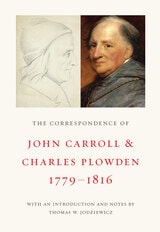
The correspondence between Bishop John Carroll and Fr. Charles Plowden offers an “insiders’” look at the establishment of the Catholic Church in the United States and the circumstances of the project of bringing about English Catholic emancipation. Carroll was the chief architect of the former; Plowden was a spirited, and public, and published, participant in the latter. Their correspondence is filled with details about their activities, and mutual encouragement, as each of these ex-Jesuits encountered the upheavals precipitated by wars (American Revolution, French Revolution, Napoleonic); the contemporary intellectual, theological, philosophical challenges of the Enlightenment and Age of Reason; anti-Catholic (and anti-Jesuit) sentiment and prejudices; the long wait for renewal of the Society of Jesus; the situation (and prerogatives) of the papacy; and the vagaries of early modern postal service. The Carroll side of this correspondence has been printed (although not completely accurately), but the Plowden side, far more strident and provocative, has mostly been unnoticed. Plowden’s letters, and published writings, with Carroll’s comments on them all, provide significant insights into the intricacies of the English Catholic excitement, including internal tensions, accompanying the early modern crusade for religious emancipation in Britain.
[more]
cover of The Cross and the Flag: Papal Diplomacy and John Paul II's Struggle Against the Tyranny of the Possible

The Cross and the Flag

Papal Diplomacy and John Paul II's Struggle Against the Tyranny of the Possible

John Tanyi Nquah Lebui

St. Augustine's Press, 2024

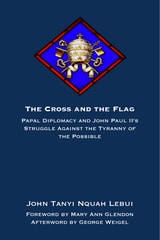
What is papal diplomacy and what role does it play on the larger geopolitical stage? Why does it matter what popes say to a global audience? "As John Tanyi points out, papal diplomacy has followed a trajectory all its own over the years.  In today’s globalized world, the Holy See stands out as an important communicator with a widely respected moral voice.  It is often said that 'When the Pope speaks, the world listens.'  What sets the diplomatic voices of the Holy Father and his envoys apart from all others is that they speak and act for the good of humanity––not just for the sovereign entity they represent, and not just for Catholics.  As a former foreign minister of the Holy See, Cardinal Jean Louis Tauran, once described the mission of papal diplomats:  'Our duty is to promote and defend not only the freedom and rights of Catholic communities around the world, but also to promote certain principles without which there is no civilization.'" 
     The particular example of Pope John Paul II is a groundbreaking example of the critical nature of ecclesiastical diplomacy and why popes as diplomats are playing at a greater level than other statesmen. As George Weigel notes, popes must combat all the problems of the world, but also importantly what he calls the 'tyranny of the possible'––that is, in all things compromise and complacency will play a part. It is the position occupied by one man, the heir of St. Peter, to know when to defy the entirety of global politics (and sometimes what seems like common sense) to say 'yes' and 'no' definitively in light of unchanging truths.  

 
[more]
cover of The Diaconate Revisited: Questions and Developments Since Vatican II

The Diaconate Revisited

Questions and Developments Since Vatican II

Marc B. Caron

Catholic University of America Press, 2026
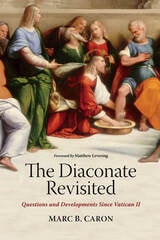
The sacrament of Holy Orders is the only one of the seven sacraments which exists in three ranks arranged hierarchically, that is, bishops, presbyters, and deacons. Deacons are distinct from both bishops and presbyters, yet united with them in one sacrament. Since the Second Vatican Council, various magisterial documents have limited the priestly dimension of holy orders to bishops and presbyters alone. If deacons do not share in the hierarchical priesthood at all, how are they then related to bishops and to presbyters? In the end, is the diaconate even part of the sacrament of holy orders? This book attempts to show how a ministerial dimension to the character received in ordination to each of the three ranks unites the episcopate, the presbyterate, and the diaconate in a single sacrament. According to the theology of the sacrament of holy orders found in Lumen gentium, the bishop receives the fullness of the sacrament, meaning both its sacerdotal and diaconal or ministerial dimensions. The presbyter then receives a lesser portion than the bishop of both sacerdotal and ministerial dimensions of the sacrament. Finally, the deacon receives an even lesser share than that of the presbyter of the ministerial dimension of holy orders alone. This approach makes clear that the bishop is the greatest servant of the Church as well as its high priest. It challenges presbyters to be of greater service to the Body of Christ than even deacons. The baptismal call to holiness of all the faithful can also be described as having both priestly and ministerial or diaconal dimensions as well. With this understanding, it now becomes clearer how the laity can perform certain functions by delegation which the Church normally entrusts to deacons by ordination. Finally, the unity of the diaconate with the two priestly ranks must inform the current discussions taking place about any possible ordination of women to the sacrament of holy orders in the diaconal rank.
[more]
cover of The Didache: A Missing Piece of the Puzzle in Early Christianity

The Didache

A Missing Piece of the Puzzle in Early Christianity

Jonathan A. Draper

SBL Press, 2015

An intriguing dilemma for those who study ancient Christian contexts and literature

This edited volume includes essays and responses from specialists in the Didache and in early church history in general.

Features:

  • Strategies for understanding liturgical constructions and ritual worship found in the text
  • Studies that apply generally to the overall content and background of the Didache
  • Essays on the relationship between the Didache and scripture—particularly with respect to the Gospel of Matthew
[more]
cover of The Digital Bay Psalm Book: A Virtual Reconstruction of the New World's First English-Language Book

The Digital Bay Psalm Book

A Virtual Reconstruction of the New World's First English-Language Book

Ian Christie-Miller, with a foreword by Kevin Cattrell

University of Alabama Press, 2010

In 1638, the first printing press was imported to the Massachusetts Bay Colony and a group of local religious leaders—including, it is thought, Richard Mather, John Cotton, and Richard Eliot—set about to create “a plain and familiar translation of the psalms and words of David into English metre” for use in the colony’s church meetings. Earlier psalteries had been brought to the New World by colonists, but in Puritan thought they had strayed too far from the original Hebrew text. In 1640, The Whole Booke of Psalmes Faithfully Translated into English Metre was published in Cambridge; it was the first book published in the American Colonies. The Bay Psalm Book, as it has come to be known, consists of a substantial introduction summarizing the creators’ philosophy and intentions, followed by translations of the Psalms rendered into meter, enabling them to be sung to well-known tunes of the day. The psaltery was soon in widespread use on both sides of the Atlantic. It went through multiple printings and editions before being succeeded by newer texts in later decades.

Generations of theologians and scholars have turned to The Bay Psalm Book, considering it from a variety of perspectives. Besides its significance as a religious treatise, spiritual guide, and historical document, The Bay Psalm Book is also recognized as an important milestone in the evolution of the American musical tradition. In recent years, a new generation of scholars has returned to the book, seeing it from fresh perspectives—as a social document, for example, and as a physical artifact of early American life in the Massachusetts Bay area.

The Digital Bay Psalm Book gives scholars, researchers, and enthusiasts alike a rich and intimate experience of the book as it was known by its earliest readers.

As an electronic-only publication offered as a downloadable PDF, The Digital Bay Psalm Book takes advantage of digital technology to offer meticulously rendered photographs of the 7.25 x 4 inch book, one of several once owned by Thomas Prince, scholar and minister of Boston’s Old South Church from 1718 to 1758. In this format, users are able to zoom in to examine each individual page, the quality of the paper and printing, marginalia, notes, and other marks accrued over the centuries, yielding insights into the owner’s use and understanding of the text as well as the very life of the book itself. In addition, Christie-Miller provides four supplements that shed light on the technology and craft that went into the creation of America’s first English-language book.
[more]
cover of The Dividing of Christendom

The Dividing of Christendom

Christopher Dawson

Catholic University of America Press, 2026
Christopher Dawson, the renowned historian of culture, offered an overarching narrative in two volumes of the rise and fall of Christian unity within Western Civilization in lectures he delivered at Harvard University between 1958 and 1962. Volume 1, The Formation of Christendom, laid out Dawson’s anthropological approach to culture in general and to the formation of Christian culture in particular. Volume 2, The Dividing of Christendom, examines the forces that led to the dissolution of European unity and the rise of a new secular vision of humanity with its hopes set on material progress. Dawson begins the tale of dissolution in the Middle Ages, examining its spiritual, intellectual, and social causes. A Church in desperate need of reform, divided in its allegiance during the Great Western Schism, could not muster the collective will to overcome laxity and corruption. Nominalism and voluntarism unraveled the great intellectual synthesis of scholasticism. Political and economic forces, burdened by feudal restraints, needed only a catalyst to overturn the old order. The Dividing of Christendom highlights the social and cultural forces that shaped the Age of Reformations and its aftermath. While not neglecting the importance of theological claims, Dawson explains how political ambition and consolidation of power played a role just as significant. Furthermore, the distinct theological vision of the different reformations of the sixteenth century created a new culture, focused much more on the individual and an emphasis on industry. The mystical extravagance of the Baroque period, which characterized the Catholic renewal of southern Europe and spread throughout the world, eventually gave way to the more utilitarian values of the ascendant European north. Religious wars resulted in a secularism that prioritized science and economics in the shaping of modern culture. The Enlightenment, in particular, initiated a campaign against throne and altar that paved the way for political revolutions. Successful movements of religious revival occurred simultaneously, as Dawson traces their influence on the American colonies, particularly Puritanism and Methodism. Nevertheless, those bent on material progress as a kind of new religion undermined the spiritual foundations of Christian culture so completely that we must seek to rediscover a new source of internal vigor and unity to overcome our cultural crisis.
[more]
cover of The First Urban Churches 1: Methodological Foundations

The First Urban Churches 1

Methodological Foundations

James R. Harrison

SBL Press, 2015

A fresh look at early urban churches

This collection of essays examines the urban context of early Christian churches in the first-century Roman world. A city-by-city investigation of the early churches in the New Testament clarifies the challenges, threats, and opportunities that urban living provided for early Christians. Readers will come away with a better understanding of how scholars assemble an accurate picture of the cities in which the first Christians flourished.

Features:

  • Analysis of urban evidence of the inscriptions, papyri, archaeological remains, coins, and iconography
  • Discussion of how to use different types of evidence responsibly
  • Outline of what constitutes proper methodological use for establishing a nuanced, informed portrait of ancient urban life
[more]
cover of The First Urban Churches 2: Roman Corinth

The First Urban Churches 2

Roman Corinth

James R. Harrison

SBL Press, 2016

Investigate the challenges, threats, and opportunities experienced by the early church

Volume two of The First Urban Churches focuses on the urban context of Christian churches in first-century Roman Corinth. An investigation of the material evidence of Corinth helps readers today understand properly the challenges, threats, and opportunities that the early Corinthian believers faced in the city. The essays demonstrate decisively the difference that such an approach makes in grappling with the meaning and context of the Corinthian epistles in the New Testament.

Features:

  • Analysis of urban evidence of the inscriptions, papyri, archaeological remains, coins, and iconography
  • Proposed reeconstructions of the past and its social, religious, and political significance
  • A nuanced, informed portrait of ancient urban life in Corinth
[more]
cover of The First Urban Churches 3: Ephesus

The First Urban Churches 3

Ephesus

James R. Harrison

SBL Press, 2018

Investigate the challenges, threats, and opportunities experienced by the early church in Ephesus

The third installment of The First Urban Churches focuses on the urban context of Christian churches in first-century Ephesus. As with previous volumes, contributors illustrate how an investigation of the material evidence will help readers understand properly the challenges, threats, and opportunities that the early Ephesian believers faced in that city. Brad Bitner, James R. Harrison, Michael Haxby, Fredrick J. Long, Guy M. Rogers, Michael Theophilos, Paul Trebilco, and Stephan Witetschek demonstrate decisively the difference that such an approach makes in grappling with the meaning and context of the New Testament writings, particularly Ephesians, Acts, and Revelation.

Features

  • Analysis of urban evidence of the inscriptions, papyri, archaeological remains, coins, and iconography
  • Proposed reconstructions of the past and its social, religious and political significance
  • A nuanced, informed portrait of ancient urban life in Ephesus
[more]
cover of The First Urban Churches 4: Roman Philippi

The First Urban Churches 4

Roman Philippi

James R. Harrison

SBL Press, 2018

Investigate the challenges and opportunities experienced by the early church

This fourth installment of The First Urban Churches, edited by James R. Harrison and L. L. Welborn, focuses on the urban context of Christian churches in first-century Roman Philippi. The international team of New Testament and classical scholars contributing to the volume present essays that use inscriptions, papyri, archaeological remains, coins, and iconography to examine the rivalries, imperial context, and ecclesial setting of the Philippian church.

Features:

  • Analysis of the material and epigraphic evidence relating to first- and second-century CE Roman Philippi
  • Examination of important passages from Philippians within their ancient urban context
  • Investigation of the social composition and membership of the Philippian church from the archaeological and documentary evidence
[more]
cover of The First Urban Churches 6: Rome and Ostia

The First Urban Churches 6

Rome and Ostia

James R. Harrison

SBL Press, 2021

An examination of early Roman Christianity by New Testament and classical scholars

Building on the methodologies introduced in the first volume of The First Urban Churches and supplementing the in-depth studies of Corinth, Ephesus, Philippi, Colossae, Hierapolis, and Laodicea (vols. 2–5), essays in this volume challenge readers to reexamine what we know about the early church within Rome and the port city of Ostia. In the introductory section of the book, James R. Harrison discusses the material and documentary evidence of both cities, which sets the stage for the essays that follow. In the second section, Mary Jane Cuyler, James R. Harrison, Richard Last, Annelies Moeser, Thomas A. Robinson, Michael P. Theophilos, and L. L. Welborn examine a range of topics, including the Ostian Synagogue, Romans 1:2–4 against the backdrop of Julio-Claudian adoption and apotheosis traditions, and the epistle of 1 Clement. In the final section of this volume, Jutta Dresken-Welland and Mark Reasoner engage Peter Lampe’s magnum opus From Paul to Valentinus; Lampe wraps up the section and the volume with a response. Throughout, readers are provided with a rich demonstration of how the material evidence of the city of Rome illuminates the emergence of Roman Christianity, especially in the first century CE.
[more]
cover of The Formation of Christendom

The Formation of Christendom

Christopher Dawson

Catholic University of America Press, 2026
Together with its sequel The Dividing of Christendom, this book was the fruit of the Harvard lectures that Christopher Dawson delivered as the first occupant of the Charles Chauncey Stillman Chair of Roman Catholic Studies from 1958-1962. Here, as in all his works, he sees religion as the dynamic element of culture. This work traces the formation of Christian culture from its roots in the Judeo-Christian tradition through the rise and fall of medieval Christendom, and ends with an epilogue in which the author reflects on the defining characteristics of Christianity in general and the Catholic Church in particular. In the introductory section of this work, Dawson highlights the importance of language in the origin and development of civilization. Christina Scott, the author’s daughter and first biographer, summarises Dawson’s ideas on this point in her work A Historian and his World: “In the beginning was the word: language was the gateway to the human world and was the single factor that distinguished man from the animal kingdom.” Language, as Dawson wrote, “enables man to think, to create a new world of imagination and reason.” In parts two and three Dawson traces the beginnings of Christian culture in the first centuries after Christ through to the decline of medieval unity. Some of the tantalizing chapter headings include The Christian and Jewish Idea of Revelation, The Foundation of Europe: The Monks of the West, The Carolingian Age, Feudal Europe and the Age of Anarchy, The Achievement of Medieval Thought, and East and West in the Middle Ages. Dawson shared with Arnold Toynbee the ideal of a universal spiritual society as the goal of history; but whereas Dr. Toynbee saw this as achievable by a consensus of the great world religions, Dawson concludes his work with a clear exposition of the Catholic ideal of a universal spiritual society. It provides an excellent summary of the author’s view of the uniqueness and universality of the Catholic Church, as well as its fundamentally non-sectarian basis. His concluding words demonstrate his commitment to the concept of unity: “On the other hand, if Christianity were to lead the nations still further apart from one another into spiritual disunity, it would defeat the central purpose of the Church’s institution.”
[more]
cover of The French Revolution Confronts Pius VI: Volume 1: His Writings to Louis XVI, French Cardinals, Bishops, the National Assembly, and the People of France with Special Emphasis on the Civil Constitution of the Clergy

The French Revolution Confronts Pius VI

Volume 1: His Writings to Louis XVI, French Cardinals, Bishops, the National Assembly, and the People of France with Special Emphasis on the Civil Constitution of the Clergy

Jeffrey J. Langan

St. Augustine's Press, 2020

The writings of Pope Pius VI, head of the Catholic Church during the most destructive period of the French Revolution, were compiled in two volumes by M.N.S. Guillon and published in 1798 and 1800. But during the Revolution, the reign of Napoleon, and the various revolutionary movements of the 19th century, there were extraordinary efforts to destroy writings that critiqued the revolutionary ideology. Many books and treatises, if they survived the revolution or the sacking from Napoleon’s armies. To this day, no public copy of Guillon’s work exists in Paris.
    Now, for the first time in English, these works comprising the letters, briefs, and other writings of Pius VI on the French Revolution are available. Volume I treats the first shock of the Revolution and the efforts of the Pope in 1790 and 1791 to oppose the Civil Constitution of the Clergy (which famous revolutionary and shrewd diplomat Talleyrand referred to as “the greatest fault of the National Assembly”). Volume II will be published later, and deals with the aftermath of the Civil Constitution through Pius’s death in exile). Editor and translator Jeffrey Langan presents the materials leading up to and directly connected with these decrees, in which the National Assembly attempted to set up a Catholic Church that would be completely submissive to the demands of the Assembly. Volume I also covers Pius’s efforts to deal with the immediate aftermath of the Constitution after the National Assembly implemented it, including his encyclical, Quod Aliquantum.
    The letters will show how Pius chose to oppose the Civil Constitution. He did so not by a public campaign, for he had no real temporal power to oppose the violence, but by attempting to work personally with Louis XVI and various archbishops in France to articulate what were the points on which he could concede (matters dealing with the political structures of France) and what were the essential points in which he could not concede (matters dealing with the organization of dioceses and appointment of bishops).
    Since the 1980s, with the writings and school that developed around François Furet, as well as Simon Schama’s Citizens, a new debate over the French Revolution has ensued, bringing forth a more objective account of the Revolution, one that avoids an excessively Marxist lens and that brings to light some of its defects and more gruesome parts – the destruction and theft of Church property, and the sadistic methods of torture and killing of priests, nuns, aristocrats, and fellow-revolutionaries. 
    An examination of the writings of Pius VI will not only help set the historical record straight for English-speaking students of the Revolution, it will also aid them to better understand the principles that the Catholic Church employs when confronted with chaotic political change. They will see that the Church has a principled approach to distinguishing, while not separating, the power of the Church and the power of the state. They will also see, as Talleyrand himself also saw, that one of the essential elements that makes the Church the Church is the right to appoint bishops and to discipline its own bishops. The Church herself recognizes that she cannot long survive without this principle that guarantees her unity.
    Pius VI’s efforts were able to keep the Catholic Church intact (though badly bruised) so that she could reconstitute herself and build up a vibrant life in 19th-century France. (He did this in the face of the Church’s prestige having sunk to historic lows; some elites in Europe thought there would be no successor to Pius and jokingly referred to him as “Pius the Last.”) He began a process that led to the restoration of the prestige of the Papacy throughout the world, and he initiated a two-century process that led to the Church finally being able to select bishops without any interference from secular authorities. This had been at least a 1,000-year problem in the history of the Church. By 1990, only two countries of the world, China and Vietnam, were interfering in any significant way in the process that the Church used to select bishops. 
    Pius VI’s papacy, especially during the years of the French Revolution, was a pivotal point for the French Revolution and for the interaction between Church and state in Western history. All freedom-loving people will be happy to read his distinc-tions between the secular power and the spiritual power. His papacy also was important for the internal developments that the Church would make over the next 200 years with respect to its self-understanding of the Papacy and the role of the bishop.
[more]
cover of The Hibernensis: Book 1: A Study and Edition

The Hibernensis

Book 1: A Study and Edition

Roy Flechner

Catholic University of America Press, 2019

The Hibernensis is the longest and most comprehensive canon-law text to have circulated in Carolingian Europe. Compiled in Ireland in the late seventh or early eighth century, it exerted a strong and long-lasting influence on the development of European canon law. The present edition offers—for the first time—a complete text of the Hibernensis combining the two main branches of its manuscript transmission. This is accompanied by an English translation and a commentary that is both historical and philological. The Hibernensis is an invaluable source for those interested in church history, the history of canon law, social-economic history, as well as intellectual history, and the history of the book.

Widely recognized as the single most important source for the history of the church in early medieval Ireland, the Hibernensis is also our best index for knowing what books were available in Ireland at the time of its compilation: it consists of excerpted material from the Bible, Church Fathers and doctors, hagiography, church histories, chronicles, wisdom texts, and insular normative material unattested elsewhere. This in addition to the staple sources of canonical collections, comprising the acta of church councils and papal letters. Altogether there are forty-two cited authors and 135 cited texts. But unlike previous canonical collections, the contents of the Hibernensis are not simply derivative: they have been modified and systematically organised, offering an important insight into the manner in which contemporary clerical scholars attempted to define, interpret, and codify law for the use of a growing Christian society.
[more]
cover of The Hibernensis: Book 2: Translation, Commentary, and Indexes

The Hibernensis

Book 2: Translation, Commentary, and Indexes

Roy Flechner

Catholic University of America Press, 2019

The Hibernensis is the longest and most comprehensive canon-law text to have circulated in Carolingian Europe. Compiled in Ireland in the late seventh or early eighth century, it exerted a strong and long-lasting influence on the development of European canon law. The present edition offers—for the first time—a complete text of the Hibernensis combining the two main branches of its manuscript transmission. This is accompanied by an English translation and a commentary that is both historical and philological. The Hibernensis is an invaluable source for those interested in church history, the history of canon law, social-economic history, as well as intellectual history, and the history of the book.

Widely recognized as the single most important source for the history of the church in early medieval Ireland, the Hibernensis is also our best index for knowing what books were available in Ireland at the time of its compilation: it consists of excerpted material from the Bible, Church Fathers and doctors, hagiography, church histories, chronicles, wisdom texts, and insular normative material unattested elsewhere. This in addition to the staple sources of canonical collections, comprising the acta of church councils and papal letters. Altogether there are forty-two cited authors and 135 cited texts. But unlike previous canonical collections, the contents of the Hibernensis are not simply derivative: they have been modified and systematically organised, offering an important insight into the manner in which contemporary clerical scholars attempted to define, interpret, and codify law for the use of a growing Christian society.
[more]
cover of The High Middle Ages

The High Middle Ages

Kari Elisabeth Børresen

SBL Press, 2015

An international collection of ecumenical, gender-sensitive interpretations

The latest volume in the Bible and Women series examines the relationship between women and the Bible's reception in the centuries of the High and Late Middle Ages in Europe. Contributors bring a variety of new insights to questions of how women of the Bible were treated in literary, mystical, and doctrinal texts as well as in art and music. Though the Bible was used to legitimize the subordination of women to men and to exclude them from power, during this period women produced works of theology and biblical interpretation. Contributors include Gemma Avenoza, Marina Benedetti, Dinora Corsi, Maria Laura Giordano, Elisabeth Gössmann, Maria Leticia Sánchez Hernández, Hildegund Keul, Linda Maria Koldau, Martina Kreidler-Kos, Rita Librandi, Gary Macy, Constant J. Mews, Magda Motté, Rosa María Parrinello, María Isabel Toro Pascua, Claudia Poggi, Carmel Posa, Marina Santini, Valeria Ferrari Schiefer, Andrea Taschl-Erber, Adriana Valerio, and Paola Vitolo.

Features

  • Essays on the treatment of women in commentaries and didactic moral literature written by men
  • Close study of women as scholars and interpreters of the Bible from the twelfth through the fifteen centuries
  • Twenty-one essays from twenty-three scholars from around the world
[more]
cover of The History of Byzantine and Eastern Canon Law to 1500

The History of Byzantine and Eastern Canon Law to 1500

Wilfried Hartmann

Catholic University of America Press, 2012
This newest volume in the History of Medieval Canon Law series surveys the history of Byzantine and Eastern canon law. Beginning in the Patristic Age, Susan Wessel outlines the evolution of ecclesiastical law before the Council of Nicaea (325 A.D.).
[more]
cover of The History of Courts and Procedure in Medieval Canon Law

The History of Courts and Procedure in Medieval Canon Law

Wilfried Hartmann

Catholic University of America Press, 2016
By the end of the thirteenth century, court procedure in continental Europe in secular and ecclesiastical courts shared many characteristics. As the academic jurists of the Ius commune began to excavate the norms of procedure from Justinian's great codification of law and then to expound them in the classroom and in their writings, they shaped the structure of ecclesiastical courts and secular courts as well. These essays also illuminate striking differences in the sources that we find in different parts of Europe. In northern Europe the archives are rich but do not always provide the details we need to understand a particular case. In Italy and Southern France the documentation is more detailed than in other parts of Europe but here too the historical records do not answer every question we might pose to them. In Spain, detailed documentation is strangely lacking, if not altogether absent. Iberian conciliar canons and tracts on procedure tell us much about practice in Spanish courts. As these essays demonstrate, scholars who want to peer into the medieval courtroom, must also read letters, papal decretals, chronicles, conciliar canons, and consilia to provide a nuanced and complete picture of what happened in medieval trials. This volume will give sophisticated guidance to all readers with an interest in European law and courts.
[more]
cover of The History of Medieval Canon Law in the Classical Period, 1140-1234: From Gratian to the Decretals of Pope Gregory IX (History of Medieval Canon Law)

The History of Medieval Canon Law in the Classical Period, 1140-1234

From Gratian to the Decretals of Pope Gregory IX (History of Medieval Canon Law)

Wilfried Hartmann

Catholic University of America Press, 2008
This latest volume in the ongoing History of Medieval Canon Law series covers the period from Gratian's initial teaching of canon law during the 1120s to just before the promulgation of the Decretals of Pope Gregory IX in 1234.
[more]
cover of The Holy Mass

The Holy Mass

Mike Aquilia

Catholic University of America Press, 2021
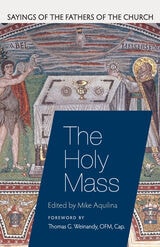
The Catholic University of America Press is proud to present the third volume in its Sayings of the Fathers of the Church series. Featuring esteemed scholars and writers compiling material from our acclaimed Fathers of the Church volumes, each title is devoted to select areas of theology. The inaugural volumes covered the Seven Deadly Sins and the Four Last Things, and now we turn to The Holy Mass. The documents of early Christianity are rich in mentions of the Mass and its component parts. Sometimes they’re detailed descriptions, sometimes quick allusions. In this volume Mike Aquilina, a popular author on early Christianity, takes readers step by step through the Mass, from the Sign of the Cross through the Dismissal, illuminating the way with the words of the Fathers. Along the way readers encounter familiar rites, words, and gestures, but also familiar complaints — about long homilies, bad singing, liturgical abuses, and distracted congregations. The Holy Mass is divided into chapters based on the parts of the Mass known to modern Catholics of the Roman Rite. The Mass did not follow this sequence through the entirety of the era of the Fathers. Gregory the Great moved the position of the Lord’s Prayer. There were geographic variants for the placement of the Sign of Peace. Some ancient liturgies lacked a specific penitential rite — though all the liturgies had a penitential dimension to their prayers. Mike Aquilina’s introduction provides historical context and describes the rich development of the liturgy through the Church’s first few centuries. A foreword by Thomas Weinandy, a member of the Vatican’s International Theological Commission, speaks of the relevance of this material for worshipers today.
[more]
cover of The KGB and the Vatican: Secrets of the Mitrokhin Files

The KGB and the Vatican

Secrets of the Mitrokhin Files

Sean Brennan

Catholic University of America Press, 2022
One of the greatest ironies of the history of Soviet rule is that, for an officially atheistic state, those in the political police and in the Politburo devoted an enormous amount of time and attention to the question of religion. The Soviet government’s policies toward religious institutions in the USSR, and toward religious institutions in the non-Communist world, reflected this, especially when it came to the Vatican and Catholic Churches, both the Latin and Byzantine Rite, in Soviet territory. The KGB and the Vatican consists of the transcripts of KGB records concerning the policies of the Soviet secret police towards the Vatican and the Catholic Church in the Communist world, transcripts provided by KGB archivist and defector Vasili Mitrokhin, from the Second Vatican Council to the election of John Paul II. Among the topics covered include how the Soviet regime viewed the efforts of John XXIII and Paul VI of reaching out to eastern side of the Iron Curtain, the experience of the Roman Catholic Church in Lithuanian Soviet Socialist Republic and the underground Greek Catholic Church in the Ukrainian Soviet Socialist Republic, the religious underground in the key cities of Leningrad and Moscow, and finally the election of John Paul II and its effect on the tumultuous events in Poland in the late 1970s and early 1980s. This valuable primary source collection also contains a historical introduction written by the translator, Sean Brennan, a professor of History at the University of Scranton.
[more]
cover of The Key to Unlocking the Door to the Truth: Father Ignacio Gordon, SJ, and His Contribution to the Discipline of Canonical Procedural Law

The Key to Unlocking the Door to the Truth

Father Ignacio Gordon, SJ, and His Contribution to the Discipline of Canonical Procedural Law

William L. Daniel

Catholic University of America Press, 2022
Father Ignacio Gordon, SJ, taught canon law (the Catholic Church’s law) from 1960 until 1985 at the Pontifical Gregorian University in Rome, with a concentration on procedural law, or the laws on trials. By all testimonies, he was outstanding for the clarity of his teaching, his humble affection for his students, his indefatigable and hidden service to the Apostolic See, and his priestly zeal. Notable among his endeavors was an educational initiative for the ongoing formation of judges and other ministers of justice in ecclesiastical tribunals. In his teaching, he stressed the ecclesial importance and supernatural implications of procedural law in general, and the indispensability of the judicial protection of marriage in particular. Special efforts were made to make procedural law understandable to his students and to canonists in general, at a time when the Church was celebrating and implementing the teachings of the Second Vatican Ecumenical Council, as a result of which her law was undergoing a major revision. Father Gordon taught from the consistent canonical tradition, while also laying bare the latest developments in law and jurisprudence. He taught the entirety of the law on trials, producing numerous scholarly works on questions both timeless and new, giving marked emphasis to the problem of the excessive length of trials and the causes of delayed justice. An area of his particular attention and dedication was the Supreme Tribunal of the Apostolic Signatura—of which he was a consultor (referendary and later votans)—including both its proper law and its history. This history displayed, in part, why that Tribunal was the natural one to function as the supreme administrative tribunal of the Church. Father Gordon’s contribution to the question of ecclesiastical administrative justice was among those leading the novel and dynamic discussion about it in the 1960s and 1970s.
[more]
cover of The Life of Adam and Eve in Greek: A Critical Edition

The Life of Adam and Eve in Greek

A Critical Edition

Johannes Tromp

SBL Press, 2016

A Brill classic now in paperback from SBL Press

This critical edition of the Life of Adam and Eve in Greek is based on all available manuscripts. In the introduction the history of previous research is summarized, and the extant manuscripts are presented. Next comes a description of the grammatical characteristics of the manuscripts’ texts, followed by a detailed study of the genealogical relationships between them, resulting in a reconstruction of the writing’s history of transmission in Greek. On the basis of all this information, the Greek text of the Life of Adam and Eve in its earliest attainable stage, is established.

Features:

  • Illustrations of textual relationships and variants
  • Indices for subjects, passages, words in the text, variants, and additions and revisions
  • Full critical apparatus with relevant evidence from the manuscripts
[more]
cover of The Noble Army: The Modern Martyrs of Westminster Abbey

The Noble Army

The Modern Martyrs of Westminster Abbey

Edited by James Hawkey

Haus Publishing, 2024

The narratives of the figures behind the ten statues of martyrs at the Westminster Abbey.

In July 1998, ten statues of martyrs of the twentieth century were unveiled surmounting the Great West Door of Westminster Abbey. Ten figures were identified from different continents and different churches: victims of Nazi and Bolshevik oppression, state-sponsored violence, and religious hatred, these images stand as a testimony to the bloodshed of the twentieth century. Some, such as Oscar Romero and Martin Luther King, are famed across the world. Others are less known.

The Noble Army offers reflections on each of these ten lives, explores the questions surrounding their choices, and tells us the stories behind them. These statues were intended to represent those millions of individuals who suffered for their faith in Christ in the twentieth century. These reflections culminate in a chapter on the contemporary reality of Christian marginalization and persecution, written by Archbishop Bashar Warda of Erbil, Iraq.
 
[more]
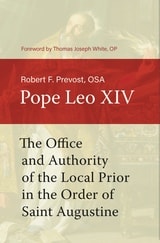
cover of The Office and Authority of the Local Prior in the Order of Saint Augustine

The Office and Authority of the Local Prior in the Order of Saint Augustine

Robert F. Prevost

Catholic University of America Press, 2025
As a young priest, Robert Prevost was sent in 1981 to Rome to study church law at the Pontifical University of Saint Thomas (known as the Angelicum). There he earned a licentiate and composed a doctoral thesis, which made final in 1987. This is that thesis, the first book-length work composed by the man now known as Pope Leo XIV. Specifically, his study— drawing from sources in English, Italian, and Spanish and from medieval history and theology as well as canon law —focused on the role of the prior as the local superior in the Order of St. Augustine. In doing so, he describes a traditional notion of obedience in religious life -- one based on love of the truth and growth in one's inner freedom to pursue holiness. At the center of his reflection are key ideas regarding the common good of the Church; the Eucharistic liturgy at the center of the life of the community; the role of hierarchy and consultation; and mutual respect for the diverse contributions of each person. Present in this text, moreover, is a far-reaching conception of the priesthood characterized by the triple munera: the priestly work of teaching, sanctification, and governance. Central to the whole volume is an Augustinian conception of the spiritual life that focuses on the inward work of grace, the primacy of the love of God, and inward conformity to Christ. The book's preface—composed by eminent theologian and present-day rector of the Angelicum, Fr. Thomas Joseph White, OP—helps frame the work for the wider public interested in it as a privileged window into the mind and heart of Prevost as a young priest, showing how its subject matter has implications for how one thinks about the life of the Catholic Church. There are clearly in this early work central themes regarding the life of Church, the apostolic tradition, and ecclesial authority in the service of the common good, that may well indicate directions and themes in the subsequent life and teaching of the author. Canonists will be drawn to Prevost's analysis of the Constitutions of the Augustinians in light of the then-newly promulgated Code of Canon Law. Historians and theologians alike may enjoy considering parallelisms that occur between this Augustinian vision of the prior and the subsequent unfolding of an Augustinian pontificate. Hopefully the publication of this work will lead to constructive debate about and comprehension of the relation of between the two.
[more]
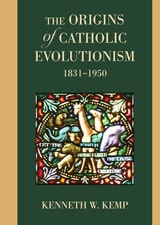
cover of The Origins of Catholic Evolutionism, 1831-1950

The Origins of Catholic Evolutionism, 1831-1950

Kenneth W. Kemp

Catholic University of America Press, 2025

The history of the Catholic Church’s response to evolutionary biology has often been badly misrepresented as antagonistic. In fact, its response is better characterized as a long process of accommodation. This work is a comprehensive introduction to the work of the Catholic scientists and theologians who worked out the details of that accommodation. Few Catholics found the evolutionary origin of plant and animal species theologically objectionable. None thought that evolutionary processes provided a sufficient account of the origin of the first human beings. Catholics differed over whether those processes played a role in the origin of the first human body. Catholic evolutionism began with the work of four nineteenth-century scientists who might be called the pioneers of Catholic evolutionism—Belgian geologist Jean-Baptiste d’Omalius d’Halloy, English anatomist George Mivart, Italian anatomist Filippo De Filippi, and French paleontologist Albert Gaudry. The next generations of Catholic evolutionists, writing in the period from about 1890 -1940, included scientists (Jesuit entomologists Erich Wasmann and Felix Rüschkamp) as well as priests who focused more exclusively on the question of compatibility (Dalmace Leroy, John Zahm, Henry de Dorlodot, and Ernest Messenger). Among the scientists might also be included French paleontologist Pierre Teilhard de Chardin, who made some contributions to the general idea of the compatibility of evolutionary biology and Catholic theology, but who eventually veered off in the direction of a comprehensive evolutionary theology of nature the details of which are beyond the scope of this book. Catholic anti-evolutionists made efforts to have the Church prohibit works of Catholic evolutionism that, in their judgment gave evolutionary processes too great a rôle in the formation of the human body or that relied on problematic principles of hermeneutics. Efforts on the former front were eventually blocked by Pope Pius XI. The first magisterial statement on the question came, however, only in 1950, with Pope Pius XII’s encyclical Humani generis, which provisionally declared the orthodoxy of evolutionary accounts of the origin of the human body. In addition to providing details about Catholic evolutionists and the magisterium, the book also reviews the treatment of the new ideas in Catholic encyclopedias, periodicals, and textbooks. Although written in the first instance as a work of scholarship, the book was also written with attention to the needs of scientists, priests, and members of the general public who are interested in the question.
[more]
cover of The Panarion of Epiphanius of Salamis: Book I (Sects 1–46)

The Panarion of Epiphanius of Salamis

Book I (Sects 1–46)

Frank Williams

SBL Press, 2016

Now in Paperback!

Epiphanius, monastic founder and bishop of Salamis on Cyprus for almost forty years of the fourth century, threw heart and soul into the controversies of the time and produced the Panario or Medicine Chest, a historical encyclopedia of sects and heresies and their refutations. Book I deals with material that is also found in Nag Hammadi, other Gnostic writings, and in such patristic authors as Irenaeus and Hippolytus. Students of Nag Hammadi and Gnosticism, patrologists, historians of religion, church historians, and Judaism have found this translation useful.

Features:

  • Paperback format of an essential Brill reference set
  • Coverage of Gnostic and Jewish Christian groups
  • Documents not available elsewhere in paperback
[more]
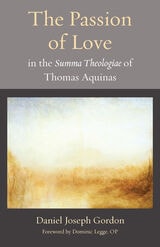
cover of The Passion of Love in the <i>Summa Theologiae</i> of Thomas Aquinas

The Passion of Love in the <i>Summa Theologiae</i> of Thomas Aquinas

Daniel Joseph Gordon

Catholic University of America Press, 2023
This book is an introduction to three questions on love according to St. Thomas Aquinas (Summa Theologiae I–II, qq. 26–28). These three questions reflect on the nature of love (q. 26), the causes of love (q. 27), and the effects of love (q. 28). It is thus an introduction to the entire phenomenon of love, both as a bodily passion and an act of the will. The purpose is to present the Thomistic and broadly scholastic account of human and divine love from a philosophical and theological perspective. It aims to be a theological and philosophical study of the topic, useful both for a graduate/professional audience, as part of an undergraduate or graduate course, and perhaps for the educated reader. The thesis of the book is that, contrary to contemporary conceptions, not all loves are created equal. Some loves perfect us and some loves corrupt us. The worth of a love depends on its object and end. St. Thomas thus presents an objective and teleological account of human and divine love that is of philosophical and theological interest. The method is broadly exegetical, presenting a careful reading of the text and supplying the philosophical and theological background which the text of Aquinas assumes. The scope of the work is limited to three questions (ST I–II, qq. 26–28). References to interpretative disputes of Aquinas and references to further resources in the secondary literature will be mostly limited to the footnotes, making the body of the text accessible to more readers.
[more]
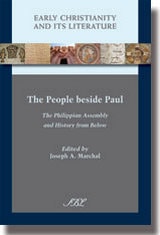
cover of The People beside Paul: The Philippian Assembly and History from Below

The People beside Paul

The Philippian Assembly and History from Below

Joseph A. Marchal

SBL Press, 2015

Who are the people beside Paul, and what can we know about them?

This volume brings together an international and interdisciplinary group of scholars with a broad range of expertise and a common interest: Philippi in antiquity. Each essay engages one set of contextual particularities for Paul and the ordinary people of the Philippian assembly, while simultaneously placing them in wider settings. This 'people's history' uses both traditional and more cutting-edge methods to reconsider archaeology and architecture, economy and ethnicity, prisons and priestesses, slavery, syncretism, stereotypes of Jews, the colony of Philippi, and a range of communities. The contributors are Valerie Abrahamsen, Richard S. Ascough, Robert L. Brawley, Noelle Damico, Richard A. Horsley, Joseph A. Marchal, Mark D. Nanos, Peter Oakes, Gerardo Reyes Chavez, Angela Standhartinger, Eduard Verhoef, and Antoinette Clark Wire.

Features

  • An examination of the social forms and forces that shaped and affected the Philippian church
  • Essays offer insight into standard questions about the letter s hymn and audience, Paul's 'opponents,' and the sites of the community and of Paul's imprisonment
  • A focused exploration of more marginalized topics and groups, including women, slaves, Jews, and members of localized cults
[more]
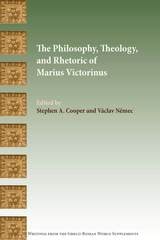
cover of The Philosophy, Theology, and Rhetoric of Marius Victorinus

The Philosophy, Theology, and Rhetoric of Marius Victorinus

Stephen A. Cooper

SBL Press, 2022

Pagan rhetor, (Neo-)Platonist philosopher, Christian theologian

This collection of essays is devoted to the rhetoric, Neoplatonic philosophy, and Christian theology of Marius Victorinus, a mid-fourth-century professor of rhetoric and philosopher who converted to Christianity late in life. Scholars from eight different countries, some of whom have not previously published in English, reflect on debates about his writings and theological development. These topics include Victorinus's deployment of philosophical sources for trinitarian theology, possible connections in his work to Origen, Augustine, Plotinus, Porphyry, and Gnosticism, as well as his contributions to Latin rhetoric and dialectic. Contributors include Jan Dominik Bogataj, Michael Chase, Nello Cipriani, Stephen A. Cooper, Volker Henning Drecoll, Lenka Karfíková, Josef Lössl, Václav Němec, Thomas Riesenweber, Guadalupe Lopetegui Semperena, Miran Špelič, Chiara O. Tommasi, John D. Turner, and Florian Zacher. The chapters in this volume are of great interest to students of late antique philosophy, Christian theology, and Latin rhetoric.
[more]
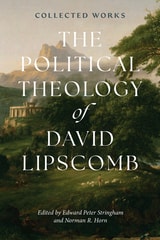
cover of The Political Theology of David Lipscomb: Collected Works

The Political Theology of David Lipscomb

Collected Works

David Lipscomb; Edited by Edward Peter Stringham and Norman R. Horn

Vanderbilt University Press, 2026

Few figures shaped the Stone-Campbell Restoration movement more than David Lipscomb, whose influence on its theology and practice rivaled that of any of his contemporaries. Yet the writings in this volume have long been unavailable to general readers, and most people are no longer familiar with his ideas, including his belief that Christians should not participate in secular politics.

In the early decades of the Stone-Campbell movement, adherents argued their positions in person and in print, and the direction of the movement was decided by these wide-ranging theological discussions. Dissent was built into the discourse and considered a part of the spiritual well-being of the movement. Followers were expected to read and have opinions on all these discussions. And now most of these books and articles have all but vanished from circulation—not just Lipscomb’s but many of the nineteenth-century Campbellite theologians’ writings.

This volume comprises three of Lipscomb’s most important works regarding Christians’ relationship to civil government, along with an introduction by Edward Peter Stringham and Norman R. Horn that explains how Lipscomb’s political writings receded from view within the movement he once shaped.

[more]
cover of The Presence of God and Union with God: Creation, Divine Indwelling Through Grace, Incarnation and the Blessed Vision According to Saint Thomas Aquinas

The Presence of God and Union with God

Creation, Divine Indwelling Through Grace, Incarnation and the Blessed Vision According to Saint Thomas Aquinas

Gilles Emery, OP

Catholic University of America Press, 2027
How can one discover or recover the sense of God’s presence, of living union with God? The Bible speaks to us from beginning to end of God’s presence as Creator and Savior: a presence received, a presence loved, a presence for whose fullness we intensely hope. The liturgy of the Church celebrates God present in Christ and in his Spirit who unite us to the Father. Christian existence is lived in faith by the light of this loving presence of the God who has created us, who has saved us, and who calls us to return to him. This book seeks to ponder God’s presence in its length, depth, and breadth: the presence of God in all his creatures, his presence of indwelling through grace, his presence radiating in the Son’s Incarnation, his presence in the gift of the Holy Spirit, and finally his presence in the blessed vision whereby we shall be united immediately to him. The reader is invited to take a “theological journey” in the school of Saint Thomas Aquinas, a journey in five chapters, which constitute as many stages. The first chapter offers a reflection on the relation that all creatures, including human persons, have with the creating God. The second chapter considers God’s presence in grace: the three divine persons come to abide in the just whom they make their temple. The third chapter is consecrated to Christ Jesus: “In him the whole plenitude of the divinity dwells bodily” (Col 2:9). The fourth chapter turns to the Holy Spirit, considering his presence and the gift of grace. And finally, the fifth and closing chapter deals with the consummation of Christian hope: the union with God in the blessed vision.
[more]
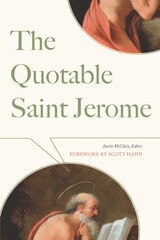
cover of The Quotable Saint Jerome

The Quotable Saint Jerome

Jerome Saint Jerome

Catholic University of America Press, 2020
Among the illustrious writers of the early Church, Saint Jerome (345-420) had a way with words few could equal. To honor the 1600th anniversary of the death of this patron saint of librarians and Scripture scholars, the Catholic University of America Press is releasing The Quotable Jerome, a well-organized collection of memorable wisdom from this early witness to Catholic truth. While Jerome is known for acerbic wits, editor Justin McClain shows that much of the time, Jerome's writings are instructive and even inspiring. Homilists will easily be able to find what Jerome said on any number of topics--Scripture, the Trinity, the sacraments, persecution, heresy, divine revelation, or chastity--just to name a few. All citations are clearly sourced if the reader wants to pursue the longer passage in question. “I am upset because I am human; I control my tongue because I am a Christian. Anger surges up in my heart, but I do not give vent to it.” - Homilies on the Psalms, Homily 10, Psalm 76 (77) (FOTC 48) “The doer of evil has, indeed, killed his own soul; but the heretic—the liar—has killed as many souls as he has seduced.” - Homilies on the Psalms, Homily 2, Psalm 5 (FOTC 48) “The Church does not consist in walls, but in the truths of her teachings. The Church is there where there is true faith.” - Homilies on the Psalms, Homily 46, Psalm 133 (134) “To err is human, but to lay snares is diabolical.” - Dogmatic and Polemical Works, The Apology Against the Books of Rufinus, Book Three, paragraph 33 (FOTC 53) “So much for what Scripture says; learn now what it means.” - Homilies on the Psalms, Homily 15, Psalm 82 (83) (FOTC 48)
[more]
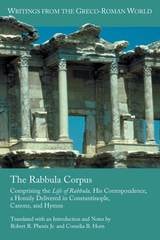
cover of The Rabbula Corpus: Comprising the Life of Rabbula, His Correspondence, a Homily Delivered in Constan

The Rabbula Corpus

Comprising the Life of Rabbula, His Correspondence, a Homily Delivered in Constan

Robert R. Phenix Jr.

SBL Press, 2017

A significant new study of Rabbula and Christianity in Edessa

This volume makes available for the first time both the Syriac text and an English translation of every available original composition by Rabbula, the controversial bishop of Edessa (ca. 411–435 CE). It includes a new edition of the Life of Rabbula and other biographical traditions about him, including his conversion from paganism to Christianity. The texts collected in the volume are a valuable source for studying the reception history of biblical themes. In addition, the corpus offers insights into the beginnings of ecclesiastical legislation in the East, charitable work, pilgrimage, ascetic ideals, and church administration. Horn and Phenix examine Rabbula’s contribution to the Christological controversies of the fifth and sixth centuries, including his influence on Cyril of Alexandria in his debate with Theodoret of Cyrrhus and Theodore of Mopsuestia.

Features

  • A critical study of the theological, cultural, and historical development of Syriac Christianity
  • Thorough historical, theological, and socio-cultural analysis provided for each text
  • A previously unidentified Christian Palestinian Aramaic fragment
[more]
cover of The Realm Of Prester John

The Realm Of Prester John

Robert Silverberg

Ohio University Press, 1996

In this modern account of the genesis of a great medieval myth, celebrated science fiction author Robert Silverberg’s explores the mysterious origins of Prester John, the astonishing Christian potentate of the East.

Prester John was a legendary figure who cast a powerful spell over Latin Christendom for almost five centuries. Rumors of the warrior-king-prelate’s fabulous realms first reached Europe in the eleventh century and quickly assumed an exalted status alongside such fabled wonders as El Dorado, The Fountain of Youth, and the Holy Grail.

The defeat of a Moslem Turkish tribe by a Buddhist Chinese warlord seems to have been the unlikely historical nugget around which the Prester John myth grew, but contributions to this strange saga have also been traced all around the globe to the Apostle Thomas' apocryphal preaching in India, to the actual existence of small colonies of Nestorian schismatics in central Asia, and even to Genghis Khan.
[more]
cover of The Reception of Pragmatism in France and the Rise of Roman Catholic Modernism, 1890-1914

The Reception of Pragmatism in France and the Rise of Roman Catholic Modernism, 1890-1914

David G. Schultenover

Catholic University of America Press, 2009
This collection of essays provides a small revolution in the study of Roman Catholic Modernism, a movement that until now has been largely seen as an episode that underscored institutional Catholicism's isolation from the mainstream intellectual currents of the time.
[more]
cover of The Seeds of Triumph: Church and State in Gomulka's Poland

The Seeds of Triumph

Church and State in Gomulka's Poland

Hannah Diskin

Central European University Press, 2001

The Roman Catholic Church has played a unique role in the history of Poland in the twentieth century: the people and the Church drew closer and closer together during Nazi rule, the Stalinist period and the somewhat milder, though strongly anti-religious and repressive Gomulka regime (1956-1970). The power struggle between the Church and the communist government did in fact play a role in shaping world politics, the Polish Church having been the force behind the opposition movement in Poland. Against this background, a Polish pope appeared and made a major contribution to the collapse of communism.

The Seeds of Triumph, the most comprehensive recent book on the opposition of Church and State in post-war Poland, compares the characteristics and consequences of this relationship during three different periods: the first and second periods of Gomulka's rule, and the Stalinist era between the two Gomulka periods. It examines the balance of power, studying to what degree the Church and other factors in the political environment influenced governmental policy-making. The author disproves the common stereotype, held at the time, that domestic conditions played only a marginal role. In examining the regime's policies, she covers the legal background, the general policy characteristics, the specific policies implemented during the period, and the role of the individual actors, most notably the pivotal role of the two main protagonists, Cardinal Wyszynski and Wladislaw Gomulka.

In her landmark study, Diskin makes a significant contribution to the study of authoritarian systems and greatly enhances our understanding of the centrality of the Church in recent Polish history.

[more]