Results by title
121 books match the query 'Cinema' and 26 start with t
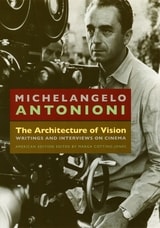
The Architecture of Vision
Writings and Interviews on CinemaMichelangelo Antonioni
University of Chicago Press, 2007
Through autobiographical sketches, theoretical essays, interviews, and conversations with such luminaries as Jean-Luc Godard and Alberto Moravia, this compelling volume explores the director’s unique brand of narrative-defying cinema as well as the motivations and anxieties of the man behind the camera.
“The Architecture of Vision provides a filmmaker’s absorbing reflections and insights on his career. . . . Antonioni’s comments . . . deepen and humanize a sometimes cerebral book.”—Publishers Weekly
“[Antonioni’s] erudition is astonishing . . . few of his peers can match his verbal articulateness.”—Film Quarterly
“This valuable resource offers entrée to material difficult to gain access to under other circumstances.”—Library Journal
The Chinese Diaspora on American Screens
Race, Sex, and CinemaGina Marchetti
Temple University Press, 2012
The Chinese Diaspora on American Screens looks at the way in which issues of race and sexuality have become central concerns in cinema generated by and about Chinese communities in America after the mid-1990s. This companion volume to Marchetti's From Tian'anmen to Times Square looks specifically at the Chinese diaspora in relation to ethnic, racial, gender, and sexual identity as depicted in the cinema.
Examining films from the United States and Canada, as well as transnational co-productions, The Chinese Diaspora on American Screens includes analyses of films such as The Wedding Banquet and Double Happiness in addition to interviews with celebrated filmmakers such as Wayne Wang.
Marchetti also reflects on how Chinese identity is presented in a multitude of media forms, including commercial cinema, documentaries, experimental films, and hybrid digital media to offer a textured look at representations of the Chinese diasporic experience after Tian'anmen.
The Cinema and Its Shadow
Race and Technology in Early CinemaAlice Maurice
University of Minnesota Press, 2013
The Cinema and Its Shadow argues that race has defined the cinematic apparatus since the earliest motion pictures, especially at times of technological transition. In particular, this work explores how racial difference became central to the resolving of cinematic problems: the stationary camera, narrative form, realism, the synchronization of image and sound, and, perhaps most fundamentally, the immaterial image—the cinema’s “shadow,” which figures both the material reality of the screen image and its racist past.
Discussing early “race subjects,” Alice Maurice demonstrates that these films influenced cinematic narrative in lasting ways by helping to determine the relation between stillness and motion, spectacle and narrative drive. The book examines how motion picture technology related to race, embodiment, and authenticity at specific junctures in cinema’s development, including the advent of narratives, feature films, and sound. In close readings of such films as The Cheat, Shadows, and Hallelujah!, Maurice reveals how the rhetoric of race repeatedly embodies film technology, endowing it with a powerful mix of authenticity and magic. In this way, the racialized subject became the perfect medium for showing off, shoring up, and reintroducing the cinematic apparatus at various points in the history of American film.
Moving beyond analyzing race in purely thematic or ideological terms, Maurice traces how it shaped the formal and technological means of the cinema.
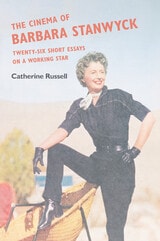
The Cinema of Barbara Stanwyck
Twenty-Six Short Essays on a Working StarCatherine Russell
University of Illinois Press, 2023
Original and rich, The Cinema of Barbara Stanwyck is an essential and entertaining reexamination of an enduring Hollywood star.
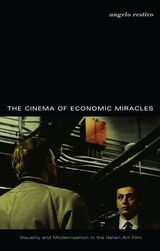
The Cinema of Economic Miracles
Visuality and Modernization in the Italian Art FilmAngelo Restivo
Duke University Press, 2002
Restivo studies numerous films of the period, focusing mainly on the works of Pier Paolo Pasolini and Michelangelo Antonioni. He finds that these auteurs’ films reworked the neorealist aesthetic developed in the 1940s and 1950s, explored issues brought to the fore by the subsequent consumer boom, and presaged developments central to both critical theory and the visual arts in the 1980s and 1990s. Drawing on the theories of Lacan, Zizek, Benjamin, Foucault, Jameson, and Deleuze, he shines new light on such films as Pasolini’s Accattone and Teorema, and Antonioni’s Red Desert and Blow-Up. Restivo’s model for understanding the relationship of the 1960s Italian art film to its cultural contexts also has implications that extend to the developing national cinemas of countries such as Brazil and Taiwan.
The Cinema of Economic Miracles will interest scholars and students in all areas of film studies, especially those studying theories of the image, national cinema theory, and Italian cinema, and to those engaged in poststructuralist theory, philosophy, and comparative literature.
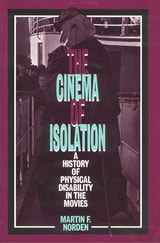
The Cinema of Isolation
A History of Physical Disability in the MoviesNorden, Martin F
Rutgers University Press, 1994
Norden offers a dazzling array of physically disabled characters who embody or break out of the stereotypes that have both influenced and been symptomatic of societys fluctuating relationship with its physically disabled minority. He shows us "sweet innocents" like Tiny Tim, "obsessive avengers" like Quasimodo, variations on the disabled veteran, and many others. He observes the arrival of a new set of stereotypes tied to the growth of science and technology in the 1970s and 1980s, and underscores movies like My Left Foot and The Waterdance that display a newfound sensitivity. Nordens in-depth knowledge of disability history makes for a particularly intelligent and sensitive approach to this long-overlooked issue in media studies.

The Cinema of Mika Kaurismäki
Transvergent Cinescapes, Emergent IdentitiesPietari Kääpä
Intellect Books, 2011
A PDF version of this book is available for free in open access via the OAPEN Library platform, www.oapen.org It has been made available under a Creative Commons Attribution 4.0 International Public License and is part of Knowledge Unlatched.
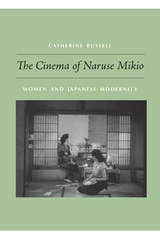
The Cinema of Naruse Mikio
Women and Japanese ModernityCatherine Russell
Duke University Press, 2008
Naruse was a studio-based director, a company man renowned for bringing films in on budget and on time. During his long career, he directed movies in different styles of melodrama while displaying a remarkable continuity of tone. His films were based on a variety of Japanese literary sources and original scripts; almost all of them were set in contemporary Japan. Many were “women’s films.” They had female protagonists, and they depicted women’s passions, disappointments, routines, and living conditions. While neither Naruse or his audiences identified themselves as “feminist,” his films repeatedly foreground, if not challenge, the rigid gender norms of Japanese society. Given the complex historical and critical issues surrounding Naruse’s cinema, a comprehensive study of the director demands an innovative and interdisciplinary approach. Russell draws on the critical reception of Naruse in Japan in addition to the cultural theories of Harry Harootunian, Miriam Hansen, and Walter Benjamin. She shows that Naruse’s movies were key texts of Japanese modernity, both in the ways that they portrayed the changing roles of Japanese women in the public sphere and in their depiction of an urban, industrialized, mass-media-saturated society.
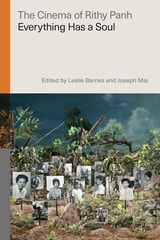
The Cinema of Rithy Panh
Everything Has a SoulLeslie Barnes
Rutgers University Press, 2022
Born in 1964, Cambodian filmmaker Rithy Panh grew up in the midst of the Khmer Rouge’s genocidal reign of terror, which claimed the lives of many of his relatives. After escaping to France, where he attended film school, he returned to his homeland in the late 1980s and began work on the documentaries and fiction films that have made him Cambodia’s most celebrated living director.
The fourteen essays in The Cinema of Rithy Panh explore the filmmaker’s unique aesthetic sensibility, examining the dynamic and sensuous images through which he suggests that “everything has a soul.” They consider how Panh represents Cambodia’s traumatic past, combining forms of individual and collective remembrance, and the implications of this past for Cambodia’s transition into a global present. Covering documentary and feature films, including his literary adaptations of Marguerite Duras and Kenzaburō Ōe, they examine how Panh’s attention to local context leads to a deep understanding of such major themes in global cinema as justice, imperialism, diaspora, gender, and labor.
Offering fresh takes on masterworks like The Missing Picture and S-21 while also shining a light on the director’s lesser-known films, The Cinema of Rithy Panh will give readers a new appreciation for the boundless creativity and ethical sensitivity of one of Southeast Asia’s cinematic visionaries.
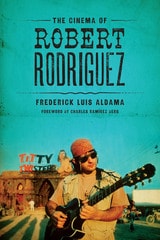
The Cinema of Robert Rodriguez
By Frederick Luis Aldama
University of Texas Press, 2014
Robert Rodriguez stands alone as the most successful U.S. Latino filmmaker today, whose work has single-handedly brought U.S. Latino filmmaking into the mainstream of twenty-first-century global cinema. Rodriguez is a prolific (eighteen films in twenty-one years) and all-encompassing filmmaker who has scripted, directed, shot, edited, and scored nearly all his films since his first breakout success, El Mariachi, in 1992. With new films constantly coming out and the launch of his El Rey Network television channel, he receives unceasing coverage in the entertainment media, but systematic scholarly study of Rodriguez’s films is only just beginning.
The Cinema of Robert Rodriguez offers the first extended investigation of this important filmmaker’s art. Accessibly written for fans as well as scholars, it addresses all of Rodriguez’s feature films through Spy Kids 4 and Machete Kills, and his filmmaking process from initial inspiration, to script, to film (with its myriad visual and auditory elements and choices), to final product, to (usually) critical and commercial success. In addition to his close analysis of Rodriguez’s work, Frederick Luis Aldama presents an original interview with the filmmaker, in which they discuss his career and his relationship to the film industry. This entertaining and much-needed scholarly overview of Rodriguez’s work shines new light on several key topics, including the filmmaker’s creative, low-cost, efficient approach to filmmaking; the acceptance of Latino films and filmmakers in mainstream cinema; and the consumption and reception of film in the twenty-first century.
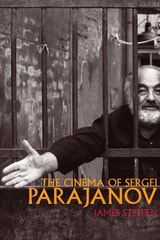
The Cinema of Sergei Parajanov
James Steffen
University of Wisconsin Press, 2013
The Cinema of Sergei Parajanov is the first English-language book on the director's films and the most comprehensive study of his work. James Steffen provides a detailed overview of Parajanov's artistic career: his identity as an Armenian in Georgia and its impact on his aesthetics; his early films in Ukraine; his international breakthrough in 1964 with Shadows of Forgotten Ancestors; his challenging 1969 masterpiece, The Color of Pomegranates, which was reedited against his wishes; his unrealized projects in the 1970s; and his eventual return to international prominence in the mid-to-late 1980s with The Legend of the Surami Fortress and Ashik-Kerib. Steffen also provides a rare, behind-the-scenes view of the Soviet film censorship process and tells the dramatic story of Parajanov's conflicts with the authorities, culminating in his 1973–77 arrest and imprisonment on charges related to homosexuality.
Ultimately, the figure of Parajanov offers a fascinating case study in the complicated dynamics of power, nationality, politics, ethnicity, sexuality, and culture in the republics of the former Soviet Union.
The Cinema of Wang Bing
Chinese Documentary between History and LaborBruno Lessard
Hong Kong University Press, 2023
In The Cinema of Wang Bing, Bruno Lessard examines documentarian Wang Bing’s most important films. He focuses on the two obsessions at the heart of Wang’s oeuvre—the legacy of Maoist China in the present and the transformation of labor since China’s entry into the market economy—and how the crucial figures of survivor and worker are represented on screen. Bruno Lessard argues that Wang is a minjian (grassroots) intellectual whose films document the impact of Mao’s Great Leap Forward on Chinese collective memory and register the repercussions of China’s turn to neoliberalism on workers in the post-Reform era. Bringing together Chinese documentary studies and China studies, Lessard shows how Wang’s practice reflects the minjian ethos when documenting the survivors of the Great Famine and those who have not benefitted from China’s neoliberal policies—from laid-off workers to migrant workers. The films discussed include some of Wang’s most celebrated works such as West of the Tracks and Dead Souls, as well as neglected documentaries such as Coal Money and Bitter Money.
The Cinema of Yakov Protazanov
F. Booth Wilson
Rutgers University Press, 2024
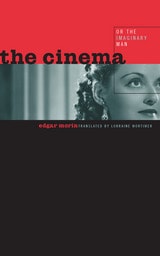
The Cinema, or The Imaginary Man
Edgar Morin
University of Minnesota Press, 2005
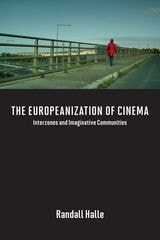
The Europeanization of Cinema
Interzones and Imaginative CommunitiesRandall Halle
University of Illinois Press, 2014
He focuses especially on films about borders, borderlands, and cultural zones as he traces the development of interzones from the inception of central European cinema to the avant-garde films of today. Throughout, he shows how cinema both reflects and engenders interzones that explore the important questions of Europe's social order: imperialism and nation-building in the late nineteenth and early twentieth centuries; "first contact" between former adversaries (such as East and West Germany) following World War II and the Cold War; and migration, neo-colonialism, and cultural imperialism in the twenty-first century.
Ultimately, Halle argues that today's cinema both produces and reflects imaginative communities. He demonstrates how, rather than simply erasing boundaries, the European Union instead fosters a network of cultural interzones that encourage cinematic exploration of the new Europe's processes and limits of connectivity, tolerance, and cooperation.
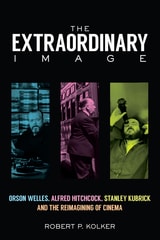
The Extraordinary Image
Orson Welles, Alfred Hitchcock, Stanley Kubrick, and the Reimagining of CinemaKolker, Robert P
Rutgers University Press, 2016
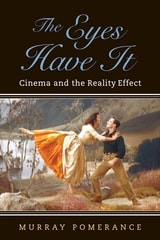
The Eyes Have It
Cinema and the Reality EffectPomerance, Murray
Rutgers University Press, 2013
Beginning with a penetrating study of five cornfield sequences—including The Wizard of Oz, Arizona Dream, and Signs—Murray Pomerance journeys through a vast array of cinematic moments, technical methods, and laborious collaborations from the 1930s to the 2000s to show how the viewer's experience of "reality" is put in context, challenged, and willfully engaged.
Four meditations deal with “reality effects” from different philosophical and technical angles. “Vivid Rivals” assesses active participation and critical judgment in seeing effects with such works as Defiance, Cloverfield, Knowing, Thelma & Louise, and more. “The Two of Us” considers double placement and doubled experience with such films as The Prestige, Niagara, and A Stolen Life. “Being There” discusses cinematic performance and the problems of believability, highlighting such films as Gran Torino, The Manchurian Candidate, In Harm’s Way, and other films. “Fairy Land” explores the art of scenic backing, focusing on the fictional world of Brigadoon, which borrows from both hard-edged realism and evocative landscape painting.
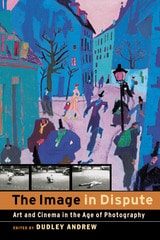
The Image in Dispute
Art and Cinema in the Age of PhotographyEdited by Dudley Andrew
University of Texas Press, 1997
Photography, cinema, and video have irrevocably changed the ways in which we view and interpret images. Indeed, the mechanical reproduction of images was a central preoccupation of twentieth-century philosopher Walter Benjamin, who recognized that film would become a vehicle not only for the entertainment of the masses but also for consumerism and even communism and fascism.
In this volume, experts in film studies and art history take up the debate, begun by Benjamin, about the power and scope of the image in a secular age. Part I aims to bring Benjamin's concerns to life in essays that evoke specific aspects and moments of the visual culture he would have known. Part II focuses on precise instances of friction within the traditional arts brought on by this century's changes in the value and mission of images. Part III goes straight to the image technologies themselves—photography, cinema, and video—to isolate distinctive features of the visual cultures they help constitute.
As we advance into the postmodern era, in which images play an ever more central role in conveying perceptions and information, this anthology provides a crucial context for understanding the apparently irreversible shift from words to images that characterized the modernist period. It will be important reading for everyone in cultural studies, film and media studies, and art history.
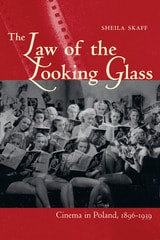
The Law of the Looking Glass
Cinema in Poland, 1896–1939Sheila Skaff
Ohio University Press, 2008
The Law of the Looking Glass: Cinema in Poland, 1896–1939 reveals the complex relationship between nationhood, national language, and national cinema in Europe before World War II. Author Sheila Skaff describes how the major issues facing the region before World War I, from the relatively slow pace of modernization to the desire for national sovereignty, shaped local practices in film production, exhibition, and criticism. She goes on to analyze local film production, practices of spectatorship in large cities and small towns, clashes over language choice in intertitles, and controversy surrounding the first synchronized sound experiments before World War I. Skaff depicts the creation of a national film industry in the newly independent country, the golden years of the silent cinema, the transition from silent to sound film—and debates in the press over this transition—as well as the first Polish and Yiddish “talkies.” She places particular importance on conflicts in majority-minority relations in the region and the types of collaboration that led to important films such as The Dybbuk and The Ghosts.
The Law of the Looking Glass: Cinema in Poland, 1896–1939 is the first comprehensive history of the country’s film industry before World War II. This history is characterized by alternating periods of multilingual, multiethnic production, on the one hand, and rejection of such inclusiveness, on the other. Through it all, however, runs a single unifying thread: an appreciation for visual imagery.
The Neoliberal Self in Bollywood
Cinema, Popular Culture, and IdentityNamrata Rele Sathe
Intellect Books, 2025
The neoliberal self, far from being a stable marker of urban, liberal, millennial Indian identity, is replete with contradictions and oppositions. This study of the unstable neoliberal identity lays bare the sense of precarity and inherent inequality that neoliberal regimes confer upon their subjects.
This analysis draws upon theories of feminist media studies, popular culture analyses, and film studies to critique mainstream Hindi cinema texts produced in the last two decades. Rele Sathe also examines a variety of peripheral subjects and texts, including the film star, the urban space, web series, YouTube videos, and social media content.
The Process Genre
Cinema and the Aesthetic of LaborSalomé Aguilera Skvirsky
Duke University Press, 2020
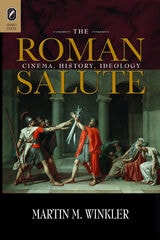
The Roman Salute
Cinema, History, IdeologyMartin M. Winkler
The Ohio State University Press, 2009

The Stranger from Omaha
Travel Narratives in the Cinema of Alexander PayneJason Sperb
University of Texas Press, 2025
The first in-depth analysis of the films of Alexander Payne through the lenses of authorship, tourism, and leisure.
With the films Election, About Schmidt, Sideways, Nebraska, and The Holdovers, Alexander Payne has carved out an unusual role in American cinema as a bankable auteur. There is something about Payne’s neurotics and searchers, his working stiffs and disillusioned idealists—something funny, moving, and filled with insight.
Jason Sperb dissects Payne’s oeuvre, focusing on the director’s penchant for travel narratives. Payne’s films usually center on male protagonists discontent with the emotional and material realities of the day-to-day and seeking satisfaction in some literal or metaphorical elsewhere. But their attempts to escape wind up perpetuating, rather than alleviating, the imbalance between labor and leisure that structures modern life. In this sense, Sperb argues, Payne’s characters are akin to tourists, searching for fleeting glimpses of the fulfillment they dream about. Examining themes of masculinity, nostalgia, whiteness, and class, The Stranger from Omaha is the first auteur study devoted to Payne’s delicately balanced cinematic world. An outsider even in his own heartland, Payne proves to be an artist working at a clarifying remove—a witness to the American condition, observing from just enough distance.
The Third Eye
Race, Cinema, and Ethnographic SpectacleFatimah Tobing Rony
Duke University Press, 1996
In films as seemingly dissimilar as Nanook of the North, King Kong, and research footage of West Africans from an 1895 Paris ethnographic exposition, Rony exposes a shared fascination with—and anxiety over—race. She shows how photographic “realism” contributed to popular and scientific notions of evolution, race, and civilization, and how, in turn, anthropology understood and critiqued its own use of photographic technology. Looking beyond negative Western images of the Other, Rony considers performance strategies that disrupt these images—for example, the use of open resistance, recontextualization, and parody in the films of Katherine Dunham and Zora Neale Hurston, or the performances of Josephine Baker. She also draws on the work of contemporary artists such as Lorna Simpson and Victor Masayesva Jr., and writers such as Frantz Fanon and James Baldwin, who unveil the language of racialization in ethnographic cinema.
Elegantly written and richly illustrated, innovative in theory and original in method, The Third Eye is a remarkable interdisciplinary contribution to critical thought in film studies, anthropology, cultural studies, art history, postcolonial studies, and women’s studies.
Thinking in the Dark
Cinema, Theory, PracticePomerance, Murray
Rutgers University Press, 2015
Thinking in the Dark introduces readers to twenty-one key theorists whose work has made a great impact on film scholarship today, including Rudolf Arnheim, Sergei Eisenstein, Michel Foucault, Siegfried Kracauer, and Judith Butler. Rather than just discussing each theorist’s ideas in the abstract, the book shows how those concepts might be applied when interpreting specific films by including an analysis of both a classic film and a contemporary one. It thus demonstrates how theory can help us better appreciate films from all eras and genres: from Hugo to Vertigo, from City Lights to Sunset Blvd., and from Young Mr. Lincoln to A.I. and Wall-E.
The volume’s contributors are all experts on their chosen theorist’s work and, furthermore, are skilled at explaining that thinker’s key ideas and terms to readers who are not yet familiar with them. Thinking in the Dark is not only a valuable resource for teachers and students of film, it’s also a fun read, one that teaches us all how to view familiar films through new eyes.
Theorists examined in this volume are: Rudolf Arnheim, Béla Balázs, Roland Barthes, André Bazin, Walter Benjamin, Judith Butler, Stanley Cavell, Michel Chion, Gilles Deleuze, Jean Douchet, Sergei Eisenstein, Jean Epstein, Michel Foucault, Siegfried Kracauer, Jacques Lacan, Vachel Lindsay, Christian Metz, Hugo Münsterberg, V. F. Perkins, Jacques Rancière, and Jean Rouch.
Translating Time
Cinema, the Fantastic, and Temporal CritiqueBliss Cua Lim
Duke University Press, 2009
In Translating Time, Bliss Cua Lim argues that fantastic cinema depicts the coexistence of other modes of being alongside and within the modern present, disclosing multiple “immiscible temporalities” that strain against the modern concept of homogeneous time. In this wide-ranging study—encompassing Asian American video (On Cannibalism), ghost films from the New Cinema movements of Hong Kong and the Philippines (Rouge, Itim, Haplos), Hollywood remakes of Asian horror films (Ju-on, The Grudge, A Tale of Two Sisters) and a Filipino horror film cycle on monstrous viscera suckers (Aswang)—Lim conceptualizes the fantastic as a form of temporal translation. The fantastic translates supernatural agency in secular terms while also exposing an untranslatable remainder, thereby undermining the fantasy of a singular national time and emphasizing shifting temporalities of transnational reception.
Lim interweaves scholarship on visuality with postcolonial historiography. She draws on Henri Bergson’s understanding of cinema as both implicated in homogeneous time and central to its critique, as well as on postcolonial thought linking the ideology of progress to imperialist expansion. At stake in this project are more ethical forms of understanding time that refuse to domesticate difference as anachronism. While supernaturalism is often disparaged as a vestige of primitive or superstitious thought, Lim suggests an alternative interpretation of the fantastic as a mode of resistance to the ascendancy of homogeneous time and a starting-point for more ethical temporal imaginings.