Results by title
188 books match the query 'City planning' and 38 start with t
THE MYSTERIES OF THE GREAT CITY
THE POLITICS OF URBAN DESIGN, 1877-1937JOHN FAIRFIELD
The Ohio State University Press, 1997
The Mysteries of the Great City examines the physical, cultural, and political transformations of the American city between the Gilded Age and the New Deal. Focusing on New York, Chicago, and Cincinnati, John Fairfield demonstrates that these transformations before and after the advent of city planning were the result of political decisions influenced by corporate and private wealth.
The expansion and reorganization of the great city stood out as the most visible symbol of the transformation. The new metropolitan form, with its skyscraping business center, industrial satellites, crowded working-class neighborhoods, and exclusive suburbs, embodied an emerging corporate order. But the metropolis also disguised the new order and gave it an apparent physical implacability and inevitability that obscured the role of choice in its creation and therefore placed it beyond criticism. Fairfield unravels the mysteries of the new form to reveal the centrality of power and politics in urban design.
While acknowledging that a great many factors shaped urban development, Fairfield underscores the decisive role of human design. He argues that American cities, both before and after the advent of professional planning, have always been in some measure “planned.” Discussing such figures as Frederick Law Olmsted, Henry George, Daniel Burnham, Frederic Howe, Edward Bassett, Robert E. Park, and Louis Wirth, Fairfield illuminates the political and intellectual conflicts among advocates of alternative paths of urban development.
The Mysteries of the Great City will enlighten all readers interested in the development of cities, particularly urban historians and planners. In pointing to the Gilded Age as a period of great possibilities of progressive reform, this study will also reward readers interested in the historical foundations of our modern society.
Tactical Urbanism for Librarians
Quick, Low-Cost Ways to Make Big ChangesKaren Munro
American Library Association, 2017
Taking the Land to Make the City
A Bicoastal History of North AmericaBy Mary P. Ryan
University of Texas Press, 2019
The history of the United States is often told as a movement westward, beginning at the Atlantic coast and following farmers across the continent. But cities played an equally important role in the country’s formation. Towns sprung up along the Pacific as well as the Atlantic, as Spaniards and Englishmen took Indian land and converted it into private property. In this reworking of early American history, Mary P. Ryan shows how cities—specifically San Francisco and Baltimore—were essential parties to the creation of the republics of the United States and Mexico.
Baltimore and San Francisco share common roots as early trading centers whose coastal locations immersed them in an international circulation of goods and ideas. Ryan traces their beginnings back to the first human habitation of each area, showing how the juggernaut toward capitalism and nation-building could not commence until Europeans had taken the land for city building. She then recounts how Mexican ayuntamientos and Anglo American city councils pioneered a prescient form of municipal sovereignty that served as both a crucible for democracy and a handmaid of capitalism. Moving into the nineteenth century, Ryan shows how the citizens of Baltimore and San Francisco molded landscape forms associated with the modern city: the gridded downtown, rudimentary streetcar suburbs, and outlying great parks. This history culminates in the era of the Civil War when the economic engines of cities helped forge the East and the West into one nation.
Terror and Wonder
Architecture in a Tumultuous AgeBlair Kamin
University of Chicago Press, 2010
For more than twenty years now, Blair Kamin of the Chicago Tribune has explored how architecture captures our imagination and engages our deepest emotions. A winner of the Pulitzer Prize for criticism, Kamin treats his subjects not only as works of art but also as symbols of the cultural and political forces that inspire them. Terror and Wonder gathers the best of Kamin’s writings from the past decade along with new reflections on an era framed by the destruction of the World Trade Center and the opening of the world’s tallest skyscraper.
Assessing ordinary commercial structures as well as head-turning designs by some of the world’s leading architects, Kamin paints a sweeping but finely textured portrait of a tumultuous age torn between the conflicting mandates of architectural spectacle and sustainability. For Kamin, the story of our built environment over the past ten years is, in tangible ways, the story of the decade itself. Terror and Wonder considers how architecture has been central to the main events and crosscurrents in American life since 2001: the devastating and debilitating consequences of 9/11 and Hurricane Katrina; the real estate boom and bust; the use of over-the-top cultural designs as engines of civic renewal; new challenges in saving old buildings; the unlikely rise of energy-saving, green architecture; and growing concern over our nation’s crumbling infrastructure.
A prominent cast of players—including Santiago Calatrava, Frank Gehry, Helmut Jahn, Daniel Libeskind, Barack Obama, Renzo Piano, and Donald Trump—fills the pages of this eye-opening look at the astounding and extraordinary ways that architecture mirrors our values—and shapes our everyday lives.
The Assassination of Paris
Louis Chevalier
University of Chicago Press, 1994
He describes an almost continual parade of garish and grandiose plans: some, like the destruction of the glorious marketplace of les Halles for him the heart of the city, were realized; others, like the superhighway along the left bank of the Seine, were bitterly and successfully resisted.
Almost twenty years later, we find it difficult to remember the city as it was. And while Paris looks to many much the way it always has, behind the carefully sandblasted stone and restored shop fronts is a city radically transformed—emptied of centuries of popular life; of entire neighborhoods and the communities they housed engineered out to desolate suburban slums. The battle over the soul and spirit of the city continues.
This book is not entirely about the loss of physical places. Or a romance about a world that never really was. It is a cautionary tale filled with lessons for all who struggle to protect the human scale, the diversity, and the welcoming public life that are the threatened gifts of all great cities.
The Chicken Came First
A primer for renewing and sustaining our communitiesWilliam Henry Asti, AIA
Parkhurst Brothers, Inc., 2011
“Sustainability is not a buzz-word anymore; it’s a matter of survival. Meaningful achievement in sustainability will require significant paradigm shifts in attitudes about how we live, how we consume resources, how we govern ourselves and how we transport people and goods. Asti’s excellent exploration of the issues is a must-read.”
-- Subrata Basu, AIA, AICP Miami-Dade County Department of Planning and Zoning
“Industries, health care, education and others are trying to tread more lightly on our environment. To achieve sustainability goals our times demand, we must work together to maximize the benefit to our communities. Asti has always seen the larger picture and encouraged orchestration of diverse initiatives. The Chicken Came First is full of knowledge, sensitivity, and insights certain to advance the achievement of sustainable communities.”
--Richard Renfro, AIA
Renfro Design Group, AIA, New York City
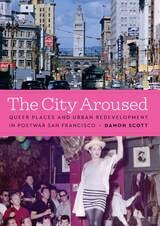
The City Aroused
Queer Places and Urban Redevelopment in Postwar San FranciscoDamon Scott
University of Texas Press, 2023
A history of San Francisco that studies change in the postwar urban landscape in relation to the city's queer culture.
The City Aroused is a lively history of urban development and its influence on queer political identity in postwar San Francisco. By reconstructing the planning and queer history of waterfront drinking establishments, Damon Scott shows that urban renewal was a catalyst for community organizing among racially diverse operators and patrons with far-reaching implications for the national gay rights movement.
Following the exclusion of suspected homosexuals from the maritime trades in West Coast ports in the early 1950s, seamen’s hangouts in the city came to resemble gay bars. Local officials responded by containing the influx of gay men to a strip of bars on the central waterfront while also making plans to raze and rebuild the area. This practice ended when city redevelopment officials began acquiring land in the early 1960s. Aided by law enforcement, they put these queer social clubs out of business, replacing them with heteronormative, desexualized land uses that served larger postwar urban development goals. Scott argues that this shift from queer containment to displacement aroused a collective response among gay and transgender drinking publics who united in solidarity to secure a place in the rapidly changing urban landscape.
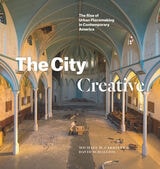
The City Creative
The Rise of Urban Placemaking in Contemporary AmericaMichael H. Carriere and David Schalliol
University of Chicago Press, 2021
Spanning the 1950s to the post-recession 2010s, The City Creative highlights the roles of such prominent individuals and organizations as Jane Jacobs, Christopher Alexander, Richard Sennett, Project for Public Spaces, and the National Endowment for the Arts in the development of urban placemaking, both in the abstract and on the ground. But that’s only half the story. Bringing the narrative to the present, Michael H. Carriere and David Schalliol also detail placemaking interventions at more than 200 sites in more than 40 cities, combining archival research, interviews, participant observation, and Schalliol’s powerful documentary photography. Carriere and Schalliol find that while these formal and informal placemaking interventions can bridge local community development and regional economic plans, more often than not, they push the boundaries of mainstream placemaking. Rather than simply stressing sociability or market-driven economic development, these initiatives offer an alternative model of community-led progress with the potential to redistribute valuable resources while producing tangible and intangible benefits for their communities. The City Creative provides a kaleidoscopic overview of how these initiatives grow, and sometimes collapse, illustrating the centrality of placemaking in the evolution of the American city and how it can be reoriented to meet demands for a more equitable future.
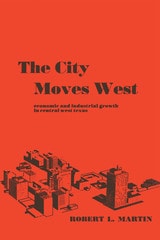
The City Moves West
Economic and Industrial Growth in Central West TexasBy Robert L. Martin
University of Texas Press, 1969
Where water supply, railway transportation, and oil reserves have been abundant, towns in central West Texas have prospered; where these resources are few, settlements have maintained only slight growth or disappeared entirely. Supporting his conclusions with profuse statistical evidence, Robert L. Martin traces the economic development of six major towns in the area, all with over 10,000 residents in 1960: Lamesa, Snyder, Sweetwater, Big Spring, Midland, and Odessa.
Ranching brought the first settlers to West Texas in the 1870s and dominated the economy until 1900. In the 1880s farmers began to arrive, and between 1900 and 1930 agricultural production replaced ranching as the most important industry.
With the influx of population came the railroad, and small settlements were established along its route. Those with sufficient water supply prospered and, as counties were organized, became county seats and supply centers for the surrounding agricultural regions.
The land could not support a large agricultural population, and agriculture-related manufactures soon drew population to the towns. However, it was not until the oil discoveries of the 1920's that the modern city emerged. After World War II, oil production and oil-related industries generated great wealth and caused a boom in population growth and urban development. Despite the growth in prosperity, the economy is precariously balanced. Urban centers dependent on oil—an industry of limited life—have matured in an area without sufficient water or agricultural resources to support them. Martin concludes that, without careful planning and a solution to the water problem, these cities could some day become ghost towns on the plains.
The City of Our Dreaming
The Alchemy LectureLaleh Khalili, V. Mitch McEwen, Gabriela Leandro Pereira, and Leanne Betasamosake Simpson
Duke University Press, 2026
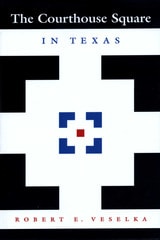
The Courthouse Square in Texas
By Robert E. Veselka
University of Texas Press, 2000
With its dignified courthouse set among shade trees and lawns dotted with monuments to prominent citizens and fallen veterans, the courthouse square remains the civic center in a majority of the county seats of Texas. Yet the squares themselves vary in form and layout, reflecting the different town-planning traditions that settlers brought from Europe, Mexico, and the United States. In fact, one way to trace settlement patterns and ethnic dispersion in Texas is by mapping the different types of courthouse squares.
This book offers the first complete inventory of Texas courthouse squares, drawn from extensive archival research and site visits to 139 of the 254 county seats. Robert Veselka classifies every existing plan by type and origin, including patterns and variants not previously identified. He also explores the social and symbolic functions of these plans as he discusses the historical and modern uses of the squares. He draws interesting new conclusions about why the courthouse square remains the hub of commercial and civic activity in the smaller county seats, when it has lost its prominence in others.
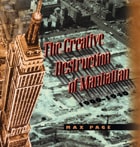
The Creative Destruction of Manhattan, 1900-1940
Max Page
University of Chicago Press, 1999
"It'll be a great place if they ever finish it," O. Henry wrote about New York City. This laconic remark captures the relentlessly transitory character of New York, and it points toward Max Page's synthetic perspective. Against the prevailing motif of a naturally expanding metropolis, Page argues that the early-twentieth-century city was dominated by the politics of destruction and rebuilding that became the hallmark of modern urbanism.
The oxymoron "creative destruction" suggests the tensions that are at the heart of urban life: between stability and change, between particular places and undifferentiated spaces, between market forces and planning controls, and between the "natural" and "unnatural" in city growth. Page investigates these cultural counterweights through case studies of Manhattan's development, with depictions ranging from private real estate development along Fifth Avenue to Jacob Riis's slum clearance efforts on the Lower East Side, from the elimination of street trees to the efforts to save City Hall from demolition.
In these examples some New Yorkers celebrate planning by destruction or marvel at the domestication of the natural environment, while others decry the devastation of their homes and lament the passing of the city's architectural heritage. A central question in each case is the role of the past in the shaping of collective memory—which buildings are preserved? which trees are cut down? which fragments are enshrined in museums? Contrary to the popular sense of New York as an ahistorical city, the past—as recalled by powerful citizens—was, in fact, at the heart of defining how the city would be built.
Beautifully illustrated and written in clear, engaging prose, The Creative Destruction of Manhattan offers a new way of viewing the development of the American city.
"An excellent, multifaceted analysis of the process of urban development-not the inevitability of development but the choices individuals, organizations, and developers made that transformed Manhattan. The politics of place was, Max Page convincingly argues, an ongoing battle to define and thereby control the evolving shape of the city."—David Schuyler, author of Apostle of Taste: Andrew Jackson Downing 1815-1852
"Max Page transcends the usual dichotomy between those who glorify destruction for the sake of change and those who would avoid both at all cost. The sizeable borderland between architecture and preservation reveals new dimensions about science and history, innovation and memory, the cities that have been, and those yet to come."—Gwendolyn Wright, author of The Politics of Design in French Colonial Urbanism
"A sober, humane explanation of how and why New York City became a place of continuous rebuilding. . . . For real or armchair New Yorkers, the whole package is a treat."—Kirkus Reviews

The Dallas Myth
The Making and Unmaking of an American CityHarvey J. Graff
University of Minnesota Press, 2010
In The Dallas Myth, Harvey J. Graff presents a novel interpretation of a city that has proudly declared its freedom from the past. He scrutinizes the city's origin myth and its governance ideology, known as the "Dallas Way," looking at how these elements have shaped Dallas and served to limit democratic participation and exacerbate inequality. Advancing beyond a traditional historical perspective, Graff proposes an original, integrative understanding of the city's urban fabric and offers an explicit critique of the reactionary political foundations of modern Dallas: its tolerance for right-wing political violence, the endemic racism and xenophobia, and a planning model that privileges growth and monumental architecture at the expense of the environment and social justice.
Revealing the power of myths that have defined the city for so long, Graff presents a new interpretation of Dallas that both deepens our understanding of America's urban landscape and enables its residents to envision a more equitable, humane, and democratic future for all.
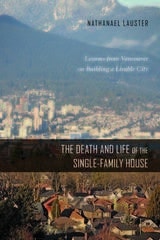
The Death and Life of the Single-Family House
Lessons from Vancouver on Building a Livable CityNathanael Lauster
Temple University Press, 2016
Vancouver today is recognized as one of the most livable cities in the world as well as an international model for sustainability and urbanism. Single-family homes in this city are “a dying breed.” Most people live in the various low-rise and high-rise urban alternatives throughout the metropolitan area.
The Death and Life of the Single-Family House explains how residents in Vancouver attempt to make themselves at home without a house. Local sociologist Nathanael Lauster has painstakingly studied the city’s dramatic transformation to curb sprawl. He tracks the history of housing and interviews residents about the cultural importance of the house as well as the urban problems it once appeared to solve.
Although Vancouver’s built environment is unique, Lauster argues that it was never predestined by geography or demography. Instead, regulatory transformations enabled the city to renovate, build over, and build around the house. Moreover, he insists, there are lessons here for the rest of North America. We can start building our cities differently, and without sacrificing their livability.
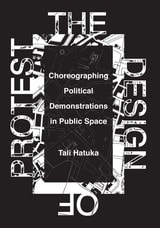
The Design of Protest
Choreographing Political Demonstrations in Public SpaceBy Tali Hatuka
University of Texas Press, 2018
Public protests are a vital tool for asserting grievances and creating temporary, yet tangible, communities as the world becomes more democratic and urban in the twenty-first century. While the political and social aspects of protest have been extensively studied, little attention has been paid to the physical spaces in which protests happen. Yet place is a crucial aspect of protests, influencing the dynamics and engagement patterns among participants. In The Design of Protest, Tali Hatuka offers the first extensive discussion of the act of protest as a design: that is, a planned event in a space whose physical geometry and symbolic meaning are used and appropriated by its organizers, who aim to challenge socio-spatial distance between political institutions and the people they should serve.
Presenting case studies from around the world, including Tiananmen Square in Beijing; the National Mall in Washington, DC; Rabin Square in Tel Aviv; and the Plaza de Mayo in Buenos Aires, Hatuka identifies three major dimensions of public protests: the process of planning the protest in a particular place; the choice of spatial choreography of the event, including the value and meaning of specific tactics; and the challenges of performing contemporary protests in public space in a fragmented, complex, and conflicted world. Numerous photographs, detailed diagrams, and plans complement the case studies, which draw upon interviews with city officials, urban planners, and protesters themselves.
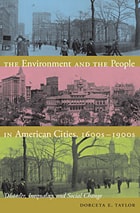
The Environment and the People in American Cities, 1600s-1900s
Disorder, Inequality, and Social ChangeDorceta E. Taylor
Duke University Press, 2009
Taylor traces the progression of several major thrusts in urban environmental activism, including the alleviation of poverty; sanitary reform and public health; safe, affordable, and adequate housing; parks, playgrounds, and open space; occupational health and safety; consumer protection (food and product safety); and land use and urban planning. At the same time, she presents a historical analysis of the ways race, class, and gender shaped experiences and perceptions of the environment as well as environmental activism and the construction of environmental discourses. Throughout her analysis, Taylor illuminates connections between the social and environmental conflicts of the past and those of the present. She describes the displacement of people of color for the production of natural open space for the white and wealthy, the close proximity between garbage and communities of color in early America, the cozy relationship between middle-class environmentalists and the business community, and the continuous resistance against environmental inequalities on the part of ordinary residents from marginal communities.
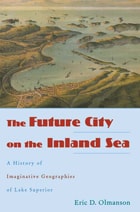
The Future City on the Inland Sea
A History of Imaginative Geographies of Lake SuperiorEric D. Olmanson
Ohio University Press, 2007
Winner of the AAG’s John Brinckerhoff Jackson Prize
Winner of the Great Lakes American Studies Association/Ohio University Press Book Award
Throughout the nineteenth century, the southern shores of Lake Superior held great promise for developers imagining the next great metropolis. These new territories were seen as expanses to be filled, first with romantic visions, then with scientific images, and later with vistas designed to entice settlement and economic development. The Future City on the Inland Sea describes the attempts of explorers under government, commercial, or scientific sponsorship to project their imaginative visions on a region where the future did not happen as planned.
Author Eric D. Olmanson takes a fresh look at the settlements in the vicinity of Chequamegon Bay and the Apostle Islands by analyzing the texts and images left by the missionaries, geologists, ordinance surveyors, newspaper editors, and boosters. The Future City on the Inland Sea shows how new visions of the place absorbed and replaced the old ones, eventually producing what might be called for the first time “a region.”
More than a regional geography, The Future City on the Inland Sea is an appraisal of these early efforts to meld geographies of physical nature with those of human ideals, a demonstration of how thoroughly and paradoxically those two realms are entangled.
The Ghosts of Berlin
Confronting German History in the Urban LandscapeBrian Ladd
University of Chicago Press, 1997
"Written in a clear and elegant style, The Ghosts of Berlin is not just another colorless architectural history of the German capital. . . . Mr. Ladd's book is a superb guide to this process of urban self-definition, both past and present."—Katharina Thote, Wall Street Journal
"If a book can have the power to change a public debate, then The Ghosts of Berlin is such a book. Among the many new books about Berlin that I have read, Brian Ladd's is certainly the most impressive. . . . Ladd's approach also owes its success to the fact that he is a good storyteller. His history of Berlin's architectural successes and failures reads entertainingly like a detective novel."—Peter Schneider, New Republic
"[Ladd's] well-written and well-illustrated book amounts to a brief history of the city as well as a guide to its landscape."—Anthony Grafton, New York Review of Books
The Ghosts of Berlin
Confronting German History in the Urban LandscapeBrian Ladd
University of Chicago Press, 2018
The Humane Metropolis
People and Nature in the 21st-Century CityRutherford H. Platt
University of Massachusetts Press, 2006
Four-fifths of Americans now live in the nation's sprawling metropolitan areas, and half of the world's population is now classified as “urban.” As cities become the dominant living environment for humans, there is growing concern about how to make such places more habitable, more healthy and safe, more ecological, and more equitable—in short, more “humane.”
This book explores the prospects for a more humane metropolis through a series of essays and case studies that consider why and how urban places can be made greener and more amenable. Its point of departure is the legacy of William H. Whyte (1917-1999), one of America's most admired urban thinkers. From his eyrie high above Manhattan in the offices of the Rockefeller Brothers Fund, Whyte laid the foundation for today's “smart growth” and “new urbanist” movements with books such as The Last Landscape (1968). His passion for improving the habitability of cities and suburbs is reflected in the diverse grassroots urban design and regreening strategies discussed in this volume.
Topics examined in this book include urban and regional greenspaces, urban ecological restoration, social equity, and green design. Some of the contributors are recognized academic experts, while others offer direct practical knowledge of particular problems and initiatives. The editor's introduction and epilogue set the individual chapters in a broader context and suggest how the strategies described, if widely replicated, may help create more humane urban environments.
In addition to Rutherford H. Platt, contributors to the volume include Carl Anthony, Thomas Balsley, Timothy Beatley, Eugenie L. Birch, Edward J. Blakely, Colin M. Cathcart, Steven E. Clemants, Christopher A. De Sousa, Steven N. Handel, Peter Harnik, Michael C. Houck, Jerold S. Kayden, Albert LaFarge, Andrew Light, Charles E. Little, Anne C. Lusk, Thalya Parilla, Deborah E. Popper, Frank J. Popper, Mary V. Rickel, Cynthia Rosenzweig, Robert L. Ryan, Laurin N. Sievert, Andrew G. Wiley-Schwartz, and Ann Louise Strong.
Included in the back of the book is a DVD of a 22-minute film created by Ted White, which serves as a companion to the text.

The Language of Planning
Essays on the Origins and Ends of American Planning ThoughtAlbert Z. Guttenberg
University of Illinois Press, 1993
The Loop
The “L” Tracks That Shaped and Saved ChicagoPatrick T. Reardon
Southern Illinois University Press, 2021
Every day Chicagoans rely on the loop of elevated train tracks to get to their jobs, classrooms, or homes in the city’s downtown. But how much do they know about the single most important structure in the history of the Windy City? In engagingly brisk prose, Patrick T. Reardon unfolds the fascinating story about how Chicago’s elevated Loop was built, gave its name to the downtown, helped unify the city, saved the city’s economy, and was itself saved from destruction in the 1970s.
This unique volume combines urban history, biography, engineering, architecture, transportation, culture, and politics to explore the elevated Loop’s impact on the city’s development and economy and on the way Chicagoans see themselves. The Loop rooted Chicago’s downtown in a way unknown in other cities, and it protected that area—and the city itself—from the full effects of suburbanization during the second half of the twentieth century. Masses of data underlie new insights into what has made Chicago’s downtown, and the city as a whole, tick.
The Loop features a cast of colorful Chicagoans, such as legendary lawyer Clarence Darrow, poet Edgar Lee Masters, mayor Richard J. Daley, and the notorious Gray Wolves of the Chicago City Council. Charles T. Yerkes, an often-demonized figure, is shown as a visionary urban planner, and engineer John Alexander Low Waddell, a world-renowned bridge creator, is introduced to Chicagoans as the designer of their urban railway.
This fascinating exploration of how one human-built structure reshaped the social and economic landscape of Chicago is the definitive book on Chicago’s elevated Loop.

The Man-Made City
The Land-Use Confidence Game in ChicagoGerald D. Suttles
University of Chicago Press, 1990
Gerald D. Suttles here offers an irreverent, highly critical guide to both the realities and myths of land-use planning and development in Chicago from 1976 through 1987.
The Metropolis in Latin America, 1830-1930
Cityscapes, Photographs, DebatesIdurre Alonso
J. Paul Getty Trust, The, 2021
In the century between 1830 and 1930, following independence from Spain and Portugal, major cities in Latin America experienced large-scale growth, with the development of a new urban bourgeois elite interested in projects of modernization and rapid industrialization. At the same time, the lower classes were eradicated from old city districts and deported to the outskirts. The Metropolis in Latin America, 1830–1930 surveys this expansion, focusing on six capital cities—Havana, Mexico City, Rio de Janeiro, Buenos Aires, Santiago de Chile, and Lima—as it examines sociopolitical histories, town planning, art and architecture, photography, and film in relation to the metropolis.
Drawing from the Getty Research Institute’s vast collection of books, prints, and photographs from this period, largely unpublished until now, this volume reveals the cities’ changes through urban panoramas, plans depicting new neighborhoods, and photographs of novel transportation systems, public amenities, civic spaces, and more. It illustrates the transformation of colonial cities into the monumental modern metropolises that, by the end of the 1920s, provided fertile ground for the emergence of today’s Latin American megalopolis.
The Modernist City
An Anthropological Critique of BrasiliaJames Holston
University of Chicago Press, 1989

The New American City Faces its Regional Future
A Cleveland PerspectiveDavid C. Sweet
Ohio University Press, 1999
The fate of Cleveland, Ohio, rides on a web of interdependencies on a regional scale. People and communities throughout that area of Ohio are being forced to adjust to new civic roles. The city of Cleveland must understand how it fits into Greater Cleveland. And suburbs must understand their dependence on the historic central city and be drawn into the Cleveland community.
In this sweeping study by local and national experts, these and more specific issues are raised and examined in depth. The New American City Faces Its Regional Future captures the dynamic thinking concerned with Cleveland and its surrounding region. The authors address questions of importance not only to Cleveland and its region but also to communities across the country that are facing similar issues. How does the city want to grow in the future? How can it become a more livable community? As the population of the region moves farther and farther out from the established urban areas, consuming more and more land, and as it enters its third century, these questions will need to be addressed. This book takes some first, important steps toward providing the answers.
The New Chicago
A Social and Cultural Analysisedited by John P. Koval, Larry Bennett, Michael I. J. Bennett, Fassil Demissie, Roberta Garner and Kiljoong Kim
Temple University Press, 2006
The Olympics that Never Happened
Denver '76 and the Politics of GrowthAdam Berg
University of Texas Press, 2023
A look back at how powerful politicians, business leaders, and a diverse cast of activists used a thwarted Olympics to shape the state of Colorado and the city of Denver.
If you don’t recall the 1976 Denver Olympic Games, it’s because they never happened. The Mile-High City won the right to host the winter games and then was forced by Colorado citizens to back away from its successful Olympic bid through a statewide ballot initiative. Adam Berg details the powerful Colorado regime that gained the games for Denver and the grassroots activism that brought down its Olympic dreams, and he explores the legacy of this milestone moment for the games and politics in the United States.
The ink was hardly dry on Denver’s host agreement when Mexican American and African American urbanites, white middle-class environmentalists, and fiscally concerned local politicians realized opposition to the Olympics provided them new political openings. The Olympics quickly became a platform for taking stands on a range of issues, from conservation to urban livability to the very idea of growth, which for decades had been unquestioned in Colorado. The Olympics That Never Happened argues that hostility to the Olympics galvanized and empowered diverse citizens in a major US city, with long-term ramifications for Colorado and political activism elsewhere. The Olympics themselves were changed forever, compelling organizers to take seriously competing interests from subgroups within their communities.
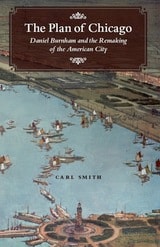
The Plan of Chicago
Daniel Burnham and the Remaking of the American CityCarl Smith
University of Chicago Press, 2006
Arguably the most influential document in the history of urban planning, Daniel Burnham’s 1909 Plan of Chicago, coauthored by Edward Bennett and produced in collaboration with the Commercial Club of Chicago, proposed many of the city’s most distinctive features, including its lakefront parks and roadways, the Magnificent Mile, and Navy Pier. Carl Smith’s fascinating history reveals the Plan’s central role in shaping the ways people envision the cityscape and urban life itself.
Smith’s concise and accessible narrative begins with a survey of Chicago’s stunning rise from a tiny frontier settlement to the nation’s second-largest city. He then offers an illuminating exploration of the Plan’s creation and reveals how it embodies the renowned architect’s belief that cities can and must be remade for the better. The Plan defined the City Beautiful movement and was the first comprehensive attempt to reimagine a major American city. Smith points out the ways the Plan continues to influence debates, even a century after its publication, about how to create a vibrant and habitable urban environment.
Richly illustrated and incisively written, his insightful book will be indispensable to our understanding of Chicago, Daniel Burnham, and the emergence of the modern city.
The Politics of Design in French Colonial Urbanism
Gwendolyn Wright
University of Chicago Press, 1991
Gwendolyn Wright focuses on three French colonies—Indochina, Morocco, and Madagascar—that were the most discussed, most often photographed, and most admired showpieces of the French empire in the early twentieth century. She explores how urban policy and design fit into the French colonial policy of "association," a strategy that accepted, even encouraged, cultural differences while it promoted modern urban improvements that would foster economic development for Western investors. Wright shows how these colonial cities evolved, tracing the distinctive nature of each locale under French imperialism. She also relates these cities to the larger category of French architecture and urbanism, showing how consistently the French tried to resolve certain stylistic and policy problems they faced at home and abroad.
With the advice of architects and sociologists, art historians and geographers, colonial administrators sought to exert greater control over such matters as family life and working conditions, industrial growth and cultural memory. The issues Wright confronts—the potent implications of traditional norms, cultural continuity, modernization, and radical urban experiments—still challenge us today.
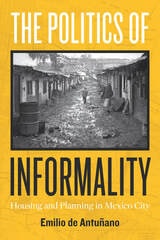
The Politics of Informality
Housing and Planning in Mexico CityEmilio de Antuñano
University of Texas Press, 2026
An examination of the central role and political power of informal neighborhoods in Mexico City.
At the beginning of the twentieth century, Mexico City was tightly bounded, with a population of about half a million people. By the end of that century, it was an unfathomable megalopolis of some 20 million. It had also become exhibit A in an “urban crisis” decried by demographers, NGOs, and the Mexican government. Mexico City’s greatest sin was its shantytowns—informal neighborhoods built in defiance of regulations and viewed as incurably disordered.
The Politics of Informality is an illuminating political and intellectual history, examining how these neighborhoods have figured in Mexican life and in the ideologies underlying urban planning. Prior to the Mexican Revolution of 1910, urban experts saw Mexico City as a tidy modern capital in-waiting. But during the interwar period, informal neighborhoods boomed, as working-class families asserted claims to housing under the revolution’s framework of citizenship and social justice. Then, amid Cold War realignments, a new cohort of urban experts pathologized Mexico City, turning it into a transnational laboratory for the study of poverty, migration, and overpopulation. Tracing a fascinating evolution, ThePolitics of Informality underscores the stubborn opposition between technocratic modernism and revolutionary, extralegal politics.
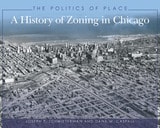
The Politics of Place
A History of Zoning in ChicagoJoseph P. Schwieterman and Dana M. Caspall
Southern Illinois University Press, 2006
The Third City
Chicago and American UrbanismLarry Bennett
University of Chicago Press, 2010
Our traditional image of Chicago—as a gritty metropolis carved into ethnically defined enclaves where the game of machine politics overshadows its ends—is such a powerful shaper of the city’s identity that many of its closest observers fail to notice that a new Chicago has emerged over the past two decades. Larry Bennett here tackles some of our more commonly held ideas about the Windy City—inherited from such icons as Theodore Dreiser, Carl Sandburg, Daniel Burnham, Robert Park, Sara Paretsky, and Mike Royko—with the goal of better understanding Chicago as it is now: the third city.
Bennett calls contemporary Chicago the third city to distinguish it from its two predecessors: the first city, a sprawling industrial center whose historical arc ran from the Civil War to the Great Depression; and the second city, the Rustbelt exemplar of the period from around 1950 to 1990. The third city features a dramatically revitalized urban core, a shifting population mix that includes new immigrant streams, and a growing number of middle-class professionals working in new economy sectors. It is also a city utterly transformed by the top-to-bottom reconstruction of public housing developments and the ambitious provision of public works like Millennium Park. It is, according to Bennett, a work in progress spearheaded by Richard M. Daley, a self-consciously innovative mayor whose strategy of neighborhood revitalization and urban renewal is a prototype of city governance for the twenty-first century. The Third City ultimately contends that to understand Chicago under Daley’s charge is to understand what metropolitan life across North America may well look like in the coming decades.
The Transatlantic Collapse of Urban Renewal
Postwar Urbanism from New York to BerlinChristopher Klemek
University of Chicago Press, 2011
The Transatlantic Collapse of Urban Renewal examines how postwar thinkers from both sides of the Atlantic considered urban landscapes radically changed by the political and physical realities of sprawl, urban decay, and urban renewal. With a sweep that encompasses New York, London, Berlin, Philadelphia, and Toronto, among others, Christopher Klemek traces changing responses to the challenging issues that most affected the lives of the world’s cities.
In the postwar decades, the principles of modernist planning came to be challenged—in the grassroots revolts against the building of freeways through urban neighborhoods, for instance, or by academic critiques of slum clearance policy agendas—and then began to collapse entirely. Over the 1960s, several alternative views of city life emerged among neighborhood activists, New Left social scientists, and neoconservative critics. Ultimately, while a pessimistic view of urban crisis may have won out in the United States and Great Britain, Klemek demonstrates that other countries more successfully harmonized urban renewal and its alternatives. Thismuch anticipated book provides one of the first truly international perspectives on issues central to historians and planners alike, making it essential reading for anyone engaged with either field.
Toward Oregon 2050
Planning a Better FutureMegan Horst
Oregon State University Press, 2024
In this compelling volume, leading experts in land use and urban planning, in cooperation with other scholars and community partners, envision various possible futures and begin the work of developing statewide plans to guide Oregon through the decades ahead. Building on the state’s policy innovation and planning legacy, contributors to Toward Oregon 2050 address current challenges such as housing scarcity, income inequality, the rural-urban divide, and climate change. They offer recommendations on a range of issues, from culture to incarceration, transportation to voting rights, all with the goal of imagining what a fair and equitable Oregon might look like.
Some of the imagined futures—with worsening effects of climate change, environmental harms, and social inequities—are not bright for many Oregonians. Other futures include enhanced resiliency to forest fires and flooding, more Oregonians in high-paying jobs and in secure housing, and more children walking and biking to school. But those positive futures are not guaranteed, and getting there won’t be easy. They’ll require all stakeholders—state and local government, members of all political parties, private businesses, non-profit organizations, and individual residents—to play a role in ensuring a better future for the next generation of Oregonians.
Intended for all Oregonians who care about their state’s future, Toward Oregon 2050 will also appeal to scholars and planners who have long looked to Oregon for inspiration and lessons learned. The book invites readers to envision the future of Oregon and to contribute their part toward a better future for the state.
Transforming Cities and Minds through the Scholarship of Engagement
Economy, Equity, and EnvironmentLorlene Hoyt
Vanderbilt University Press, 2013
Across the country from Camden to Oakland, the contributors engaged with community partners--hospitals, churches, community development corporations, community foundations, and other rooted institutions--to help restore old cities to life. Their collaborative thesis project engaged them with one another and university staff; it may offer a new paradigm for graduate education.
Turin 1564-1680
Urban Design, Military Culture, and the Creation of the Absolutist CapitalMartha D. Pollak
University of Chicago Press, 1991
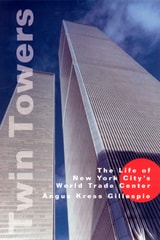
Twin Towers
Gillespie, Angus K
Rutgers University Press, 1999
A readable account of both the history of the construction of the Twin Towers and the life of the people who work there.
The Twin Towers of the World Trade Center are more than office buildings. They are symbols of America, just as the Eiffel Tower and Big Ben represent their countries. Commissioned in 1962 and completed in 1976, these edifices are still the tallest man-made structures in New York City. Indeed, the builders intended the towers to make a statement about the importance of the Port of New York and New Jersey. The complex rises like Emerald City, with fountains and sculpture from what was once a dilapidated area of half-abandoned stores.
Folklorist Angus Gillespie takes us on a tour that goes back in time and continues to the present day. He recounts the political maneuvering necessary to get the State of New Jersey to agree to situate the project at its present location. Deftly presenting portraits of the men responsible for mooring the World Trade Center at its present location, Gillespie provides ample evidence that the World Trade Center backers were “second to none in self promotion.”
Twin Towers also demonstrates how engineers prepared the site and solved complex problems (wind patterns, elevator placement, ground-water complications) in order to erect the towers, each with 110 stories. And he discusses the contrast between the architectural community’s almost universal disdain for the towers’ design and the public’s enthusiastic acceptance of the buildings as a symbol of New York.
There is more to the Twin Towers than its architecture, however. People give this complex life, purpose, vibrancy, Gillespie points out. The World Trade Center houses more than 400 businesses and organizations from some 60 different countries engaged in a broad range of international business activities. Through his numerous first-hand interviews conducted with the people who daily work there, Gillespie vividly portrays the world of bankers, shippers, freight forwarders, and traders. With skill and insight, he captures what happens during a normal 24-hour day in the Twin Towers, starting with early morning food deliveries and ending with the patrols of nighttime security guards.
Twin Towers is both a fitting tribute and careful analysis of one of the most resonating symbols in American culture.