Results by title
148 books match the query 'Colonization' and 27 start with t
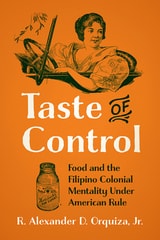
Taste of Control
Food and the Filipino Colonial Mentality under American RuleR. Alexander D. Orquiza, Jr.
Rutgers University Press, 2020
Winner of the 2021 Gourmand Awards, Asian Section & Culinary History Section
Filipino cuisine is a delicious fusion of foreign influences, adopted and transformed into its own unique flavor. But to the Americans who came to colonize the islands in the 1890s, it was considered inferior and lacking in nutrition. Changing the food of the Philippines was part of a war on culture led by Americans as they attempted to shape the islands into a reflection of their home country.
Taste of Control tells what happened when American colonizers began to influence what Filipinos ate, how they cooked, and how they perceived their national cuisine. Food historian René Alexander D. Orquiza, Jr. turns to a variety of rare archival sources to track these changing attitudes, including the letters written by American soldiers, the cosmopolitan menus prepared by Manila restaurants, and the textbooks used in local home economics classes. He also uncovers pockets of resistance to the colonial project, as Filipino cookbooks provided a defense of the nation’s traditional cuisine and culture.
Through the topic of food, Taste of Control explores how, despite lasting less than fifty years, the American colonial occupation of the Philippines left psychological scars that have not yet completely healed, leading many Filipinos to believe that their traditional cooking practices, crops, and tastes were inferior. We are what we eat, and this book reveals how food culture served as a battleground over Filipino identity.
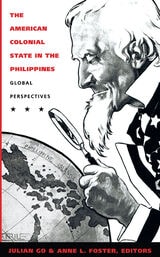
The American Colonial State in the Philippines
Global PerspectivesJulian Go and Anne L. Foster, eds.
Duke University Press, 2003
Written by social scientists and historians, these essays investigate various aspects of American colonial government through comparison with and contextualization within colonial regimes elsewhere in the world—from British Malaysia and Dutch Indonesia to Japanese Taiwan and America's other major overseas colony, Puerto Rico. Contributors explore the program of political education in the Philippines; constructions of nationalism, race, and religion; the regulation of opium; connections to politics on the U.S. mainland; and anticolonial resistance. Tracking the complex connections, circuits, and contests across, within, and between empires that shaped America's colonial regime, The American Colonial State in the Philippines sheds new light on the complexities of American imperialism and turn-of-the-century colonialism.
Contributors. Patricio N. Abinales, Donna J. Amoroso, Paul Barclay, Vince Boudreau, Anne L. Foster, Julian Go, Paul A. Kramer
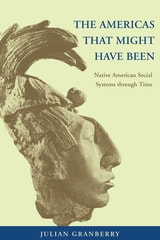
The Americas That Might Have Been
Native American Social Systems through TimeJulian Granberry
University of Alabama Press, 2005
This work answers the hypothetical question: What would the Americas be like today—politically, economically, culturally—if Columbus and the Europeans had never found them, and how would American peoples interact with the world’s other societies? It assumes that Columbus did not embark from Spain in 1492 and that no Europeans found or settled the New World afterward, leaving the peoples of the two American continents free to follow the natural course of their Native lives.
The Americas That Might Have Been is a professional but layman-accessible, fact-based, nonfiction account of the major Native American political states that were thriving in the New World in 1492. Granberry considers a contemporary New World in which the glories of Aztec Mexico, Maya Middle America, and Inca Peru survived intact. He imagines the roles that the Iroquois Confederacy of the American Northeast, the powerful city-states along the Mississippi River in the Midwest and Southeast, the Navajo Nation and the Pueblo culture of the Southwest, the Eskimo Nation in the Far North, and the Taino/Arawak chiefdoms of the Caribbean would play in American and world politics in the 21st Century.
Following a critical examination of the data using empirical archaeology, linguistics, and ethnohistory, Granberry presents a reasoned and compelling discussion of native cultures and the paths they would have logically taken over the past five centuries. He reveals the spectacular futures these brilliant pre-Columbian societies might have had, if not for one epochal meeting that set off a chain of events so overwhelming to them that the course of human history was forever changed.
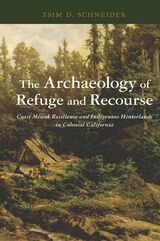
The Archaeology of Refuge and Recourse
Coast Miwok Resilience and Indigenous Hinterlands in Colonial CaliforniaTsim D. Schneider
University of Arizona Press, 2021
Applying theories of place and landscape, social memory, and mobility to the analysis of six archaeological sites, Tsim D. Schneider argues for a new direction in the archaeology of colonialism. This book offers insight about the critical and ongoing relationships Indigenous people maintained to their homelands despite colonization and systematic destruction of their cultural sites.
Schneider is a citizen of the Federated Indians of Graton Rancheria, the sovereign and federally recognized tribe of Coast Miwok and Southern Pomo people whose ancestral homelands and homewaters are the central focus of The Archaeology of Refuge and Recourse. Viewing this colonial narrative from an Indigenous perspective, Schneider focuses on the nearly one quarter of Coast Miwok people who survived the missions and created outlets within and beyond colonial settlements to resist and endure colonialism.
Fleeing these colonial missions and other establishments and taking refuge around the San Francisco Bay Area, Coast Miwok people sought to protect their identities by remaining connected to culturally and historically significant places. Mobility and a sense of place further enabled Coast Miwok people to find recourse and make decisions about their future through selective participation in colonial projects. In this book, Tsim D. Schneider argues that these distancing and familiarizing efforts contribute to the resilience of Coast Miwok communities and a sense of relevance and belonging to stolen lands and waters. Facing death, violence, and the pervading uncertainty of change, Indigenous people of the Marin Peninsula balanced the pull and persistence of place against the unknown possibilities of a dynamic colonial landscape and the forward-thinking required to survive. History, change, and the future can be read in the story of Coast Miwok people.
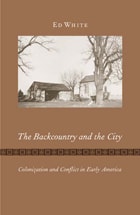
The Backcountry and the City
Colonization and Conflict in Early AmericaEd White
University of Minnesota Press, 2005
Ed White explores the backcountry-city divide as well as the dynamics of indigenous peoples, bringing together two distinct bodies of scholarship: one stressing the political culture of the Revolutionary era, the other taking an ethnohistorical view of white–Native American contact. White concentrates his study in Pennsylvania, a state in which the majority of the population was rural, and in Philadelphia, a city that was a center of publishing and politics and the national capital for a decade. Against this backdrop, White reads classic political texts such as Crèvecoeur’s Letters from an American Farmer, Franklin’s Autobiography, and Paine’s “Agrarian Justice,” alongside missionary and captivity narratives, farmers’ petitions, and Native American treaties. Using historical and ethnographic sources to enrich familiar texts, White demonstrates the importance of rural areas in the study of U.S. nation formation and finds unexpected continuities between the early colonial period and the federal ascendancy of the 1790s.
Ed White is associate professor of English at the University of Florida.
The Brink of Freedom
Improvising Life in the Nineteenth-Century Atlantic WorldDavid Kazanjian
Duke University Press, 2016
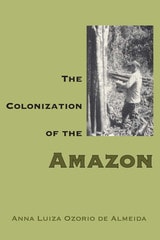
The Colonization of the Amazon
By Anna Luiza Ozorio de Almeida
University of Texas Press, 1992
Deforestation in the Amazon, one of today's top environmental concerns, began during a period of rapid colonization in the 1970s. Throughout that decade, Anna Luiza Ozorio de Almeida, a Stanford-trained economist, conducted a complex and massive economic study of what was going on in the Amazon, who was investing what, what was gained, and what it cost in all its aspects. The Colonization of the Amazon, the resulting work, brings together information on the physical, demographic, institutional, and economic dimensions of directed settlement in the Amazon Basin and raises significant questions about the gains and losses of the settlers, the reasons for these outcomes, and the economic rationale behind the devastation of the rainforest.
Particularly illuminating is Almeida's exploration of the role of the frontier in Brazil and her distinction between types of migrants and migrations. She concludes that the political costs avoided by not undertaking agrarian reform are being paid by devastating the Amazon, with the conflict between distribution and conservation steadily worsening. Today, it can no longer be circumvented.
The Colonizing Self
Or, Home and Homelessness in Israel/PalestineHagar Kotef
Duke University Press, 2020
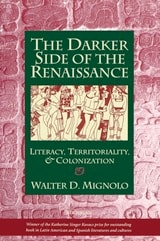
The Darker Side of the Renaissance
Literacy, Territoriality, and ColonizationWalter D. Mignolo
University of Michigan Press, 1995
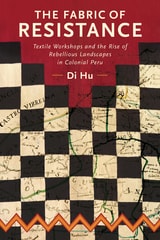
The Fabric of Resistance
Textile Workshops and the Rise of Rebellious Landscapes in Colonial PeruDi Hu
University of Alabama Press, 2022
Textiles as sites of power, production, and rebellion in the early modern Andes.
The Fabric of Resistance: Textile Workshops and the Rise of Rebellious Landscapes in Colonial Peru documents the impact of Spanish colonial institutions of labor on identity and social cohesion in Peru. Through archaeological and historical lines of evidence, Di Hu examines the long-term social conditions that enabled the large-scale rebellions in the late Spanish colonial period in Peru. Hu argues that ordinary people from different backgrounds pushed back against the top-down identity categories imposed by the Spanish colonial government and in the process created a cosmopolitan social landscape that later facilitated broader rebellion.
Hu’s case study is Pomacocha, the site of an important Spanish colonial hacienda (agricultural estate) and obraje (textile workshop). At its height, the latter had more than one hundred working families and sold textiles all over the Andes. Through analysis of this site, Hu explores three main long-term causes of rebellions against Spanish oppression. First, the Spanish colonial economy provided motivation and the social spaces for intercaste (indigenous, African, and mestizo) mixing at textile workshops. Second, new hybrid cultural practices and political solidarity arose there that facilitated the creation of new rebellious identities. Third, the maturation in the eighteenth century of popular folklore that reflected the harsh nature of Spanish labor institutions helped workers from diverse backgrounds gain a systemic understanding of exploitation.
This study provides a fresh archaeological and historical perspectives on the largest and most cosmopolitan indigenous-led rebellions of the Americas. Hu interweaves analyses of society at multiple scales including fine-grained perspectives of social networks, demography, and intimate details of material life in the textile workshop. She examines a wide range of data sources including artifacts, food remains, architectural plans, account books, censuses, court documents, contracts, maps, and land title disputes.
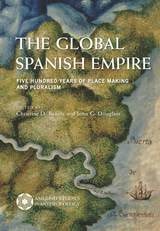
The Global Spanish Empire
Five Hundred Years of Place Making and PluralismEdited by Christine D. Beaule and John G. Douglass
University of Arizona Press, 2020
The Spanish Empire was a complex web of places and peoples. Through an expansive range of essays that look at Africa, the Americas, Asia, the Caribbean, and the Pacific, this volume brings a broad range of regions into conversation. The contributors focus on nuanced, comparative exploration of the processes and practices of creating, maintaining, and transforming cultural place making within pluralistic Spanish colonial communities.
The Global Spanish Empire argues that patterned variability is necessary in reconstructing Indigenous cultural persistence in colonial settings. The volume’s eleven case studies include regions often neglected in the archaeology of Spanish colonialism. The time span under investigation is extensive as well, transcending the entirety of the Spanish Empire, from early impacts in West Africa to Texas during the 1800s. The contributors examine the making of a social place within a social or physical landscape. They discuss the appearance of hybrid material culture, the incorporation of foreign goods into local material traditions, the continuation of local traditions, and archaeological evidence of opportunistic social climbing. In some cases, these changes in material culture are ways to maintain aspects of traditional culture rather than signifiers of new cultural practices.
The Global Spanish Empire tackles broad questions about Indigenous cultural persistence, pluralism, and place making using a global comparative perspective grounded in the shared experience of Spanish colonialism.
Contributors
Stephen Acabado
Grace Barretto-Tesoro
James M. Bayman
Christine D. Beaule
Christopher R. DeCorse
Boyd M. Dixon
John G. Douglass
William R. Fowler
Martin Gibbs
Corinne L. Hofman
Hannah G. Hoover
Stacie M. King
Kevin Lane
Laura Matthew
Sandra Montón-Subías
Natalia Moragas Segura
Michelle M. Pigott
Christopher B. Rodning
David Roe
Roberto Valcárcel Rojas
Steve A. Tomka
Jorge Ulloa Hung
Juliet Wiersema
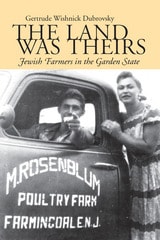
The Land Was Theirs
Jewish Farmers in the Garden StateGertrude W. Dubrovsky
University of Alabama Press, 1992
A historical account of Jewish agricultural colonies in New Jersey that examines how immigrants built farming communities in early America.
The Land Was Theirs is about Farmingdale, New Jersey, a community of Jewish farming communities in the United States established with the help of the Jewish Agricultural Society. The 50 year history of Farmingdale provides a perspective on the pressures, problems, and satisfactions of rural Jewish life as experienced in one community.
Beginning in 1919, the community grew around the small town of Farmingdale, when two Jewish families pooled their resources to establish a farm. The community evolved gradually as unrelated individuals with no previous farm experience settled and then created the institutions and organizations they needed to sustain their Jewish life. By 1945 Farmingdale was one of the leading egg-producing communities in the United States, and contributed in large measure to New Jersey’s reputation as the “egg basket of America.”
The Land Was Theirs draws from life-history interviews with 120 farmers, from the author’s personal experiences, and from a variety of private and community papers and documents. They are the pieces from which a full picture of a single Jewish farm community emerges.
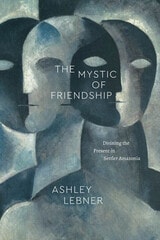
The Mystic of Friendship
Divining the Present in Settler AmazoniaAshley Lebner
University of Chicago Press, 2025
On Brazil’s Amazonian frontier, settlers pursue land and opportunity, but they also gather for prayer and pilgrimage, yearning for a deep relationship with God and one another. In this book, anthropologist Ashley Lebner examines how everyday religious practices and feelings, what she calls a mystic of friendship, shape and sustain colonization in the Amazon.
Lebner invites us to a stretch of highway in Pará, Brazil, where violent colonization coexists with prophetic dreams, Afro-Brazilian prayers, and emerging evangelicalism. She shows how, amid political tensions and physical hardship, settlers believe that the violence they experience and enact derives from the bestial nature of earthly life that must be overcome. In exposing a longing for divinely-infused friendship that animates colonization, Lebner offers a powerful new perspective on the forces driving colonialism as much as religious and political expression.
The New Kingdom of Granada
The Making and Unmaking of Spain's Atlantic EmpireSantiago Muñoz-Arbeláez
Duke University Press, 2025
The North Atlantic World in the Seventeenth Century
K.G. Davies
University of Minnesota Press, 1976
The North Atlantic World in the Seventeenth Century was first published in 1974. Minnesota Archive Editions uses digital technology to make long-unavailable books once again accessible, and are published unaltered from the original University of Minnesota Press editions.
In his preface the author writes: "Europe's style was both courageous and ignoble, Europe's achievement both magnificent and appalling. There is less need now that Europe's hegemony is over, for pride or shame to color historical judgments." In that candid vein Mr. Davies provides a balanced and impartial history of British, French, and Dutch beginnings in North America, the Caribbean, and West Africa to the end of the seventeenth century. He contrasts two styles of empire: the planting of trading posts in order to gather fur, fish, and slaves; and the planting of people in colonies of settlement to grow tobacco and sugar. He shows that the first style, involving little outlay of capital, was favored by European merchants; the second, by rulers and landlords. In his conclusion he examines the impact made by the Europeans on the people they traded with and expropriated, and assesses the diplomatic, economic, and cultural repercussions of the North Atlantic on Europe itself.
"Should provide valuable supplementary reading in courses in British imperial and American colonial history, as well as a source of information for those who teach them." –History.
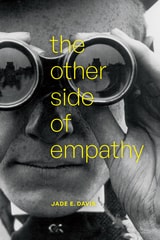
The Other Side of Empathy
Jade E. Davis
Duke University Press, 2023
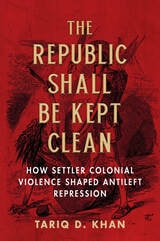
The Republic Shall Be Kept Clean
How Settler Colonial Violence Shaped Antileft RepressionTariq D. Khan
University of Illinois Press, 2023
The colonizing wars against Native Americans created the template for anticommunist repression in the United States. Tariq D. Khan’s analysis reveals bloodshed and class war as foundational aspects of capitalist domination and vital elements of the nation’s long history of internal repression and social control. Khan shows how the state wielded the tactics, weapons, myths, and ideology refined in America’s colonizing wars to repress anarchists, labor unions, and a host of others labeled as alien, multi-racial, multi-ethnic urban rabble. The ruling classes considered radicals of all stripes to be anticolonial insurgents. As Khan charts the decades of red scares that began in the 1840s, he reveals how capitalists and government used much-practiced counterinsurgency rhetoric and tactics against the movements they perceived and vilified as “anarchist.”
Original and boldly argued, The Republic Shall Be Kept Clean offers an enlightening new history with relevance for our own time.
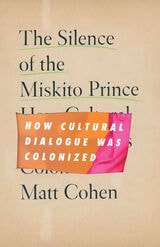
The Silence of the Miskito Prince
How Cultural Dialogue Was ColonizedMatt Cohen
University of Minnesota Press, 2022
Confronting the rifts created by our common conceptual vocabulary for North American colonial studies
How can we tell colonial histories in ways that invite intercultural conversation within humanistic fields that are themselves products of colonial domination? Beginning with a famous episode of failed communication from the narrative of the freed slave Olaudah Equiano, The Silence of the Miskito Prince explores this question by looking critically at five concepts frequently used to imagine solutions to the challenges of cross-cultural communication: understanding, cosmopolitanism, piety, reciprocity, and patience.
Focusing on the first two centuries of North American colonization, Matt Cohen traces how these five concepts of cross-cultural relations emerged from, and continue to evolve within, colonial dynamics. Through a series of revealing archival explorations, he argues the need for a new vocabulary for the analysis of past interactions drawn from the intellectual and spiritual domains of the colonized, and for a historiographical practice oriented less toward the illusion of complete understanding and scholarly authority and more toward the beliefs and experiences of descendant communities.
The Silence of the Miskito Prince argues for new ways of framing scholarly conversations that use past interactions as a site for thinking about intercultural relations today. By investigating the colonial histories of these terms that were assumed to promote inclusion, Cohen offers both a reflection on how we got here and a model of scholarly humility that holds us to our better or worse pasts.
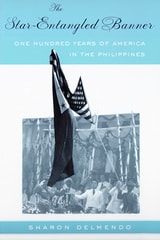
The Star-Entangled Banner
One Hundred Years of America in the PhilippinesDelmendo, Sharon
Rutgers University Press, 2004
During a ceremony held in 1996 to commemorate the fiftieth anniversary of formal Philippine independence, the U.S. flag was being lowered while the Philippine flag was being raised, and the two became entangled. In The Star-Entangled Banner, Sharon Delmendo demonstrates that this incident is indicative of the longstanding problematic relationship between the two countries. When faced with a national crisis or a compelling need to reestablish its autonomy, each nation paradoxically turns to its history with the other to define its place in the world.
Each chapter of the book deals with a separate issue in this linked history: the influence of Buffalo Bill’s show on the proto-nationalism of José Rizal, who is often described as the “First Filipino”; the portrayal of the Philippines in American children’s books; Back to Bataan, a World War II movie starring John Wayne; the post-independence fiction of F. Sionil José; and the refusal of the U..S military to return the Balangiga Bells, which were taken as war booty during the Philippine-American War. Ultimately, Delmendo demonstrates how the effects of U.S. imperialism in the Philippines continue to resonate in U.S. foreign policy in the post cold war era and the war on terrorism.
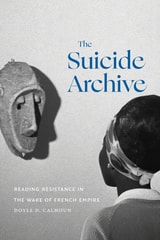
The Suicide Archive
Reading Resistance in the Wake of French EmpireDoyle D. Calhoun
Duke University Press, 2024
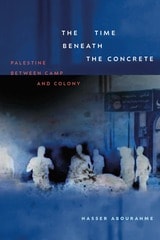
The Time beneath the Concrete
Palestine between Camp and ColonyNasser Abourahme
Duke University Press, 2025

The Transit of Empire
Indigenous Critiques of ColonialismJodi A. Byrd
University of Minnesota Press, 2011
In 1761 and again in 1768, European scientists raced around the world to observe the transit of Venus, a rare astronomical event in which the planet Venus passes in front of the sun. In The Transit of Empire, Jodi A. Byrd explores how indigeneity functions as transit, a trajectory of movement that serves as precedent within U.S. imperial history. Byrd argues that contemporary U.S. empire expands itself through a transferable “Indianness” that facilitates acquisitions of lands, territories, and resources.
Examining an array of literary texts, historical moments, and pending legislations—from the Cherokee Nation of Oklahoma’s vote in 2007 to expel Cherokee Freedmen to the Native Hawaiian Government Reorganization bill—Byrd demonstrates that inclusion into the multicultural cosmopole does not end colonialism as it is purported to do. Rather, that inclusion is the very site of the colonization that feeds U.S. empire.
Byrd contends that the colonization of American Indian and indigenous nations is the necessary ground from which to reimagine a future where the losses of indigenous peoples are not only visible and, in turn, grieveable, but where indigenous peoples have agency to transform life on their own lands and on their own terms.
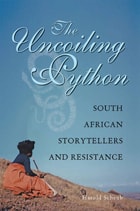
The Uncoiling Python
South African Storytellers and ResistanceHarold Scheub
Ohio University Press, 2010
There are many collections of African oral traditions, but few as carefully organized as The Uncoiling Python. Harold Scheub, one of the world’s leading scholars of African oral traditions and folklore, explores the ways in which oral traditions have served to combat and subvert colonial domination in South Africa. From the time colonial forces first came to southern Africa in 1487, oral and written traditions have been a bulwark against what became 350 years of colonial rule, characterized by the racist policies of apartheid. The Uncoiling Python: South African Storytellers and Resistance is the first in-depth study of oral tradition as a means of survival.
In open insurrections and other subversive activities Africans resisted the daily humiliations of colonial rule, but perhaps the most effective and least apparent expression of subversion was through indigenous storytelling and poetic traditions. Harold Scheub has collected the stories and poetry of the Xhosa, Zulu, Swati, and Ndebele peoples to present a fascinating analysis of how the apparently harmless tellers of tales and creators of poetry acted as front-line soldiers.
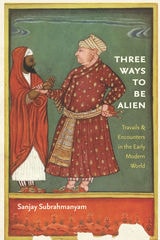
Three Ways to Be Alien
Travails and Encounters in the Early Modern WorldSanjay Subrahmanyam
Brandeis University Press, 2011
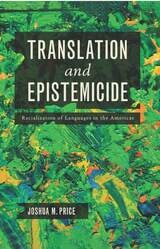
Translation and Epistemicide
Racialization of Languages in the AmericasJoshua M. Price
University of Arizona Press, 2023
The book gives an account of translation-as-epistemicide in the Americas, drawing on a range of examples from the early colonial period to the War on Terror. The first chapters demonstrate four distinct operations of epistemicide: the commensuration of worlds, the epistemic marginalization of subaltern translators and the knowledge they produce, the criminalization of translators and interpreters, and translation as piracy or extractivism. The second part of the book outlines decolonial translation strategies, including an epistemic posture the author calls “bewilderment.”
Translation and Epistemicide tracks how through the centuries translation practices have enabled colonialism and resulted in epistemicide, or the destruction of Indigenous and subaltern knowledge.
Tropical Freedom
Climate, Settler Colonialism, and Black Exclusion in the Age of EmancipationIkuko Asaka
Duke University Press, 2017
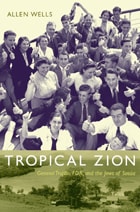
Tropical Zion
General Trujillo, FDR, and the Jews of SosúaAllen Wells
Duke University Press, 2009
Why did a dictator admit these desperate refugees when so few nations would accept those fleeing fascism? Eager to mollify international critics after his army had massacred 15,000 unarmed Haitians, Trujillo sent representatives to Évian, France, in July, 1938 for a conference on refugees from Nazism. Proposed by FDR to deflect criticism from his administration’s restrictive immigration policies, the Évian Conference proved an abject failure. The Dominican Republic was the only nation that agreed to open its doors. Obsessed with stemming the tide of Haitian migration across his nation’s border, the opportunistic Trujillo sought to “whiten” the Dominican populace, welcoming Jewish refugees who were themselves subject to racist scorn in Europe.
The Roosevelt administration sanctioned the Sosúa colony. Since the United States did not accept Jewish refugees in significant numbers, it encouraged Latin America to do so. That prodding, paired with FDR’s overriding preoccupation with fighting fascism, strengthened U.S. relations with Latin American dictatorships for decades to come. Meanwhile, as Jewish organizations worked to get Jews out of Europe, discussions about the fate of worldwide Jewry exposed fault lines between Zionists and Non-Zionists. Throughout his discussion of these broad dynamics, Wells weaves vivid narratives about the founding of Sosúa, the original settlers and their families, and the life of the unconventional beach-front colony.