Results by title
80 books match the query 'Composition and exercises' and 6 start with t
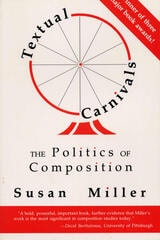
Textual Carnivals
The Politics of CompositionSusan Miller
Southern Illinois University Press, 1993
This is the first book-length study of the status of composition in English studies and the uneasy relationship between composition and literature. Composition studies and institutional histories of English studies have long needed this kind of clarification of the historical and political contexts of composition teaching, research, and administration.
Susan Miller argues that composition constitutes a major national industry, citing the four million freshman-level students enrolled in such courses each year, the $40 million annual expenditure for textbooks, and the more than $50 million in teacher salaries. But this concrete magnitude is not expressed in political power within departments. Miller calls on her associates in composition to engage in a persistent critique of the social practices and political agenda of the discipline that have been responsible for its institutional marginalization. Drawing on her own long experience as a composition administrator, teacher, and scholar, as well as on a national survey of composition professionals, Miller argues that composition teachers inadvertently continue to foster the negative myth about composition’s place in the English studies hierarchy by assuming an assigned, self-sacrificial cultural identity. Composition has been regarded as subcollegiate, practical, a "how-to," and has been denied intellectual rigor in order to preserve literature’s presentations of quasi-religious textual ideals.
Winner of three major book awards:
The Modern Language Association’s Mina P. Shaughnessy Prize
The Conference on College Composition and Communication’s Outstanding Book Award
The Teachers of Advanced Composition’s W. Ross Winterowd Award
The Community College Writer
Exceeding ExpectationsHoward Tinberg and Jean-Paul Nadeau
Southern Illinois University Press, 2010
While there have been several studies of writing programs at larger, baccalaureate institutions, the community college classroom has often been overlooked. Authors Howard Tinberg and Jean-Paul Nadeau fill this gap with The Community College Writer, a systematic and unique case study of first semester writing students at a community college. Drawing on surveys, interviews, and samples of classroom assignments, Tinberg and Nadeau use their research at one community college to reach out to instructors throughout the nation, fostering communication between community college faculty members in the effort to establish full-fledged writing programs geared toward student success.
At the heart of the book are the voices of the students themselves, as they discuss both their teachers’ expectations and their own. Through a series of case studies, the authors reveal the challenges students face as budding writers, and their firsthand experiences with writing programs at the community college level.
With this informative study, Tinberg and Nadeau seek not only to encourage dialogue between student and teacher or community college instructors, but to expand the conversation about program improvement to include both two- and four-year colleges, bringing composition faculty together in an effort to improve writing programs in all schools. Included in the volume are seven appendices, including surveys and interviews with faculty and students, making The Community College Writer a comprehensive and practical guide to tackling the issues facing writing programs and instructors.
The Syntax of Sports, Class 7
Information FlowPatrick Barry
Michigan Publishing Services, 2025
The Wealth of Reality
An Ecology of CompositionMargaret A. Syverson
Southern Illinois University Press, 1999
Margaret A. Syverson discusses the ways in which a theory of composing situations as ecological systems might productively be applied in composition studies. She demonstrates not only how new research in cognitive science and complex systems can inform composition studies but also how composing situations can provide fruitful ground for research in cognitive science.
Syverson first introduces theories of complex systems currently studied in diverse disciplines. She describes complex systems as adaptive, self-organizing, and dynamic; neither utterly chaotic nor entirely ordered, these systems exist on the boundary between order and chaos. Ecological systems are "metasystems" composed of interrelated complex systems. Writers, readers, and texts, together with their environments, constitute one kind of ecological system.
Four attributes of complex systems provide a theoretical framework for this study: distribution, embodiment, emergence, and enaction. Three case studies provide evidence for the application of these concepts: an analysis of a passage from an autobiographical poem by Charles Reznikoff, a study of first-year college students writing collaboratively, and a conflict in a computer forum of social scientists during the Gulf War. The diversity of these cases tests the robustness of theories of distributed cognition and complex systems and suggests possibilities for wider application.
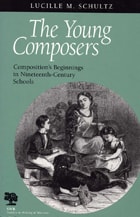
The Young Composers
Composition's Beginnings in Nineteenth-Century SchoolsLucille M. Schultz
Southern Illinois University Press, 1999
Lucille M. Schultz's The Young Composers: Composition's Beginnings in Nineteenth-Century Schools is the first full-length history of school-based writing instruction. Schultz demonstrates that writing instruction in nineteenth-century American schools is much more important in the overall history of writing instruction than we have previously assumed.
Drawing on primary materials that have not been considered in previous histories of writing instruction—little-known textbooks and student writing that includes prize-winning essays, journal entries, letters, and articles written for school newspapers—Schultz shows that in nineteenth-century American schools, the voices of the British rhetoricians that dominated college writing instruction were attenuated by the voice of the Swiss education reformer Johann Heinrich Pestalozzi. Partly through the influence of Pestalozzi's thought, writing instruction for children in schools became child-centered, not just a replica or imitation of writing instruction in the colleges.
It was also in these nineteenth-century American schools that personal or experience-based writing began and where the democratization of writing was institutionalized. These schools prefigured some of our contemporary composition practices: free writing, peer editing, and the use of illustrations as writing prompts. It was in these schools, in fact, where composition instruction as we know it today began, Schultz argues.
This book features a chapter on the agency of textbook iconography, which includes illustrations from nineteenth-century composition books as well as a cultural analysis of those illustrations. Schultz also includes a lengthy bibliography of nineteenth-century composition textbooks and student and school newspapers.
Twenty-One Genres and How to Write Them
Brock Dethier
Utah State University Press, 2013
In the first section, Dethier efficiently presents each genre, providing models; a description of the genres’ purpose, context, and discourse; and suggestions for writing activities or “moves” that writers can use to get words on the page and accomplish their writing tasks. The second section explains these moves, over two hundred of them, in chapters ranging from “Solve Your Process Problems” and “Discover” to “Revise” and “Present.” Applicable to any writing task or genre, these moves help students overcome writing blocks and develop a piece of writing from the first glimmers of an idea to its presentation.
This approach to managing the complexity and challenge of writing in college strives to be useful, flexible, eclectic, and brief—a valuable resource for students learning to negotiate unfamiliar writing situations.