Results by title
75 books match the query 'Confederate States of America' and 14 start with t
The Civil War Diary of Rev. James Sheeran, C.Ss.R.
Patrick J. Hayes
Catholic University of America Press, 2017
The Civil War Memoirs of a Virginia Cavalryman
Lt. Robert T. Hubard Jr., Edited by Thomas P. Nanzig
University of Alabama Press, 2007
Robert Hubard was an enlisted man and officer of the 3rd Virginia Cavalry in the Army of Northern Virginia (CSA) from 1861 through 1865. He wrote his memoir during an extended convalescence spent at his father’s Virginia plantation after being wounded at the battle of Five Forks on April 1, 1865. Hubard served under such Confederate luminaries as Jeb Stuart, Fitz Lee, Wade Hampton, and Thomas L. Rosser. He and his unit fought at the battles of Antietam, on the Chambersburg Raid, in the Shenandoah Valley, at Fredericksburg, Kelly’s Ford, Chancellorsville, Gettysburg, Bristoe Station, and down into Virginia from the Wilderness to nearly the end of the war at Five Forks.
Hubard was like many of his class and station a son of privilege and may have felt that his service was an act of noblesse oblige. Unlike many of his contemporaries, however, he was a keen observer and a writer of unusual grace, clarity, humor, and intelligence. The editor has fleshed out his memoir by judicious use of Hubard’s own wartime letters, which not only fill in gaps but permit the reader to see developments in the writer’s thinking after the passage of time. Because he was a participant in events of high drama and endured the quotidian life of a soldier, Hubard’s memoir should be of value to both scholars and avocational readers.
The Confederacy's Fighting Chaplain
Father John B. BannonPhillip Thomas Tucker
University of Alabama Press, 1992
The Confederacy’s Fighting Chaplain is the remarkable story of the Irishman who brought the Bible and his own resourcefulness and daring to both the battlefield and the diplomatic field—a story that has been largely ignored for more than 130 years. The biography of John B. Bannon also chronicles the forgotten Southerners—the Irish immigrants of the Confederacy—whose colorful and crucial role in the Civil War has been seriously neglected.
The Confederate Belle
Giselle Roberts
University of Missouri Press, 2003
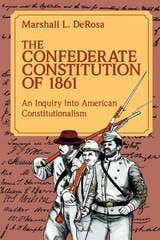
The Confederate Constitution of 1861
An Inquiry into American ConstitutionalismMarshall L. DeRosa
University of Missouri Press, 1991
In The Confederate Constitution of 1861, Marshall DeRosa argues that the Confederate Constitution was not, as is widely believed, a document designed to perpetuate a Southern "slaveocracy," but rather an attempt by the Southern political leadership to restore the Anti-Federalist standards of limited national government. In this first systematic analysis of the Confederate Constitution, DeRosa sheds new light on the constitutional principles of the CSA within the framework of American politics and constitutionalism. He shows just how little the Confederate Constitution departed from the U.S. Constitution on which it was modeled and examines closely the innovations the delegates brought to the document.
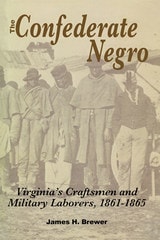
The Confederate Negro
Virginia's Craftsmen and Military Laborers, 1861-1865James H. Brewer
University of Alabama Press, 2007
A superb work in the social history of American industry
A Gettysburg College "Top 200 Civil War Books" selection
Mayflower Award Winner for 1970
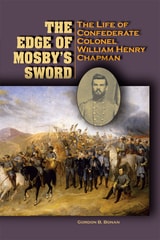
The Edge of Mosby’s Sword
The Life of Confederate Colonel William Henry ChapmanGordon B. Bonan
Southern Illinois University Press, 2009
The Edge of Mosby’s Sword is the first scholarly volume to delve into the story of one of John Singleton Mosby’s most trusted and respected officers, Colonel William Henry Chapman. Presenting both military and personal perspectives of Chapman’s life, Gordon B. Bonan offers an in-depth understanding of a man transformed by the shattering of his nation. This painstakingly researched account exposes a soldier and patriot whose convictions compelled him to battle fiercely for Southern independence; whose quest for greatness soured when faced with the brutal realities of warfare; and who sought to heal his wounded nation when the guns of war were silenced.
Born into a wealthy slave-owning family, Chapman was a student of the fiery secessionist rhetoric of antebellum Virginia who eagerly sought glory and adventure on the battlefields of the Civil War. Bonan traces Chapman’s evolution from an impassioned student at the University of Virginia to an experienced warrior and leader, providing new insight into the officer’s numerous military accomplishments. Explored here are Chapman’s previously overlooked endeavors as a student warrior, leader of the Dixie Artillery, and as second-in-command to Mosby, including his participation in the capture of Harpers Ferry, the battering of Union forces at Second Manassas, and his ferocious raids during the 1864 Shenandoah Valley campaign. Bonan reveals fresh perspectives on the intrepid maneuvers of Mosby’s Rangers, the hardships of war, and Chapman’s crucial role as the right hand of the “Gray Ghost.” But while Mosby recognized him for his bravery and daring, the fame Chapman sought always eluded him. Instead, with his honors and successes came disillusionment and sorrow, as he watched comrades and civilians alike succumb to the terrible toll of the war.
The end of the struggle between North and South saw Chapman accept defeat with dignity, leading the Rangers to their official surrender and parole at Winchester. With the horrors of the war behind him, he quickly moved to embrace the rebuilding of his country, joining the Republican party and beginning a forty-two-year career at the IRS enforcing Federal law throughout the South. In the end, Chapman’s life is a study in contradictions: nationalism and reconciliation; slavery and liberty; vengeance and chivalry.
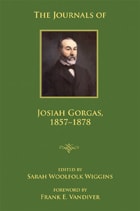
The Journals of Josiah Gorgas, 1857–1878
Josiah Gorgas, edited by Sarah Woolfolk Wiggins, foreword by Frank E. Vandiver
University of Alabama Press, 2009
Josiah Gorgas was best known as the highly regarded Chief of Confederate Ordnance. Born in 1818, he attended West Point, served in the U.S. Army, and later, after marrying Amelia Gayle, daughter of a former Alabama governor, joined the Confederacy. After the Civil War he served as president of The University of Alabama until ill health forced him to resign. His journals, maintained between 1857 and 1878, reflect the family's economic successes and failures, detail the course of the South through the Civil War, and describe the ordeal of Reconstruction. Few journals cover such a sweep of history. An added dimension is the view of Victorian family life as Gorgas explored his feelings about aspects of parental responsibility and transmission of values to children--a rarely documented account from the male perspective. His son, called Willie in the journals, was William Crawford Gorgas (1854-1920), who was noted for his fight to control yellow fever and who became surgeon general of the United States.
In his foreword to the volume, Frank E. Vandiver states: "Wiggins has done much more than present a well-edited version of Gorgas's diaries and journals; she has interpreted them in full Gorgas family context and in perspective of the times they cover. . . . Wiggins informs with the sort of editorial notes expected of a careful scholar, but she enlightens with wide knowledge of American and southern history. . . . Josiah Gorgas [was] an unusually observant, passionate man, a 'galvanized Rebel' who deserves rank among the true geniuses of American logistics."
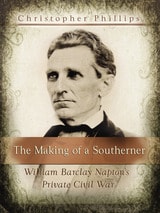
The Making of a Southerner
William Barclay Napton's Private Civil WarChristopher Phillips
University of Missouri Press, 2008
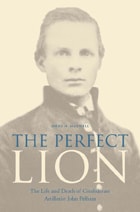
The Perfect Lion
The Life and Death of Confederate Artillerist John PelhamJerry H. Maxwell
University of Alabama Press, 2011
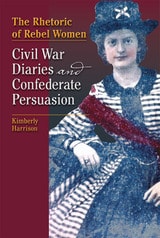
The Rhetoric of Rebel Women
Civil War Diaries and Confederate PersuasionKimberly Harrison
Southern Illinois University Press, 2013
Informed by more than one hundred diaries, this study provides insight into how women cultivated rhetorical agency, challenging traditional gender expectations while also upholding a cultural status quo. Author Kimberly Harrison analyzes the rhetorical choices these women made and valued in wartime and postwar interactions with Union officers and soldiers, slaves and former slaves, local community members, and even their God. In their intimate accounts of everyday war, these diarists discussed rhetorical strategies that could impact their safety, their livelihoods, and those of their families. As they faced Union soldiers in attempts to protect their homes and property, diarists saw their actions as not only having local, immediate impact on their well-being but also as reflecting upon their cause and the character of the southern people as a whole. They instructed themselves through their personal writing, allowing insight into how southern women prepared themselves to speak and act in new and contested contexts.
The Rhetoric of Rebel Women highlights the contributions of privileged white southern women in the development of the Confederate national identity, presenting them not as passive observers but as active participants in the war effort.
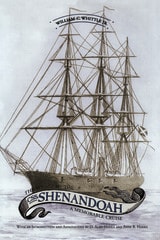
The Voyage of the CSS Shenandoah
A Memorable CruiseWilliam C. Whittle
University of Alabama Press, 2005
The only Confederate ship to circumnavigate the globe
The Confederate cruiser Shenandoah was the last of a group of commerce raiders deployed to prey on Union merchant ships. Ordered to the Pacific Ocean to “greatly damage and disperse” the Yankee whaling fleet in those waters, the Shenandoah’s successful pursuit of her quarry compared favorably with the exploits of the more celebrated Alabama and Florida but has never been as well known because it coincided with the war’s end and the Confederacy’s downfall. It was, however, one of the best documented naval expeditions—from England to the Indian Ocean, Australia and the South Pacific, the Bering Sea, San Francisco, and finally to port in Liverpool—during the Civil War.
The ship’s log and Captain James Waddell’s notes are well preserved, and a number of the Shenandoah’s officers kept detailed journals of the entire voyage. One of the most significant journals, by Lieutenant William Whittle, is presented here, with annotations from other journals, the official records and logs, and newspaper accounts of the Shenandoah’s activities, together bringing to life the history of this remarkable voyage.
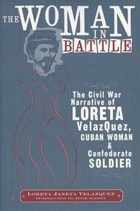
The Woman in Battle
The Civil War Narrative of Loreta Janeta Velazquez, Cuban Woman and Confederate SoldierLoreta Janeta Velazquez
University of Wisconsin Press, 2003
Originally published in 1876 as The Woman in Battle, this Civil War narrative offers Velazquez’s seemingly impossible autobiographical account, as well as a new critical introduction and glossary by Jesse Alemán. Scholars are divided between those who read the book as a generally honest autobiography and those who read it as mostly fiction. According to Alemán’s critical introduction, the book also reads as pulp fiction, spy memoir, seduction narrative, travel literature, and historical account, while it mirrors the literary conventions of other first-person female accounts of cross-dressing published in the United States during wartime, dating back to the Revolutionary War. Whatever the facts are, this is an authentic Civil War narrative, Alemán concludes, that recounts how war disrupts normal gender roles, redefines national borders, and challenges the definition of identity.
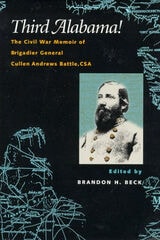
Third Alabama!
The Civil War Memoir of Brigadier General Cullen Andrews Battle, CSACullen Andrews Battle
University of Alabama Press, 2002
From Seven Pines to Sharpsburg and Chancellorsville to Spotsylvania, the Third Alabama Regiment played a key role in the Civil War. One of the first infantry units from the Deep South to make the journey to Virginia in 1861, the Third Alabama was the first to cross the Potomac into Maryland and to enter the streets of Gettysburg in 1863.
As the regiment’s leader and one of General Robert E. Lee’s brigade commanders, General Cullen Andrews Battle witnessed the extent of the many triumphs and sufferings of the Army of Northern Virginia. Trained as a journalist and lawyer, he records these events honestly and with compassion. Battle captures the courage of citizen soldiers fighting without prior military training, always paying tribute to the heroism of those under his command, while providing vivid accounts of some of the war’s bloodiest fights. He assesses Confederate mistakes, particularly at Seven Pines—and sheds light on the third Battle of Winchester, the only decisive defeat in which the regiment was involved.
Brandon Beck’s introductory notes provide a thorough review of Battle’s life and valuable biographical information on soldiers under his command as well as on other officers in the Army of Northern Virginia. A worthwhile addition to all Civil War libraries, public or private, Third Alabama! offers an informative, dramatic reading of the wartime activities of one of the Confederacy’s bravest fighting units.