Results by title
56 books match the query 'Context' and 7 start with t

Telemedicine Systems for Unreached Communities
Context, challenges and opportunitiesMehdi Hasan
The Institution of Engineering and Technology, 2026
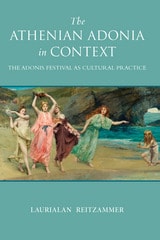
The Athenian Adonia in Context
The Adonis Festival as Cultural PracticeLaurialan Reitzammer
University of Wisconsin Press, 2018
Reitzammer uncovers correlations of the Adonia to Athenian wedding rituals and civic funeral oration and provides illuminating evidence that the festival was a significant cultural template for such diverse works as Aristophanes’ drama Lysistrata and Plato’s dialogue Phaedrus. Her fresh approach is a timely contribution to studies of the ways gender and sexuality intersect with religion and ritual in ancient Greece.
The Context of Ancient Drama
Eric Csapo and William J. Slater
University of Michigan Press, 1995

The Context of Self
A Phenomenological Inquiry Using Medicine as a ClueRichard M. Zaner
Ohio University Press, 1981
This study takes up the challenge presented to philosophy in a dramatic and urgent way by contemporary medicine: the phenomenon of human life. Initiated by a critical appreciation of the work of Hans Jonas, who poses that issue as well, the inquiry is brought to focus on the phenomenon of embodiment, using relevant medical writing to help elicit its concrete dimensions.
The explication of embodiment, aided by critical studies and inquiries into medical phenomena (autism, brain injury, terminal illness) make possible the development of the author’s original phenomenological theory of self, and its concrete relationships with the other self. This study attempts not only to show connections among the works of a number of thinkers in terms of central problems, but to demonstrate the mutual relevance of medicine and philosophy through concrete illustrations and analysis.
The International Monetary Fund and Latin America
The Argentine Puzzle in ContextClaudia Kedar
Temple University Press, 2013
The International Monetary Fund (IMF) has played a critical role in the global economy since the postwar era. But, claims Claudia Kedar, behind the strictly economic aspects of the IMF’s intervention, there are influential interactions between IMF technocrats and local economists—even when countries are not borrowing money.
In The International Monetary Fund and Latin America, Kedar seeks to expose the motivations and constraints of the operations of both the IMF and borrowers. With access to never-before-seen archive materials, Kedar reveals both the routine and behind-the-scenes practices that have depicted International Monetary Fund–Latin American relations in general and the asymmetrical IMF-Argentina relations in particular.
Kedar also analyzes the “routine of dependency” that characterizes IMF-borrower relations with several Latin American countries such as Chile, Peru, and Brazil. The International Monetary Fund and Latin America shows how debtor countries have adopted IMF’s policies during past decades and why Latin American leaders today largely refrain from knocking at the IMF’s doors again.
The Spectacle 2.0
Reading Debord in the Context of Digital CapitalismMarco Briziarelli and Emiliana Armano
University of Westminster Press, 2017
“Necessary reading for scholars interested in theorising the spectacle's relation to the labour theory of value, commodity fetishism and subjectivity under post-Fordism.” - https://www.triple-c.at/index.php/tripleC/article/view/1015/1176
Spectacle 2.0 recasts Debord's theory of spectacle within the frame of 21st century digital capitalism. It offers a reassessment of Debord’s original notion of Spectacle from the late 1960s, of its posterior revisitation in the 1990s, and it presents a reinterpretation of the concept within the scenario of contemporary informational capitalism and more specifically of digital and media labour. It is argued that the Spectacle 2.0 form operates as the interactive network that links through one singular (but contradictory) language and various imaginaries, uniting diverse productive contexts such as logistics, finance, new media and urbanism. Spectacle 2.0 thus colonizes most spheres of social life by processes of commodification, exploitation and reification. Diverse contributors consider the topic within the book’s two main sections: Part I conceptualizes and historicizes the Spectacle in the context of informational capitalism; contributions in Part II offer empirical cases that historicise the Spectacle in relation to the present (and recent past) showing how a Spectacle 2.0 approach can illuminate and deconstruct specific aspects of contemporary social reality. All contributions included in this book rework the category of the Spectacle to present a stimulating compendium of theoretical critical literature in the fields of media and labour studies. In the era of the gig-economy, highly mediated content and President Trump, Debord’s concept is arguably more relevant than ever.

Theatermachine
Tadeusz Kantor in ContextEdited by Magda Romanska and Kathleen Cioffi
Northwestern University Press, 2019