69 books match the query 'Country life' and 11 start with t

cover of Tales from the Big Thicket

Tales from the Big Thicket

Francis Edward Abernethy

University of North Texas Press, 2002

Abernethy presents the history and folklore of the Big Thicket and its people, including a collection of Alabama-Coushatta tales, a search for hidden Jayhawkers during the Civil War, a nineteenth-century travel account, and a family history of the legendary Hooks.
[more]
cover of The Country of the Pointed Firs and Other Stories

The Country of the Pointed Firs and Other Stories

Sarah Orne Jewett

University of New Hampshire Press, 1997

The Country of the Pointed Firs (1896) is Sarah Orne Jewett's most popular book. In its elegantly constructed sketches, a worldly, anonymous writer spends the summer in a tiny Maine fishing village where she hopes to find peace and solitude. As she gains the acceptance and trust of her hosts, the community's power and complexity are slowly revealed. While its episodes portray the difficulty and loneliness of rural life, they also display its dignity and strength, particularly as expressed in the bonds between women: mothers, daughters, and friends.

This centennial edition contains a facsimile of the original text, thereby restoring the novel to Jewett's own version, which had been considerably altered in other published versions, plus four related stories. Further enhancing the importance of this volume is editor Sarah Way Sherman's introduction, which includes a sketch of Jewett's life and professional development, a commentary on textual accuracy, and a discussion of the book's themes and techniques as well as its historical context.
[more]
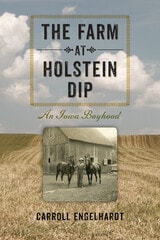
cover of The Farm at Holstein Dip: An Iowa Boyhood

The Farm at Holstein Dip

An Iowa Boyhood

Carroll Engelhardt

University of Iowa Press, 2012

Carroll Engelhardt’s parents grew up in homes without electricity on farms without tractors and began farming in the same way. As a farm boy in northeastern Iowa, he thought that history happened only to important people in earlier times and more exotic places. After decades of teaching, he at last perceived that history happens to us all, and he began writing this book. Set within the thoughtfully presented contexts of the technological revolution in American agriculture, the Second World War, the Cold War, and the emerging culture of affluence, The Farm at Holstein Dip is both a loving coming-of-age memoir and an educational glimpse into rural and small-town life of the 1940s and 1950s.
 
Engelhardt writes about growing up in a spacious farmhouse where life was centered in the kitchen and frugality dictated that every purchase be weighed carefully. His chores grew up with him: he fed chickens and gathered eggs at age six, rode a horse on the hayfork at nine or ten, milked cows by hand at eleven, and hired out to other farmers to load bales in the field and work in the haymow at fifteen. The simple pleasures and predictable routines of a Saturday night at the movies in nearby Elkader, Pioneer Days on the 4th of July, Confirmation Sunday, class picnics, and baseball and basketball games play out against a background of rural decline, alternating economic uncertainty and prosperity, and Cold War anxiety—next to polio, he most feared Communist subversion and atomic blasts. The values and contradictions imparted by this evolving mix of international, national, and local cultures shaped his coming of age.
 

Engelhardt brings us into the world of his fourth-generation farm family, who lived by the family- and faith-based work ethic and concern for respectability they had inherited from their German and Norwegian ancestors. His writing has a particularly Iowa flavor, a style that needs no definition to those who live in the state. Readers will discover the appeal of his wry, humorous, and kind observations and appreciate his well-informed perspective on these transformative American decades. 
[more]
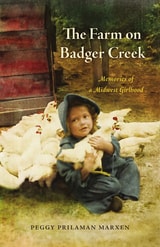
cover of The Farm on Badger Creek: Memories of a Midwest Girlhood

The Farm on Badger Creek

Memories of a Midwest Girlhood

Peggy Prilaman Marxen

Wisconsin Historical Society Press, 2021
Peggy Prilaman Marxen grew up near the town of Meteor in northwestern Wisconsin’s Sawyer County, isolated by geography yet surrounded by close-knit extended family. Multiple generations of her family witnessed changes to rural Wisconsin that altered the fabric of their lives and the lives of all in their community, including the introduction of new farming techniques, school consolidation, and revolutions in transportation and technology. They supplemented their subsistence herd of dairy cows by hunting, fishing, and selling timber and maple syrup. For many years, her home, like those of her neighbors, lacked indoor plumbing, electricity, and a telephone. As a young child, Peggy attended a one-room schoolhouse and walked, biked, or sledded the three miles to school and back, no matter the weather. 
 
[more]
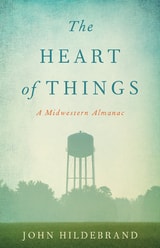
cover of The Heart of Things: A Midwestern Almanac

The Heart of Things

A Midwestern Almanac

John Hildebrand

Wisconsin Historical Society Press, 2014

“I’ve never believed that living in one place means being one thing all the time, condemned like Minnie Pearl to wear the same hat for every performance. Life is more complicated than that.”
In this remarkable book of days, John Hildebrand charts the overlapping rings—home, town, countryside—of life in the Midwest. Like E. B. White, Hildebrand locates the humor and drama in ordinary life: church suppers, Friday night football, outdoor weddings, garden compost, family reunions, roadside memorials, camouflage clothing. In these wry, sharply observed essays, the Midwest isn’t The Land Time Forgot but a more complicated (and vastly more interesting) place where the good life awaits once we figure exactly out what it means. From his home range in northwestern Wisconsin, Hildebrand attempts to do just that by boiling down a calendar year to its rich marrow of weather, animals, family, home—in other words, all the things that matter.

[more]
cover of The Land Still Lives

The Land Still Lives

Jerry Apps

Wisconsin Historical Society Press, 2019

“Apps is a man of ideas who is sensitive to the touch, the smells, and the feel of doing things by hand, today and a hundred years ago.”—from the foreword by Senator Gaylord Nelson

Originally published in 1970, The Land Still Lives is the first book by Wisconsin’s greatest rural philosopher, Jerry Apps. Written when he was still a young agriculture professor at the University of Wisconsin, The Land Still Lives was readers’ first introduction to Jerry’s farm in central Wisconsin, called Roshara, and the surrounding community of Skunk’s Hollow. This special 50th-anniversary edition features a new epilogue, in which Jerry revisits his philosophy of caring for the land so it in turn will care for us. This is vintage Apps, essential reading for Jerry’s legions of fans—and for all who, like Jerry, wish “to develop a relationship with nature and all its mystery and wonder.”
[more]
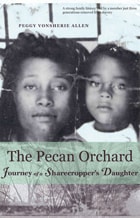
cover of The Pecan Orchard: Journey of a Sharecropper's Daughter

The Pecan Orchard

Journey of a Sharecropper's Daughter

Peggy Vonsherie Allen

University of Alabama Press, 2011

The true story of the struggle, survival, and ultimate success of a large black family in south Alabama who, in the middle decades of the 20th century, lifted themselves out of poverty to achieve the American dream of property ownership

This is a true story of the struggle, survival, and ultimate success of a large black family in south Alabama who, in the middle decades of the 20th century, lifted themselves out of poverty to achieve the American dream of property ownership. Descended from slaves and sharecroppers in the Black Belt region, this family of hard-working parents and their thirteen children is mentored by its matriarch, Moa, the author’s beloved great grandmother, who passes on to the family, along with other cultural wealth, her recipe for moonshine.

Without rancor or blame, and even with occasional humor, The Pecan Orchard offers a window into the inequities between blacks and whites in a small southern town still emerging from Jim Crow attitudes.

Told in clean, straightforward prose, the story radiates the suffocating midday heat of summertime cotton fields and the biting winter wind sifting through porous shanty walls. It conveys the implicit shame in “Colored Only” restrooms, drinking fountains, and eating areas; the beaming satisfaction of a job well done recognized by others; the “yessum” manners required of southern society; and the joyful moments, shared memories, and loving bonds that sustain—and even raise—a proud family.
[more]
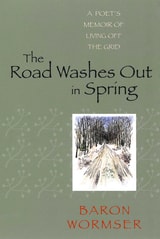
cover of The Road Washes Out in Spring: A Poet’s Memoir of Living Off the Grid

The Road Washes Out in Spring

A Poet’s Memoir of Living Off the Grid

Baron Wormser

University Press of New England, 2008

For nearly twenty-five years, poet Baron Wormser and his family lived in a house in Maine with no electricity or running water. They grew much of their own food, carried water by hand, and read by the light of kerosene lamps. They considered themselves part of the “back to the land” movement, but their choice to live off the grid was neither statement nor protest: they simply had built their house too far from the road and could not afford to bring in power lines. Over the years, they settled in to a life that centered on what Thoreau called “the essential facts.” In this graceful meditation, Wormser similarly spurns ideology in favor of observation, exploration, and reflection. “When we look for one thread of motive,” he writes, “we are, in all likelihood, deceiving ourselves.” His refusal to be satisfied with the obvious explanation, the single thread of motive, makes him a keen and sympathetic observer of his neighbors and community, a perceptive reader of poetry and literature, and an honest and unselfconscious analyst of his own responses to the natural world. The result is a series of candid personal essays on community and isolation, nature, civilization, and poetry.
[more]
cover of The War Against The Beavers: Learning to Be Wild in the North Woods

The War Against The Beavers

Learning to Be Wild in the North Woods

Verena Andermatt Conley

University of Minnesota Press, 2005
A lifelong city dweller, Verena Andermatt Conley had long harbored romantic ideals about the natural world and dreamed of a wilderness retreat for herself and her husband, Tom. When a sizable tract of land along the Vermillion River on the edge of Minnesota's Boundary Waters - complete with two primitive log cabins - became available, they jumped at the chance to own a piece of paradise.The War against the Beavers is a wry and funny account of two people's ten-year apprenticeship in backwoods living, from their arrival as literal babes in the woods to their education in the ways of nature as they face plagues of insects, fungus, storms, and droughts, and embark on a lengthy campaign to eradicate a colony of beavers that threatens the peace and beauty of their forest refuge. It is only the coming of a mechanized and much more menacing threat - bulldozers and other heavy machinery clear-cutting the woods - that restores perspective to the obsessed cabin dwellers.
[more]
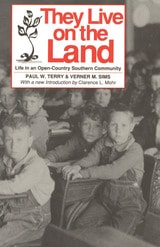
cover of They Live on The Land: Life in an Open Country Southern Community

They Live on The Land

Life in an Open Country Southern Community

Paul W. Terry

University of Alabama Press, 1993

"First published in 1940 as part of the information-gathering effort of the TVA, the work examines Gorgas, Alabama, a predominantly white farming settlement. Hailed as the most intensive case study ever made in the South, the book provides a detailed portrait of southern rural life on the verge of extinction."
—Florida Historical Quarterly

"One of the finest examples of the genre of the community survey. . . The book is remarkably free of special pleading. And every chapter is paced with fascinating data and insights. The University of Alabama Prss is to be congratulated for reissuing this splendid community study; the volume fits the description of a classic. And Clarence L. Mohr's introduction alone is worth the price of the volume."
—Journal of Southwest Georgia History

[more]
cover of To Make a Prairie: Essays on Poets, Poetry, and Country Living

To Make a Prairie

Essays on Poets, Poetry, and Country Living

Maxine Kumin

University of Michigan Press, 1980

Kumin reflects on the process of writing poetry and on life in the country
[more]