Results by title
51 books match the query 'Cultural Politics' and 8 start with t
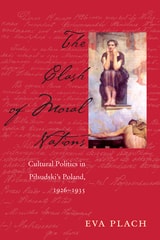
The Clash of Moral Nations
Cultural Politics in Pilsudski’s Poland, 1926–1935Eva Plach
Ohio University Press, 2006
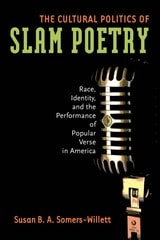
The Cultural Politics of Slam Poetry
Race, Identity, and the Performance of Popular Verse in AmericaSusan B. A. Somers-Willett
University of Michigan Press, 2010
"For a lucid and thorough 'real-world' analysis of the movement from the ground-up--including its history, aesthetics, and culture, there is surely no better place to start than Somers-Willett's trailblazing book."
--- Jerome Sala, Pleiades
"Finally, a clear, accurate, and thoroughly researched examination of slam poetry, a movement begun in 1984 by a mixed bag of nobody poets in Chicago. At conception, slam poetry espoused universal humanistic ideals and a broad spectrum of participants, and especially welcome is the book's analysis of how commercial marketing forces succeeded in narrowing public perception of slam to the factionalized politics of race and identity. The author's knowledge of American slam at the national level is solid and more authentic than many of the slammers who claim to be."
---Marc Kelly Smith, founder/creator of the International Poetry Slam movement
The cultural phenomenon known as slam poetry was born some twenty years ago in white working-class Chicago barrooms. Since then, the raucous competitions have spread internationally, launching a number of annual tournaments, inspiring a generation of young poets, and spawning a commercial empire in which poetry and hip-hop merge.
The Cultural Politics of Slam Poetry is the first critical book to take an in-depth look at slam, shedding light on the relationships that slam poets build with their audiences through race and identity performance and revealing how poets come to celebrate (and at times exploit) the politics of difference in American culture.
With a special focus on African American poets, Susan B. A. Somers-Willett explores the pros and cons of identity representation in the commercial arena of spoken word poetry and, in doing so, situates slam within a history of verse performance, from blackface minstrelsy to Def Poetry. What's revealed is a race-based dynamic of authenticity lying at the heart of American culture. Rather than being mere reflections of culture, Somers-Willett argues, slams are culture---sites where identities and political values get publicly refigured and exchanged between poets and audiences.
Susan B. A. Somers-Willett is a decade-long veteran of slam and teaches creative writing and poetics as an Assistant Professor of English at Montclair State University. She is the author of two books of poetry, Quiver and Roam. Visit the author's website at: http://www.susansw.com/.
Photo by Jennifer Lacy.

The Cultural Politics of the New American Studies
John Carlos Rowe
Michigan Publishing Services, 2012
Second, if neoliberalism has successfully employed various cultural media, then what are the best means of criticizing its main claims and fundamental purposes? Is it possible under these circumstances to imagine a “counter-culture” which might effectively challenge neoliberalism or is such an alternative already controlled and contained by such labels as “political correctness,” “the far left,” “radicalism,” “extremism,” even “terrorism,” which in the popular imagination refer to political and social minorities, doomed thereby to marginalization?
Rowe argues that the tradition of “cultural criticism” advocated by influential public intellectuals like Edward Said can be adapted to the new circumstances demanded by the hegemony of neoliberalism and its successful command of new media. Yet rather than simply honoring important predecessors such as Said, we need to reconceive the role of the public intellectual as more than just an “interdisciplinary scholar” but also as a social critic able to negotiate the different media.

The Exceptional Woman
Elisabeth Vigee-Lebrun and the Cultural Politics of ArtMary D. Sheriff
University of Chicago Press, 1996
In The Exceptional Woman, Mary D. Sheriff uses Vigée-Lebrun's career to explore the contradictory position of "woman-artist" in the moral, philosophical, professional, and medical debates about women in eighteenth-century France. Paying particular attention to painted and textual self-portraits, Sheriff shows how Vigée-Lebrun's images and memoirs undermined the assumptions about "woman" and the strictures imposed on women.
Engaging ancien-régime philosophy, as well as modern feminism, psychoanalysis, literary theory, and art criticism, Sheriff's interpretations of Vigée-Lebrun's paintings challenge us to rethink the work and the world of this controversial woman artist.
The Suburb of Dissent
Cultural Politics in the United States and Canada during the 1930sCaren Irr
Duke University Press, 1998
Irr highlights works by Richard Wright, John Dos Passos, Nathanael West, and others to uncover the complex relationship between American anti-communism and communist anti-Americanism. In an unprecedented move, she extends her inquiry to the work of Canadian intellectuals such as Dorothy Livesay and Hugh MacLennan to reveal the important yet overlooked fact that the territory at the border of the United States and Canada provided a vital contact zone and transnational “home” for leftist thinkers. Attending to intersections of race, ethnicity, and gender, Irr illustrates the ways dissenting writers made culture actively respond to the political crises of the Great Depression and questioned the nature of what it means to be “American.”
Drawing on insights from postcolonial and American studies and taking into account the intellectual and cultural dimensions of leftist politics, The Suburb of Dissent is the first study of the 1930s to bring together U.S. and Canadian writings. In doing so, it reveals how the unique culture of the left contributed to North American history at this critical juncture and beyond.
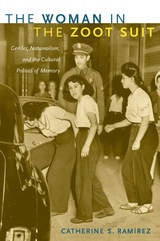
The Woman in the Zoot Suit
Gender, Nationalism, and the Cultural Politics of MemoryCatherine S. Ramírez
Duke University Press, 2009
Two events in wartime Los Angeles thrust young Mexican American zoot suiters into the media spotlight. In the Sleepy Lagoon incident, a man was murdered during a mass brawl in August 1942. Twenty-two young men, all but one of Mexican descent, were tried and convicted of the crime. In the Zoot Suit Riots of June 1943, white servicemen attacked young zoot suiters, particularly Mexican Americans, throughout Los Angeles. The Chicano movement of the 1960s–1980s cast these events as key moments in the political awakening of Mexican Americans and pachucos as exemplars of Chicano identity, resistance, and style. While pachucas and other Mexican American women figured in the two incidents, they were barely acknowledged in later Chicano movement narratives. Catherine S. Ramírez draws on interviews she conducted with Mexican American women who came of age in Los Angeles in the late 1930s, 1940s, and 1950s as she recovers the neglected stories of pachucas. Investigating their relative absence in scholarly and artistic works, she argues that both wartime U.S. culture and the Chicano movement rejected pachucas because they threatened traditional gender roles. Ramírez reveals how pachucas challenged dominant notions of Mexican American and Chicano identity, how feminists have reinterpreted la pachuca, and how attention to an overlooked figure can disclose much about history making, nationalism, and resistant identities.
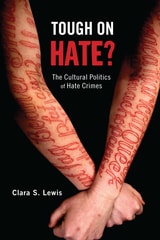
Tough on Hate?
The Cultural Politics of Hate CrimesLewis, Clara S
Rutgers University Press, 2013
Why do we know every gory crime scene detail about such victims as Matthew Shepard and James Byrd Jr. and yet almost nothing about the vast majority of other hate crime victims? Now that federal anti-hate-crimes laws have been passed, why has the number of these crimes not declined significantly? To answer such questions, Clara S. Lewis challenges us to reconsider our understanding of hate crimes. In doing so, she raises startling issues about the trajectory of civil and minority rights.
Tough on Hate is the first book to examine the cultural politics of hate crimes both within and beyond the law. Drawing on a wide range of sources—including personal interviews, unarchived documents, television news broadcasts, legislative debates, and presidential speeches—the book calls attention to a disturbing irony: the sympathetic attention paid to certain shocking hate crime murders further legitimizes an already pervasive unwillingness to act on the urgent civil rights issues of our time. Worse still, it reveals the widespread acceptance of ideas about difference, tolerance, and crime that work against future progress on behalf of historically marginalized communities.

Transnational Korean Cinema
Cultural Politics, Film Genres, and Digital TechnologiesDal Yong Jin
Rutgers University Press, 2020
The book emphasizes the economic and industrial aspects of the story, looking at questions on the interaction of politics and economics, including censorship and public funding, and provides a better view of the big picture by laying bare the relationship between film industries, the global market, and government. Jin also sheds light on the operations and globalization strategies of Korean film industries alongside changing cultural policies in tandem with Hollywood’s continuing influences in order to comprehend the power relations within cultural politics, nationally and globally. This is the first book to offer a full overview of the nascent development of Korean cinema.