Results by title
73 books match the query 'Cultural property' and 11 start with t
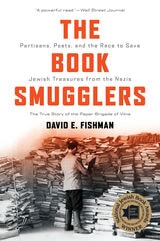
The Book Smugglers
Partisans, Poets, and the Race to Save Jewish Treasures from the NazisDavid E. Fishman
University Press of New England, 2018
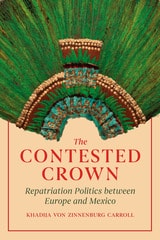
The Contested Crown
Repatriation Politics between Europe and MexicoKhadija von Zinnenburg Carroll
University of Chicago Press, 2022
In The Contested Crown, Khadija von Zinnenburg Carroll meditates on the case of a spectacular feather headdress believed to have belonged to Montezuma, emperor of the Aztecs. This crown has long been the center of political and cultural power struggles, and it is one of the most contested museum claims between Europe and the Americas. Taken to Europe during the conquest of Mexico, it was placed at Ambras Castle, the Habsburg residence of the author’s ancestors, and is now in Vienna’s Welt Museum. Mexico has long requested to have it back, but the Welt Museum uses science to insist it is too fragile to travel.
Both the biography of a cultural object and a history of collecting and colonizing, this book offers an artist’s perspective on the creative potentials of repatriation. Carroll compares Holocaust and colonial ethical claims, and she considers relationships between indigenous people, international law and the museums that amass global treasures, the significance of copies, and how conservation science shapes collections. Illustrated with diagrams and rare archival material, this book brings together global history, European history, and material culture around this fascinating object and the debates about repatriation.
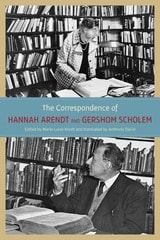
The Correspondence of Hannah Arendt and Gershom Scholem
Hannah Arendt and Gershom Scholem
University of Chicago Press, 2017
Arendt and Scholem met in 1932 in Berlin and quickly bonded over their mutual admiration for and friendship with Walter Benjamin. They began exchanging letters in 1939, and their lively correspondence continued until 1963, when Scholem’s vehement disagreement with Arendt’s Eichmann in Jerusalem led to a rupture that would last until Arendt’s death a dozen years later. The years of their friendship, however, yielded a remarkably rich bounty of letters: together, they try to come to terms with being both German and Jewish, the place and legacy of Germany before and after the Holocaust, the question of what it means to be Jewish in a post-Holocaust world, and more. Walter Benjamin is a constant presence, as his life and tragic death are emblematic of the very questions that preoccupied the pair. Like any collection of letters, however, the book also has its share of lighter moments: accounts of travels, gossipy dinner parties, and the quotidian details that make up life even in the shadow of war and loss.
In a world that continues to struggle with questions of nationalism, identity, and difference, Arendt and Scholem remain crucial thinkers. This volume offers us a way to see them, and the development of their thought, anew.
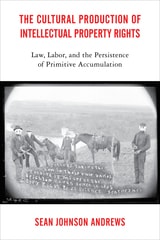
The Cultural Production of Intellectual Property Rights
Law, Labor, and the Persistence of Primitive AccumulationSean Johnson Andrews
Temple University Press, 2019
The protection and accumulation of intellectual property rights—like property rights in general—is one of the most important contemporary American values. In his cogent book, The Cultural Production of Intellectual Property Rights, Sean Johnson Andrews shows that the meaning, power, and value of intellectual properties are the consequence of an extended process of cultural production.
Johnson Andrews argues that it is deeper ideological and historical roots which demand that, in the contemporary global, digital economy, all property rights be held sacrosanct and all value must flow back to the legal owner.
Johnson Andrews explains that if we want to rebalance the protection of copyrights and trademarks, we should focus on undermining the reified culture of property that underpins capitalism as a whole. He outlines a framework for analyzing culture; situates intellectual property rights in the history of capitalist property relations; synthesizes key theories of media, politics, and law; and ultimately provides scholars and activists a path to imagining a different future where we prioritize our collective production of value in the commons.

The Culture of Property
The Crisis of Liberalism in Modern BritainJordanna Bailkin
University of Chicago Press, 2004
Drawing on court transcripts, gallery archives, exhibition reviews, private correspondence—and a striking series of cartoons and photographs—The Culture of Property traverses the history of gender, material culture, urban life, colonialism, Irish and Scottish nationalism, and British citizenship. This fascinating book challenges recent scholarship in museum studies in light of ongoing culture wars. It should be required reading for cultural policy makers, museum professionals, and anyone interested in the history of art and Britain.

The Heritage Machine
Fetishism and Domination in Maragateria, SpainPablo Alonso Gonzalez
Pluto Press, 2018
Focusing on a case study in the region of Maragatería, Spain, Gonzalez explores the ethnic and racial discrimination faced by the local population in the context of Spanish nationalism and shows how this hostile dynamic shaped what we recognize as the region’s heritage today. Challenging widespread notions about how and why we preserve traditional cultures, The Heritage Machine rethinks the relations between heritage studies and converging disciplines, from anthropology to cultural and memory studies.

The Idols of ISIS
From Assyria to the InternetAaron Tugendhaft
University of Chicago Press, 2020
Beginning with the Islamic State’s claim that the smashed objects were idols of the “age of ignorance,” Aaron Tugendhaft questions whether there can be any political life without idolatry. He then explores the various roles Mesopotamian sculpture has played in European imperial competition, the development of artistic modernism, and the formation of Iraqi national identity, showing how this history reverberates in the choice of the Mosul Museum as performance stage. Finally, he compares the Islamic State’s production of images to the ways in which images circulated in ancient Assyria and asks how digitization has transformed politics in the age of social media. An elegant and accessibly written introduction to the complexities of such events, The Idols of ISIS is ideal for students and readers seeking a richer cultural perspective than the media usually provides.
The Politics of Collecting
Race and the Aestheticization of PropertyEunsong Kim
Duke University Press, 2024

The Public Trust and the First Americans
Ruthann Knudson
Oregon State University Press, 1995
This Contested Land
The Storied Past and Uncertain Future of America's National MonumentsMcKenzie Long
University of Minnesota Press, 2022
One woman’s enlightening trek through the natural histories, cultural stories, and present perils of thirteen national monuments, from Maine to Hawaii—now available in paperback
This land is your land. When it comes to national monuments, the sentiment could hardly be more fraught. Gold Butte in Nevada, Organ Mountains–Desert Peaks in New Mexico, Katahdin Woods and Waters in Maine, Cascade–Siskiyou in Oregon and California: these are among the thirteen natural sites McKenzie Long visits in This Contested Land, an eye-opening exploration of the stories these national monuments tell, the passions they stir, and the controversies surrounding them today.
Starting amid the fragrant sagebrush and red dirt of Bears Ears National Monument on the eve of the Trump Administration’s decision to reduce the site by 85 percent, Long climbs sandstone cliffs, is awed by Ancestral Pueblo cliff dwellings and is intrigued by 4,000-year-old petroglyphs. She hikes through remote pink canyons recently removed from the boundary of Grand Staircase–Escalante, skis to a backcountry hut in Maine to view a truly dark night sky, snorkels in warm Hawaiian waters to plumb the meaning of marine preserves, volunteers near the most contaminated nuclear site in the United States, and witnesses firsthand the diverse forms of devotion evoked by the Rio Grande. In essays both contemplative and resonant, This Contested Land confronts an unjust past and imagines a collaborative future that bears witness to these regions’ enduring Indigenous connections.
From hazardous climate change realities to volatile tensions between economic development and environmental conservation, practical and philosophical issues arise as Long seeks the complicated and often overlooked—or suppressed—stories of these incomparable places. Her journey, mindfully undertaken and movingly described, emphasizes in clear and urgent terms the unique significance of, and grave threats to, these contested lands.
Treasured Possessions
Indigenous Interventions into Cultural and Intellectual PropertyHaidy Geismar
Duke University Press, 2013