Results by title
75 books match the query 'Death & Dying' and 16 start with t
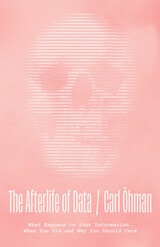
The Afterlife of Data
What Happens to Your Information When You Die and Why You Should CareCarl Öhman
University of Chicago Press, 2024
A short, thought-provoking book about what happens to our online identities after we die.
These days, so much of our lives takes place online—but what about our afterlives? Thanks to the digital trails that we leave behind, our identities can now be reconstructed after our death. In fact, AI technology is already enabling us to “interact” with the departed. Sooner than we think, the dead will outnumber the living on Facebook. In this thought-provoking book, Carl Öhman explores the increasingly urgent question of what we should do with all this data and whether our digital afterlives are really our own—and if not, who should have the right to decide what happens to our data.
The stakes could hardly be higher. In the next thirty years alone, about two billion people will die. Those of us who remain will inherit the digital remains of an entire generation of humanity—the first digital citizens. Whoever ends up controlling these archives will also effectively control future access to our collective digital past, and this power will have vast political consequences. The fate of our digital remains should be of concern to everyone—past, present, and future. Rising to these challenges, Öhman explains, will require a collective reshaping of our economic and technical systems to reflect more than just the monetary value of digital remains.
As we stand before a period of deep civilizational change, The Afterlife of Data will be an essential guide to understanding why and how we as a human race must gain control of our collective digital past—before it is too late.
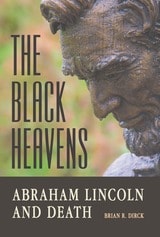
The Black Heavens
Abraham Lincoln and DeathBrian R. Dirck
Southern Illinois University Press, 2019
From multiple personal tragedies to the terrible carnage of the Civil War, death might be alongside emancipation of the slaves and restoration of the Union as one of the great central truths of Abraham Lincoln’s life. Yet what little has been written specifically about Lincoln and death is insufficient, sentimentalized, or devoid of the rich historical literature about death and mourning during the nineteenth century. The Black Heavens: Abraham Lincoln and Death is the first in-depth account of how the sixteenth president responded to the riddles of mortality, undertook personal mourning, and coped with the extraordinary burden of sending hundreds of thousands of soldiers to be killed on battlefields.
Going beyond the characterization of Lincoln as a melancholy, tragic figure, Brian R. Dirck investigates Lincoln’s frequent encounters with bereavement and sets his response to death and mourning within the social, cultural, and political context of his times. At a young age Lincoln saw the grim reality of lives cut short when he lost his mother and sister. Later, he was deeply affected by the deaths of two of his sons, three-year-old Eddy in 1850 and eleven-year-old Willie in 1862, as well as the combat deaths of close friends early in the war. Despite his own losses, Lincoln learned how to approach death in an emotionally detached manner, a survival skill he needed to cope with the reality of his presidency.
Dirck shows how Lincoln gradually turned to his particular understanding of God’s will in his attempts to articulate the meaning of the atrocities of war to the American public, as showcased in his allusions to religious ideas in the Gettysburg Address and the Second Inaugural. Lincoln formed a unique approach to death: both intellectual and emotional, typical and yet atypical of his times. In showing how Lincoln understood and responded to death, both privately and publicly, Dirck paints a compelling portrait of a commander in chief who buried two sons and gave the orders that sent an unprecedented number of Americans to their deaths.
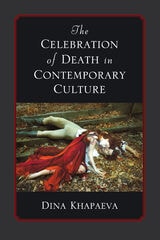
The Celebration of Death in Contemporary Culture
Dina Khapaeva
University of Michigan Press, 2017
This book links the mounting demand for images of violent death with dramatic changes in death-related social rituals. It offers a conceptual framework that connects observations of fictional worlds—including The Twilight Saga, The Vampire Diaries, and the Harry Potter series—with real-world sociocultural practices, analyzing the aesthetic, intellectual, and historical underpinnings of the cult of death. It also places the celebration of death in the context of a longstanding critique of humanism and investigates the role played by 20th-century French theory, posthumanism, transhumanism, and the animal rights movement in shaping the current antihumanist atmosphere.
This timely, thought-provoking book will appeal to scholars of culture, film, literature, anthropology, and American and Russian studies, as well as general readers seeking to understand a defining phenomenon of our age.
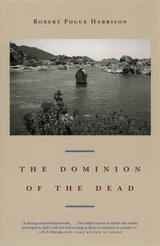
The Dominion of the Dead
Robert Pogue Harrison
University of Chicago Press, 2003
This elegantly conceived work devotes particular attention to the practice of burial. Harrison contends that we bury our dead to humanize the lands where we build our present and imagine our future. As long as the dead are interred in graves and tombs, they never truly depart from this world, but remain, if only symbolically, among the living. Spanning a broad range of examples, from the graves of our first human ancestors to the empty tomb of the Gospels to the Vietnam Veterans Memorial, Harrison also considers the authority of predecessors in both modern and premodern societies. Through inspired readings of major writers and thinkers such as Vico, Virgil, Dante, Pater, Nietzsche, Heidegger, and Rilke, he argues that the buried dead form an essential foundation where future generations can retrieve their past, while burial grounds provide an important bedrock where past generations can preserve their legacy for the unborn.
The Dominion of the Dead is a profound meditation on how the thought of death shapes the communion of the living. A work of enormous scope, intellect, and imagination, this book will speak to all who have suffered grief and loss.
The Dying Patient
Orville G., Jr. Brim
Russell Sage Foundation, 1970
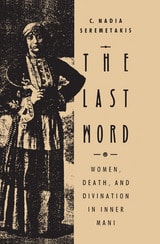
The Last Word
Women, Death, and Divination in Inner ManiC. Nadia Seremetakis
University of Chicago Press, 1991
The Sanctity of Social Life
Physician's Treatment of Critically Ill PatientsDiana Crane
Russell Sage Foundation, 1975
The Solemn Sentence of Death
Capital Punishment in ConnecticutLawrence B. Goodheart
University of Massachusetts Press, 2011
The Sorrow Psalms
A Book of Twentieth-Century ElegyLynn Strongin
University of Iowa Press, 2006
The Thought of Death and the Memory of War
Marc Crépon
University of Minnesota Press, 2013
War lays bare death and our relation to it. And in the wars—or more precisely the memories of war—of the twentieth century, images of the deaths of countless faceless or nameless others eclipse the singularity of each victim’s death as well as the end of the world as such that each death signifies.
Marc Crépon’s The Thought of Death and the Memory of War is a call to resist such images in which death is no longer actual death since it happens to anonymous others, and to seek instead a world in which mourning the other whose mortality we always already share points us toward a cosmopolitics. Crépon pursues this path toward a cosmopolitics of mourning through readings of works by Freud, Heidegger, Sartre, Patocka, Levinas, Derrida, and Ricœur, and others. The movement among these writers, Crépon shows, marks a way through—and against—twentieth-century interpretation to argue that no war, genocide, or neglect of people is possible without suspending how one relates to the death of another human being.
A history of a critical strain in contemporary thought, this book is, as Rodolphe Gasché says in the Foreword, “a profound meditation on what constitutes evil and a rigorous and illuminating reflection on death, community, and world.”
The translation of this work received financial support from the French Ministry of Foreign Affairs.
The Unruly Dead
Spirits, Memory, and State Formation in Timor-LesteLia Kent
University of Wisconsin Press, 2024
With generous, careful ethnography and incisive analysis, Kent challenges comfortable, linear narratives of transitional justice and argues that this memory work is reshaping the East Timorese social and political order—a process in which the dead are active, and sometimes disruptive, participants. Community ties and even the landscape itself are imbued with their presence and demands, and the horrific scale of mass death in recent times—at least a third of the population perished during the Indonesian occupation—means Timor-Leste’s dead have real, significant power in the country’s efforts to remember, recover, and reestablish itself.
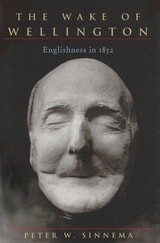
The Wake of Wellington
Englishness in 1852Peter W. Sinnema
Ohio University Press, 2006
Soldier, hero, and politician, the Duke of Wellington is one of the best-known figures of nineteenth-century England. From his victory at Waterloo over Napoleon in 1815, he rose to become prime minister of his country. But Peter Sinnema finds equal fascination in Victorian England’s response to the duke’s death.
The Wake of Wellington considers Wellington’s spectacular funeral pageant in the fall of 1852—an unprecedented event that attracted one and a half million spectators to London—as a threshold event against which the life of the soldier-hero and High Tory statesman could be re-viewed and represented.
Canvassing a profuse and dramatically proliferating Wellingtoniana, Sinnema examines the various assumptions behind, and implications of, the Times’s celebrated claim that the Irish-born Wellington “was the very type and model of an Englishman.” The dead duke, as Sinnema demonstrates, was repeatedly caught up in interpretive practices that stressed the quasi-symbolic relations between hero and nation.
The Wake of Wellington provides a unique view of how in death Wellington and his career were promoted as the consummation of a national destiny intimately bound up with Englishness itself, and with what it meant to be English at midcentury.
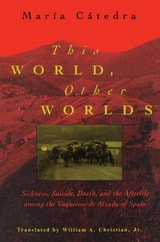
This World, Other Worlds
Sickness, Suicide, Death, and the Afterlife among the Vaqueiros de Alzada of SpainMaría Cátedra
University of Chicago Press, 1992
Applying sensitive ethnographic insight to a rich body of oral testimony, Cátedra discloses an unsuspected symbolic universe native to the Vaqueiros. Death is seen here in close, coherent relation to pain, age, and suffering; sickness and suicide, one must understand the cultural valuation of different ways of dying and the conditions under which suicides take place. To understand what it means to be a Vaqueiro is to understand how suicide can be perceived by a people as acceptable.
A groundbreaking work in European ethnography, This World, Other Worlds takes symbolic analysis to a new level. In its illumination of local conceptions of death, grace, and sainthood, the book also makes a substantial contribution to the anthropology of religion.
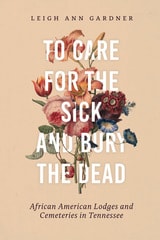
To Care for the Sick and Bury the Dead
African American Lodges and Cemeteries in TennesseeLeigh Ann Gardner
Vanderbilt University Press, 2022
These Black cemeteries dot the Tennessee landscape, but few know their history or the societies of care they represent. To Care for the Sick and Bury the Dead is the first book-length look at these cemeteries and the lodges that fostered them.
This book is a must-have for genealogists, historians, and family members of the people buried in these cemeteries.
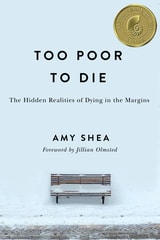
Too Poor to Die
The Hidden Realities of Dying in the MarginsAmy Shea
Rutgers University Press, 2025
Gold Winner in the Death & Dying Category of the Nautilus Book Awards
Winner of the 2025 Book Excellence Awards in the Death and Dying Category
Silver Winner in the Reader Views Literary Awards in the Humanities and Societal Issues categories
Best Nonfiction Book in TalkDeath's Reader Choice Awards
CALIBA Golden Poppy Award Finalist — Nonfiction category
Death is the great equalizer, but not all deaths are created equal. In recent years, there has been an increased interest and advocacy concerning end-of-life and after-death care. An increasing number of individuals and organizations from health care to the funeral and death care industries are working to promote and encourage people to consider their end-of-life wishes. Yet, there are limits to who these efforts reach and who can access such resources. These conversations come from a place of good intentions, but also from a place of privilege.
Too Poor to Die: The Hidden Realities of Dying in the Margins, a collection of closely connected essays, takes the reader on a journey into what happens to those who die while experiencing homelessness or who end up indigent or unclaimed at the end of life. Too Poor to Die bears witness to the disparities in death and dying faced by some of society’s most vulnerable and marginalized and asks the reader to consider their own end-of-life and disposition plans within the larger context of how privilege and access plays a role in what we want versus what we get in death.

Torture and the War on Terror
Tzvetan Todorov
Seagull Books, 2009
One of the world's leading intellectuals dismantles the political and ethical justifications for institutional torture.
In the aftermath of 9/11, the US government approved interrogation tactics for enemy combatant detainees that could be defined as torture, which was outlawed in Europe in the eighteenth century and forbidden by the Geneva Conventions and the United Nations Convention Against Torture. In conjunction with these policies, the Bush administration vocally defended torture as a necessary tool in its Global War on Terror. Though the election of Barack Obama and his signing of the executive order to close the prison at Guantanamo Bay signaled a considerable shift away from the policies of the Bush era, the lessons to be learned from the Global War on Terror will remain relevant and necessary for many years to come.
In Torture and the War on Terror, Tzvetan Todorov argues that the use of the terms “war” and “terror” dehumanizes the enemy and permits treatment that would otherwise be impermissible. He examines the implications and corrupting impact of the attempt to impose “good” through violence and spread democratic values by unethical means. Todorov asks: Can violence overcome violence? Does the need to protect one’s own country justify violating human rights? Challenging one by one the political and ethical arguments in favor of torture, Todorov likens institutional torture to a cancer that is eroding our society and undermining the very fundamental democratic ideas of justice and right.