Results by title
104 books match the query 'Deconstruction' and 31 start with t
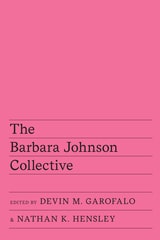
The Barbara Johnson Collective
Edited by Devin M. Garofalo and Nathan K. Hensley
Northwestern University Press, 2027
Collaboratively reassesses Barbara Johnson’s legacy as a reader and thinker with an eye to contemporary conditions
Across an archive of essays on abortion and race, Mallarmé and Melville, feminist philosophy, rhetorical device, and pedagogical method, Barbara Johnson built a legacy of thought whose energies reverberate into the present. This collected volume gathers writers and critics from a range of North American higher educational settings to engage with this essential but still often underappreciated critic in a time of renewed and deepening crisis.
In Zoom meetings and shared essays, across a virtualized map of today’s academic and para-academic worlds, the group assessed how the rolling catastrophes of late neoliberalism continue to stage the sort of analogy Johnson herself would highlight between patriarchy, capitalism, ecocide, and other forms of structural violence. Emerging from that assemblage, this experimental collection tracks Johnson’s efforts to link literary reading with concrete matters of personhood and care at a moment when the very system of higher education that enabled Johnson’s work in the 1980s and 1990s faces existential threat. The frozen record of a live experience, the book is an impure procedure, tangled in the idiom of its own unfolding: a temporary culmination of an ongoing collaborative undertaking that will always remain unfinished.

The Beast and the Sovereign, Volume I
Jacques Derrida
University of Chicago Press, 2009
When he died in 2004, Jacques Derrida left behind a vast legacy of unpublished material, much of it in the form of written lectures. With The Beast and the Sovereign, Volume 1, the University of Chicago Press inaugurates an ambitious series, edited by Geoffrey Bennington and Peggy Kamuf, translating these important works into English.
The Beast and the Sovereign, Volume 1 launches the series with Derrida’s exploration of the persistent association of bestiality or animality with sovereignty. In this seminar from 2001–2002, Derrida continues his deconstruction of the traditional determinations of the human. The beast and the sovereign are connected, he contends, because neither animals nor kings are subject to the law—the sovereign stands above it, while the beast falls outside the law from below. He then traces this association through an astonishing array of texts, including La Fontaine’s fable “The Wolf and the Lamb,” Hobbes’s biblical sea monster in Leviathan, D. H. Lawrence’s poem “Snake,” Machiavelli’s Prince with its elaborate comparison of princes and foxes, a historical account of Louis XIV attending an elephant autopsy, and Rousseau’s evocation of werewolves in The Social Contract.
Deleuze, Lacan, and Agamben also come into critical play as Derrida focuses in on questions of force, right, justice, and philosophical interpretations of the limits between man and animal.

The Beast and the Sovereign, Volume II
Jacques Derrida
University of Chicago Press, 2011
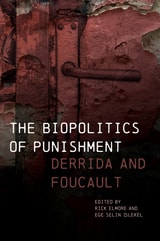
The Biopolitics of Punishment
Derrida and FoucaultEdited by Rick Elmore and Ege Selin Islekel
Northwestern University Press, 2022
With the resurgence of fascism and authoritarianism across the globe, the rise of white supremacist and xenophobic violence, and the continued brutality of state-sanctioned and extrajudicial killings by police, border patrols, and ordinary citizens, there is a pressing need to critically analyze our political present. These essays bring to bear the critical force of Derrida’s and Foucault’s biopolitical thought to practices of mass incarceration, the death penalty, life without parole, immigration and detention, racism and police violence, transphobia, human and animal relations, and the legacies of colonization. At the heart of their biopolitics, the volume shows, lies the desire to deconstruct and resist in the name of a future that is more just and less policed. It is this impulse that makes reading their work together, at this moment, both crucial and worthwhile.
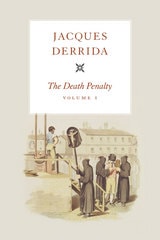
The Death Penalty, Volume I
Jacques Derrida
University of Chicago Press, 2013
With his signature genius and patient yet dazzling readings of an impressive breadth of texts, Derrida examines everything from the Bible to Plato to Camus to Jean Genet, with special attention to Kant and post–World War II juridical texts, to draw the landscape of death penalty discourses. Keeping clearly in view the death rows and execution chambers of the United States, he shows how arguments surrounding cruel and unusual punishment depend on what he calls an “anesthesial logic,” which has also driven the development of death penalty technology from the French guillotine to lethal injection. Confronting a demand for philosophical rigor, he pursues provocative analyses of the shortcomings of abolitionist discourse. Above all, he argues that the death penalty and its attendant technologies are products of a desire to put an end to one of the most fundamental qualities of our finite existence: the radical uncertainty of when we will die.
Arriving at a critical juncture in history—especially in the United States, one of the last Christian-inspired democracies to resist abolition—The Death Penalty is both a timely response to an important ethical debate and a timeless addition to Derrida’s esteemed body of work.
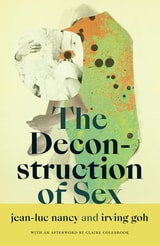
The Deconstruction of Sex
Jean-Luc Nancy and Irving Goh
Duke University Press, 2021

The Division of Literature
Or the University in DeconstructionPeggy Kamuf
University of Chicago Press, 1996
Kamuf begins by analyzing the complex history of literary study within the modern university, critically reading developments from the French Revolution through the nineteenth century and beyond in Europe. She then turns to one of the most troubling works in the American literary canon—Melville's The Confidence-Man—to show how academic literary history has avoided confronting the implications of works in which meaning is never solely confined within a past. By engaging a future readership to which it applies for credit, Kamuf argues, literature cannot serve as a stable object of study. It locates, rather, a site of "the university in deconstruction."
Ranging from disciplinary histories of literature to our current culture wars, Kamuf offers a fascinating critique of academic literary study.
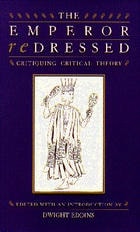
The Emperor Redressed
Critiquing Critical TheoryDwight Eddins
University of Alabama Press, 1995
The essays in this volume represent a collective questioning of the poststructuralist ascendancy, and of the assumptions involved therin, by a group of our most prominent scholars. These scholars were charged with examining the truth-value, methodology, practice, and humanistic status of poststructuralist theories and with speculating on what their conclusions portend for the future of theory. They provide cogent evidence that the poststructuralist heyday has passed.
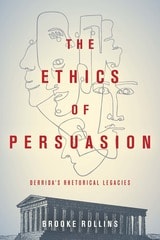
The Ethics of Persuasion
Derrida's Rhetorical LegaciesBrooke Rollins
The Ohio State University Press, 2020
Drawing on Derrida’s (non)definition of ethics and his pointed accounts of performativity, Rollins argues that this vital ethical component of many ancient theories, practices, and pedagogies of persuasion has been undertheorized for more than two millennia. Through deconstructive readings of some of these texts, she shows us that we are not simply sovereign beings who both wield and guard against linguistic techniques of rule. Our persuasive endeavors, rather, are made possible by an ethics—an always prior encounter with otherness that interrupts self-presence.

The Fate of the Self
German Writers and French TheoryStanley Corngold
Duke University Press, 1994

The Gift of Death, Second Edition & Literature in Secret
Jacques Derrida
University of Chicago Press, 2008
The Gift of Death, Second Edition & Literature in Secret
Jacques Derrida
University of Chicago Press, 2008

The History of Continental Philosophy
Edited by Alan D. Schrift
University of Chicago Press, 2010
From Kant to Kierkegaard, from Hegel to Heidegger, continental philosophers have indelibly shaped the trajectory of Western thought since the eighteenth century. Although much has been written about these monumental thinkers, students and scholars lack a definitive guide to the entire scope of the continental tradition. The most comprehensive reference work to date, this eight-volume History of Continental Philosophy will both encapsulate the subject and reorient our understanding of it. Beginning with an overview of Kant’s philosophy and its initial reception, the History traces the evolution of continental philosophy through major figures as well as movements such as existentialism, phenomenology, hermeneutics, and poststructuralism. The final volume outlines the current state of the field, bringing the work of both historical and modern thinkers to bear on such contemporary topics as feminism, globalization, and the environment. Throughout, the volumes examine important philosophical figures and developments in their historical, political, and cultural contexts.
The first reference of its kind, A History of Continental Philosophy has been written and edited by internationally recognized experts with a commitment to explaining complex thinkers, texts, and movements in rigorous yet jargon-free essays suitable for both undergraduates and seasoned specialists. These volumes also elucidate ongoing debates about the nature of continental and analytic philosophy, surveying the distinctive, sometimes overlapping characteristics and approaches of each tradition. Featuring helpful overviews of major topics and plotting road maps to their underlying contexts, A History of Continental Philosophy is destined to be the resource of first and last resort for students and scholars alike.
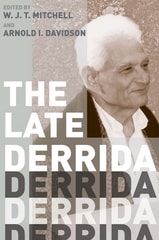
The Late Derrida
Edited by W. J. T. Mitchell and Arnold I. Davidson
University of Chicago Press, 2007
The rubric “The Late Derrida,” with all puns and ambiguities cheerfully intended, points to the late work of Jacques Derrida, the vast outpouring of new writing by and about him in the period roughly from 1994 to 2004. In this period Derrida published more than he had produced during his entire career up to that point. At the same time, this volume deconstructs the whole question of lateness and the usefulness of periodization. It calls into question the “fact” of his turn to politics, law, and ethics and highlights continuities throughout his oeuvre.
The scholars included here write of their understandings of Derrida’s newest work and how it impacts their earlier understandings of such classic texts as Glas and Of Grammatology. Some have been closely associated with Derrida since the beginning—both in France and in the United States—but none are Derrideans. That is, this volume is a work of critique and a deep and continued engagement with the thought of one of the most significant philosophers of our time. It represents a recognition that Derrida’s work has yet to be addressed—and perhaps can never be addressed—in its totality.
The Minor Gesture
Erin Manning
Duke University Press, 2016
The Ontology of Becoming and the Ethics of Particularity
M. C. Dillon
Ohio University Press, 2012
M. C. Dillon (1938–2005) was widely regarded as a world-leading Merleau-Ponty scholar. His book Merleau-Ponty’s Ontology (1988) is recognized as a classic text that revolutionized the philosophical conversation about the great French phenomenologist. Dillon followed that book with two others: Semiological Reductionism, a critique of early-1990s linguistic reductionism, and Beyond Romance, a richly developed theory of love. At the time of his death, Dillon had nearly completed two further books to which he was passionately committed. The first one offers a highly original interpretation of Nietzsche’s ontology of becoming. The second offers a detailed ethical theory based on Merleau-Ponty’s account of carnal intersubjectivity. The Ontology of Becoming and the Ethics of Particularity collects these two manuscripts written by a distinguished philosopher at the peak of his powers—manuscripts that, taken together, offer a distinctive and powerful view of human life and ethical relations.

The Politics of Deconstruction
Jacques Derrida and the Other of PhilosophyEdited by Martin McQuillan
Pluto Press, 2007
The Post Card
From Socrates to Freud and BeyondJacques Derrida
University of Chicago Press, 1987
You were reading a somewhat retro loveletter, the last in history. But you have not yet received it. Yes, its lack or excess of address prepares it to fall into all hands: a post card, an open letter in which the secret appears, but indecipherably.
What does a post card want to say to you? On what conditions is it possible? Its destination traverses you, you no longer know who you are. At the very instant when from its address it interpellates, you, uniquely you, instead of reaching you it divides you or sets you aside, occasionally overlooks you. And you love and you do not love, it makes of you what you wish, it takes you, it leaves you, it gives you.
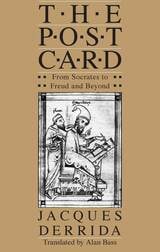
On the other side of the card, look, a proposition is made to you, S and p, Socrates and plato. For once the former seems to write, and with his other hand he is even scratching. But what is Plato doing with his outstretched finger in his back? While you occupy yourself with turning it around in every direction, it is the picture that turns you around like a letter, in advance it deciphers you, it preoccupies space, it procures your words and gestures, all the bodies that you believe you invent in order to determine its outline. You find yourself, you, yourself, on its path.
The thick support of the card, a book heavy and light, is also the specter of this scene, the analysis between Socrates and Plato, on the program of several others. Like the soothsayer, a "fortune-telling book" watches over and speculates on that-which-must-happen, on what it indeed might mean to happen, to arrive, to have to happen or arrive, to let or to make happen or arrive, to destine, to address, to send, to legate, to inherit, etc., if it all still signifies, between here and there, the near and the far, da und fort, the one or the other.
You situate the subject of the book: between the posts and the analytic movement, the pleasure principle and the history of telecommunications, the post card and the purloined letter, in a word the transference from Socrates to Freud, and beyond. This satire of epistolary literature had to be farci, stuffed with addresses, postal codes, crypted missives, anonymous letters, all of it confided to so many modes, genres, and tones. In it I also abuse dates, signatures, titles or references, language itself.
J. D.
"With The Post Card, as with Glas, Derrida appears more as writer than as philosopher. Or we could say that here, in what is in part a mock epistolary novel (the long section is called "Envois," roughly, "dispatches" ), he stages his writing more overtly than in the scholarly works. . . . The Post Card also contains a series of self-reflective essays, largely focused on Freud, in which Derrida is beautifully lucid and direct."—Alexander Gelley, Library Journal
The Premodern Condition
Medievalism and the Making of TheoryBruce Holsinger
University of Chicago Press, 2005
Holsinger shows that the preoccupation with medieval cultures and practices among Bataille, Derrida, Lacan, Barthes, Bourdieu, and their cohorts was so wide ranging that it merits recognition as one of the most significant epiphenomena of postwar French thought. Not simply an object of nostalgic longing or an occasional source of literary exempla, the medieval epoch was continually mined by these thinkers for specific philosophical vocabularies, social formations, and systems of thought.
To supplement its master thesis, The Premodern Condition also contains original essays by Bataille and Bourdieu—translated here for the first time into English—that testify in various ways to the strange persistence of medievalisms in French postwar avant-garde writings. What results is an important and original work that will be a touchstone for specialists in medieval studies and critical theory alike.
The Problem of Genesis in Husserl's Philosophy
Jacques Derrida
University of Chicago Press, 2003
For Derrida, the problem of genesis in Husserl's philosophy is that both temporality and meaning must be generated by prior acts of the transcendental subject, but transcendental subjectivity must itself be constituted by an act of genesis. Hence, the notion of genesis in the phenomenological sense underlies both temporality and atemporality, history and philosophy, resulting in a tension that Derrida sees as ultimately unresolvable yet central to the practice of phenomenology.
Ten years later, Derrida moved away from phenomenology entirely, arguing in his introduction to Husserl's posthumously published Origin of Geometry and his own Speech and Phenomena that the phenomenological project has neither resolved this tension nor expressly worked with it. The Problem of Genesis complements these other works, showing the development of Derrida's approach to phenomenology as well as documenting the state of phenomenological thought in France during a particularly fertile period, when Levinas, Sartre, Merleau-Ponty, Ricoeur, and Tran-Duc-Thao, as well as Derrida, were all working through it. But the book is most important in allowing us to follow Derrida's own development as a philosopher by tracing the roots of his later work in deconstruction to these early critical reflections on Husserl's phenomenology.
"A dissertation is not merely a prerequisite for an academic job. It may set the stage for a scholar's life project. So, the doctoral dissertations of Max Weber and Jacques Derrida, never before available in English, may be of more than passing interest. In June, the University of Chicago Press will publish Mr. Derrida's dissertation, The Problem of Genesis in Husserl's Philosophy, which the French philosopher wrote in 1953-54 as a doctoral student, and which did not appear in French until 1990. From the start, Mr Derrida displayed his inventive linguistic style and flouting of convention."—Danny Postel, Chronicle of Higher Education
The Saving Lie
Harold Bloom and DeconstructionAgata Bielik-Robson
Northwestern University Press, 2011
Bloom is indeed a party of one, a truly strong poet of his own mode of religious-literary criticism, who, in a typically Emersonian manner, makes his own circumstances and sheds influences by incorporating them into his idiosyncratic theory.In this unprecedented full-length study on Harold Bloom, Agata Bielik-Robson explores the many facets of Bloom’s critical writings and career. In his work, she argues, Bloom draws on a variety of disparate traditions—Judaism, gnosis, Romanticism, American pragmatism, and Freudianism, but also, especially recently, Victorian aestheticism—that comprise a dialectical, difficult whole in a constant quarrel with itself. Yet, this is precisely the image of "life-in-antithesis," which constitutes Bloom’s highest speculative achievement, she observes. The Saving Lie brings all these "Blooms" together and, despite their own tendencies toward dissociation, lets them speak unisono: in one almost harmonious voice that will clearly utter the principles of a new speculative position—Bloom’s antithetical vitalism. This study of Bloom and his contributions will not soon be surpassed.
The Truth in Painting
Jacques Derrida
University of Chicago Press, 1987
The Truth in Painting
Jacques Derrida
University of Chicago Press, 1987
The Verge of Philosophy
John Sallis
University of Chicago Press, 2007
The Verge of Philosophy is both an exploration of the limits of philosophy and a memorial for John Sallis’s longtime friend and interlocutor Jacques Derrida. The centerpiece of the book is an extended examination of three sites in Derrida’s thought: his interpretation of Heidegger regarding the privileging of the question; his account of the Platonic figure of the good; and his interpretation of Plato’s discourse on the crucial notion of the chora, the originating space of the universe.
Sallis’s reflections are given added weight—even poignancy—by his discussion of his many public and private philosophical conversations with Derrida over the decades of their friendship. This volume thus simultaneously serves to mourn and remember a friend and to push forward the deeply searching discussions that lie at the very heart of that friendship.
“All of John Sallis’s work is essential, but [this book] in particular is remarkable. . . . Sallis shows better than anyone I have ever read what it means to practice philosophy on the verge.”—Walter Brogan, Villanova University
The Work of Mourning
Jacques Derrida
University of Chicago Press, 2001
Gathered here are texts—letters of condolence, memorial essays, eulogies, funeral orations—written after the deaths of well-known figures: Roland Barthes, Paul de Man, Michel Foucault, Louis Althusser, Edmond Jabès, Louis Marin, Sarah Kofman, Gilles Deleuze, Emmanuel Levinas, Jean-François Lyotard, Max Loreau, Jean-Marie Benoist, Joseph Riddel, and Michel Servière.
With his words, Derrida bears witness to the singularity of a friendship and to the absolute uniqueness of each relationship. In each case, he is acutely aware of the questions of tact, taste, and ethical responsibility involved in speaking of the dead—the risks of using the occasion for one's own purposes, political calculation, personal vendetta, and the expiation of guilt. More than a collection of memorial addresses, this volume sheds light not only on Derrida's relation to some of the most prominent French thinkers of the past quarter century but also on some of the most important themes of Derrida's entire oeuvre-mourning, the "gift of death," time, memory, and friendship itself.
"In his rapt attention to his subjects' work and their influence upon him, the book also offers a hesitant and tangential retelling of Derrida's own life in French philosophical history. There are illuminating and playful anecdotes—how Lyotard led Derrida to begin using a word-processor; how Paul de Man talked knowledgeably of jazz with Derrida's son. Anyone who still thinks that Derrida is a facetious punster will find such resentful prejudice unable to survive a reading of this beautiful work."—Steven Poole, Guardian
"Strikingly simpa meditations on friendship, on shared vocations and avocations and on philosophy and history."—Publishers Weekly
The Work of Mourning
Jacques Derrida
University of Chicago Press, 2003
Gathered here are texts—letters of condolence, memorial essays, eulogies, funeral orations—written after the deaths of well-known figures: Roland Barthes, Paul de Man, Michel Foucault, Louis Althusser, Edmond Jabès, Louis Marin, Sarah Kofman, Gilles Deleuze, Emmanuel Levinas, Jean-François Lyotard, Max Loreau, Jean-Marie Benoist, Joseph Riddel, and Michel Servière.
With his words, Derrida bears witness to the singularity of a friendship and to the absolute uniqueness of each relationship. In each case, he is acutely aware of the questions of tact, taste, and ethical responsibility involved in speaking of the dead—the risks of using the occasion for one's own purposes, political calculation, personal vendetta, and the expiation of guilt. More than a collection of memorial addresses, this volume sheds light not only on Derrida's relation to some of the most prominent French thinkers of the past quarter century but also on some of the most important themes of Derrida's entire oeuvre-mourning, the "gift of death," time, memory, and friendship itself.
"In his rapt attention to his subjects' work and their influence upon him, the book also offers a hesitant and tangential retelling of Derrida's own life in French philosophical history. There are illuminating and playful anecdotes—how Lyotard led Derrida to begin using a word-processor; how Paul de Man talked knowledgeably of jazz with Derrida's son. Anyone who still thinks that Derrida is a facetious punster will find such resentful prejudice unable to survive a reading of this beautiful work."—Steven Poole, Guardian
"Strikingly simpa meditations on friendship, on shared vocations and avocations and on philosophy and history."—Publishers Weekly

The Yale Critics
Deconstruction in AmericaJonathan Arac, Wlad Godzich, and Wallace Martin, Editors
University of Minnesota Press, 1983
The Yale Critics was first published in 1983. Minnesota Archive Editions uses digital technology to make long-unavailable books once again accessible, and are published unaltered from the original University of Minnesota Press editions.
A heated debate has been raging in North America in recent years over the form and function of literature. At the center of the fray is a group of critics teaching at Yale University—Harold Bloom, Geoffrey Hartman, Paul de Man, and J. Hillis Miller—whose work can be described in relation to the deconstructive philosophy practiced by French philosopher Jacques Derrida. For over a decade the Yale Critics have aroused controversy; most often they are considered as a group, to be applauded or attacked, rather than as individuals whose ideas merit critical scrutiny. Here a new generation of scholars attempts for the first time a serious, broad assessment of the Yale group. These essays appraise the Yale Critics by exploring their roots, their individual careers, and the issues they introduce.
Wallace Martin's introduction offers a brilliant, compact account of the Yale Critics and of their relation to deconstruction and the deconstruction to two characteristically Anglo-American enterprises; Paul Bove explores the new criticism and Wlad Godzich the reception of Derrida in America. Next come essays giving individual attention to each of the critics: Michael Sprinker on Hartman, Donald Pease on Miller, Stanley Corngold on de Man, and Daniel O'Hara on Bloom. Two essays then illuminate "deconstruction in America" through a return to modern continental philosophy: Donald Marshall on Maurice Blanchot, and Rodolphe Gasche on Martin Heidegger. Finally, Jonathan Arac's afterword brings the volume together and projects a future beyond the Yale Critics.
Throughout, the contributors aim to provide a balanced view of a subject that has most often been treated polemically. While useful as an introduction, The Yale Critics also engages in a serious critical reflection on the uses of the humanities in American today.
Theory and Practice
Jacques Derrida
University of Chicago Press, 2019
Theory and Practice is a series of nine lectures that Jacques Derrida delivered at the École Normale Supérieure in 1976 and 1977. The topic of “theory and practice” was associated above all with Marxist discourse and particularly the influential interpretation of Marx by Louis Althusser. Derrida’s many questions to Althusser and other thinkers aim at unsettling the distinction between thinking and acting.
Derrida’s investigations set out from Marx’s “Theses on Feuerbach,” in particular the eleventh thesis, which has often been taken as a mantra for the “end of philosophy,” to be brought about by Marxist practice. Derrida argues, however, that Althusser has no such end in view and that his discourse remains resolutely philosophical, even as it promotes the theory/practice pair as primary values. This seminar also draws fascinating connections between Marxist thought and Heidegger and features Derrida’s signature reconsideration of the dichotomy between doing and thinking. This text, available for the first time in English, shows that Derrida was doing important work on Marx long before Specters of Marx. As with the other volumes in this series, it gives readers an unparalleled glimpse into Derrida’s thinking at its best—spontaneous, unpredictable, and groundbreaking.
Thinking Out of Sight
Writings on the Arts of the VisibleJacques Derrida
University of Chicago Press, 2021
The book is divided into three sections. The first demonstrates Derrida’s preoccupation with visibility, image, and space. The second contains interviews and collaborations with artists on topics ranging from the politics of color to the components of painting. Finally, the book delves into Derrida’s writings on photography, video, cinema, and theater, ending with a text published just before his death about his complex relationship to his own image. With many texts appearing for the first time in English, Thinking out of Sight helps us better understand the critique of representation and visibility throughout Derrida’s work, and, most importantly, to assess the significance of his insights about art and its commentary.
Tomb(e)
Hélène Cixous
Seagull Books, 2014
Turning Emotion Inside Out
Affective Life beyond the SubjectEdward S. Casey
Northwestern University Press, 2022
This book begins with a brief critique of internalist views of emotion that hold that feelings are sequestered within a subject. Casey affirms that while certain emotions are felt as resonating within our subjectivity, many others are experienced as occurring outside any such subjectivity. These include intentional or expressive feelings that transpire between ourselves and others, such as an angry exchange between two people, as well as emotions or affects that come to us from beyond ourselves. Casey claims that such far‑out emotions must be recognized in a full picture of affective life. In this way, the book proposes to “turn emotion inside out.”