Results by title
63 books match the query 'Detroit' and 14 start with t
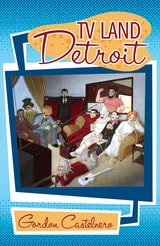
TV Land--Detroit
Gordon Castelnero
University of Michigan Press, 2006
Long before cable, prepackaged syndication, infomercials, do-it-yourselfers, and reality shows cluttered the television dial, there was a brand of entertainment that has today nearly vanished from the airwaves: local TV. And with its colorful and quirky cast of characters, Detroit TV arguably offered some of the best of the best of local programming anywhere in the nation-a smorgasbord of exuberant, one-of-a-kind television shows.
Based on actual interviews with the people who made Detroit TV, Gordon Castelnero's TV Land-Detroit awakens the emotional attachment and nostalgia our community has for these shows, bringing the beloved characters and memorable programs back to life.
From the glamorous Rita Bell to the insanity of the Ghoul, the zany Jingles in Boofland to the opinionated and often confrontational Lou Gordon and the gruff-voiced and somnolent George Pierrot, Castelnero reacquaints us with the talent and behind-the-scenes people, of the creative spirit in Detroit, and the intimacy they shared with the community both on and off the air.
Gordon Castelnero was a producer at WNIC radio for four years. He produced the acclaimed documentaries for WDIV and WTVS, Michigan, It Started Here! Michigan and the American Dream, and Titanic: The Final Chapter. He currently lives in Livonia, Michigan, and works at Technicolor in DVD and game media distribution. He can be contacted by e-mail at tvlanddetroit@yahoo.com

Talking Union
Judith Stepan-Norris and Maurice Zeitlin
University of Illinois Press, 1996
and cultural oral history of the struggle to unionize the River Rouge
Plant near Detroit during the 1930s and 40s, this book affords us a rare
insight into the difficulties of organizing a union in the face of the
then anti-union Ford Motor Company. Against a backdrop of the depression
and entrenched racism, history was made by courageous individuals whose
rich, eloquent stories illuminate the character and views of others like
them across the nation, from all backgrounds: left, right, and center;
black and white; native and foreign born, Jew and gentile.
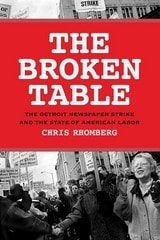
The Broken Table
The Detroit Newspaper Strike and the State of American LaborChris Rhomberg
Russell Sage Foundation, 2012
The Changing Face of Inequality
Urbanization, Industrial Development, and Immigrants in Detroit, 1880-1920Olivier Zunz
University of Chicago Press, 1983
The City after Property
Abandonment and Repair in Postindustrial DetroitSara Safransky
Duke University Press, 2023
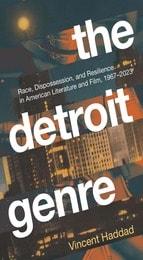
The Detroit Genre
Race, Dispossession, and Resilience in American Literature and Film, 1967-2023Vincent Haddad
Lever Press, 2024
The book first establishes the concept of the “Detroit genre” that emerged in late 1960s and traces the tropes of this white-centric narrative genre in popular culture, touching on key texts including Blue Collar, Robocop, The Crow, It Follows, and Barbarian. The second part shows how Black writers, including Alice Randall, adrienne maree brown, Stephen Mack Jones, and Angela Flournoy, reclaimed and revised the Detroit genre by un-fixing Detroit narratives of dispossession, criminality, and industrial and social failure through formal experimentations on genre itself.
Where Detroit has typically been painted in the news as one of three things—the center of the automotive industry; crime-ridden and in ruins; or as a “blank canvas” with limitless potential of entrepreneurship—Vincent Haddad shows that the Detroit genre in literature and film can be far more powerful than news media in narrating Black dispossession as a pragmatic, even liberal consensus. The texts studied here condition forgetfulness about Detroit’s history or expose it to a full reckoning, direct attention toward or away from the city’s agents of injustice, fetishize resilience or model resistance, and foreclose or imagine a future of Black liberation. Appealing to scholars of popular literature, media, race, and American studies, The Detroit Genre is an accessible and engaging study of the city’s influence on a wide array of genres in pop culture.
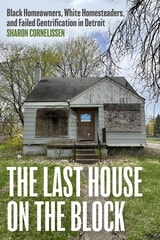
The Last House on the Block
Black Homeowners, White Homesteaders, and Failed Gentrification in DetroitSharon Cornelissen
University of Chicago Press, 2025
In the minds of many, Detroit is undergoing a renaissance thanks to gentrifying urbanites who’ve been drawn to the city with the promise of cheap housing and thriving culture. But what happens when gentrification attempts to come to one of the most depopulated neighborhoods in the country—a place where every other property in the neighborhood was a vacant lot and every third house stood empty? To find out, Sharon Cornelissen moved to the Brightmoor neighborhood of Detroit for three years and became the owner of a $7,000 house.
The Last House on the Block takes us to Brightmoor to meet Cornelissen’s fellow residents. She introduces us to the long-time residents of the neighborhood who reveal their struggles to keep a home while keeping violence, tall grass, and yes—gentrification—at bay. We also meet the eclectic white newcomers of Brightmoor and learn about their real estate bargains, urban farms, and how they became the unlikely defenders of urban desolation. Where oldtimers take pride in neatly mowed lawns and hope for a return to residential density, newcomers love the open space and aim to buy more empty lots to raise chickens and goats. It is a story of gentrification, but not at all in the usual sense: it is a case of failed gentrification. We often think about gentrification as an unstoppable force—once the first white newcomers with yoga mats enter an often brown or Black community, the coffee shops and restaurants follow. But in Brightmoor, the dreams of white newcomers met the harsh reality of decade-long decline. Nearly a decade after Cornelissen’s fieldwork began, Brightmoor is even emptier than it was when she started.
Today, depopulation remains more common than gentrification in poor communities. Cornelissen’s story offers deep insights into what it is like to live in a declining neighborhood, and through the example of Brightmoor, Cornelissen reveals why depopulation continues and helps us imagine a more inclusive and equitable city turnaround.
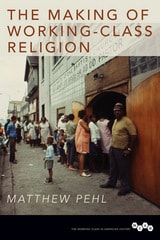
The Making of Working-Class Religion
Matthew Pehl
University of Illinois Press, 2016
Pehl embarks on an integrative view of working-class faith that ranges across boundaries of class, race, denomination, and time. As he shows, workers in the 1910s and 1920s practiced beliefs characterized by emotional expressiveness, alliance with supernatural forces, and incorporation of mass culture's secular diversions into the sacred. That gave way to the more pragmatic class-conscious religion cultures of the New Deal era and, from the late Thirties on, a quilt of secular working-class cultures that coexisted in competitive, though creative, tension. Finally, Pehl shows how the ideology of race eclipsed class in the 1950s and 1960s, and in so doing replaced the class-conscious with the race-conscious in religious cultures throughout the city.
An ambitiously inclusive contribution to a burgeoning field, The Making of Working-Class Religion breaks new ground in the study of solidarity and the sacred in the American heartland.
The Rise and Fall of an Urban School System
Detroit, 1907-81, Second EditionJeffrey Mirel
University of Michigan Press, 1999
Detroit's public school system, lauded as a model for the nation in the 1920s and 1930s, has become one of the city's most conspicuous failures. Jeffrey Mirel draws on Detroit's experience to offer a new interpretation of urban educational decline in the twentieth century, suggesting specific answers to what ails America's public schools and how public education can be improved.
Jeffrey Mirel has won two prestigious book awards for The Rise and Fall of an Urban School System. Stanford University and the American Educational Research Association awarded the book the 1994-95 "Outstanding Book Award" stating, "Mirel's documentation and interpretations serve as valuable and refreshing commentary on the current status of urban education, and by extension, all American education and society. . . . The book is admirably written with touches of drama, pathos, and hope." The American Educational Studies Association awarded Mirel the 1994 "Critics' Choice Award" for his outstanding contribution to Educational Studies.
This paperback edition includes a comprehensive epilogue focusing on recent events in Detroit educational reform. Detailing the formation and rapid collapse of a campaign in the late 1980s and early 1990s to radically restructure the Detroit public schools, Mirel's new analysis of this experiment illuminates both the persistence of historical trends in the school district and the possibilities for change.
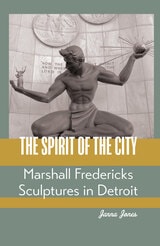
The Spirit of the City
Marshall Fredericks Sculptures in DetroitJanna Jones
Michigan State University Press, 2023
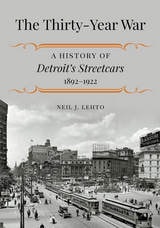
The Thirty-Year War
A History of Detroit's Streetcars, 1892–1922Neil J. Lehto
Michigan State University Press, 2017
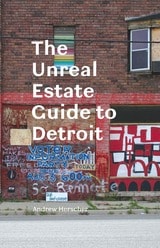
The Unreal Estate Guide to Detroit
Andrew Herscher
University of Michigan Press, 2012
Intense attention has been paid to Detroit as a site of urban crisis. This crisis, however, has not only yielded the massive devaluation of real estate that has so often been noted; it has also yielded an explosive production of seemingly valueless urban property that has facilitated the imagination and practice of alternative urbanisms. The first sustained study of Detroit’s alternative urban cultures, The Unreal Estate Guide to Detroit initiates a new focus on Detroit as a site not only of urban crisis but also of urban possibility.
The Guide documents art and curatorial practices, community and guerilla gardens, urban farming and forestry, cultural platforms, living archives, evangelical missions, temporary public spaces, intentional communities, furtive monuments, outsider architecture, and other work made possible by the ready availability of urban space in Detroit. The Guide poses these spaces as “unreal estate”: urban territory that has slipped through the free- market economy and entered other regimes of value, other contexts of meaning, and other systems of use. The appropriation of this territory in Detroit, the Guide suggests, offers new perspectives on what a city is and can be, especially in a time of urban crisis.
Three Bullets Sealed His Lips
Bruce A. Rubenstein
Michigan State University Press, 1987
The gangland style slaying if State Senator Warren G. Hooper on January 11, 1945, three days before he was to testify before a grand jury investigating alleged corruption in the Michigan legislature, forced coverage of Allied war triumphs from the state's newspaper headlines. National media representatives flocked to Michigan to join local reporters in following the efforts of grand jury special prosecutor Kim Sigler and the State Police to apprehend the killers. Because no arrests ever were made, a 1951 journalistic prediction has proven true: "The Hooper case will continue to come back to remind the people and politicians of Michigan of the black days of 1945 when almost every official of the state had his price." For this reason, the Hooper murder has endured as one of the most intriguing unsolved mysteries in the annals of Michigan crime.
Utilizing interviews, trial transcripts, State police files, and a collection of grand jury testimony long thought to have been destroyed, Professors Bruce A. Rubenstein and Lawrence E. Ziewacz set forth the reason for Hooper's assassination. Written in a lively style, using dialogue taken from court records and correspondence, Three Bullets Sealed His Lips demonstrates that historical writing need not be dull.
Tight Spaces
Kesho Scott
University of Iowa Press, 1999