Results by title
106 books match the query 'Dictionaries' and 32 start with t
Take My Word for It
A Dictionary of English IdiomsAnatoly Liberman
University of Minnesota Press, 2022
Three centuries of English idioms—their unusual origins and unexpected interpretations
To pay through the nose. Raining cats and dogs. By hook or by crook. Curry favor. Drink like a fish. Eat crow. We hear such phrases every day, but this book is the first truly all-encompassing etymological guide to both their meanings and origins. Spanning more than three centuries, Take My Word for It is a fascinating, one-of-a-kind window into the surprisingly short history of idioms in English. Widely known for his studies of word origins, Anatoly Liberman explains more than one thousand idioms, both popular and obscure, occurring in both American and British standard English and including many regional expressions.
The origins, and even the precise meaning, of most idioms are often obscure and lost in history. Based on a critical analysis of countless conjectures, with exact, in-depth references (rare in the literature on the subject), Take My Word for It provides not only a large corpus of idiomatic phrases but also a vast bibliography. Detailed indexes and a thesaurus make the content accessible at a glance, and Liberman’s introduction and conclusion add historical dimensions. The result of decades of research by a leading authority, this book is both instructive and absorbing for scholars and general readers, who won’t find another resource as comparable in scope or based on data even remotely as exhaustive.
The American Sign Language Handshape Dictionary
Richard A. Tennant
Gallaudet University Press, 2020
Featuring
•More than 1,900 Sign Illustrations Including 327 New Signs•Plus DVD Showing How to Form Signs
•Arranged by Handshape for Easy Identification
•Complete Index of English Vocabulary for All Signs
•An Introduction to Deaf Culture and ASL Structure
The first reference source that allows users to access ASL signs without previous knowledge of their English equivalents (far superior to those in most other English-ASL glossaries). Likely to become indispensable on many educators’ and students’ bookshelves.—CHOICE
Now, the bestselling resource The American Sign Language Handshape Dictionary has been completely revised with more than 320 new signs and a new DVD. This unique reference can help users locate a sign whose meaning they have forgotten, or help them find the meaning of a new sign they have just seen for the first time. It organizes more than 1,900 ASL signs by 40 basic handshapes and includes detailed descriptions on how to form these signs to represent the different English words that they might mean. ASL students can begin to track down a sign by determining whether it is formed with one hand or two. Further distinctions of handshape, palm orientation, location, movement, and other nonmanual body signals help them pinpoint their search while also refining their grasp of ASL syntax and grammar. A complete English word index provides the option of referring to an alphabetical listing of English terms to locate an equivalent sign or choice of signs.
The new DVD shows how each sign is formed from beginning to end. Users can watch a sign at various speeds to learn precisely how to master it themselves. Together, the new edition of The American Sign Language Handshape Dictionary and its accompanying DVD presents students, sign language teachers, and deaf and hearing people alike with the perfect combination for enhancing communication skills in both ASL and English.
The American Sign Language Handshape Starter
A Beginner's GuideRichard A. Tennant
Gallaudet University Press, 2002
The Biographical Dictionary of Iowa
David Hudson
University of Iowa Press, 2009
Written by an impressive team of more than 150 scholars and writers, the readable narratives include each subject’s name, birth and death dates, place of birth, education, and career and contributions. Many of the names will be instantly recognizable to most Iowans; others are largely forgotten but deserve to be remembered. Beyond the distinctive lives and times captured in the individual biographies, readers of the dictionary will gain an appreciation for how the character of the state has been shaped by the character of the individuals who have inhabited it.
From Dudley Warren Adams, fruit grower and Grange leader, to the Younker brothers, founders of one of Iowa’s most successful department stores, The Biographical Dictionary of Iowa is peopled with the rewarding lives of more than four hundred notable citizens of the Hawkeye State. The histories contained in this essential reference work should be eagerly read by anyone who cares about Iowa and its citizens.
Entries include Cap Anson, Bix Beiderbecke, Black Hawk, Amelia Jenks Bloomer, William Carpenter, Philip Greeley Clapp, Gardner Cowles Sr., Samuel Ryan Curtis, Jay Norwood Darling, Grenville Dodge, Julien Dubuque, August S. Duesenberg, Paul Engle, Phyllis L. Propp Fowle, George Gallup, Hamlin Garland, Susan Glaspell, Josiah Grinnell, Charles Hearst, Josephine Herbst, Herbert Hoover, Inkpaduta, Louis Jolliet, MacKinlay Kantor, Keokuk, Aldo Leopold, John L. Lewis, Marquette, Elmer Maytag, Christian Metz, Bertha Shambaugh, Ruth Suckow, Billy Sunday, Henry Wallace, and Grant Wood.
Excerpt from the entry on:
Gallup, George Horace (November 19, 1901–July 26, 1984)—founder of the American Institute of Public Opinion, better known as the Gallup Poll, whose name was synonymous with public opinion polling around the world—was born in Jefferson, Iowa. . . . . A New Yorker article would later speculate that it was Gallup’s background in “utterly normal Iowa” that enabled him to find “nothing odd in the idea that one man might represent, statistically, ten thousand or more of his own kind.” . . . In 1935 Gallup partnered with Harry Anderson to found the American Institute of Public Opinion, based in Princeton, New Jersey, an opinion polling firm that included a syndicated newspaper column called “America Speaks.” The reputation of the organization was made when Gallup publicly challenged the polling techniques of The Literary Digest, the best-known political straw poll of the day. Calculating that the Digest would wrongly predict that Kansas Republican Alf Landon would win the presidential election, Gallup offered newspapers a money-back guarantee if his prediction that Franklin Delano Roosevelt would win wasn’t more accurate. Gallup believed that public opinion polls served an important function in a democracy: “If govern¬ment is supposed to be based on the will of the people, somebody ought to go and find what that will is,” Gallup explained.
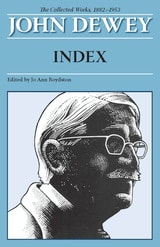
The Collected Works of John Dewey, Index
1882 - 1953John Dewey. Edited by Jo Ann Boydston
Southern Illinois University Press, 1991
This cumulative index to the thirty-seven volumes of The Collected Works of John Dewey, 1882–1953, is an invaluable guide to The Collected Works.
The Collected Works Contents incorporates all the tables of contents of Dewey’s individual volumes, providing a chronological, volume-by-volume overview of every item in The Early Works, The Middle Works, and The Later Works.
The Title Index lists alphabetically by shortened titles and by key words all items in The Collected Works. Articles republished in the collections listed above are also grouped under the titles of those books.
The Subject Index, which includes all information in the original volume indexes, expands that information by adding the authors of introductions to each volume, authors and titles of books Dewey reviewed or introduced, authors of appendix items, and relevant details from the source notes.
The Concise Greek-English Lexicon of the New Testament
Frederick William Danker
University of Chicago Press, 2009
Frederick William Danker, a world-renowned scholar of New Testament Greek, is widely acclaimed for his 2000 revision of Walter Bauer’s A Greek-English Lexicon of the New Testament and Other Early Christian Literature. With more than a quarter of a million copies in print, it is considered the finest dictionary of its kind.
Danker’s Concise Greek-English Lexicon of the New Testament will prove to be similarly invaluable to ministers, seminarians, translators, and students of biblical Greek. Unlike other lexica of the Greek New Testament, which give only brief glosses for headwords, The Concise Greek-English Lexicon offers extended definitions or explanations in idiomatic English for all Greek terms.
Each entry includes basic etymological information, short renderings, information on usage, and plentiful biblical references. Greek terms that could have different English definitions, depending on context, are thoughtfully keyed to the appropriate passages. An overarching aim of The Concise Greek-English Lexicon is to assist the reader in recognizing the broad linguistic and cultural context for New Testament usage of words.
The Concise Greek-English Lexicon retains all the acclaimed features of A Greek-English Lexicon in a succinct and affordable handbook, perfect for specialists and nonspecialists alike.
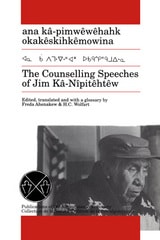
The Counselling Speeches of Jim Ka-Nipitehtew
Freda Ahenakew
University of Manitoba Press, 1998

The Cree Language is Our Identity
The La Ronge lectures of Sarah WhitecalfSarah Whitecalf
University of Manitoba Press, 1983
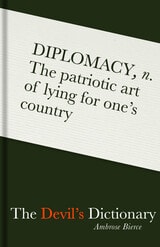
The Devil's Dictionary
Ambrose Bierce
Bodleian Library Publishing, 2018
A contemporary of Mark Twain, Bierce brought his biting humor to bear on spoof definitions of everyday words, writing deliberate mistranslations of the vocabulary of the establishment, the church, and the politics of his day, and shining a sardonic light on hypocrisy and deception. These columns formed the beginnings of a dictionary, first published in 1906 as The Cynic’s Word Book, which stopped at the letter L, and five years later as a full A–Z text known as The Devil's Dictionary. More than one hundred years later, Bierce’s redefinitions still give us pause for thought: interpreting reporter, for example, as “a writer who guesses his way to the truth and dispels it with a tempest of words”; un-american as “wicked, intolerable, heathenish”; and politics as “the conduct of public affairs for private advantage.” This timely new edition of Bierce’s irreverent and provocative dictionary is the perfect gift for misanthropes and word lovers alike.

The Dictionary of Nineteenth-Century British Scientists
Edited by Bernard Lightman
University of Chicago Press, 2004
While the Dictionary of Nineteenth-Century British Scientists covers those working in traditional scientific areas such as physics, astronomy, chemistry, mathematics, and biology, it also acknowledges those working in the human sciences such as anthropology, sociology, psychology, and medicine. In addition, areas often overlooked by historians of science—such as phrenology, mesmerism, spiritualism, scientific illustration, scientific journalism and publishing, instrument making, and government policy—are included here, as are the important roles of neglected "amateurs," such as women and members of the working class. By including those who worked in nontraditional areas and by considering the social and cultural context in which they lived, the dictionary reflects a richer picture of nineteenth-century science than has ever been seen before.
The Eloquent Shakespeare
A Pronouncing Dictionary for the Complete Dramatic Works with Notes to Untie the Modern TongueGary Logan
University of Chicago Press, 2008
The Encyclopedia of Native Music
More Than a Century of Recordings from Wax Cylinder to the InternetBrian Wright-McLeod
University of Arizona Press, 2005
In addition to the widely heard sounds of Carlos Nakai’s flute, Native music embraces a wide range of forms: country and folk, jazz and swing, reggae and rap. Brian Wright-McLeod, producer/host of Canada’s longest-running Native radio program, has gathered the musicians and their music into this comprehensive reference, an authoritative source for biographies and discographies of hundreds of Native artists.
The Encyclopedia of Native Music recognizes the multifaceted contributions made by Native recording artists by tracing the history of their commercially released music. It provides an overview of the surprising abundance of recorded Native music while underlining its historical value.
With almost 1,800 entries spanning more than 100 years, this book leads readers from early performers of traditional songs like William Horncloud to artists of the new millennium such as Zotigh. Along the way, it includes entries for jazz and blues artists never widely acknowledged for their Native roots—Oscar Pettiford, Mildred Bailey, and Keely Smith—and traces the recording histories of contemporary performers like Rita Coolidge and Jimmy Carl Black, “the Indian of the group” in the original Mothers of Invention. It also includes film soundtracks and compilation albums that have been instrumental in bringing many artists to popular attention. In addition to music, it lists spoken-word recordings, including audio books, comedy, interviews, poetry, and more.
With this unprecedented breadth of coverage and extensively cross-referenced, The Encyclopedia of Native Music is an essential guide for enthusiasts and collectors. More than that, it is a gateway to the authentic music of North America—music of the people who have known this land from time immemorial and continue to celebrate it in sound.
The First American Women Architects
Sarah Allaback
University of Illinois Press, 2007
Organized alphabetically as a reference guide, this volume provides a biographical sketch of each architect's life, education, and professional career, and a list of known works and sources for further research. Many of these remarkable women have never before appeared in any other history, making The First American Women Architects a unique and invaluable reference for students and scholars interested in women's history and architecture. As an instructive record of the legacy of women in architectural history, this book will also serve as a stimulating indicator of the broadening potential for women and other minorities within the field of architecture.
The First English Dictionary 1604
Robert Cawdrey's A Table AlphabeticallRobert Cawdrey
Bodleian Library Publishing, 2007
English is one of the most complicated languages to learn, and its constantly evolving vocabulary certainly doesn’t help matters. For centuries, men and women have striven to chronicle and categorize the expressions of the English language, and Samuel Johnson is usually thought to be their original predecessor. But that lineage is wrong: Robert Cawdrey published his Table Alphabeticall in 1604, 149 years before Johnson’s tome, and it is now republished here for the first time in over 350 years.
This edition, prepared from the sole surviving copy of the first printing, documents Cawdrey’s fascinating selection of 2,543 words and their first-ever definitions. Cawdrey subtitled his dictionary “for the benefit of Ladies, Gentlewomen, and other unskilled folk,” for his aim was not to create a comprehensive catalog, but rather an in-depth guide for the lesser educated who might not know the “hard usual English wordes, borrowed from the Hebrew, Greeke, Latine, or French.” Each entry reveals an intriguing facet of early modern life and the cultural mores of the time. There are familiar terms—“geometrie” was defined as “the art of measuring the earth,” and a “concubine” was described as a “harlot, or light huswife”—and amusingly idiomatic definitions: "prodigall" is "too riotous in spending," while "hecticke" is "inflaming the hart, and soundest parts of the bodie.”
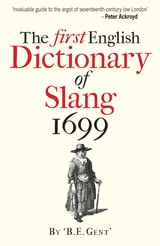
The First English Dictionary of Slang, 1699
B. E. Gent
Bodleian Library Publishing, 2010
It’s a shame that so many very apt words fall out of common use over time, like “blobber-lippd,” which means having lips that are very thick, hanging down, or turning over; and “chounter”, which is to talk pertly, and sometimes angrily. Both words can be found in The First English Dictionary of Slang, originally published in 1699 as A New Dictionary of Terms, Ancient and Modern, of the Canting Crew by B. E. Gentleman. Though a number of early texts, beginning in the sixteenth century, codified forms of cant—the slang language of the criminal underworld—in word lists which appeared as appendices or parts of larger volumes, the dictionary of 1699 was the first work dedicated to slang words and their meanings. It aimed to educate the more polite classes in the language and, consequently, the methods of thieves and vagabonds, protecting the innocent from cant speakers and their activities.
This dictionary is also the first that attempts to show the overlap and integration between canting words and common slang words. Refusing to distinguish between criminal vocabulary and the more ordinary everyday English of the period, it sets canting words side by side with terms used in domestic culture and those used by sailors and laborers. With such a democratic attitude toward words, this text is genuinely a modern dictionary, as well as the first attempt by dictionary makers to catalog the ever-changing world of English slang.
Reproduced here with an introduction by John Simpson, chief editor of the Oxford English Dictionary, describing the history and culture of canting in the seventeenth and eighteenth centuries, as well as the evolution of English slang, this is a fascinating volume for all who marvel at words and may wish to reclaim a few—say, to dabble in the parlance of a seventeenth-century sailor one day and that of a vagabond the next.
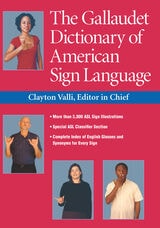
The Gallaudet Dictionary of American Sign Language
Clayton Valli
Gallaudet University Press, 2021
Created by an unparalleled board of experts led by renowned ASL linguist and poet Clayton Valli, The Gallaudet Dictionary of American Sign Language contains over 3,000 illustrations. Each sign illustration, including depictions of fingerspelling when appropriate, incorporates a complete list of English synonyms. A full, alphabetized English index enables users to cross-reference words and signs throughout the entire volume.
The comprehensive introduction lays the groundwork for learning ASL by explaining in plain language the workings of ASL syntax and structure. It also offers examples of idioms and describes the antecedents of ASL, its place in the Deaf community, and its meaning in Deaf culture. This extraordinary reference also provides a special section on ASL classifiers and their use. Readers will find complete descriptions of the various classifiers and examples of how to use these integral facets of ASL. The Gallaudet Dictionary of American Sign Language is an outstanding ASL reference for all instructors, students, and users of ASL.
*Please note that this paperback edition does not include the DVD found in the hardcover edition.
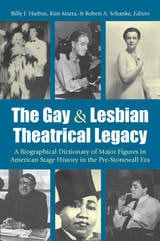
The Gay and Lesbian Theatrical Legacy
A Biographical Dictionary of Major Figures in American Stage History in the Pre-Stonewall EraBilly J. Harbin, Kim Marra, and Robert A. Schanke, Editors
University of Michigan Press, 2005
“A superb tribute to theatrical pioneers—The Gay and Lesbian Theatrical Legacy is required reading for both theatre scholars and gay/lesbian/bisexual history aficionados. A fascinating journey awaits them all in this highly recommended volume.”
—Broadside: Newsletter of the Theatre Library Association
The Gay and Lesbian Theatrical Legacy collects in a single volume biographies of more than one hundred notable figures whose careers flourished in the years before the 1969 Stonewall Riots marked the beginning of the gay and lesbian civil rights movement in the United States. The leading lights in American theater have included innumerable individuals whose sexualities have deviated from prevailing norms, but this history has until recently been largely unwritten and unknown. This book contributessignificantly to the recovery of this history, fashioning a much fuller, more nuanced portrait of American theater as it evolved and shedding light on the influence that sexual desire may have had on professional choices, relationships, and artistic achievements.
The Gay and Lesbian Theatrical Legacy collects biographies and portraits of influential actors, playwrights, composers, directors, designers, dancers, producers, managers, critics, choreographers, and technicians who made their mark on the American theater. Its broad coverage provides an extended glimpse into lives and careers that intersected and into networks of affiliation that made theatrical history and, by extension, social and cultural history.
The late Billy J. Harbin was Professor of Theater, Louisiana State University. Kim Marra is Associate Professor of Theater, University of Iowa. Robert A. Schanke is Professor of Theater Emeritus, Central College, Pella, Iowa.
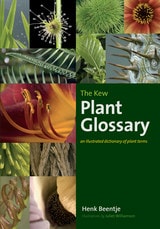
The Kew Plant Glossary
An Illustrated Dictionary of Plant TermsHenk Beentje
Royal Botanic Gardens, Kew, 2010
This accessible, comprehensive glossary covers all the descriptive terms for plants that one is likely to encounter in botanical writing, including everything from magazine articles to plant field guides, scientific papers, and monographs. An essential companion, it presents 3,600 botanical terms, accompanied by full definitions and detailed illustrations to aid in identification, all laid out in a clear, easy-to-use fashion. It will be indispensable for plant scientists, conservationists, horticulturists, gardeners, writers, and anyone working with plant descriptions, plant identification keys, floras, or field guides.
The Origins of Catholic Words
A Discursive DictionaryAnthony Lo Bello
Catholic University of America Press, 2020
The PhDictionary
A Glossary of Things You Don't Know (but Should) about Doctoral and Faculty LifeHerb Childress
University of Chicago Press, 2016
With more than two decades as a doctoral student, college teacher, and administrator, Herb Childress has tripped over almost every possible misunderstood term, run up against every arcane practice, and developed strategies to deal with them all. He combines current data and personal stories into memorable definitions of 150 key phrases and concepts graduate students will need to know (or pretend to know) as they navigate their academic careers. From ABD to white paper—and with buyout, FERPA, gray literature, and soft money in between—each entry contains a helpful definition and plenty of relevant advice. Wry and knowledgeable, Childress is the perfect guide for anyone hoping to scale the ivory tower.
The Popular Press Companion to Popular Literature
Victor E. Neuburg
University of Wisconsin Press, 1983
The Regional Vocabulary of Texas
By E. Bagby Atwood
University of Texas Press, 1962
The vocabulary of Texas, and of the Southwest, has a character that sets it apart from all others. It is to some extent an amalgamation of words brought from other sections. A more important ingredient, however, has been a large group of words that initially grew into usage in Texas itself.
Utilizing a thorough knowledge of language and a remarkable insight into linguistics, E. Bagby Atwood has compiled a reference book for scholars, writers, and laypeople whose interests involve the use of this vocabulary. It is a well-balanced book, designed to present to the reader not only the actual vocabulary in use but also the area involved, topical surveys of words used, their backgrounds, and geographical aspects of their usage. Easterners and Westerners alike will relish the unique flavor of the Southwestern vocabulary.
The Translations of Nebrija
Language, Culture, and Circulation in the Early Modern WorldByron Ellsworth Hamann
University of Massachusetts Press, 2015
Tracing the global influence of Nebrija's dictionary, Byron Ellsworth Hamann, in this interdisciplinary, deeply researched book, connects pagan Rome, Muslim Spain, Aztec Tenochtitlan, Elizabethan England, the Spanish Philippines, and beyond, revealing new connections in world history. The Translations of Nebrija re-creates the travels of people, books, and ideas throughout the early modern world and reveals the adaptability of Nebrija's text, tracing the ways heirs and pirate printers altered the dictionary in the decades after its first publication. It reveals how entries in various editions were expanded to accommodate new concepts, such as for indigenous languages in the Americas—a process with profound implications for understanding pre-Hispanic art, architecture, and writing. It shows how words written in the margins of surviving dictionaries from the Americas shed light on the writing and researching of dictionaries across the early modern world.
Exploring words and the dictionaries that made sense of them, this book charts new global connections and challenges many assumptions about the early modern world.
The University of Chicago Spanish Dictionary, Fifth Edition, Spanish-English, English-Spanish
Universidad de Chicago Diccionario Español-Inglés, Inglés-EspañolEdited by David A. Pharies
University of Chicago Press, 2002
With thousands of added entries, the Dictionary builds on the features that have made it the leader in its field for more than fifty years: authority, scope, clarity, and conciseness. And with this edition, the Dictionary brilliantly captures the current core vocabularies of two rapidly changing—and increasingly connected—languages and cultures.
Entirely bilingual, the fifth edition focuses on two contemporary international languages—American English and a basic, worldwide Spanish that draws from both Latin American and Iberian sources.
Designed for a wide range of users, including travelers, businesspeople, students, teachers, and professionals, the new Dictionary is the essential first resource for speakers of both languages—from beginners to those at all other stages. Up to date, just comprehensive enough, and extraordinarily clear and easy to use, the new edition of The University of Chicago Spanish Dictionary stands alone. No other dictionary offers so many users so much help—or so much value.
The University of Chicago Spanish-English Dictionary, Sixth Edition
Diccionario Universidad de Chicago Inglés-Español, Sexta EdiciónDavid A. Pharies, Editor in Chief
University of Chicago Press, 2012
A concise, authoritative, up-to-date guide to Spanish and English
The University of Chicago Spanish–English Dictionary has long set the standard for concise bilingual dictionaries. Portable yet remarkably thorough, the dictionary enables users to find the precise equivalents of the words and phrases they seek.
The Victorian Dictionary of Slang & Phrase
J. Redding Ware
Bodleian Library Publishing, 2015
First published in 1909 and reproduced here with a new introduction by Oxford English Dictionary former editor John Simpson, The Victorian Dictionary of Slang and Phrase 1909 reflects the rich history of unofficial English. Many of the expressions are obsolete; one is not likely to have the misfortune of encountering a “parlour jumper.” Order a “shant of bivvy” at the pub and you’ll be met with a blank stare. But some of the entries reveal the origins of expressions still in use today, such as calling someone a “bad egg” to indicate that they are dishonest or of ill-repute. While showing the significant influence of American English on Victorian slang, the Dictionary also demonstrates how impressively innovative its speakers were. A treasure trove of everyday language of the nineteenth century, this book has much to offer in terms of insight into the intriguing history of English and will be of interest to anyone with a passion for words.
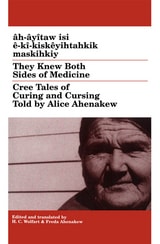
They Knew Both Sides of Medicine
Cree Tales of Curing and Cursing Told by Alice AhenakewH.C. Wolfart
University of Manitoba Press, 2000
Three Language List of Botanical Name Components
A. Radcliffe-Smith
Royal Botanic Gardens, Kew, 2000
Tohono O'odham/Pima to English, English to Tohono O'odham/Pima Dictionary
Dean Saxton, Lucille Saxton, and Susie Enos
University of Arizona Press, 1983
Tondi Songway Kiini
Reference Grammar and TSK-English-French DictionaryJeffrey Heath
CSLI, 2005
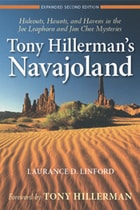
Tony Hillerman's Navajoland
Hideouts, Haunts, and Havens in the Joe Leaphorn and Jim Chee MysteriesLaurance D. Linford
University of Utah Press, 2005
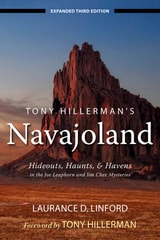
Tony Hillerman's Navajoland
Hideouts, Haunts, and Havens in the Joe Leaphorn and Jim Chee MysteriesLaurance D. Linford
University of Utah Press, 2011
Tony Hillerman is beloved for his novels of intrigue in the American Southwest. In Tony Hillerman’s Navajoland, Laurance Linford takes readers on a journey through the Four Corners region to the haunts of Hillerman’s characters. Offered in encyclopedic form, each entry gives the common name of a particular location, the Navajo name and history, and a description of the location’s significance in various Hillerman novels. An understanding of the Navajo names and their relations to the landscape will lend a new dimension to the characters and events Tony Hillerman created.