Results by title
67 books match the query 'Environmental protection' and 14 start with t
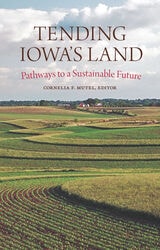
Tending Iowa’s Land
Pathways to a Sustainable FutureCornelia F. Mutel
University of Iowa Press, 2022
In the last 200 years, Iowa’s prairies and other wildlands have been transformed into vast agricultural fields. This massive conversion has provided us with food, fiber, and fuel in abundance. But it has also robbed Iowa’s land of its native resilience and created the environmental problems that today challenge our everyday lives: polluted waters, increasing floods, loss and degradation of rich prairie topsoil, compromised natural systems, and now climate change.
In a straightforward, friendly style, Iowa’s premier scientists and experts consider what has happened to our land and outline viable solutions that benefit agriculture as well as the state’s human and wild residents.
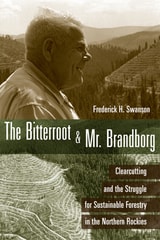
The Bitterroot and Mr. Brandborg
Clearcutting and the Struggle for Sustainable Forestry in the Northern RockiesFrederick H. Swanson
University of Utah Press, 2011
Winner of the Wallace Stegner Prize in American Environmental or Western History
Fredrick Swanson tells the story of Guy M. Brandborg and his impact on the practices of the U.S. Forest Service. As supervisor of Montana’s Bitterroot National Forest from 1935 to 1955, Brandborg engaged in a management style that promoted not only the well-being of the forest community but also the social and economic welfare of the local people. By relying on selective cutting, his goal was to protect the watersheds and wildlife habitats that are devastated by clear-cutting, and to prevent the job losses that follow such practices. Following his retirement, he became concerned that his agency was deviating from the practice of sustained-yield management of the forest’s timber lands, and led a highly visible public outcry that became known as the Bitterroot controversy. Brandborg’s behind-the-scenes lobbying contributed materially to the passage of the National Forest Management Act of 1976, the single most important law affecting public forestry since the creation of the Forest Service.
Winner of the Western Writers of America Spur Award for Best Western Nonfiction-Contemporary.
The Environmental Beat
Inside the Struggle to Legitimize the Environment as NewsSuzannah Evans Comfort
University of Missouri Press, 2026
Environmental degradation has been part of American life for centuries, and yet environmental journalism as a specialized reporting beat has only existed since the 1960s. In the ensuing decades, the environment has fallen in and out of favor as a priority for news organizations. Moreover, journalists who pursue environmental stories have long been dogged by a reputation that they are activists, a charge that delegitimizes their labor and further undermines the potential for news organizations to commit to reporting on environmental issues.
In The Environmental Beat: Inside the Struggle to Legitimize the Environment as News, Suzannah Evans Comfort examines the circumstances under which news organizations chose to invest in environmental journalism since the early 20th century, demonstrating that a combination of external social factors and internal newsroom dynamics must occur for the environment to appear as a newsworthy topic. Comfort also examines actors on the margins of journalistic legitimacy, such as newspaper outdoor columnists who wrote on the sports pages, and environmental advocacy presses that provided a far more consistent source of environmental news making than their peers in the newsroom. These low-status actors in the journalistic field embraced advocacy and rejected both-siderism in their reporting on issues of the environment. Their consistency and longevity, even as more traditionally produced news attention waxed and waned, may provide an explanation for the perception of environmental news making as fundamentally activist.
The Environmental Beat will be of interest to working journalists as well as scholars of journalism.

The Green Economy
Environment, Sustainable Development and the Politics of the FutureMichael Jacobs
Pluto Press, 1992
The Making of Environmental Law
Richard J. Lazarus
University of Chicago Press, 2004
In The Making of Environmental Law, Richard J. Lazarus offers a new interpretation of the past three decades of this area of the law, examining the legal, political, cultural, and scientific factors that have shaped—and sometimes hindered—the creation of pollution controls and natural resource management laws. He argues that in the future, environmental law must forge a more nuanced understanding of the uncertainties and trade-offs, as well as the better-organized political opposition that currently dominates the federal government. Lazarus is especially well equipped to tell this story, given his active involvement in many of the most significant moments in the history of environmental law as a litigator for the Justice Department's Environment and Natural Resources Division, an assistant to the Solicitor General, and a member of advisory boards of the U.S. Environmental Protection Agency, the World Wildlife Fund, and the Environmental Defense Fund.
Ranging widely in his analysis, Lazarus not only explains why modern environmental law emerged when it did and how it has evolved, but also points to the ambiguities in our current situation. As the field of environmental law "grays" with middle age, Lazarus's discussions of its history, the lessons learned from past legal reforms, and the challenges facing future lawmakers are both timely and invigorating.
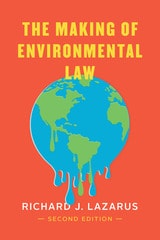
The Making of Environmental Law
Richard J. Lazarus
University of Chicago Press, 2022
How did environmental law first emerge in the United States? Why has it evolved in the ways that it has? And what are the unique challenges inherent to environmental lawmaking in general and in the United States in particular?
Since its first edition, The Making of Environmental Law has been foundational to our understanding of these questions. For the second edition, Richard J. Lazarus returns to his landmark book and takes stock of developments over the last two decades. Drawing on many years of experience on the frontlines of legal and policy battles, Lazarus provides a theoretical overview of the challenges that environmental protection poses for lawmaking, related to both the distinctive features of US lawmaking institutions and the spatial and temporal dimensions of ecological change. The book explains why environmental law emerged in the manner and form that it did in the 1970s and traces how it developed over sequent decades through key laws and controversies. New chapters, composing more than half of the second edition, examine a host of recent developments. These include how Congress dropped out of environmental lawmaking in the early twenty-first century; the shifting role of the judiciary; long-overdue efforts to provide environmental justice to disadvantaged communities; and the destabilization of environmental law that has resulted from the election of Presidents with dramatically clashing environmental policies.
As the nation’s partisan divide has grown deeper and the challenge of climate change has dramatically raised the perceived stakes for opposing interests, environmental law is facing its greatest challenges yet. This book is essential reading for understanding where we have been and what challenges and opportunities lie ahead.
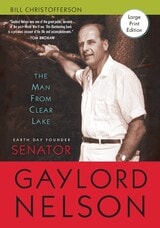
The Man from Clear Lake
Earth Day Founder Senator Gaylord NelsonBill Christofferson
University of Wisconsin Press, 2009
On Earth Day 1970 twenty million Americans displayed their commitment to a clean environment. It was called the largest demonstration in human history, and it permanently changed the nation’s political agenda. By Earth Day 2000 participation had exploded to 500 million people in 167 countries.
The seemingly simple idea—a day set aside to focus on protecting our natural environment—was the brainchild of U.S. Senator Gaylord Nelson of Wisconsin. It accomplished, far beyond his expectations, his lifelong goal of putting the environment onto the nation’s and the world’s political agendas.
A remarkable man, Nelson ranks as one of history’s leading environmentalists. He also played a major role as an early, outspoken opponent of the Vietnam War, and as a senate insider was a key player in civil rights, poverty, civil liberties and consumer protection issues.
The life of Nelson, a small town boy who learned his values and progressive political principles at an early age, is woven through the political history of the twentieth century. Nelson’s story intersects at times with Fighting Bob La Follette, Joe McCarthy, and Bill Proxmire in Wisconsin, and with George McGovern, Lyndon Johnson, Hubert Humphrey, Russell Long, Walter Mondale, John F. Kennedy, and others on the national scene.
Winner, Elizabeth A. Steinberg Prize, University of Wisconsin Press
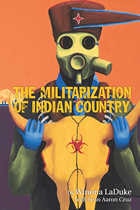
The Militarization of Indian Country
Winona LaDuke
Michigan State University Press, 2013
When it became public that Osama bin Laden’s death was announced with the phrase “Geronimo, EKIA!” many Native people, including Geronimo’s descendants, were insulted to discover that the name of a Native patriot was used as a code name for a world-class terrorist. Geronimo descendant Harlyn Geronimo explained, “Obviously to equate Geronimo with Osama bin Laden is an unpardonable slander of Native America and its most famous leader.” The Militarization of Indian Country illuminates the historical context of these negative stereotypes, the long political and economic relationship between the military and Native America, and the environmental and social consequences. This book addresses the impact that the U.S. military has had on Native peoples, lands, and cultures. From the use of Native names to the outright poisoning of Native peoples for testing, the U.S. military’s exploitation of Indian country is unparalleled and ongoing.
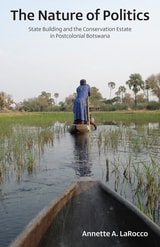
The Nature of Politics
State Building and the Conservation Estate in Postcolonial BotswanaAnnette A. LaRocco
Ohio University Press, 2024
The Reporter's Environmental Handbook
Third EditionBernadette M West, M. Jane Lewis, Michael R Greenberg, David B. Sachsman, and Renee M. Rogers
Rutgers University Press, 2003
The Rise of the American Conservation Movement
Power, Privilege, and Environmental ProtectionDorceta E. Taylor
Duke University Press, 2016
This Magnetic North
Candid Conversations on a Changing Northern MichiganTim Mulherin
Michigan State University Press, 2025
This book explores a phenomenon occurring around Michigan’s Great Lakes and other high-demand scenic locations across the country: natural landscapes are undergoing profound human and climatological change as people pick up their lives and move to bucolic locations. The Grand Traverse region in northwest lower Michigan has been one of the most impacted regions in the state, with the population increase accelerated by the pandemic and climate change. The impact of this growth is explored through field observations and interviews involving dozens of born-and-raised locals, “boomerangers” (those who grew up, left, then returned), and relocators. The author explores the tensions between newcomers and “natives.” Interviewees include tourist industry leaders, conservationists, business owners, public safety officials, tribal members, Sleeping Bear Dunes National Lakeshore officials, and more. These voices characterize the region’s diverse views, providing insight into how one of the most popular vacation destinations in the country is attempting to balance environmental preservation with an influx of people. Northwest lower Michigan’s story of transformation, as tradition collides with progress, holds many lessons and will resonate with everyone who has ever lived in or visited such an enchanting place and dreams of calling it home.
Thoreaus Sense of Place
Essays in American Environmental WritingRichard J. Schneider
University of Iowa Press, 2000
The contributors to this stimulating collection address the ways in which Thoreau and his successors attempt to cope with the basic epistemological split between perceiver and place inherent in writing about nature; related discussions involve the kinds of discourse most effective for writing about place. They focus on the impact on Thoreau and his successors of culturally constructed assumptions deriving from science, politics, race, gender, history, and literary conventions. Finally, they explore the implications surrounding a writer's appropriation or even exploitation of places and objects.
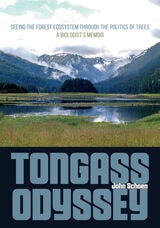
Tongass Odyssey
Seeing the Forest Ecosystem through the Politics of TreesJohn Schoen
University of Alaska Press, 2020