Results by title
177 books match the query 'Equality' and 37 start with t
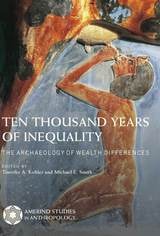
Ten Thousand Years of Inequality
The Archaeology of Wealth DifferencesEdited by Timothy A. Kohler and Michael E. Smith
University of Arizona Press, 2018
Ten Thousand Years of Inequality addresses these and other questions by presenting the first set of consistent quantitative measurements of ancient wealth inequality. The authors are archaeologists who have adapted the Gini index, a statistical measure of wealth distribution often used by economists to measure contemporary inequality, and applied it to house-size distributions over time and around the world. Clear descriptions of methods and assumptions serve as a model for other archaeologists and historians who want to document past patterns of wealth disparity.
The chapters cover a variety of ancient cases, including early hunter-gatherers, farmer villages, and agrarian states and empires. The final chapter synthesizes and compares the results. Among the new and notable outcomes, the authors report a systematic difference between higher levels of inequality in ancient Old World societies and lower levels in their New World counterparts.
For the first time, archaeology allows humanity’s deep past to provide an account of the early manifestations of wealth inequality around the world.
Contributors
Nicholas Ames
Alleen Betzenhauser
Amy Bogaard
Samuel Bowles
Meredith S. Chesson
Abhijit Dandekar
Timothy J. Dennehy
Robert D. Drennan
Laura J. Ellyson
Deniz Enverova
Ronald K. Faulseit
Gary M. Feinman
Mattia Fochesato
Thomas A. Foor
Vishwas D. Gogte
Timothy A. Kohler
Ian Kuijt
Chapurukha M. Kusimba
Mary-Margaret Murphy
Linda M. Nicholas
Rahul C. Oka
Matthew Pailes
Christian E. Peterson
Anna Marie Prentiss
Michael E. Smith
Elizabeth C. Stone
Amy Styring
Jade Whitlam
The "Vanity of the Philosopher"
From Equality to Hierarchy in Post-Classical EconomicsSandra J. Peart and David M. Levy
University of Michigan Press, 2005
Here, Peart and Levy tackle the issues of racism, eugenics, hierarchy, and egalitarianism in classical economics and take a broad view of classical economics' doctrine of human equality. Responding to perennial accusations from the left and the right that the market economy has created either inequality or too much equality, the authors trace the role of the eugenics movement in pulling economics away from the classical economist's respect for the individual toward a more racist view at the turn of the century.
The "Vanity of the Philosopher" reveals the consequences of hierarchy in social science. It shows how the "vanity of the philosopher" has led to recommendations that range from the more benign but still objectionable "looking after" paternalism, to overriding preferences, and, in the extreme, to eliminating purportedly bad preferences. The authors suggest that an approach that abstracts from difference and presumes equal competence is morally compelling.
"People in the know on intellectual history and economics await the next book from Peart and Levy with much the same enthusiasm that greets a new Harry Potter book in the wider world. This book delivers the anticipated delights big time!"
-William Easterly, Professor of Economics and Africana Studies, NYU, and non-resident Senior Fellow, Center for Global Development
"In their customary idiosyncratic manner, Sandra Peart and David Levy reexamine the way in which the views of classical economists on equality and hierarchy were shifted by contact with scholars in other disciplines, and the impact this had on attitudes towards race, immigration, and eugenics. This is an imaginative and solid work of scholarship, with an important historical message and useful lessons for scholars today."
-Stanley Engerman, John Munro Professor of Economics and Professor of History, University of Rochester
Sandra J. Peart, Professor of Economics at Baldwin-Wallace College, has published articles on utilitarianism, the methodology of J. S. Mill, and the transition to neoclassicism. This is her fourth book. David M. Levy is Professor of Economics at George Mason University and Director of the Center for Study of Public Choice. This is his third book.

The American Non-Dilemma
Racial Inequality Without RacismNancy DiTomaso
Russell Sage Foundation, 2013
The Basic Symbols of the American Political Tradition
Willmoore Kendall
Catholic University of America Press, 1995
The Beneficiary
Bruce Robbins
Duke University Press, 2017
The Bonds of Inequality
Debt and the Making of the American CityDestin Jenkins
University of Chicago Press, 2021
In this passionate and deeply researched book, Destin Jenkins shows in vivid detail how, beyond the borrowing decisions of American cities and beneath their quotidian infrastructure, there lurks a world of politics and finance that is rarely seen, let alone understood. Focusing on San Francisco, The Bonds of Inequality offers a singular view of the postwar city, one where the dynamics that drove its creation encompassed not only local politicians but also banks, credit rating firms, insurance companies, and the national municipal bond market. Moving between the local and the national, The Bonds of Inequality uncovers how racial inequalities in San Francisco were intrinsically tied to municipal finance arrangements and how these arrangements were central in determining the distribution of resources in the city. By homing in on financing and its imperatives, Jenkins boldly rewrites the history of modern American cities, revealing the hidden strings that bind debt and power, race and inequity, democracy and capitalism.
The Borders of Justice
Etienne Balibar
Temple University Press, 2013
International in scope and featuring a diverse group of contributors, The Borders of Justice investigates the complexities of transitional justice that emerge from its “social embeddedness.” This original and provocative collection of essays, which stem from a collective research program on social justice undertaken by the Calcutta Research Group, confronts the concept and practices of justice. The editors and contributors question the relationship between geography, methodology, and justice—how and why justice is meted out differently in different places.
Expanding on Michael Walzer's idea of the “spheres of justice,” the contributors argue that justice is burdened with our notions of social realities and expectations, in addition to the influence of money, law, and government. Chapters provide close readings of Pascal, Plato and Marx, theories on global justice, the relationship between liberalism and multiculturalism, struggles of social injustice, and how and where we draw the borders of justice.
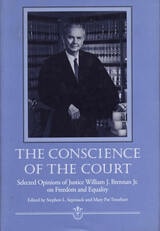
The Conscience of the Court
Selected Opinions of Justice William J. Brennan Jr. on Freedom and EqualityEdited by Stephen L. Sepinuck and Mary Pat Treuthart
Southern Illinois University Press, 1999
The Conscience of the Court celebrates the work of Justice William J. Brennan Jr., who served on the United States Supreme Court for thirty-four years (1956–1990).
Stephen L. Sepinuck and Mary Pat Treuthart introduce and present selected judicial opinions written by Justice Brennan on issues involving personal freedom, civil liberties, and equality. Brennan is ranked by many as the best writer ever to have served on the Supreme Court, and his written opinions depict real people, often in desperate, emotional situations. Remarkable for their clarity of analysis, for their eloquence, and for their forcefulness and persuasiveness, his opinions demonstrate that judicial thought need not be a proprietary enclave of lawyers or the intellectual elite.
The extended excerpts selected by Sepinuck and Treuthart highlight Brennan's approach to judicial decision making. Concerned always with how each decision would actually affect people's lives, Brennan possessed a rare quality of empathy. In Brennan, the editors note, "people and groups who lacked influence in society—Communists and flag burners, children and foreigners, criminal defendants and racial minorities"—found a champion they could count on "to listen to their causes and judge them unmoved by the passions of the politically powerful."
In their introduction to each opinion, the editors provide background facts, discuss how the excerpted opinion transformed the law or otherwise fit into the realm of constitutional jurisprudence, and delve into Justice Brennan's judicial philosophy, his method of constitutional interpretation, and the language he used.
The Cost of Inclusion
How Student Conformity Leads to Inequality on College CampusesBlake R. Silver
University of Chicago Press, 2020
Blake R. Silver spent a year immersed in student life at a large public university. He trained with the Cardio Club, hung out with the Learning Community, and hosted service events with the Volunteer Collective. Through these day-to-day interactions, he witnessed how students sought belonging and built their social worlds on campus. Over time, Silver realized that these students only achieved inclusion at significant cost. To fit in among new peers, they clung to or were pushed into raced and gendered cultural assumptions about behavior, becoming “the cool guy,” “the nice girl,” “the funny one,” “the leader,” “the intellectual,” or “the mom of the group.” Instead of developing dynamic identities, they crafted and adhered to a cookie-cutter self, one that was rigid and two-dimensional. Silver found that these students were ill-prepared for the challenges of a diverse college campus, and that they had little guidance from their university on how to navigate the trials of social engagement or the pressures to conform. While colleges are focused on increasing the diversity of their enrolled student body, Silver’s findings show that they need to take a hard look at how they are failing to support inclusion once students arrive on campus.

The Culture of Inequality
Michael Lewis
University of Massachusetts Press, 1993
Why do America’s wars against poverty turn out to be wards against the poor? Why does a nation so committed to fighting crime show such a bad record of combatting it and so morbid a fascination with it? Why is American racism so deeply rooted?
These and other questions are answered in this milestone study. Its central thesis is that the national faith in individual initiative and free opportunity has become a breeding ground for guilt about our own limited successes and prejudice against all who exhibit signs of failure.
The Death Gap
How Inequality KillsDavid A. Ansell, MD
University of Chicago Press, 2017
While the contrasts and disparities among Chicago’s communities are particularly stark, the death gap is truly a nationwide epidemic—as Ansell shows, there is a thirty-five-year difference in life expectancy between the healthiest and wealthiest and the poorest and sickest American neighborhoods. If you are poor, where you live in America can dictate when you die. It doesn’t need to be this way; such divisions are not inevitable. Ansell calls out the social and cultural arguments that have been raised as ways of explaining or excusing these gaps, and he lays bare the structural violence—the racism, economic exploitation, and discrimination—that is really to blame. Inequality is a disease, Ansell argues, and we need to treat and eradicate it as we would any major illness. To do so, he outlines a vision that will provide the foundation for a healthier nation—for all.
Inequality is all around us, and often the distance between high and low life expectancy can be a matter of just a few blocks. But geography need not be destiny, urges Ansell. In The Death Gap he shows us how we can face this national health crisis head-on and take action against the circumstances that rob people of their dignity and their lives.
The Death Gap
How Inequality KillsDavid A. Ansell, MD
University of Chicago Press, 2021
While the contrasts and disparities among Chicago’s communities are particularly stark, the death gap is truly a nationwide epidemic—as Ansell shows, there is a thirty-five-year difference in life expectancy between the healthiest and wealthiest and the poorest and sickest American neighborhoods. If you are poor, where you live in America can dictate when you die. It doesn’t need to be this way; such divisions are not inevitable. Ansell calls out the social and cultural arguments that have been raised as ways of explaining or excusing these gaps, and he lays bare the structural violence—the racism, economic exploitation, and discrimination—that is really to blame. Inequality is a disease, Ansell argues, and we need to treat and eradicate it as we would any major illness. To do so, he outlines a vision that will provide the foundation for a healthier nation—for all.
As the COVID-19 mortality rates in underserved communities proved, inequality is all around us, and often the distance between high and low life expectancy can be a matter of just a few blocks. Updated with a new foreword by Chicago mayor Lori Lightfoot and an afterword by Ansell, The Death Gap speaks to the urgency to face this national health crisis head-on.
The Economic History of American Inequality
New Evidence and PerspectivesEdited by Martha J. Bailey, Leah Platt Boustan, and William J. Collins
University of Chicago Press, 2025
A meticulous examination of the history and roots of economic inequality within the United States.
This volume refines and extends the economic history literature on economic inequality in the United States. Economic inequality manifests itself on various dimensions, including access to resources and economic security, as well as access to education and opportunities for migration, marriage, and other important life decisions. Measuring inequality and studying its variation over time and in response to economic shocks such as recessions and wars deepen our understanding of how the economy operates and can inform the design of public policies. The studies in this compendium present comprehensive evidence on income distribution during the nineteenth and early twentieth centuries, drawing on new data on wages and prices. They also consider disparities in economic well-being that are reflected in outcomes other than wage and salary income, such as homeownership and marriage. The volume also presents new evidence on the effects of income inequality on social outcomes. It concludes with an intellectual history of “human capital,” a core concept in the economic analysis of the underpinnings of labor market inequality.
The Economic Other
Inequality in the American Political ImaginationMeghan Condon and Amber Wichowsky
University of Chicago Press, 2020
Through an astute blend of experiments, surveys, and descriptions people offer in their own words, The Economic Other reveals that when less-advantaged Americans compare with the rich, they become more accurate about their own status and want more from government. But American society is structured to prevent upward comparison. In an increasingly divided, anxious nation, opportunities to interact with the country’s richest are shrinking, and people prefer to compare to those below to feel secure. Even when comparison with the rich does occur, many lose confidence in their power to effect change.
Laying bare how social comparisons drive political attitudes, The Economic Other is an essential look at the stubborn plight of inequality and the measures needed to solve it.
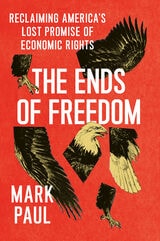
The Ends of Freedom
Reclaiming America's Lost Promise of Economic RightsMark Paul
University of Chicago Press, 2023
Since the Founding, Americans have debated the true meaning of freedom. For some, freedom meant the provision of life’s necessities, those basic conditions for the “pursuit of happiness.” For others, freedom meant the civil and political rights enumerated in the Bill of Rights and unfettered access to the marketplace—nothing more. As Mark Paul explains, the latter interpretation—thanks in large part to a particularly influential cadre of economists—has all but won out among policymakers, with dire repercussions for American society: rampant inequality, endemic poverty, and an economy built to benefit the few at the expense of the many.
In this book, Paul shows how economic rights—rights to necessities like housing, employment, and health care—have been a part of the American conversation since the Revolutionary War and were a cornerstone of both the New Deal and the Civil Rights Movement. Their recuperation, he argues, would at long last make good on the promise of America’s founding documents. By drawing on FDR’s proposed Economic Bill of Rights, Paul outlines a comprehensive policy program to achieve a more capacious and enduring version of American freedom. Among the rights he enumerates are the right to a good job, the right to an education, the right to banking and financial services, and the right to a healthy environment.
Replete with discussions of some of today’s most influential policy ideas—from Medicare for All to a federal job guarantee to the Green New Deal—The Ends of Freedom is a timely and urgent call to reclaim the idea of freedom from its captors on the political right—to ground America’s next era in the country’s progressive history and carve a path toward a more economically dynamic and equitable nation.
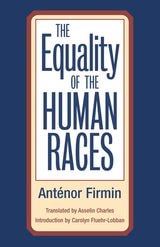
The Equality of Human Races
Positivist AnthropologyAnténor Firmin, Translated from the French by Asselin Charles. Introduction by Carolyn Fluehr-Lobban
University of Illinois Press, 2000
Rediscovering an early scientific challenge to racism
This is the first paperback edition of the only English-language translation of the Haitian scholar Anténor Firmin's The Equality of the Human Races, a foundational text in critical anthropology first published in 1885 when anthropology was just emerging as a specialized field of study. Marginalized for its "radical" position that the human races were equal, Firmin's lucid and persuasive treatise was decades ahead of its time. Arguing that the equality of the races could be demonstrated through a positivist scientific approach, Firmin challenged racist writings and the dominant views of the day. Translated by Asselin Charles and framed by Carolyn Fluehr-Lobban's substantial introduction, this rediscovered text is an important contribution to contemporary scholarship in anthropology, pan-African studies, and colonial and postcolonial studies.
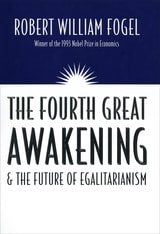
The Fourth Great Awakening and the Future of Egalitarianism
Robert William Fogel
University of Chicago Press, 2000
"To take a trip around the mind of Robert Fogel, one of the grand old men of American economic history, is a rare treat. At every turning, you come upon some shiny pearl of information."—The Economist
In this broad-thinking and profound piece of history, Robert William Fogel synthesizes an amazing range of data into a bold and intriguing view of America's past and future—one in which the periodic Great Awakenings of religion bring about waves of social reform, the material lives of even the poorest Americans improve steadily, and the nation now stands poised for a renewed burst of egalitarian progress.
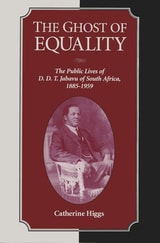
The Ghost of Equality
The Public Lives of D. D. T. Jabavu of South Africa, 1885–1959Catherine Higgs
Ohio University Press, 1996
Davidson Don Tengo Jabavu was born in the Cape Colony in British southern Africa on October 20, 1885, when a few African men could vote and the prospects for black equality with the ruling whites seemed promising. He died on August 3, 1959, in the Cape Province of the Union of South Africa, eleven years after the apartheid state had begun stripping blacks of their rights and exorcising the ‘ghost of equality’ with a completeness unparalleled in the country’s history. The ‘ghost of equality was the last vestige of the Cape liberal tradition — itself best summed up by the dictum ’equal rights for all civilized men‘ — finally erased in 1959 with the passage of legislation that would, the following year, remove from parliament the last elected white representatives of Africans.…
If D.D.T. Jabavu’s life reveals anything about South Africa’s political history, it is that this history was not monolithic. It was not simply a lengthly confrontation between a black elite represented by the African National Congress and the white segregationist state. Rather, there was a range of black political opinion and activity, of which Jabavu, an active participant in virtually every government-sponsored and every major extraparliamentary conference between 1920 and the late 1940s, represented one prominent historical strain.
This book, however, is about more than D.D.T. Javavu’s politics; it is about his public life, or perhaps more accurately, his public lives. The book is arranged thematically, divided according to the parts Jabavu played: student, teacher, Methodist, and politician.
— from the introduction by the author
The Illusion of Equality
The Rhetoric and Reality of Divorce ReformMartha Albertson Fineman
University of Chicago Press, 1991
The Jews in Mussolini's Italy
From Equality to PersecutionMichele Sarfatti; Translated by John and Anne C. Tedeschi
University of Wisconsin Press, 2006
The Long Walk to Equality
Perspectives on Racial Inequality, Injustice and the LawAvis Whyte, Patricia Tuitt and Judith Bourne
University of Westminster Press, 2024
The Many Futures of Work
Rethinking Expectations and Breaking MoldsEdited by Peter A. Creticos, Larry Bennett, Laura Owen, Costas Spirou, and Maxine Morphis-Riesbeck
Temple University Press, 2021
What will work eventually look like? This is the question at the heart of this timely collection. The editors and contributors—a mix of policy experts, academics, and advocates—seek to reframe the typical projections of the “future” of work. They examine the impact of structural racism on work, the loss of family‑sustaining jobs, the new role of gig work, growing economic inequality, barriers to rewarding employment such as age, gender, disability, and immigration status, and the business policies driving these ongoing challenges.
Together the essays present varied and practical insights into both U.S. and global trends, discuss the role of labor activism in furthering economic justice, and examine progressive strategies to improve the experience of work, wages, and the lives of workers. The Many Futures of Work offers a range of viable policies and practices that can promote rewarding employment and steer our course away from low-wage, unstable jobs toward jobs that lead to equitable prosperity and economic inclusion.

The Men's Section
Orthodox Jewish Men in an Egalitarian WorldElana Maryles Sztokman
Brandeis University Press, 2011
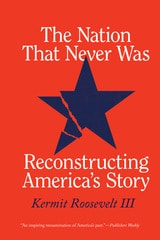
The Nation That Never Was
Reconstructing America's StoryKermit Roosevelt III
University of Chicago Press, 2022
There’s a common story we tell about America: that our fundamental values as a country were stated in the Declaration of Independence, fought for in the Revolution, and made law in the Constitution. But, with the country increasingly divided, this story isn’t working for us anymore—what’s more, it’s not even true. As Kermit Roosevelt argues in this eye-opening reinterpretation of the American story, our fundamental values, particularly equality, are not part of the vision of the Founders. Instead, they were stated in Lincoln’s Gettysburg Address and were the hope of Reconstruction, when it was possible to envision the emergence of the nation committed to liberty and equality.
We face a dilemma these days. We want to be honest about our history and the racism and oppression that Americans have both inflicted and endured. But we want to be proud of our country, too. In The Nation That Never Was, Roosevelt shows how we can do both those things by realizing we’re not the country we thought we were. Reconstruction, Roosevelt argues, was not a fulfillment of the ideals of the Founding but rather a repudiation: we modern Americans are not the heirs of the Founders but of the people who overthrew and destroyed that political order. This alternate understanding of American identity opens the door to a new understanding of ourselves and our story, and ultimately to a better America.
America today is not the Founders’ America, but it can be Lincoln’s America. Roosevelt offers a powerful and inspirational rethinking of our country’s history and uncovers a shared past that we can be proud to claim and use as a foundation to work toward a country that fully embodies equality for all.

The New Metropolis
Power, Place, and Inequality in Twenty-First-Century AmericaMargaret Weir
University of Chicago Press, 2027
A path-breaking investigation of changing patterns of inequality and contestation in America’s metropolises.
Since 1990, a new political geography of winners and losers has emerged in metros across America. This new metropolis looks nothing like the old. In many exurbs, suburban mansions abut declining towns and distressed communities. In historic central cities, African American communities reel from institutional stripping, even as gentrification and immigration revitalize once forgotten neighborhoods. The New Metropolis considers why, despite all the changes over the past four decades, we have recreated a metropolis that makes it harder for low-income Americans—especially low-income Americans of color—to thrive and why some efforts to promote equitable opportunity succeed against the odds.
With a focus on Chicago, Atlanta, and Houston, The New Metropolis shows how multi-level political actors and translocal networks build power across political boundaries to determine the pool of local public resources and the scope of local powers. Weir demonstrates how the timing of urbanization set up distinct conflicts over the public sector in Frostbelt versus Sunbelt metropolises, explaining how partisan divisions now supercharge these conflicts.
The New Metropolis shows why the battle over the metropolis sits at the center of American politics. It determines the shape of the public arenas where we make decisions and, ultimately, the kinds of connections Americans have with one another.
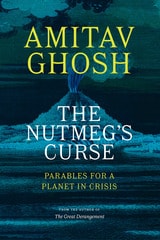
The Nutmeg's Curse
Parables for a Planet in CrisisAmitav Ghosh
University of Chicago Press, 2021
A powerful work of history, essay, testimony, and polemic, Amitav Ghosh’s new book traces our contemporary planetary crisis back to the discovery of the New World and the sea route to the Indian Ocean. The Nutmeg’s Curse argues that the dynamics of climate change today are rooted in a centuries-old geopolitical order constructed by Western colonialism. At the center of Ghosh’s narrative is the now-ubiquitous spice nutmeg. The history of the nutmeg is one of conquest and exploitation—of both human life and the natural environment. In Ghosh’s hands, the story of the nutmeg becomes a parable for our environmental crisis, revealing the ways human history has always been entangled with earthly materials such as spices, tea, sugarcane, opium, and fossil fuels. Our crisis, he shows, is ultimately the result of a mechanistic view of the earth, where nature exists only as a resource for humans to use for our own ends, rather than a force of its own, full of agency and meaning.
Writing against the backdrop of the global pandemic and the Black Lives Matter protests, Ghosh frames these historical stories in a way that connects our shared colonial histories with the deep inequality we see around us today. By interweaving discussions on everything from the global history of the oil trade to the migrant crisis and the animist spirituality of Indigenous communities around the world, The Nutmeg’s Curse offers a sharp critique of Western society and speaks to the profoundly remarkable ways in which human history is shaped by non-human forces.
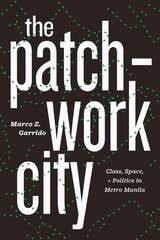
The Patchwork City
Class, Space, and Politics in Metro ManilaMarco Z. Garrido
University of Chicago Press, 2019
The Patchwork City illuminates how segregation, class relations, and democracy are all intensely connected. It makes clear, ultimately, that class as a social structure is as indispensable to the study of Manila—and of many other cities of the Global South—as race is to the study of American cities.
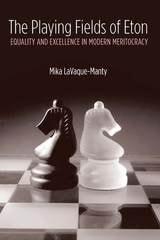
The Playing Fields of Eton
Equality and Excellence in Modern MeritocracyMika LaVaque-Manty
University of Michigan Press, 2009
"Beautifully written and brilliantly argued, The Playing Fields of Eton takes us on a three-century tour of modern mental and physical life. We visit gymnasiums and dueling fields, murderball courts and Olympic venues, and while immersed in thought-provoking stories of people wrestling with the twin pursuit of equality and excellence, we find ourselves learning what it might mean to be modern. With equal measures of erudition and gentle humor, Mika LaVaque-Manty convincingly refutes the view that egalitarian progress forecloses possibilities for human excellence."
---Elisabeth Ellis, Texas A&M University
"A very insightful and clearly written philosophical inquiry into the nature of sport."
---Marion Smiley, Brandeis University
"A marvelously original analysis of the tensions---and interdependence---between equality and excellence in modern political life. From eighteenth-century dueling to contemporary doping in sports, LaVaque-Manty illuminates the bodily life of democracy at play, and challenges us to think in new ways about the connections between achievement and autonomy. The Playing Fields of Eton is an important book that pushes liberal and democratic theory in fruitful new directions."
---Sharon Krause, Brown University
Can equality and excellence coexist? If we assert that no person stands above the rest, can we encourage and acknowledge athletic, artistic, and intellectual achievements? Perhaps equality should merely mean equality of opportunity. But then how can society reconcile inherent differences between men and women, the strong and the weak, the able-bodied and the disabled?
In The Playing Fields of Eton, Mika LaVaque-Manty addresses questions that have troubled philosophers, reformers, and thoughtful citizens for more than two centuries. Drawing upon examples from the eighteenth-century debate over dueling as a gentleman's prerogative to recent controversies over athletes' use of performance-enhancing drugs, LaVaque-Manty shows that societies have repeatedly redefined equality and excellence. One constant remains, however: sports provide an arena for working out tensions between these two ideals.
Just as in sports where athletes are sorted by age, sex, and professional status, in modern democratic society excellence has meaning only in the context of comparisons among individuals who are, theoretically, equals. LaVaque-Manty's argument will engage philosophers, and his inviting prose and use of familiar illustrations will welcome nonphilosophers to join the conversation.
Mika LaVaque-Manty is Associate Professor of Political Science at the University of Michigan.
The Political Origins of Inequality
Why a More Equal World Is Better for Us AllSimon Reid-Henry
University of Chicago Press, 2015
The problem of inequality, Reid-Henry argues, is a problem that manifests between places as well as over time. This is one reason why it cannot be resolved by the usual arguments of left versus right, bound as they are to the national scale alone. Most of all, however, it is why the level of inequality that confronts us today is indicative of a more general crisis in political thought. Modern political discourse has no place for public reason or the common good. Equality is yesterday’s dream. Yet the fact that we now accept such a world—a world that values security over freedom, special treatment over universal opportunity, and efficiency over fairness—is ultimately because we have stopped even trying in recent decades to build the political architecture the world actually requires.
Our politics has fallen out of step with the world, then, and at the every moment it is needed more than ever. Yet it is within our power to address this. Doing so involves identifying and then meeting our political responsibilities to others, not just offering them the selective charity of the rich. It means looking beyond issues of economics and outside our national borders. But above all it demands of us that we reinvent the language of equality for a modern, global world: and then institute this. The world is not falling apart. Different worlds, we all can see, are colliding together. It is our capacity to act in concert that is falling apart. It is this that needs restoring most of all.

The Power of the Badge
Sheriffs and Inequality in the United StatesEmily M. Farris and Mirya R. Holman
University of Chicago Press, 2024
A sobering exploration of the near unchecked power of sheriffs in the United States.
Across the United States, more than 3,000 sheriffs occupy a unique position in the US political and legal systems. Elected by voters—usually in low-visibility, noncompetitive elections—sheriffs oversee more than a third of law enforcement employees and control almost all local jails. They have the power to both set and administer policies, and they can imprison, harm, and even kill members of their communities. Yet, they enjoy a degree of autonomy not seen by other political officeholders.
The Power of the Badge offers an unprecedented, data-rich look into the politics of the office and its effects on local communities. Emily M. Farris and Mirya R. Holman draw on two surveys of sheriffs taken nearly a decade apart, as well as election data, case studies, and administrative data to show how a volatile combination of authority and autonomy has created an environment where sheriffs rarely change; elections seldom create meaningful accountability; employees, budgets, and jails can be used for political gains; marginalized populations can be punished; and reforms fail. Farris and Holman also track the increasingly close linkages between sheriffs and right-wing radical groups in an era of high partisanship and intra-federal conflict.
The Racial Order Of Things
Cultural Imaginaries Of The Post-Soul EraRoopali Mukherjee
University of Minnesota Press, 2006
The Reconstruction Desegregation Debate
The Policies of Equality and the Rhetoric of Place, 1870-1875Kirt H. Wilson
Michigan State University Press, 2002
In the decade that followed the Civil War, two questions dominated political debate: To what degree were African Americans now “equal” to white Americans, and how should this equality be implemented in law? Although Republicans entertained multiple, even contradictory, answers to these questions, the party committed itself to several civil rights initiatives. When Congress passed the Thirteenth Amendment, the 1866 Civil Rights Act, the Fourteenth Amendment, and the Fifteenth Amendment, it justified these decisions with a broad egalitarian rhetoric. This rhetoric altered congressional culture, instituting new norms that made equality not merely an ideal,but rather a pragmatic aim for political judgments.
Kirt Wilson examines Reconstruction’s desegregation debate to explain how it represented an important movement in the evolution of U.S. race relations. He outlines how Congress fought to control the scope of black civil rights by contesting the definition of black equality, and the expediency and constitutionality of desegregation. Wilson explores how the debate over desegregation altered public memory about slavery and the Civil War, while simultaneously shaping a political culture that established the trajectory of race relations into the next century.
The Sociology of Housing
How Homes Shape Our Social LivesEdited by Brian J. McCabe and Eva Rosen
University of Chicago Press, 2023
In 1947, the president of the American Sociological Association, Louis Wirth, argued for the importance of housing as a field of sociological research. Now, seventy-five years later, the sociology of housing has still not developed as a distinct subfield, leaving efforts to understand housing’s place in society to other disciplines, such as economics and urban planning. With this volume, the editors and contributors solidify the importance of housing studies within the discipline of sociology by tackling topics like racial segregation, housing instability, the supply of affordable housing, and the process of eviction. In doing so, they showcase the very best traditions of sociology: they draw on diverse methodologies, present unique field sites and data sources, and foreground a range of theoretical approaches to elucidate the relationships between contemporary housing, public policy, and key social outcomes.
The Sociology of Housing is a landmark volume that will be used by researchers and students alike to define this growing subfield, map continued directions for research, and center sociologists in interdisciplinary conversations about housing.
The Street Porter and the Philosopher
Conversations on Analytical EgalitarianismSandra J. Peart and David M. Levy, editors
University of Michigan Press, 2009
Adam Smith, asserting the common humanity of the street porter and the philosopher, articulated the classical economists' model of social interactions as exchanges among equals. This model had largely fallen out of favor until, recently, a number of scholars in the avant-garde of economic thought rediscovered it and rechristened it "analytical egalitarianism." In this volume, Sandra J. Peart and David M. Levy bring together an impressive array of authors to explore the ramifications of this analytical ideal and to discuss the ways in which an egalitarian theory of individuality can enable economists to reconcile ideas from opposite ends of the political spectrum.
"The analytical egalitarianism project that Peart and Levy have advanced has come to occupy a prominent place in the current agenda of historians of economic thought."
---Ross Emmett, Associate Professor of Economics and Co-Director of the Michigan Center for Innovation and Economic Prosperity, Michigan State University
"These essays and dialogs from the Summer Institute would make Adam Smith, economist and moral philosopher, proud."
---J. Daniel Hammond, Hultquist Family Professor of Economics, Wake Forest University
With essays by:
- James M. Buchanan, Alfred Nobel Memorial Prize in Economic Sciences recipient (1985) and Professor Emeritus, George Mason University and Virginia Polytechnic and State University
- Juan Pablo Couyoumdijian, Universidad del Desearrollo, Chile
- Tyler Cowen, George Mason University
- Eric Crampton, University of Canterbury, New Zealand
- Andrew Farrant, Dickinson College
- Samuel Hollander, Professor Emeritus, University of Toronto
- M. Ali Khan, Johns Hopkins University
- Thomas Leonard, Princeton University
- Deirdre McCloskey, University of Illinois, Chicago
- Leonidas Montes, Dean of School of Government, Universidad Adolfo Ibañez, Chile
- Maria Pia Paganelli, Yeshiva University and New York University
- Warren J. Samuels, Professor Emeritus, Michigan State University
- Eric Schliesser, VENI post-doctoral research fellow, Leiden University, and University of Amsterdam
- Gordon Tullock, George Mason University
Sandra J. Peart is Dean of the Jepson School of Leadership Studies, University of Richmond, Virginia.
David M. Levy is Professor of Economics at George Mason University (GMU) and Research Associate at the Center for Study of Public Choice at GMU.
They are Co-Directors of George Mason University's Summer Institute for the Preservation of the History of Economics.
The Street
A Photographic Field Guide to American InequalityNaa Oyo A. Kwate
Rutgers University Press, 2021
Using MacArthur fellow Camilo José Vergara’s intimate street photographs of Camden, New Jersey as reference points, the essays in this collection analyze these images within the context of troubled histories and misguided policies that have exacerbated racial and economic inequalities. Rather than blaming Camden’s residents for the blighted urban landscape, the multidisciplinary array of scholars contributing to this guide reveal the oppressive structures and institutional failures that have led the city to this condition. Tackling topics such as race and law enforcement, gentrification, food deserts, urban aesthetics, credit markets, health care, childcare, and schooling, the contributors challenge conventional thinking about what we should observe when looking at neighborhoods.

The Western Illusion of Human Nature
With Reflections on the Long History of Hierarchy, Equality and the Sublimation of Anarchy in the West, and Comparative Notes on Other Conceptions of the Human ConditionMarshall Sahlins
Prickly Paradigm Press, 2008

Three Cartesian Feminist Treatises
François Poullain de la Barre
University of Chicago Press, 2002
Poullain published three books (anonymously) on this topic in the 1670s, all of which are included in English translation in this volume. In On the Equality of the Two Sexes he argued that the supposedly "natural" inferiority of women was culturally produced. To help women recognize and combat this prejudice, Poullain advocated a modern, enlightened feminine education in On the Education of Ladies. Finally, since his contemporaries largely ignored Poullain's writings, he offered a rebuttal to his own arguments in On the Excellence of Men—a rebuttal that he promptly countered, strengthening his original positions.
A truly modern feminist, Poullain laid the intellectual groundwork for the women's liberation movement centuries before it happened.