Results by title
70 books match the query 'Essay' and 14 start with t
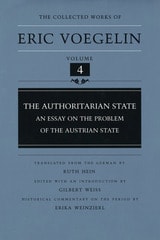
The Authoritarian State (CW4)
An Essay on the Problem of the Austrian StateEric Voegelin, Edited & Intro by Gilbert Weiss, Translated by Ruth Hein, & Historical Commentary by Erika Weinzierl
University of Missouri Press, 1999
Published in Vienna in 1936, The Authoritarian State by Eric Voegelin has remained virtually unknown to the public until now. Sales of the German edition were halted following the Nazi invasion of Austria in 1938, and the entire printing was later destroyed by wartime bombing. In this volume, Voegelin offers a critical examination of the most prominent European theories of state and constitutional law of the period while providing a political and historical analysis of the Austrian situation. He discusses the dismissal of Parliament in 1933, the civil war, the murder of Federal Chancellor Dollfuss, the adoption of the "Authoritarian Constitution" of 1934, and the predicament of being sandwiched between Hitler and Mussolini.
A radical critique of Hans Kelsen's pure theory of law lies at the heart of this work, marking Voegelin's definitive departure from Neo-Kantian epistemology. For the first time, Voegelin elaborates on the important distinction between theoretical concepts and political symbols as a basis for explaining the nontheoretical and speculative character of ideologies, both left and right. He shows that total and authoritarian are symbols of ideological self-interpretation that have no theoretical value, a distinction basic to his later work in The New Science of Politics.
Available for the first time in English, The Authoritarian State is a valuable addition to the Voegelin canon and to the field of intellectual history in general.
The Barren Sacrifice
An Essay on Political ViolencePaul Dumouchel
Michigan State University Press, 2015
The Barthes Effect
The Essay as Reflective TextRéda BensmaïaTranslated by Pat FedkiewForeword by Michèle H. Richman
University of Minnesota Press, 1987
The Barthes Effect was first published in 1987. Minnesota Archive Editions uses digital technology to make long-unavailable books once again accessible, and are published unaltered from the original University of Minnesota Press editions.
The author acknowledges the essay as an eccentric phenomenon in literary history, one that has long resisted entry into the taxonomy of genres, as it concentrates on four works by Roland Barthes: The Pleasure of the Text, A Lover's Discourse, Roland Barthes by Roland Barthes, and Camera Lucida. Maintains that with Barthes the essay achieves a status of its own, as reflective text.
". . . a study rigorously conscious of the critical maneuvers it executes and, more importantly, questions as critical practice . . . " Bensmaïa's strategy produces a successful investigation of the interstices and slippages of meaning which Barthes addressed in his work." SubStance
Reda Bensmaia is associate professor in the departments of French and comparative literature at the University of Minnesota, and translator Pat Fedkiew, a graduate student in French at Minnesota. Michele Richman is associate professor of French at the University of Pennsylvania and author of Reading Georges Bataille: Beyond the Gift.
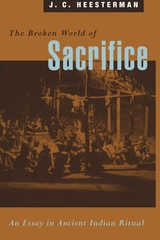
The Broken World of Sacrifice
An Essay in Ancient Indian RitualJ. C. Heesterman
University of Chicago Press, 1993
Paying close attention to anomalous elements within both the Vedic ritual texts, the brahmanas, and the ritual manuals, the srautasutras, Heesterman reconstructs the ideal sacrifice as consisting of four moments: killing, destruction, feasting, and contest. He shows that Vedic sacrifice all but exclusively stressed the offering in the fire—the element of destruction—at the expense of the other elements. Notably, the contest was radically eliminated. At the same time sacrifice was withdrawn from society to become the sole concern of the individual sacrificer. The ritual turns in on the individual as "self-sacrificer" who realizes through the internalized knowledge of the ritual the immortal Self. At this point the sacrificial cult of the fire recedes behind doctrine of the atman's transcendence and unity with the cosmic principle, the brahman.
Based on his intensive analysis Heesterman argues that Vedic sacrifice was primarily concerned with the broken world of the warrior and sacrificer. This world, already broken in itself by the violence of the sacrificial contest, was definitively broken up and replaced with the ritrualism of the single, unopposed sacrificer. However, the basic problem of sacrifice—the riddle of life and death—keeps breaking too surface in the form of incongruities, contradictions, tensions, and oppositions that have perplexed both the ancient ritual theorists and the modern scholar.
The Far Edges of the Fourth Genre
An Anthology of Explorations in Creative NonfictionSean Prentiss
Michigan State University Press, 2014
Contributors: Nancer Ballard, H. Lee Barnes, Kim Barnes, Mary Clearman Blew, Joy Castro, Robin Hemley, Judith Kitchen, Brenda Miller, Ander Monson, Dinty W. Moore, Sean Prentiss, Lia Purpura, Erik Reece, Jonathan Rovner, Bob Shacochis, and Joe Wilkins.
The Made-Up Self
Impersonation in the Personal EssayCarl H. Klaus
University of Iowa Press, 2010
The human presence that animates the personal essay is surely one of the most beguiling of literary phenomena, for it comes across in so familiar a voice that it’s easy to believe we are listening to the author rather than a textual stand-in. But the “person” in a personal essay is always a written construct, a fabricated character, its confessions and reminiscences as rehearsed as those of any novelist. In this first book-length study of the personal essay, Carl Klaus unpacks this made-up self and the manifold ways in which a wide range of essayists and essays have brought it to life.
By reconceiving the most fundamental aspect of the personal essay—the I of the essayist—Klaus demonstrates that this seemingly uncontrived form of writing is inherently problematic, not willfully devious but bordering upon the world of fiction. He develops this key idea by explaining how structure, style, and voice determine the nature of a persona and our perception of it in the works of such essayists as Michel de Montaigne, Charles Lamb, E. B. White, and Virginia Woolf. Realizing that this persona is shaped by the force of culture and the impress of personal experience, he explores the effects of both upon the point of view, content, and voice of such essayists as George Orwell, Nancy Mairs, Richard Rodriguez, and Alice Walker. Throughout, in full command of the history of the essay, he calls up numerous passages in which essayists themselves acknowledge the element of impersonation in their work, drawing upon the perspectives of Joan Didion, Edward Hoagland, Joyce Carol Oates, Leslie Marmon Silko, Scott Russell Sanders, Annie Dillard, Vivian Gornick, Loren Eiseley, James Baldwin, and a host of other literary guides.
Finally, adding yet another layer to the made-up self, Klaus succumbs to his addiction to the personal essay by placing some of the different selves that various essayists have called forth in him within the essays that he has crafted so carefully for this book. Making his way from one essay to the next with a persona variously learned, whimsical, and poignant, he enacts the palimpsest of ways in which the made-up self comes to life in the work of a single essayist. Thus over the course of this highly original, beautifully structured study, the personal essay is revealed to be more complex than many readers have supposed. With its lively analyses and illuminating examples, The Made-Up Self will speak to anyone who wishes to understand—or to write—personal essays.

The Mental and the Physical
The Essay and a PostscriptHerbert Feigl
University of Minnesota Press, 1967
The Mental and the Physical was first published in 1967. Minnesota Archive Editions uses digital technology to make long-unavailable books once again accessible, and are published unaltered from the original University of Minnesota Press editions.
Professor Feigl's essay "The 'Mental' and the 'Physical'" has provoked a great deal of comment, criticism, and discussion since it first appeared as a part of the content of Volume II of the Minnesota Studies in the Philosophy of Science about ten years ago. Now Professor Feigl takes account of the critical discussions and presents his own comments with respect to the most important points raised in the criticisms. The essay itself is presented here in full, along with the postscript. The British Journal for the Philosophy of Science has called the essay "a 'super-colossal' survey of the mind-body problem." In its review of the earlier book containing the essay, Thought said: "This essay deserves careful reading by every philosopher concerned with genuine philosophical dialogue."

The Mysterious Science of the Law
An Essay on Blackstone's CommentariesDaniel J. Boorstin
University of Chicago Press, 1996
The Princes of Naranja
An Essay in Anthrohistorical MethodBy Paul Friedrich
University of Texas Press, 1987
In this groundbreaking study, Paul Friedrich looks closely at the strong men of the Tarascan Indian village of Naranja: their leadership, friendship, kinship, and violent local politics (over a time depth of one generation), and ways to understand such phenomena. What emerges is an acutely observed portrait of the men who form the very basis of the grass-roots power structure in Mexico today.
Of interest to historians, sociologists, and political scientists, as well as Latin Americanists and anthropologists, The Princes of Naranja is a sequel to Friedrich's now classic Agrarian Revolt in a Mexican Village. It begins with biographical character studies of seven leaders—peasant gunmen, judges, politicos; here the book will grip the reader and provoke strong emotional response, from laughter to horror. A middle section places these "princes" in relation to each other, and to the contexts of village society and the larger entities of which it forms a part. Friedrich's synthesis of anthropology, local (mainly oral) history, macrohistory, microsociology, psychology, and literature gives new insight into the structure of Mexican politics from the local level up, and provides a model for other scholars doing analogous work in other parts of the world, especially in the developing world. The concluding section raises vital questions about the dynamic relations between the fieldworker, fieldwork, field notes, the villagers, the writing of a fieldwork-based book, and, implicitly, the audience for such books.
The Public and Its Problems
An Essay in Political InquiryJohn Dewey
Ohio University Press, 2016
More than six decades after John Dewey’s death, his political philosophy is undergoing a revival. With renewed interest in pragmatism and its implications for democracy in an age of mass communication, bureaucracy, and ever-increasing social complexities, Dewey’s The Public and Its Problems, first published in 1927, remains vital to any discussion of today’s political issues.
This edition of The Public and Its Problems, meticulously annotated and interpreted with fresh insight by Melvin L. Rogers, radically updates the previous version published by Swallow Press. Rogers’s introduction locates Dewey’s work within its philosophical and historical context and explains its key ideas for a contemporary readership. Biographical information and a detailed bibliography round out this definitive edition, which will be essential to students and scholars both.
The System of Professions
An Essay on the Division of Expert LaborAndrew Abbott
University of Chicago Press, 1988
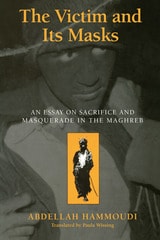
The Victim and its Masks
An Essay on Sacrifice and Masquerade in the MaghrebAbdellah Hammoudi
University of Chicago Press, 1993
To Save the Phenomena
An Essay on the Idea of Physical Theory from Plato to GalileoPierre Duhem
University of Chicago Press, 1969
Duhem's 1908 essay questions the relation between physical theory and metaphysics and, more specifically, between astronomy and physics–an issue still of importance today. He critiques the answers given by Greek thought, Arabic science, medieval Christian scholasticism, and, finally, the astronomers of the Renaissance.
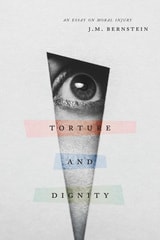
Torture and Dignity
An Essay on Moral InjuryJ. M. Bernstein
University of Chicago Press, 2015
Beginning with the attempts to abolish torture in the eighteenth century, and then sensitively examining what is suffered in torture and related transgressions, such as rape, Bernstein elaborates a powerful new conception of moral injury. Crucially, he shows, moral injury always involves an injury to the status of an individual as a person—it is a violent assault against his or her dignity. Elaborating on this critical element of moral injury, he demonstrates that the mutual recognitions of trust form the invisible substance of our moral lives, that dignity is a fragile social possession, and that the perspective of ourselves as potential victims is an ineliminable feature of everyday moral experience.