Results by title
59 books match the query 'Ethnoarchaeology' and 9 start with t
The Archaeology of Hybrid Material Culture
Edited by Jeb J. Card
Southern Illinois University Press, 2013
In recent years, archaeologists have used the terms hybrid and hybridity with increasing frequency to describe and interpret forms of material culture. Hybridity is a way of viewing culture and human action that addresses the issue of power differentials between peoples and cultures. This approach suggests that cultures are not discrete pure entities but rather are continuously transforming and recombining. The Archaeology of Hybrid Material Culture discusses this concept and its relationship to archaeological classification and the emergence of new ethnic group identities. This collection of essays provides readers with theoretical and concrete tools for investigating objects and architecture with discernible multiple influences.
The twenty-one essays are organized into four parts: ceramic change in colonial Latin America and the Caribbean; ethnicity and material culture in pre-Hispanic and colonial Latin America; culture contact and transformation in technological style; and materiality and identity. The media examined include ceramics, stone and glass implements, textiles, bone, architecture, and mortuary and bioarchaeological artifacts from North, South, and Central America, Hawai‘i, the Caribbean, Europe, and Mesopotamia. Case studies include Bronze Age Britain, Iron Age and Roman Europe, Uruk-era Turkey, African diasporic communities in the Caribbean, pre-Spanish and Pueblo revolt era Southwest, Spanish colonial impacts in the American Southeast, Central America, and the Andes, ethnographic Amazonia, historic-era New England and the Plains, the Classic Maya, nineteenth-century Hawai‘i, and Upper Paleolithic Europe. The volume is carefully detailed with more than forty maps and figures and over twenty tables.
The work presented in The Archaeology of Hybrid Material Culture comes from researchers whose questions and investigations recognized the role of multiple influences on the people and material they study. Case studies include experiments in bone working in middle Missouri; images and social relationships in prehistoric and Roman Europe; technological and material hybridity in colonial Peruvian textiles; ceramic change in colonial Latin America and the Caribbean; and flaked glass tools from the leprosarium at Kalawao, Moloka‘i. The essays provide examples and approaches that may serve as a guide for other researchers dealing with similar issues.
The Archaeology of Kinship
Advancing Interpretation and Contributions to TheoryBradley E. Ensor
University of Arizona Press, 2013
The Archaeology of Kinship supports Ensor’s objectives: to demonstrate the relevance of kinship to major archaeological questions, to describe archaeological methods for kinship analysis independent of ethnological interpretation, to illustrate the use of those techniques with a case study, and to provide specific examples of how diachronic analyses address broader theory. As Ensor shows, archaeological diachronic analyses of kinship are independently possible, necessary, and capable of providing new insights into past cultures and broader anthropological theory. Although it is an old subject in anthropology, The Archaeology of Kinship can offer new and exciting frontiers for inquiry.
Kinship research in general—and prehistoric kinship in particular—is rapidly reemerging as a topical subject in anthropology. This book is a timely archaeological contribution to that growing literature otherwise dominated by ethnology.
The Archaeology of Meaningful Places
Brenda J Bowser
University of Utah Press, 2009
Diverse spatial and temporal contexts in two culture areas--Mesoamerica and the Greater Southwest--serve as backdrops for nine chapters in which fourteen contributors show how place is an ideal starting point to begin unraveling the human past. Several authors further address the enduring significance of places of the past for contemporary peoples. Among the many strengths of this volume is the careful way in which powerful concepts, diverse lines of thought, and empirical models are integrated to reveal the multiple facets of meaningful places, and to illustrate ways in which places may be approached archaeologically, theoretically, and culturally. Ultimately, the book’s contributors champion the notion that place is a valid and useful analytical unit for describing, reconstructing, interpreting, and explaining the form, structure, and temporality of the meanings humans ascribe to their environment.
The Burials of Cerro Azul, Peru
Joyce Marcus
University of Michigan Press, 2024

The Heritage Machine
Fetishism and Domination in Maragateria, SpainPablo Alonso Gonzalez
Pluto Press, 2018
Focusing on a case study in the region of Maragatería, Spain, Gonzalez explores the ethnic and racial discrimination faced by the local population in the context of Spanish nationalism and shows how this hostile dynamic shaped what we recognize as the region’s heritage today. Challenging widespread notions about how and why we preserve traditional cultures, The Heritage Machine rethinks the relations between heritage studies and converging disciplines, from anthropology to cultural and memory studies.
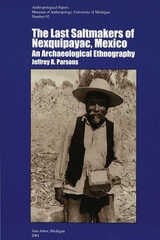
The Last Saltmakers of Nexquipayac, Mexico
An Archaeological EthnographyJeffrey R. Parsons
University of Michigan Press, 2001
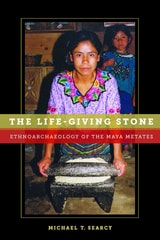
The Life-Giving Stone
Ethnoarchaeology of Maya MetatesMichael T. Searcy
University of Arizona Press, 2011
Although many archaeologists have regarded these artifacts simply as common everyday tools and therefore unremarkable, Searcy’s methodology reveals how, for the ancient Maya, the manufacture and use of grinding stones significantly impacted their physical and economic welfare. In tracing the life cycle of these tools from production to discard for the modern Maya, Searcy discovers rich customs and traditions that indicate how metates and manos have continued to sustain life—not just literally, in terms of food, but also in terms of culture. His research is based on two years of fieldwork among three Mayan groups, in which he documented behaviors associated with these tools during their procurement, production, acquisition, use, discard, and re-use.
Searcy’s investigation documents traditional practices that are rapidly being lost or dramatically modified. In few instances will it be possible in the future to observe metates and manos as central elements in household provisioning or follow their path from hand-manufacture to market distribution and to intergenerational transmission. In this careful inquiry into the cultural significance of a simple tool, Searcy’s ethnographic observations are guided both by an interest in how grinding stone traditions have persisted and how they are changing today, and by the goal of enhancing the archaeological interpretation of these stones, which were so fundamental to pre-Hispanic agriculturalists with corn-based cuisines.
The Menial Art of Cooking
Archaeological Studies of Cooking and Food PreparationSarah R. Graff
University Press of Colorado, 2012
This book examines techniques and technologies of food preparation, the spaces where food was cooked, the relationship between cooking and changes in suprahousehold economies, the religious and symbolic aspects of cooking, the relationship between cooking and social identity, and how examining foodways provides insight into social relations of production, distribution, and consumption. Contributors use a wide variety of evidence-including archaeological data; archival research; analysis of ceramics, fauna, botany, glass artifacts, stone tools, murals, and painted ceramics; ethnographic analogy; and the distribution of artifacts across space-to identify signs of cooking and food processing left by ancient cooks.
The Menial Art of Cooking is the first archaeological volume focused on cooking and food preparation in prehistoric and historic settings around the world and will interest archaeologists, social anthropologists, sociologists, and other scholars studying cooking and food preparation or subsistence.
Transformation by Fire
The Archaeology of Cremation in Cultural ContextEdited by Ian Kuijt, Colin P. Quinn, and Gabriel Cooney
University of Arizona Press, 2014
Editors Ian Kuijt, Colin P. Quinn, and Gabriel Cooney’s volume examines cremation by documenting the material signatures of cremation events and processes, as well as its transformative impact on social relations and concepts of the body. Indeed, examining why and how people chose to cremate their dead serves as an important means of understanding how people in the past dealt with death, the body, and the social world.
The contributors develop new perspectives on cremation as important mortuary practices and social transformations. Varying attitudes and beliefs on cremation and other forms of burial within the same cultural paradigm help us understand what constitutes the body and what occurs during its fiery transformation. In addition, they explore issues and interpretive perspectives in the archaeological study of cremation within and between different cultural contexts.
The global and comparative perspectives on cremation render the book a unique contribution to the literature of anthropological and mortuary archaeology.