Results by title
60 books match the query 'Evangelicalism' and 7 start with t

The Anarchy of Black Religion
A Mystic SongJ. Kameron Carter
Duke University Press, 2023
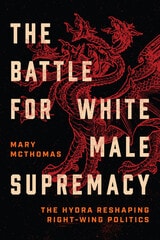
The Battle for White Male Supremacy
The Hydra Reshaping Right-Wing PoliticsMary McThomas
University of Chicago Press, 2027
Explains how interconnected race and gender ideologies underlie grievance politics on the Right and reveals how both are transforming American politics, policy, and law.
In The Battle for White Male Supremacy, Mary McThomas sheds new light on the entwined racial and gender ideologies that have come to define large segments of the American Right and are roiling American law and politics. Individual chapters trace the development, ideas, and influence of several key groups: incels, alt-right vigilante groups, Christian nationalists, and men’s rights groups at war with the judiciary. While these groups are often treated as discrete phenomena with distinct histories and ostensibly different goals, all share an interconnected belief system of victimhood and embattled white masculinity. By tracking these similarities, McThomas exposes how racial and gendered belief systems are connected both within and across groups.
What is more, McThomas shows that these groups’ beliefs and tactics have moved from the extremist fringes of society to the mainstream of American politics. They’ve gained broad traction in public opinion and political discourse, and they are transforming law and policy at both the state and federal levels.
The Divided Mind of Protestant America, 1880-1930
Ferenc M. Szasz
University of Alabama Press, 1982
The Divided Mind of Protestant America is a documented overview of American Protestantism in American culture from beginning to end. It discusses liberal-fundamentalist tensions in America and the role of mainline Protestantism, evangelicalism, and fundamentalism in American culture.
The Divine Institution
White Evangelicalism's Politics of the FamilySophie Bjork-James
Rutgers University Press, 2021
Winner of the Anne Bolin & Gil Herdt Book Prize from the Human Sexuality and Anthropology Interest Group (HSAIG)
The Divine Institution provides an account of how a theology of the family came to dominate a white evangelical tradition in the post-civil rights movement United States, providing a theological corollary to Religious Right politics.
This tradition inherently enforces racial inequality in that it draws moral, religious, and political attention away from problems of racial and economic structural oppression, explaining all social problems as a failure of the individual to achieve the strong gender and sexual identities that ground the nuclear family. The consequences of this theology are both personal suffering for individuals who cannot measure up to prescribed gender and sexual roles, and political support for conservative government policies. Exposure to experiences that undermine the idea that an emphasis on the family is the solution to all social problems is causing a younger generation of white evangelicals to shift away from this narrow theological emphasis and toward a more social justice-oriented theology. The material and political effects of this shift remain to be seen.
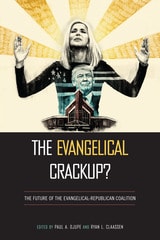
The Evangelical Crackup?
The Future of the Evangelical-Republican CoalitionEdited by Paul Djupe and Ryan L. Claassen
Temple University Press, 2019
Why did Donald Trump attract a record number of white evangelical voters without unified support—and despite nontrivial antipathy from evangelical leaders? The editors and leading scholars that contribute to the timely volume The Evangelical Crackup? answer this question and provide a comprehensive assessment of the status of evangelicals and the Christian Right in the Republican coalition.
The expected “crackup” with the Republican Party never happened. Each chapter in this cogent volume includes analyses of the 2016 election to explain why—and why that is critical. Chapters examine policy priorities, legal advocacy, and evangelical loyalty to the Republican Party; rhetoric, social networks, and evangelical elite influence; and the political implications of movements within evangelicalism, such as young evangelicals, Hispanics, and the Emergent Church movement.
Contributors include: Daniel Bennett, Mark Brockway, Ryan P. Burge, Brian R. Calfano, Jeremy Castle, Kimberly Conger, Daniel A. Cox, Kevin den Dulk, Sarah Allen Gershon, Tobin Grant, Robert P. Jones, Geoffrey Layman, Andrew R. Lewis, Ronald J. McGauvran, Joshua Mitchell, Juhem Navarro-Rivera, Jacob R. Neiheisel, Elizabeth Oldmixon, Adrian D. Pantoja, David Searcy, Anand Edward Sokhey, J. Benjamin Taylor, Robert Wuthnow, and the editors.
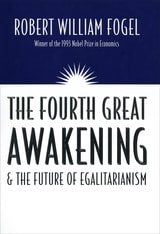
The Fourth Great Awakening and the Future of Egalitarianism
Robert William Fogel
University of Chicago Press, 2000
"To take a trip around the mind of Robert Fogel, one of the grand old men of American economic history, is a rare treat. At every turning, you come upon some shiny pearl of information."—The Economist
In this broad-thinking and profound piece of history, Robert William Fogel synthesizes an amazing range of data into a bold and intriguing view of America's past and future—one in which the periodic Great Awakenings of religion bring about waves of social reform, the material lives of even the poorest Americans improve steadily, and the nation now stands poised for a renewed burst of egalitarian progress.
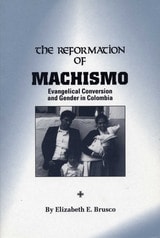
The Reformation of Machismo
Evangelical Conversion and Gender in ColombiaBy Elizabeth E. Brusco
University of Texas Press, 1995
Protestant evangelicalism has spread rapidly in Latin America at the same time that foreign corporations have taken hold of economies there. These concurrent developments have led some observers to view this religious movement as a means of melding converts into a disciplined work force for foreign capitalists rather than as a reflection of conscious individual choices made for a variety of personal, as well as economic, reasons.
In this pioneering study, Elizabeth Brusco challenges such assumptions and explores the intra-household motivations for evangelical conversion in Colombia. She shows how the asceticism required of evangelicals (no drinking, smoking, or extramarital sexual relations are allowed) redirects male income back into the household, thereby raising the living standard of women and children. This benefit helps explain the appeal of evangelicalism for women and questions the traditional assumption that organized religion always disadvantages women.
Brusco also demonstrates how evangelicalism appeals to men by offering an alternative to the more dysfunctional aspects of machismo. Case studies add a fascinating human dimension to her findings.
With the challenges this book poses to conventional wisdom about economic, gender, and religious behavior, it will be important reading for a wide audience in anthropology, women’s studies, economics, and religion. For all students of Latin America, it offers thoughtful new perspectives on a major, grass-roots agent of social change.