Results by title
72 books match the query 'Field Guide' and 9 start with t
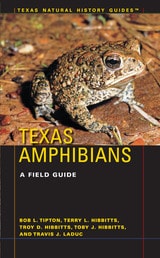
Texas Amphibians
A Field GuideBy Bob L. Tipton, Terry L. Hibbitts, Troy D. Hibbitts, Toby J. Hibbitts, and Travis J. LaDuc
University of Texas Press, 2012
With a wide variety of habitats ranging from southeastern swamps to western deserts, Texas is home to numerous species of frogs, toads, and salamanders. Each area of Texas has a particular set of species that has evolved there over thousands of years. Indeed, most amphibians are not very mobile, and many live their entire lives within a few square meters. This makes them particularly vulnerable to environmental degradation and habitat destruction.
Texas Amphibians is the only field guide focused exclusively on the state’s frogs, toads, and salamanders. It presents brief, general accounts of the two orders and fifteen families. Then it identifies each of the seventy-two species in detail, including size, description, voice (if applicable), similar species, distribution (with maps), natural history, reproduction, subspecies (if applicable), and comments and conservation information. Color photographs illustrate the species.
The book also includes a general introduction to amphibian natural history, conservation, observation and collection, maintenance in captivity, museum and preserved specimens, and scientific and common names, as well as scientific keys to Texas salamanders and frogs and a generic key to amphibian larvae. This wealth of information, compiled by a team of experts who collectively have over a century of experience in field herpetology, will increase our appreciation for amphibians and the vital role they play as an early indicator of threats to the quality of the environment that we all share.

Texas Lizards
A Field GuideBy Troy and Toby Hibbitts
University of Texas Press, 2015
“Texas offers the opportunity to observe lizard diversity like no other part of the country,” writes Laurie J. Vitt in the foreword to Texas Lizards. From the moist eastern Piney Woods to the western deserts, lizards can be found in every part of Texas. The state has forty-five native and six naturalized species of lizards, almost half of the 115 species that live in the continental United States. Yet Texas lizards have not received full coverage in regional field guides, and no other guide dedicated solely to the state’s lizards has ever been published.
Texas Lizards is a complete identification guide to all fifty-one native and established exotic lizard species. It offers detailed species accounts, range maps, and excellent color photographs (including regional, gender, and age variations for many species) to aid field identification. The authors, two of the state’s most knowledgeable herpetologists, open the book with a broad overview of lizard natural history, conservation biology, observation, and captive maintenance before providing a key to Texas lizards and accounts of the various lizard families and species. Appendices list species of questionable occurrence in Texas and nonestablished exotic species. Informational resources on Texas lizards, a map of Texas counties, a glossary, a bibliography, and indexes of common and scientific names round out the volume.
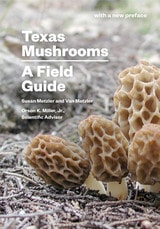
Texas Mushrooms
A Field GuideBy Susan and Van Metzler
University of Texas Press, 1992
Hundreds of species of mushrooms flourish in Texas, from the desert and semiarid regions of West Texas to the moist and acid soils of East Texas, where species that can also be found in South America live alongside those that might be spotted in Malaysia and Europe. Texas Mushrooms was the first—and is still the only—guide to all of the state’s mushrooms.
This colorful, easy-to-follow book will surprise and delight uninitiated nature enthusiasts while also supplying the experienced mushroom hunter with expert identification information. Excellent color photographs and precise descriptions of over 200 species will enable the mushroom hunter—even the amateur—to make quick, careful, easy distinctions between the edible varieties and the potentially toxic ones. In addition, kitchen-tested recipes are included, along with charts giving spore sizes and a list of recommended further reading.
In Texas, mushroom hunting can be a year-round, state-wide activity, and with this enticing field guide, collecting, identifying, and preparing wild mushrooms will become an activity the entire family can enjoy while appreciating the beauty of Texas from a new and fascinating angle.

Texas Snakes
A Field GuideBy James R. Dixon, John E. Werler, and Michael R. J. Forstner; Line drawings by Regina Levoy
University of Texas Press, 2020
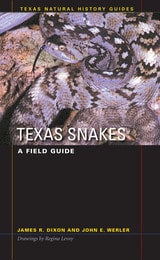
Texas Snakes
A Field GuideBy James R. Dixon and John E. Werler
University of Texas Press, 2005

Texas Turtles & Crocodilians
A Field GuideBy Troy D. Hibbitts and Terry L. Hibbitts
University of Texas Press, 2016
Texas has a large and diverse turtle population, with forms that are found nowhere else (Cagle’s Map Turtle and the Texas Map Turtle) and wide-ranging species that barely touch the state, including the Painted Turtles and the Rough-footed Mud Turtle. From the Sabine River to El Paso, and from the Rio Grande to the Panhandle, thirty-one native and established exotic turtle species are definitely known in Texas, along with one crocodilian, the American Alligator.
Texas Turtles & Crocodilians is the first complete identification guide to all the state’s turtles and to its single alligator. It offers detailed species accounts, range maps, and excellent color photographs to aid in field identification. The authors, two of the state’s most knowledgeable herpetologists, open the book with a broad overview of turtle natural history, conservation biology, observation, and captive maintenance before providing a key to Texas turtles and accounts of the various turtle families and species. Appendices provide brief accounts of species that occurred prehistorically in Texas and non-established exotic species, as well as a table of Texas’ major watersheds and the turtle diversity in each one. Informational resources on Texas turtles and alligators, a map of Texas counties, a glossary, a bibliography, and indexes of common and scientific names complete the volume.
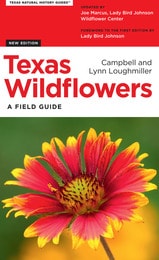
Texas Wildflowers
A Field GuideBy Campbell and Lynn Loughmiller; updated by Joe Marcus; foreword to the first edition by Lady Bird Johnson
University of Texas Press, 2018
With more than 175,000 copies sold, Texas Wildflowers has established itself as the go-to guide for identifying the state’s roadside flowers. This new edition has been completely reorganized by flower colors (and within each color section, by flowering season) to make it even easier to identify the flowers you see as you travel through Texas. Every wildflower is illustrated with a beautiful full-color photograph—over 250 of which are new to this edition. All of the descriptive identifying information is presented in a consistent format—common and botanical names, plant and leaves, flowers and fruit, flowering season, habitat and range, and notes.
What hasn’t changed is the book’s sturdy binding, which will hold up through years of active use, and its wealth of information, which has been thoroughly updated by the expert staff of the Lady Bird Johnson Wildflower Center:
- 300 species descriptions, including engaging comments about the plants’ natural histories, landscape uses, edible or medicinal properties, and folklore
- A map of Texas’s vegetational areas
- Glossaries that define and illustrate botanical terms
- A bibliography of books for learning more about wildflowers
- Indexes to common and botanical plant names, as well as plant families, that distinguish between native and non-native species
As Lady Bird Johnson observed in the foreword, Texas Wildflowers “makes me want to reach for my sunhat, put on my walking shoes, take this knowledge-filled book, and fare forth to seek and discover!”

The Old Barn Book
A Field Guide to North American Barns & Other Farm StructuresNoble, Allen G
Rutgers University Press, 1996
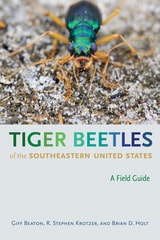
Tiger Beetles of the Southeastern United States
A Field GuideGiff Beaton, R. Stephen Krotzer, and Brian D. Holt
University of Alabama Press, 2021
Combines current data and taxonomic classifications for tiger beetles in the Southeast with stunning close-up photographs, flight season charts, and distribution maps
Tiger beetles are brightly colored and metallic beetles, often with ivory or cream-colored markings. They are most abundant and diverse in habitats near bodies of water with sandy or clay soils and can be found along rivers, on sea and lake shores, on sand dunes, around dry lakebeds, on clay banks, or on woodland paths. Conservatively estimated, the group comprises more than 2,600 species worldwide.
Tiger Beetles of the Southeastern United States identifies and describes 52 taxa (42 species and 10 additional subspecies) of tiger beetles that occur in Alabama, Florida, Georgia, Mississippi, North Carolina, South Carolina, and Tennessee. Stunning close-up photographs accompany current taxonomic and biological information in a volume designed for a growing audience of enthusiastic amateurs and professionals alike.
The authors provide an in-depth description of the anatomy, life cycle, and behavior of tiger beetles; an overview of the various southeastern habitats in which they occur; instructions for finding, identifying, and photographing them in the wild; and the conservation status of various species. The individual species accounts include stunning, detailed images, flight season charts, county-level regional distribution maps, and discussion of identifying features, habitat, similar species, and subspecies when applicable. The appendix includes two species previously found in Florida but no longer known to exist there.
The result is the most complete field guide to date on tiger beetles in the region. With more than 230 images of beetles and their habitats, as well as life history and distribution data, this book is essential for tiger beetle enthusiasts, naturalists of all kinds, photographers, biologists, and teachers throughout the region.