Results by title
208 books match the query 'Finance' and 33 start with t
Tax Haven Ireland
Brian O’ Boyle
Pluto Press, 2021
Tax Haven Ireland uncovers the central players in this process and exposes the coverups employed by the Irish state, with the help of accountants, lawyers, and financial services companies. From the lucrative internet porn industry to corruption in the property market, this issue distorts the economy across the state and in the wider international system, and its history runs deep, going back the country’s origins as a British colonial outpost.
Today, in the wake of Brexit and in the shadow of yet another economic crash, what can be done to prevent such dangerous behaviour and reorganize our economies to invest in the people? Can Ireland – and all of us – build an alternative economy based on fairness and democratic values?

The Assault on Universities
A Manifesto for ResistanceEdited by Michael Bailey and Des Freedman
Pluto Press, 2011
With funding cuts well under way and many institutions already promising to charge the maximum £9,000 yearly tuition fee, university education for the majority is under threat. This book exposes the true motives behind the government's programme and provides the analytical tools to fight it.
Widespread student protests and occupations, often supported by staff, unions and society at large, show the public's opposition to funding cuts and fee increases. The contributors to this sharp, well-written collection, many of whom are active participants in the anti-cuts movement, outline what's at stake and why it matters. They argue that university education is becoming increasingly skewed towards vocational degrees, which devalues the arts and social sciences – subjects that allow creativity and political inquiry to flourish.
Released at the beginning of the new academic year, this book will be at the heart of debates around the future of higher education in the UK and beyond, inspiring both new and seasoned activists in the fight for the soul of our universities.
The Bonds of Inequality
Debt and the Making of the American CityDestin Jenkins
University of Chicago Press, 2021
In this passionate and deeply researched book, Destin Jenkins shows in vivid detail how, beyond the borrowing decisions of American cities and beneath their quotidian infrastructure, there lurks a world of politics and finance that is rarely seen, let alone understood. Focusing on San Francisco, The Bonds of Inequality offers a singular view of the postwar city, one where the dynamics that drove its creation encompassed not only local politicians but also banks, credit rating firms, insurance companies, and the national municipal bond market. Moving between the local and the national, The Bonds of Inequality uncovers how racial inequalities in San Francisco were intrinsically tied to municipal finance arrangements and how these arrangements were central in determining the distribution of resources in the city. By homing in on financing and its imperatives, Jenkins boldly rewrites the history of modern American cities, revealing the hidden strings that bind debt and power, race and inequity, democracy and capitalism.
The Bottom Line
Observations and Arguments on the Sports BusinessAndrew Zimbalist
Temple University Press, 2006
The Changing Roles of Debt and Equity in Financing U.S. Capital Formation
Edited by Benjamin M. Friedman
University of Chicago Press, 1982
This volume, consisting of papers presented at a conference held at Williamsburg, Va., 2-3 April 1981, is a progress report on the National Bureau of Economic Research project, The Changing Roles of Debt and Equity in Financing U.S. Capital Formation. The National Bureau has undertaken this project—including the conference, the research described in this volume, and the publication of the volume itself—with the support of the American Council of Life Insurance.

The Coming Health Crisis
Who Will Pay for Care for the Aged in the 21st Century?John R. Wolfe
University of Chicago Press, 1993
In previous decades, when younger Americans far outnumbered older ones, retirees could depend on financial support through taxes from the population at large. But as "Boomers" retire and the work force begins to shrink, there will be a disproportionately large population of retirees to workers. With such a big jump in the percentage of older Americans in the population, fewer workers will be able to to transfer funds, through taxes, to retirees. Moreover, other traditionally reliable sources of financial assistance—Social Security, Medicare, and Medicaid—have faced serious financial difficulties in recent years. Who will the aged turn to for assistance?
The Coming Health Crisis suggests that as funds from all quarters dwindle, older Americans will have to look to alternative programs for financial assistance. Wolfe urges immediate action to develop new saving programs and increase existing transfer schemes to head off an imminent crisis. Although tax increases might provide some resources, he demonstrates that it is more important to accumulate capital to create solid reserves for the future. Wolfe also explores two roles for government: prefunding new or existing social insurance programs and promoting private insurance options. By exempting insurance fund income from corporate taxation and permitting people at all income levels to defer income tax on accounts earmarked for long-term care, he shows how government could greatly encourage and expand personal saving.
Finally, this work assesses the value of other recent health and long-term-care innovations: social/health maintenance organizations, long-term-care individual retirement accounts, and reverse annuity mortgages, in addition to vouchers, care rationing, mandatory public insurance, and expanded private coverage. Through this wide-ranging survey, Wolfe demonstrates that, through a combination of these programs, we can care for the aging "Baby Boom" generation by anticipating their needs and saving now.
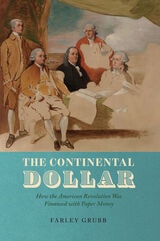
The Continental Dollar
How the American Revolution Was Financed with Paper MoneyFarley Grubb
University of Chicago Press, 2023
The Continental Dollar is a revelatory history of how the fledgling United States paid for its first war. Farley Grubb upends the common telling of this story, in which the United States printed cross-colony money, called Continentals, to serve as an early fiat currency—a currency that is not tied to a commodity like gold, but rather to a legal authority. As Grubb details, the Continental was not a fiat currency, but a “zero-coupon bond”—a wholly different species of money. As bond payoffs were pushed into the future, the money’s value declined, killing the Continentals’ viability years before the Revolutionary War would officially end.
Drawing on decades of exhaustive mining of eighteenth-century records, The Continental Dollar is an essential origin story of the early American monetary system, promising to serve as the benchmark for critical work for decades to come.
The Corporate Contract in Changing Times
Is the Law Keeping Up?Edited by Steven Davidoff Solomon and Randall Stuart Thomas
University of Chicago Press, 2019
With The Corporate Contract in Changing Times, Steven Davidoff Solomon and Randall Stuart Thomas bring together leading corporate law scholars, judges, and lawyers from top corporate law firms to explore what needs to change and what has prevented reform thus far. Among the topics addressed are how the law could be adapted to the reality that activist hedge funds pose a more serious threat to corporations than the hostile takeovers and how statutory laws, such as the rules governing appraisal rights, could be reviewed in the wake of appraisal arbitrage. Together, the contributors surface promising paths forward for future corporate law and public policy.

The Distributional Aspects of Social Security and Social Security Reform
Edited by Martin Feldstein and Jeffrey B. Liebman
University of Chicago Press, 2002
As this volume suggests, the distributional consequences of these proposals are substantially different and may disproportionately affect those groups who depend on social security to avoid poverty in old age. Together, these studies persuasively show that appropriately designed investment-based social security reforms can effectively reduce the long-term burden of an aging society on future taxpayers, increase the expected future income of retirees, and mitigate poverty rates among the elderly.
The Economics of School Choice
Edited by Caroline M. Hoxby
University of Chicago Press, 2003
Combining the results of empirical research with analyses of the basic economic forces underlying local education markets, The Economics of School Choice presents evidence concerning the impact of school choice on student achievement, school productivity, teachers, and special education. It also tackles difficult questions such as whether school choice affects where people decide to live and how choice can be integrated into a system of school financing that gives children from different backgrounds equal access to resources. Contributors discuss the latest findings on Florida's school choice program as well as voucher programs and charter schools in several other states.
The resulting volume not only reveals the promise of school choice, but examines its pitfalls as well, showing how programs can be designed that exploit the idea's potential but avoid its worst effects. With school choice programs gradually becoming both more possible and more popular, this book stands out as an essential exploration of the effects such programs will have, and a necessary resource for anyone interested in the idea of school choice.
The Effects of Taxation on Multinational Corporations
Edited by Martin Feldstein, James R. Hines Jr., and R. Glenn Hubbard
University of Chicago Press, 1995
In an attempt to quantify the effect of tax policy on international investment choices, this volume presents in-depth analyses of the interaction of international tax rules and the investment decisions of multinational enterprises. Ten papers assess the role played by multinational firms and their investment in the U.S. economy and the design of international tax rules for multinational investment; analyze channels through which international tax rules affect the costs of international business activities; and examine ways in which international tax rules affect financing decisions of multinational firms. As a group, the papers demonstrate that international tax rules have significant effects on firms' investment and other financing decisions.
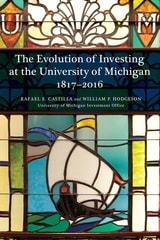
The Evolution of Investing at the University of Michigan
1817–2016Rafael E. Castilla and William P. Hodgeson
Michigan Publishing Services, 2017

The Fable of the Keiretsu
Urban Legends of the Japanese EconomyYoshiro Miwa and J. Mark Ramseyer
University of Chicago Press, 2006
In their insightful analysis, the authors show that the very idea of the keiretsu was created and propagated by Marxist scholars in post-war Japan. Western scholars merely repatriated the legend to show the culturally contingent nature of modern economic analysis. Laying waste to the notion of keiretsu, the authors debunk several related “facts” as well: that Japanese firms maintain special arrangements with a “main bank,” that firms are systematically poorly managed, and that the Japanese government guided post-war growth. In demolishing these long-held assumptions, they offer one of the few reliable chronicles of the realities of Japanese business.
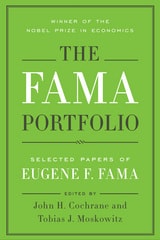
The Fama Portfolio
Selected Papers of Eugene F. FamaEugene F. Fama
University of Chicago Press, 2017
Published soon after the fiftieth anniversary of Fama’s appointment to the University of Chicago and his receipt of the Nobel Prize in Economics, The Fama Portfolio offers an authoritative compilation of Fama’s central papers. Many are classics, including his now-famous essay on efficient capital markets. Others, though less famous, are even better statements of the central ideas. Fama’s research considers key questions in finance, both as an academic field and an industry: How is information reflected in asset prices? What is the nature of risk that scares people away from larger returns? Does lots of buying and selling by active managers produce value for their clients? The Fama Portfolio provides for the first time a comprehensive collection of his work and includes introductions and commentary by the book’s editors, John H. Cochrane and Tobias Moskowitz, as well as by Fama’s colleagues, themselves top scholars and successful practitioners in finance. These essays emphasize how the ideas presented in Fama’s papers have influenced later thinking in financial economics, often for decades.
The Feature Film Distribution Deal
A Critical Analysis of the Single Most Important Film Industry AgreementJohn W. Cones
Southern Illinois University Press, 1997
John W. Cones, whose real goal is to stimulate a long-term film industry reform movement, shows how the financial control of the film industry in the hands of the major studios and distributors actually translates into creative control of the industry.
Cones discusses the pros and cons of the debate relating to the industry’s so-called net profit problem and the way in which the distribution deal plays an integral part in that problem. He then breaks down five major film finance/distribution scenarios, explaining various distribution deals and suggesting ways of negotiating distribution.
Critically examining the specific terms of the distribution deal itself, Cones covers gross receipts exclusions, distributor fees, and distribution expenses. He also investigates the various forms of interest, issues of production costs, matters of creative control, and general contractual provisions.
For handy reference, Cones includes an extensive checklist for negotiating any feature film distribution deal. The list deals with distribution fees, distribution expenses, interest, production costs, creative control issues, general contractual provisions, distributor commitments, and the limits of negotiating. His nine appendixes present a "Motion Picture Industry Overview," "Profit Participation Audit Firms," "ADI (Top 50) Market Rankings," an "AFMA Member List, 1992–1993," a "Production-Financing/Distribution Agreement," a "Negative Pickup Distribution Agreement," a "Distribution Rights Acquisition Agreement," a "Distribution Agreement (Rent-a-Distributor Deal)," and a "Foreign Distribution Agreement."
Cones wrote this book for independent producers, executive and associate producers and their representatives, directors, actors, screenwriters, members of talent guilds, distributors, and entertainment, antitrust, and securities attorneys. Securities issuers and dealers, investment bankers, and money finders, investors, and financiers of every sort also will be interested. In addition, Cones suggests and hopes that the book will interest "Congress, their research staff, government regulators at the Internal Revenue Service, the Securities and Exchange Commission, the Federal Trade Commission, and law enforcement officials such as the Los Angeles District Attorney and the U.S. Justice Department."
The Great University Gamble
Money, Markets and the Future of Higher EducationAndrew McGettigan
Pluto Press, 2013
Displaying a stunning grasp of the financial and policy details, Andrew McGettigan surveys the emerging brave new world of higher education. He looks at the big questions: What will be the role of universities within society? How will they be funded? What kind of experiences will they offer students? Where does the public interest lie?
Written in a clear and accessible style, The Great University Gamble outlines the architecture of the new policy regime and tracks the developments on the ground. It is an urgent warning that our universities and colleges are now open to commercial pressures, which threaten to transform education from a public good into a private, individual financial investment.
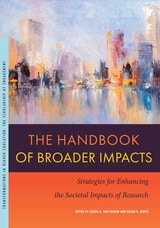
The Handbook of Broader Impacts
Strategies for Enhancing the Societal Impacts of ResearchLaurie A. Van Egeren
Michigan State University Press, 2026
The Handbook of Broader Impacts is an essential resource for researchers, administrators, policymakers, and anyone interested in the societal benefits of research. The volume brings together experts who trace the history of broader impacts as a U.S. National Science Foundation policy, explore its relationship to engaged scholarship, and provide models for institutional infrastructure and support. The book equips readers with tools to build the institutional capacity to advance the societal impacts of research, from developing researcher identities and competencies to navigating promotion and tenure. The Handbook of Broader Impacts explores a wide range of initiatives—open science, science communication, citizen science, informal STEM learning, K–12 partnerships, undergraduate research, teacher development, international collaborations, and more. By blending policy context, practical strategies, and real-world examples, the handbook spells out the value of broader impacts and demonstrates how research can contribute to direct and meaningful change.
The Measurement of Capital
Edited by Dan Usher
University of Chicago Press, 1980

The Minnesota Commission of Administration and Finance, 1925-1939
An Administrative HistoryLloyd M. Short and Carl W. Tiller
University of Minnesota Press, 0
The Minnesota Commission of Administration and Finance, 1925-1939 was first published in 1964. Minnesota Archive Editions uses digital technology to make long-unavailable books once again accessible, and are published unaltered from the original University of Minnesota Press editions.

The Money Doctor in the Andes
U.S. Advisors, Investors, and Economic Reform in Latin America from World War I to the Great DepressionPaul W. Drake
Duke University Press, 1988
Drake links the Kemmerer missions to vital developments in the political economic history of the Andean republics in the interwar period. He analyzes the domestic interest groups and political forces whose convergent strategies gave the Kemmerer missions their remarkable record in achieving local success for the reforms proposed. Second, Drake situates the Kemmerer missions at the center of a process of political modernization that created new institutions and policy agencies in each of the five countries; the missions thereby contributed to the expansion of the central government as an agent of development in ways that later differed sharply from Kemmerer's orthodox policies. Finally, The Money Doctor in the Andes regards developments in the Andean countries in the context of the region's developing economic ties to the United States. Expectations that Kemmerer's plans would simultaneously attract foreign capital and control inflation drew support from sectors as diverse as trade unions and landowners. When the Depression deepened, Kemmerer's policies proved counterproductive and the fragile consensus that had installed them fell apart, but the political and administrative reforms endured—with far-reaching consequences.
The Money Myth
School Resources, Outcomes, and EquityW. Norton Grubb
Russell Sage Foundation, 2009
The Money Problem
Rethinking Financial RegulationMorgan Ricks
University of Chicago Press, 2016
In The Money Problem, Morgan Ricks addresses all of these questions and more, offering a practical yet elegant blueprint for a modernized system of money and banking—one that, crucially, can be accomplished through incremental changes to the United States’ current system. He brings a critical, missing dimension to the ongoing debates over financial stability policy, arguing that the issue is primarily one of monetary system design. The Money Problem offers a way to mitigate the risk of catastrophic panic in the future, and it will expand the financial reform conversation in the United States and abroad.
The Mormon Hierarchy
Wealth and Corporate PowerD. Michael Quinn
Signature Books, 2017
Early in the twentieth century, it was possible for Latter-day Saints to have lifelong associations with businesses managed by their leaders or owned and controlled by the church itself. For example, one could purchase engagement rings from Daynes Jewelry, honeymoon at the Hotel Utah, and venture off on the Union Pacific Railroad, all partially owned and run by church apostles.
Families could buy clothes at Knight Woolen Mills. The husband might work at Big Indian Copper or Bullion-Beck, Gold Chain, or Iron King mining companies. The wife could shop at Utah Cereal Food and buy sugar supplied by Amalgamated or U and I Sugar, beef from Nevada Land and Livestock, and vegetables from the Growers Market. They might take their groceries home in parcels from Utah Bag Co. They probably read the Deseret News at home under a lamp plugged into a Utah Power and Light circuit. They could take out a loan from Zion’s Co-operative and insurance from Utah Home and Fire.
The apostles had a long history of community involvement in financial enterprises to the benefit of the general membership and their own economic advantage. This volume is the result of the author’s years of research into LDS financial dominance from 1830 to 2010.

The National Collegiate Athletic Association
A Study in Cartel BehaviorArthur A. Fleisher III, Brian L. Goff, and Robert D. Tollison
University of Chicago Press, 1992
Probing the history and business practices of the most powerful sports organization of colleges and universities in the United States, the authors present a persuasive case that the NCAA is in fact a cartel, its members engaged in classically defined restrictive practices for the sole purpose of jointly maximizing their profits.
This fresh perspective on the NCAA's institutional structure helps to explain why illicit payments to athletes persist, why non-NCAA organizations have not flourished, and why members have readily agreed on certain suspect rules.
Offering a valuable case study for sports analysts and students of economics and cartel behavior, this book is a revealing glimpse inside the embattled NCAA program.
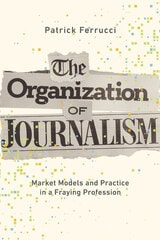
The Organization of Journalism
Market Models and Practice in a Fraying ProfessionPatrick Ferrucci
University of Illinois Press, 2024
Using rich interviews and participant observation, Patrick Ferrucci examines institutions with funding mechanisms that range from traditional mogul ownership and online-only nonprofits to staff-owned cooperatives and hedge fund control. The variations in market models have frayed the tenets of professionalization, with unique work cultures emerging from each organization’s focus on its mission and the implantation of its own processes and ethical guidelines. As a result, the field of American journalism no longer shares uniform newsgathering practices and a common identity, a break with the past that affects what information we consume today and what the press will become tomorrow.
An inside look at a fracturing profession, The Organization of Journalism illuminates the institution’s expanding impact on newsgathering and the people who practice it.
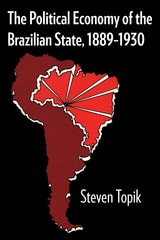
The Political Economy of the Brazilian State, 1889–1930
By Steven Topik
University of Texas Press, 1987
In this first overview of the Brazilian republican state based on extensive primary source material, Steven Topik demonstrates that well before the disruption of the export economy in 1929, the Brazilian state was one of the most interventionist in Latin America. This study counters the previous general belief that before 1930 Brazil was dominated by an export oligarchy comprised of European and North American capitalists and that only later did the state become prominent in the country’s economic development.
Topik examines the state’s performance during the First Republic (1889–1930) in four sectors—finance, the coffee trade, railroads, and industry. By looking at the controversies in these areas, he explains how domestic interclass and international struggles shaped policy and notes the degree to which the state acted relatively independently of civil society.
Topik’s primary concern is the actions of state officials and whether their decisions reflected the demands of the ruling class. He shows that conflicting interests of fractions of the ruling class and foreign investors gradually led to far greater state participation than any of the participants originally desired, and that the structure of the economy and of society—not the intentions of the actors—best explains the state’s economic presence.
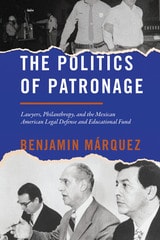
The Politics of Patronage
Lawyers, Philanthropy, and the Mexican American Legal Defense and Educational FundBy Benjamin Márquez
University of Texas Press, 2021
Co-winner, Latino Politics Best Book Award, American Political Science Association
The first book about the Mexican American Legal Defense and Educational Fund, the influential work it has done for the Latina/o community, and the issues stemming from its dependence on large philanthropic organizations.
Founded in 1968, the Mexican American Legal Defense and Educational Fund (MALDEF) is the Latino equivalent to the NAACP: a source of legal defense for the Latina/o community in cases centered on education, state immigration laws, redistricting, employment discrimination, and immigrant rights. Unlike the NAACP, however, MALDEF was founded by Mexican American activists in conjunction with the larger philanthropic structure of the Ford Foundation—a relationship that has opened it up to controversy and criticism.
In the first book to examine this little-known but highly influential organization, Benjamin Márquez explores MALDEF’s history and shows how it has thrived and served as a voice for the Latina/o community throughout its six decades of operation. But he also looks closely at large-scale investments of the Ford Foundation, Rockefeller Foundation, and others, considering how their ties to MALDEF have influenced Mexican American and Latinx politics. Its story crafted from copious research into MALDEF and its benefactors, this book brings to light the influence of outside funding on the articulation of minority identities and the problems that come with creating change through institutional means.
The Risks of Financial Institutions
Edited by Mark Carey and René M. Stulz
University of Chicago Press, 2007
Until about twenty years ago, the consensus view on the cause of financial-system distress was fairly simple: a run on one bank could easily turn to a panic involving runs on all banks, destroying some and disrupting the financial system. Since then, however, a series of events—such as emerging-market debt crises, bond-market meltdowns, and the Long-Term Capital Management episode—has forced a rethinking of the risks facing financial institutions and the tools available to measure and manage these risks.
The Risks of Financial Institutions examines the various risks affecting financial institutions and explores a variety of methods to help institutions and regulators more accurately measure and forecast risk. The contributors--from academic institutions, regulatory organizations, and banking--bring a wide range of perspectives and experience to the issue. The result is a volume that points a way forward to greater financial stability and better risk management of financial institutions.

The Shanghai Intrigue
Michael S. Koyama
Seagull Books, 2017
As the complex plot to bring down a major financial institution unfolds at a rapid pace, American and Japanese officials scramble to prevent a crisis with international implications. Set against the backdrop of the political and financial practices of Japan, China, and the US, The Shanghai Intrigue brings with it murder, betrayal, romance, even a natural disaster, as the plot races to a most unpredictable outcome. The book’s breakneck speed and thrilling twists and turns will leave readers spellbound from the first page.
The Social Life of Financial Derivatives
Markets, Risk, and TimeEdward LiPuma
Duke University Press, 2017
The Swindle of Innovative Educational Finance
Kenneth J. Saltman
University of Minnesota Press, 2018
How “innovative” finance schemes skim public wealth while hijacking public governance
Charter school expansion. Vouchers. Scholarship tax credit programs. The Swindle of Innovative Educational Finance offers a new social theory to explain why these and other privatization policies and programs win support despite being unsupported by empirical evidence. Kenneth J. Saltman details how, under the guise of innovation, cost savings, and corporate social responsibility, new and massive neoliberal educational privatization schemes have been widely adopted in the United States. From a trillion-dollar charter school bubble to the Chan Zuckerberg Initiative to celebrities branding private schools, Saltman ultimately connects such schemes to the country’s current crisis of truth and offers advice for resistance.
Forerunners is a thought-in-process series of breakthrough digital works. Written between fresh ideas and finished books, Forerunners draws on scholarly work initiated in notable blogs, social media, conference plenaries, journal articles, and the synergy of academic exchange. This is gray literature publishing: where intense thinking, change, and speculation take place in scholarship.
Trading Futures
A Theological Critique of Financialized CapitalismFilipe Maia
Duke University Press, 2022

Transnational Capitalism in East Central Europe's Heavy Industry
From Flagship Enterprises to SubsidiariesAleksandra Sznajder Lee
University of Michigan Press, 2016
This book has broad implications for the political economy of reform because it illuminates the political determinants of privatization and the resources used to resist it. In addition, Sznajder Lee sheds new light on why some countries are more likely than others to be subject to external constraints, such as IMF conditionality, and how some allegedly pro-market reformers manage to maintain public ownership over certain industry sectors.