Results by title
70 books match the query 'Folk music' and 10 start with t
Tales, Tunes, and Tassa Drums
Retention and Invention into Indo-Caribbean MusicPeter Manuel
University of Illinois Press, 2015
Music scholar Peter Manuel traces the roots of neotraditional music genres like tassa drumming to North India and reveals the ways these genres represent survivals, departures, or innovative elaborations of transplanted music forms. Drawing on ethnographic work and a rich archive of field recordings, he contemplates the music carried to Trinidad by Bhojpuri-speaking and other immigrants, including forms that died out in India but continued to thrive in the Caribbean. His reassessment of ideas of creolization, retention, and cultural survival defies suggestions that the diaspora experience inevitably leads to the loss of the original culture, while also providing avenues to broader applications for work being done in other ethnic contexts.
The Beat Cop
Chicago's Chief O'Neill and the Creation of Irish MusicMichael O'Malley
University of Chicago Press, 2022
The remarkable story of how modern Irish music was shaped and spread through the brash efforts of a Chicago police chief.
Irish music as we know it today was invented not just in the cobbled lanes of Dublin or the green fields of County Kerry, but also in the burgeoning metropolis of early-twentieth-century Chicago. The genre’s history combines a long folk tradition with the curatorial quirks of a single person: Francis O’Neill, a larger-than-life Chicago police chief and an Irish immigrant with a fervent interest in his home country’s music.
Michael O’Malley’s The Beat Cop tells the story of this singular figure, from his birth in Ireland in 1865 to his rough-and-tumble early life in the United States. By 1901, O’Neill had worked his way up to become Chicago’s chief of police, where he developed new methods of tracking criminals and recording their identities. At the same time, he also obsessively tracked and recorded the music he heard from local Irish immigrants, enforcing a strict view of what he felt was and wasn’t authentic. Chief O’Neill’s police work and his musical work were flip sides of the same coin, and O’Malley delves deep into how this brash immigrant harnessed his connections and policing skills to become the foremost shaper of how Americans see, and hear, the music of Ireland.
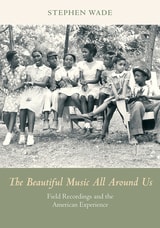
The Beautiful Music All Around Us
Field Recordings and the American ExperienceStephen Wade
University of Illinois Press, 2012
The Beautiful Music All Around Us presents the extraordinarily rich backstories of thirteen performances captured on Library of Congress field recordings between 1934 and 1942 in locations reaching from Southern Appalachia to the Mississippi Delta and the Great Plains. Including the children's play song "Shortenin' Bread," the fiddle tune "Bonaparte's Retreat," the blues "Another Man Done Gone," and the spiritual "Ain't No Grave Can Hold My Body Down," these performances were recorded in kitchens and churches, on porches and in prisons, in hotel rooms and school auditoriums. Documented during the golden age of the Library of Congress recordings, they capture not only the words and tunes of traditional songs but also the sounds of life in which the performances were embedded: children laugh, neighbors comment, trucks pass by.
Musician and researcher Stephen Wade sought out the performers on these recordings, their families, fellow musicians, and others who remembered them. He reconstructs the sights and sounds of the recording sessions themselves and how the music worked in all their lives. Some of these performers developed musical reputations beyond these field recordings, but for many, these tracks represent their only appearances on record: prisoners at the Arkansas State Penitentiary jumping on "the Library's recording machine" in a rendering of "Rock Island Line"; Ora Dell Graham being called away from the schoolyard to sing the jump-rope rhyme "Pullin' the Skiff"; Luther Strong shaking off a hungover night in jail and borrowing a fiddle to rip into "Glory in the Meetinghouse."
Alongside loving and expert profiles of these performers and their locales and communities, Wade also untangles the histories of these iconic songs and tunes, tracing them through slave songs and spirituals, British and homegrown ballads, fiddle contests, gospel quartets, and labor laments. By exploring how these singers and instrumentalists exerted their own creativity on inherited forms, "amplifying tradition's gifts," Wade shows how a single artist can make a difference within a democracy.
Reflecting decades of research and detective work, the profiles and abundant photos in The Beautiful Music All Around Us bring to life largely unheralded individuals--domestics, farm laborers, state prisoners, schoolchildren, cowboys, housewives and mothers, loggers and miners--whose music has become part of the wider American musical soundscape. The hardcover edition also includes an accompanying CD that presents these thirteen performances, songs and sounds of America in the 1930s and '40s.
The British Traditional Ballad in North America
By Tristram P. Coffin
University of Texas Press, 1977
Tristram Potter Coffin’s The British Traditional Ballad in North America, published in 1950, became recognized as the standard reference to the published material on the Child ballad in North America. Centering on the theme of story variation, the book examines ballad variation in general, treats the development of the traditional ballad into an art form, and provides a bibliographical guide to story variation as well as a general bibliography of titles referred to in the guide.
Roger deV. Renwick’s supplement to The British Traditional Ballad in North America provides a thorough review of all sources of North American ballad materials published from 1963, the date of the last revision of the original volume, to 1977. The references, which include published text fragments and published title lists of items in archival collections, are arranged according to each ballad’s story variations. Textual and thematic comparisons among ballads in the British and American tradition are made throughout. In his introductory essay Renwick synthesizes the various theoretical approaches to the phenomenon of variation that have appeared in scholarly publications since 1963 and provides examples from texts referred to in the bibliographical guide itself.
The supplement, like its parent work, is an invaluable reference tool for the study of variation in ballad form, content, and style. Together with the reprinted text of the 1963 edition, the supplement provides an exhaustive bibliography to the literature on the British traditional ballad in North America.
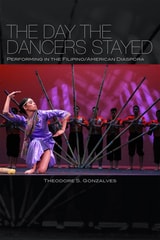
The Day the Dancers Stayed
Performing in the Filipino/American DiasporaTheodore S. Gonzalves
Temple University Press, 2009
Pilipino Cultural Nights at American campuses have been a rite of passage for youth culture and a source of local community pride since the 1980s. Through performances—and parodies of them—these celebrations of national identity through music, dance, and theatrical narratives reemphasize what it means to be Filipino American. In The Day the Dancers Stayed, scholar and performer Theodore Gonzalves uses interviews and participant observer techniques to consider the relationship between the invention of performance repertoire and the development of diasporic identification.
Gonzalves traces a genealogy of performance repertoire from the 1930s to the present. Culture nights serve several functions: as exercises in nostalgia, celebrations of rigid community entertainment, and occasionally forums for political intervention. Taking up more recent parodies of Pilipino Cultural Nights, Gonzalves discusses how the rebellious spirit that enlivened the original seditious performances has been stifled.
The Devil Is in It
A History of the American Acoustic GuitarJohn Stubbings
University of Texas Press, 2025
The rich history of the acoustic guitar and its impact on the music world.
In 2020, guitar expert John Stubbings released a limited-edition book on the American acoustic guitar that sold out in days. Now, The Devil Is in It returns with additional research and subject matter for a new generation of readers. Stubbings traveled the country and met with guitar makers, players, collectors, and historians to unravel the long and rich history of the acoustic guitar, its evolution, and the music it has made over the last hundred years.
Starting with the eighteenth-century European classical guitar, luthiers altered the instrument, changing the way musicians played them, and in turn the music they made. This slow but steady transformation created the iconic American flat-top that became influential across genres and rooted itself in cultural significance. The guitar developed from an obscure instrument into a superstar of the musical world, rivaling then overshadowing its competition. Tied to artists from Gillian Welch and Tracy Chapman to Taylor Swift and Ed Sheeran, the acoustic guitar maintains its eminence in American music and culture. The story of an alluring instrument that shaped the music of the twentieth century, The Devil Is in It is a must-read for lovers of the acoustic guitar and the music it has made.

The Erotic Muse
American Bawdy SongsEd Cray
University of Illinois Press, 1992
Ever wanted to know the "correct" words to "Roll Me Over?" Wondered where the melody of "Sweet Betsy from Pike" came from? Ed Cray ranges from "The Cod Fish Song" to "Hallelujah I'm a Bum" in a tireless quest to answer such questions and restore bawdy to an esteemed place in our folk music canon.
Extensively revised and including forty more songs than its predecessor, the second edition of The Erotic Muse is a unique collection of bawdy and even forbidden American folksongs. Cray presents the full texts of some 125 works with melodies for most and detailed annotations for all. In addition, he adds lively commentary that places the songs in historical, social, and, where appropriate, psychological context.
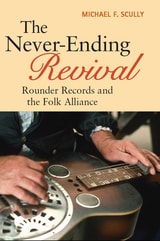
The Never-Ending Revival
Rounder Records and the Folk AllianceMichael F. Scully
University of Illinois Press, 2013
In recent years, there has been an upsurge in interest in "roots music" and "world music," popular forms that fuse contemporary sounds with traditional vernacular styles. In the 1950s and 1960s, the music industry characterized similar sounds simply as "folk music." Focusing on such music since the 1950s, The Never-Ending Revival: Rounder Records and the Folk Alliance analyzes the intrinsic contradictions of a commercialized folk culture. Both Rounder Records and the North American Folk Music and Dance Alliance have sought to make folk music widely available, while simultaneously respecting its defining traditions and unique community atmosphere. By tracing the histories of these organizations, Michael F. Scully examines the ongoing controversy surrounding the profitability of folk music. He explores the lively debates about the difficulty of making commercially accessible music, honoring tradition, and remaining artistically relevant, all without "selling out."
In the late 1950s through the 1960s, the folk music revival pervaded the mainstream music industry, with artists such as Bob Dylan and Joan Baez singing historically or politically informed ballads based on musical forms from Appalachia and the South. In the twenty-first century, the revival continues, and it includes a variety of music derived from Cajun, African American, and Mexican traditions, among many others. Even though the mainstream music industry and media largely ignore the term "folk music," a strong allure based on nostalgia, the desire for community, and a sense of exclusiveness augments an enthusiastic following connected by word-of-mouth, numerous festivals, and the Internet. There are more folk festivals now than there were during the original boom of the 1960s, suggesting that music artists, agents, and record label representatives are striking a successful balance between tradition and profitability. Scully combines rich interviews of music executives and practicing folk musicians with valuable personal experience to reveal how this American subculture remains in a "never-ending revival" based on fluid definitions of folk and folk music.
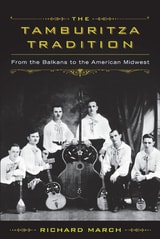
The Tamburitza Tradition
From the Balkans to the American MidwestRichard March
University of Wisconsin Press, 2013
Transforming Tradition
Folk Music Revivals ExaminedEdited by Neil V. Rosenberg: Foreword by Alan Jabbour
University of Illinois Press, 1993
Transforming Tradition examines the phenomenon of the folk song revival, those vibrant meldings of popular and folk culture that captured public awareness in the 1950s and 1960s. We remember the folk revival as forums for performers like Joan Baez and the Kingston Trio, and as incubators for unlikely radio hits like "Tom Dooley" and "Blowin' in the Wind." But it also gave rise to a bustling and influential subculture of hootenanies, coffeehouses, and blues and bluegrass appreciation, sowing a legacy that remains a vital part of American culture.
Many of the contributors to this collection performed during the revival era. Today, their expertise in folklore, ethnomusicology, and cultural history allow them to blend insider knowledge and trained analysis to offer unique perspectives.