Results by title
90 books match the query 'Growth' and 17 start with t
THE MYSTERIES OF THE GREAT CITY
THE POLITICS OF URBAN DESIGN, 1877-1937JOHN FAIRFIELD
The Ohio State University Press, 1997
The Mysteries of the Great City examines the physical, cultural, and political transformations of the American city between the Gilded Age and the New Deal. Focusing on New York, Chicago, and Cincinnati, John Fairfield demonstrates that these transformations before and after the advent of city planning were the result of political decisions influenced by corporate and private wealth.
The expansion and reorganization of the great city stood out as the most visible symbol of the transformation. The new metropolitan form, with its skyscraping business center, industrial satellites, crowded working-class neighborhoods, and exclusive suburbs, embodied an emerging corporate order. But the metropolis also disguised the new order and gave it an apparent physical implacability and inevitability that obscured the role of choice in its creation and therefore placed it beyond criticism. Fairfield unravels the mysteries of the new form to reveal the centrality of power and politics in urban design.
While acknowledging that a great many factors shaped urban development, Fairfield underscores the decisive role of human design. He argues that American cities, both before and after the advent of professional planning, have always been in some measure “planned.” Discussing such figures as Frederick Law Olmsted, Henry George, Daniel Burnham, Frederic Howe, Edward Bassett, Robert E. Park, and Louis Wirth, Fairfield illuminates the political and intellectual conflicts among advocates of alternative paths of urban development.
The Mysteries of the Great City will enlighten all readers interested in the development of cities, particularly urban historians and planners. In pointing to the Gilded Age as a period of great possibilities of progressive reform, this study will also reward readers interested in the historical foundations of our modern society.
The City in Texas
A HistoryBy David McComb
University of Texas Press, 2015
Texans love the idea of wide-open spaces and, before World War II, the majority of the state’s people did live and work on the land. Between 1940 and 1950, however, the balance shifted from rural to urban, and today 88 percent of Texans live in cities and embrace the amenities of urban culture. The rise of Texas cities is a fascinating story that has not been previously told. Yet it is essential for understanding both the state’s history and its contemporary character.
In The City in Texas, acclaimed historian David G. McComb chronicles the evolution of urban Texas from the Spanish Conquest to the present. Writing in lively, sometimes humorous and provocative prose, he describes how commerce and politics were the early engines of city growth, followed by post–Civil War cattle shipping, oil discovery, lumbering, and military needs. McComb emphasizes that the most transformative agent in city development was the railroad. This technology—accompanied by telegraphs that accelerated the spread of information and mechanical clocks that altered concepts of time—revolutionized transportation, enforced corporate organization, dictated town location, organized space and architecture, and influenced thought. McComb also thoroughly explores the post–World War II growth of San Antonio, Dallas, Fort Worth, Austin, and Houston as incubators for businesses, educational and cultural institutions, and health care centers.
The Decline of Latin American Economies
Growth, Institutions, and CrisesEditied by Sebastian Edwards, Gerardo Esquivel, and Graciela Márquez
University of Chicago Press, 2007
Latin America’s economic performance is mediocre at best, despite abundant natural resources and flourishing neighbors to the north. The perplexing question of how some of the wealthiest nations in the world in the nineteenth century are now the most crisis-prone has long puzzled economists and historians. The Decline of Latin American Economies examines the reality behind the struggling economies of Argentina, Chile, and Mexico.
A distinguished panel of experts argues here that slow growth, rampant protectionism, and rising inflation plagued Latin America for years, where corrupt institutions and political unrest undermined the financial outlook of already besieged economies. Tracing Latin America’s growth and decline through two centuries, this volume illustrates how a once-prosperous continent now lags behind. Of interest to scholars and policymakers alike, it offers new insight into the relationship between political systems and economic development.

The Development and Growth of the External Dimensions of the Human Body in the Fetal Period
Richard Scammon
University of Minnesota Press, 1929
The Electric City
Energy and the Growth of the Chicago Area, 1880-1930Harold L. Platt
University of Chicago Press, 1991
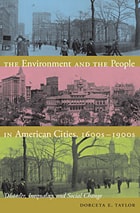
The Environment and the People in American Cities, 1600s-1900s
Disorder, Inequality, and Social ChangeDorceta E. Taylor
Duke University Press, 2009
Taylor traces the progression of several major thrusts in urban environmental activism, including the alleviation of poverty; sanitary reform and public health; safe, affordable, and adequate housing; parks, playgrounds, and open space; occupational health and safety; consumer protection (food and product safety); and land use and urban planning. At the same time, she presents a historical analysis of the ways race, class, and gender shaped experiences and perceptions of the environment as well as environmental activism and the construction of environmental discourses. Throughout her analysis, Taylor illuminates connections between the social and environmental conflicts of the past and those of the present. She describes the displacement of people of color for the production of natural open space for the white and wealthy, the close proximity between garbage and communities of color in early America, the cozy relationship between middle-class environmentalists and the business community, and the continuous resistance against environmental inequalities on the part of ordinary residents from marginal communities.

The Growth of Economic Thought, 3rd ed.
Henry W. Spiegel
Duke University Press, 1991
From reviews of previous editions:
“The history of economic thought to end all histories of economic thought.”—Robert D. Patton, Journal of Economic Literature
“The book is in the grand tradition of the history of doctrines. It is a history of economic thought broadly conceived—and superbly written to boot. It is not to much to say that Spiegel’s book will become and remain a leading text in the field.”—Warren J. Samuels, Social Science
The author conveys the essence of an idea simply and clearly, yet in a graceful style.”—William F. Kennedy, Journal of Economic Literature
The Growth of the Liberal Soul
David Walsh
University of Missouri Press, 1997
In The Growth of the Liberal Soul, David Walsh confronts a core difficulty of the liberal democratic tradition in explaining and justifying itself. Acknowledging the incompleteness of liberal order as a theoretical explication of its underlying beliefs, Walsh analyzes contemporary debates about the foundations of liberal democratic politics. The widespread abandonment of the search for foundations by John Rawls, Richard Rorty, Michael Oakeshott, and the deconstructionists has been interpreted as signifying the absence of any sustaining inner resources. The result has been the confusion of contemporary liberal democratic self-understanding, which cannot make sense of its own extraordinary historical success nor apparently prevent the evident unraveling of its own moral code. It is this state of crisis from which Walsh's study takes its point of departure.
Unique in combining contemporary political relevance with historical depth, The Growth of the Liberal Soul brings together two approaches that are often treated separately. Walsh elaborates on the existential core of the liberal political tradition by way of an investigation of the historical sources and the raging contemporary debates.
While many scholars have been content to call attention to the dependence of liberal politics on transcendent faith, Walsh studies the progress of experiential reality by which that connection is concretely effected in life. The Growth of the Liberal Soul will be of interest to all readers, especially those interested in the relationship between religion and politics.
The Growth of the Surface Area of the Human Body
Edith Boyd
University of Minnesota Press, 1935
The Iowa Writers' Workshop
origins, emergence & growthStephen Wilbers
University of Iowa Press, 1980

The Life of Adam and Eve in Greek
A Critical EditionJohannes Tromp
SBL Press, 2016
A Brill classic now in paperback from SBL Press
This critical edition of the Life of Adam and Eve in Greek is based on all available manuscripts. In the introduction the history of previous research is summarized, and the extant manuscripts are presented. Next comes a description of the grammatical characteristics of the manuscripts’ texts, followed by a detailed study of the genealogical relationships between them, resulting in a reconstruction of the writing’s history of transmission in Greek. On the basis of all this information, the Greek text of the Life of Adam and Eve in its earliest attainable stage, is established.
Features:
- Illustrations of textual relationships and variants
- Indices for subjects, passages, words in the text, variants, and additions and revisions Full critical apparatus with relevant evidence from the manuscripts

The Life of a Leaf
Steven Vogel
University of Chicago Press, 2012
In Vogel’s account, the leaf serves as a biological everyman, an ordinary and ubiquitous living thing that nonetheless speaks volumes about our environment as well as its own. Thus in exploring the leaf’s world, Vogel simultaneously explores our own.
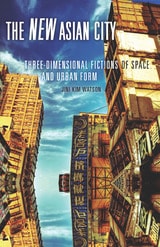
The New Asian City
Three-Dimensional Fictions of Space and Urban FormJini Kim Watson
University of Minnesota Press, 2011
Under Jini Kim Watson’s scrutiny, the Asian Tiger metropolises of Seoul, Taipei, and Singapore reveal a surprising residue of the colonial environment. Drawing on a wide array of literary, filmic, and political works, and juxtaposing close readings of the built environment, Watson demonstrates how processes of migration and construction in the hypergrowth urbanscapes of the Pacific Rim crystallize the psychic and political dramas of their colonized past and globalized present.
Examining how newly constructed spaces—including expressways, high-rises, factory zones, department stores, and government buildings—become figured within fictional and political texts uncovers how massive transformations of citizenries and cities were rationalized, perceived, and fictionalized. Watson shows how literature, film, and poetry have described and challenged contemporary Asian metropolises, especially around the formation of gendered and laboring subjects in these new spaces. She suggests that by embracing the postwar growth-at-any-cost imperative, they have buttressed the nationalist enterprise along neocolonial lines.
The New Asian City provides an innovative approach to how we might better understand the gleaming metropolises of the Pacific Rim. In doing so, it demonstrates how reading cultural production in conjunction with built environments can enrich our knowledge of the lived consequences of rapid economic and urban development.
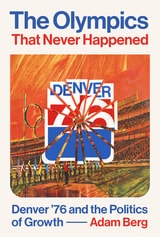
The Olympics that Never Happened
Denver '76 and the Politics of GrowthAdam Berg
University of Texas Press, 2023
A look back at how powerful politicians, business leaders, and a diverse cast of activists used a thwarted Olympics to shape the state of Colorado and the city of Denver.
If you don’t recall the 1976 Denver Olympic Games, it’s because they never happened. The Mile-High City won the right to host the winter games and then was forced by Colorado citizens to back away from its successful Olympic bid through a statewide ballot initiative. Adam Berg details the powerful Colorado regime that gained the games for Denver and the grassroots activism that brought down its Olympic dreams, and he explores the legacy of this milestone moment for the games and politics in the United States.
The ink was hardly dry on Denver’s host agreement when Mexican American and African American urbanites, white middle-class environmentalists, and fiscally concerned local politicians realized opposition to the Olympics provided them new political openings. The Olympics quickly became a platform for taking stands on a range of issues, from conservation to urban livability to the very idea of growth, which for decades had been unquestioned in Colorado. The Olympics That Never Happened argues that hostility to the Olympics galvanized and empowered diverse citizens in a major US city, with long-term ramifications for Colorado and political activism elsewhere. The Olympics themselves were changed forever, compelling organizers to take seriously competing interests from subgroups within their communities.
The Paleobiological Revolution
Essays on the Growth of Modern PaleontologyEdited by David Sepkoski and Michael Ruse
University of Chicago Press, 2009

The Purpose-Based Library
Finding Your Path to Survival, Success, and GrowthJohn J. Huber
American Library Association, 2015
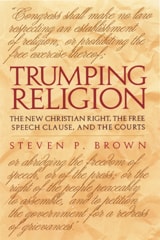
Trumping Religion
The New Christian Right, the Free Speech Clause, and the CourtsSteven P. Brown
University of Alabama Press, 2004
The first scholarly treatment of the strategies employed by the New Christian Right in redefining religious freedom in the courtroom.
Trumping Religion provides a detailed analysis of the five major public-interest law firms that have litigated religion cases in the federal courts between 1980 and 2000. Allied with several highly vocal, evangelical ministries, such as those of Jerry Falwell and Pat Robinson, these legal organizations argue that religious expression is a form of protected speech and thereby gain a greater latitude of interpretation in the courts. The long-term agenda of the New Christian Right as illuminated by this study is to shape church-state jurisprudence in a way that permits free course for the Christian gospel.
Steven P. Brown presents his research and conclusions from a balanced viewpoint. In filling a distinct void in the literature, this book will be of considerable interest to political scientists, legal scholars, law schools and seminaries, and anyone concerned with the intersection of religion and judicial politics.