Results by title
62 books match the query 'Hawaii' and 6 start with t
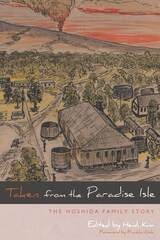
Taken from the Paradise Isle
The Hoshida Family StoryHeidi Kim
University Press of Colorado, 2015
Crafted from George Hoshida’s diary and memoir, as well as letters faithfully exchanged with his wife Tamae, Taken from the Paradise Isle is an intimate account of the anger, resignation, philosophy, optimism, and love with which the Hoshida family endured their separation and incarceration during World War II.
George and Tamae Hoshida and their children were a Japanese American family who lived in Hawai‘i. In 1942, George was arrested as a “potentially dangerous alien” and interned in a series of camps over the next two years. Meanwhile, forced to leave her handicapped eldest daughter behind in a nursing home in Hawai‘i, Tamae and three daughters, including a newborn, were incarcerated at the Jerome Relocation Center in Arkansas. George and Tamae regularly exchanged letters during this time, and George maintained a diary including personal thoughts, watercolors, and sketches. In Taken from the Paradise Isle these sources are bolstered by extensive archival documents and editor Heidi Kim’s historical contextualization, providing a new and important perspective on the tragedy of the incarceration as it affected Japanese American families in Hawai‘i.
This personal narrative of the Japanese American experience adds to the growing testimony of memoirs and oral histories that illuminate the emotional, psychological, physical, and economic toll suffered by Nikkei as the result of the violation of their civil rights during World War II.
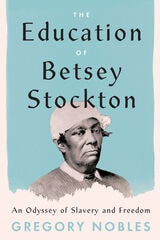
The Education of Betsey Stockton
An Odyssey of Slavery and FreedomGregory Nobles
University of Chicago Press, 2022
The life of Betsey Stockton (ca. 1798–1865) is a remarkable story of a Black woman’s journey from slavery to emancipation, from antebellum New Jersey to the Hawai‘ian Islands, and from her own self-education to a lifetime of teaching others—all told against the backdrop of the early United States’ pervasive racism. It’s a compelling chronicle of a critical time in American history and a testament to the courage and commitment of a woman whose persistence grew into a potent form of resistance.
When Betsey Stockton was a child, she was “given, as a slave” to the household of Rev. Ashbel Green, a prominent pastor and later the president of what is now Princeton University. Although she never went to school, she devoured the books in Green’s library. After being emancipated, she used that education to benefit other people of color, first in Hawai‘i as a missionary, then Philadelphia, and, for the last three decades of her life, Princeton—a college town with a genteel veneer that never fully hid its racial hostility. Betsey Stockton became a revered figure in Princeton’s sizeable Black population, a founder of religious and educational institutions, and a leader engaged in the day-to-day business of building communities.
In this first book-length telling of Betsey Stockton’s story, Gregory Nobles illuminates both a woman and her world, following her around the globe, and showing how a determined individual could challenge her society’s racial obstacles from the ground up. It’s at once a revealing lesson on the struggles of Stockton’s times and a fresh inspiration for our own.
The Kitchen of Small Hours
Derek N. Otsuji
Southern Illinois University Press, 2021
In The Kitchen of Small Hours, Derek N. Otsuji embraces the fragility and endurance of a family of immigrants from two prefectures in Japan: Kagoshima in the south and Okinawa, an island more than four hundred miles from the mainland. In these poems, five generations sing, save, scold, bury, and cook against the culture and history that emerged from the pineapple and sugar cane plantations of mid-nineteenth-century Hawaii, from the bomb-scapes and hatreds of World War II, and from the canning and tourism industry of the twentieth century. Otsuji writes of how his family used stories and rugged cheer to fill the spaces apart from the cane fields and the canning factory. Their recipes, rituals, celebrations, songs, dances, myths, and family stories passed from grandmother to father to son, who folds them into lyrics.
Here too are whispers, failures, and traceable absences: a face removed from photos, a love silenced to be acceptable, a dead firstborn housed in an urn. There are things that no one intended to give. Otsuji’s language hungers for them anyway. The haunting reunions between author and ancestor sink just as deep as roots and hold just as fast. The cooking pot, the family photo, the moon recur as images that feed and comfort. Lyrical and warm, Otsuji’s voice sounds out a sinew of words that make the remnants of heritage and home durable. In these poems each new generation seeks to reimagine for itself the elusive American Dream
The Power of the Steel-tipped Pen
Reconstructing Native Hawaiian Intellectual HistoryNoenoe K. Silva
Duke University Press, 2017
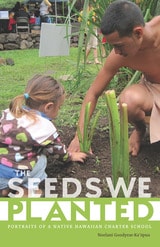
The Seeds We Planted
Portraits of a Native Hawaiian Charter SchoolNoelani Goodyear-Ka'opua
University of Minnesota Press, 2013
In 1999, Noelani Goodyear-Ka‘ōpua was among a group of young educators and parents who founded Hālau Kū Māna, a secondary school that remains one of the only Hawaiian culture-based charter schools in urban Honolulu. The Seeds We Planted tells the story of Hālau Kū Māna against the backdrop of the Hawaiian struggle for self-determination and the U.S. charter school movement, revealing a critical tension: the successes of a school celebrating indigenous culture are measured by the standards of settler colonialism.
How, Goodyear-Ka‘ōpua asks, does an indigenous people use schooling to maintain and transform a common sense of purpose and interconnection of nationhood in the face of forces of imperialism and colonialism? What roles do race, gender, and place play in these processes? Her book, with its richly descriptive portrait of indigenous education in one community, offers practical answers steeped in the remarkable—and largely suppressed—history of Hawaiian popular learning and literacy.
This uniquely Hawaiian experience addresses broader concerns about what it means to enact indigenous cultural–political resurgence while working within and against settler colonial structures. Ultimately, The Seeds We Planted shows that indigenous education can foster collective renewal and continuity.
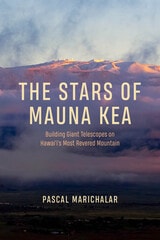
The Stars of Mauna Kea
Building Giant Telescopes on Hawai‘i’s Most Revered MountainPascal Marichalar
University of Chicago Press, 2026
The inside account of how astronomers were able to build the world’s largest observatories on Hawai‘i’s most revered mountain.
In July 2019, a demonstration erupted on Hawai‘i Island to prevent the construction of the Thirty Meter Telescope, which, if built, would be one of the largest and most advanced ground-based telescopes in the world. For months, thousands of people camped on the access road leading to the proposed location: Mauna Kea, a dormant volcano, the highest point in Hawai‘i, and a sacred site for Native Hawaiians. The standoff in 2019 was not the first. For decades, activists had resisted attempts to build the TMT and its predecessors. Even so, many astronomers were startled by opposition to the TMT and the discoveries it promised. Astronomers were focused on the stars; Native Hawaiians and environmentalists were concerned about not only the sky, but also the land.
The Stars of Mauna Kea traces the history of astronomy on Hawai‘i Island, shedding new light on why scientists were granted access to the volcano in the first place. Beginning in 1959, when Hawai‘i became the fiftieth US state, it chronicles the ways astronomers benefited from Hawai‘i’s colonial past to gain free and exclusive land use rights on what had long been the archipelago’s most revered mountain. Drawing on unprecedented archival research and extensive interviews, Pascal Marichalar carefully charts the course of astronomical development on Mauna Kea. He describes the devastating tsunami that led a local businessman to contact scientists just as a renowned astronomer was scouting for places to observe the stars; the controversial authority the University of Hawai‘i assumed over the volcano after 1964; the environmental opposition to the first large international project, the Canada-France-Hawai‘i Telescope; and the resistance to telescope development that became a major focus of the Hawaiian sovereignty movement. Marichalar introduces readers to scientists working on Mauna Kea, as well as the people living in the mountain’s shadow, including key opposition figures involved in recent events.
Like the dark matter that holds together rotating galaxies, the colonial forces that have shaped Hawai‘i exert a gravitational pull on the science undertaken on the volcano’s summit. The Stars of Mauna Kea brings readers inside an ongoing debate over the morality of scientific research conducted on contested ground.