Results by title
51 books match the query 'Holocaust survivors' and 5 start with t
The Holocaust, Corporations, and the Law
Unfinished BusinessLeora Bilsky
University of Michigan Press, 2017
The Holocaust, Corporations, and the Law explores the challenge posed by the Holocaust to legal and political thought by examining issues raised by the restitution class action suits brought against Swiss banks and German corporations before American federal courts in the 1990s. Although the suits were settled for unprecedented amounts of money, the defendants did not formally assume any legal responsibility. Thus, the lawsuits were bitterly criticized by lawyers for betraying justice and by historians for distorting history.
Leora Bilsky argues class action litigation and settlement offer a mode of accountability well suited to addressing the bureaucratic nature of business involvement in atrocities. Prior to these lawsuits, legal treatment of the Holocaust was dominated by criminal law and its individualistic assumptions, consistently failing to relate to the structural aspects of Nazi crimes. Engaging critically with contemporary debates about corporate responsibility for human rights violations and assumptions about “law,” she argues for the need to design processes that make multinational corporations accountable, and examines the implications for transitional justice, the relationship between law and history, and for community and representation in a post-national world. Her novel interpretation of the restitution lawsuits not only adds an important dimension to the study of Holocaust trials, but also makes an innovative contribution to broader and pressing contemporary legal and political debates. In an era when corporations are ever more powerful and international, Bilsky’s arguments will attract attention beyond those interested in the Holocaust and its long shadow.
Leora Bilsky argues class action litigation and settlement offer a mode of accountability well suited to addressing the bureaucratic nature of business involvement in atrocities. Prior to these lawsuits, legal treatment of the Holocaust was dominated by criminal law and its individualistic assumptions, consistently failing to relate to the structural aspects of Nazi crimes. Engaging critically with contemporary debates about corporate responsibility for human rights violations and assumptions about “law,” she argues for the need to design processes that make multinational corporations accountable, and examines the implications for transitional justice, the relationship between law and history, and for community and representation in a post-national world. Her novel interpretation of the restitution lawsuits not only adds an important dimension to the study of Holocaust trials, but also makes an innovative contribution to broader and pressing contemporary legal and political debates. In an era when corporations are ever more powerful and international, Bilsky’s arguments will attract attention beyond those interested in the Holocaust and its long shadow.
[more]
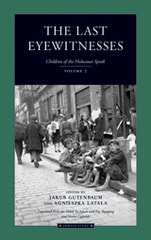
The Last Eyewitnesses, Volume 2
The Children of the Holocaust SpeakJakub Gutenbaum and Agnieszka Latala
Northwestern University Press, 2005
The memoirs of Jews who were children during the Nazi occupation of Poland
This book serves as a memorial to loved ones who do not even have a grave, as well as a tribute to those who risked their lives and families to save a Jewish child. A wide variety of experiences during the Nazi occupation of Poland are related with wrenching simplicity and candor, experiences that illustrate horrors and deprivation, but also present examples of courage and compassion.
These recollections-whether of hiding in forests or camouflaged bunkers, fighting with groups of partisans, enduring the horrors of concentration camps, or living in fear under disguised identities-serve as eloquent testimony to the depth, diversity, and richness of humanity under siege and offer a powerful lesson for future generations. Written by people who remained in Poland after the war, these accounts convey a great immediacy; the authors are not removed from the environment in which these experiences took place. The psychological impact on these child survivors and the difficulties they encountered even after the war are very poignant. The passing years have brought urgency to the publication of these stories, as those who wrote them are the last surviving eyewitnesses of these tumultuous events.
[more]
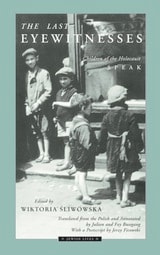
The Last Eyewitnesses
Children of the Holocaust SpeakWiktoria Sliwowska
Northwestern University Press, 1998
These testimonies, submitted by individual authors and not originally intended for publication, were assembled as a historical record by the Association of the Children of the Holocaust in Poland. While evil and brutal anti-Semitism are described, the accounts also reveal the great risks taken by courageous individuals in order to save Jewish children.
[more]
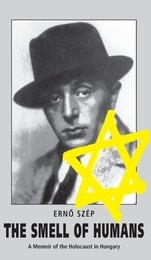
The Smell of Humans
A Memoir of the Holocaust in HungaryErno Szép
Central European University Press, 1994
Primarily a piece of creative writing and autobiographical literature of a very distinctive Central European kind, this detailed and imaginative short memoir is also an important document of the Holocaust in Hungary in 1944. Written by a master of twentieth-century Hungarian literature, it describes life for the Jewish population of German-occupied Budapest—the constant fear of deportation overshadowing the daily trials of living in the ghetto—before concentrating on the writer's own internment in a labor camp during the first weeks of rule by the extremist Arrow Cross regime. The experiences of those nineteen days spent in the camp are both harsh and disturbing, yet throughout his memoir Szep manages to maintain an extraordinary degree of compassion and detachment, even humor. Published to coincide with the fiftieth anniversary of the events described, this is the last of Szep's many literary works to appear in English."
[more]
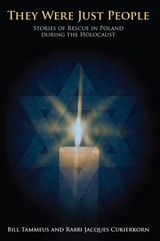
They Were Just People
Stories of Rescue in Poland During the HolocaustBill Tammeus & Rabbi Jacques Cukierkorn
University of Missouri Press, 2009
Hitler’s attempt to murder all of Europe’s Jews almost succeeded. One reason it fell short of its nefarious goal was the work of brave non-Jews who sheltered their fellow citizens. In most countries under German control, those who rescued Jews risked imprisonment and death. In Poland, home to more Jews than any other country at the start of World War II and location of six German-built death camps, the punishment was immediate execution.
This book tells the stories of Polish Holocaust survivors and their rescuers. The authors traveled extensively in the United States and Poland to interview some of the few remaining participants before their generation is gone. Tammeus and Cukierkorn unfold many stories that have never before been made public: gripping narratives of Jews who survived against all odds and courageous non-Jews who risked their own lives to provide shelter.
These are harrowing accounts of survival and bravery. Maria Devinki lived for more than two years under the floors of barns. Felix Zandman sought refuge from Anna Puchalska for a night, but she pledged to hide him for the whole war if necessary—and eventually hid several Jews for seventeen months in a pit dug beneath her house. And when teenage brothers Zygie and Sol Allweiss hid behind hay bales in the Dudzik family’s barn one day when the Germans came, they were alarmed to learn the soldiers weren’t there searching for Jews, but to seize hay. But Zofia Dudzik successfully distracted them, and she and her husband insisted the boys stay despite the danger to their own family.
Through some twenty stories like these, Tammeus and Cukierkorn show that even in an atmosphere of unimaginable malevolence, individuals can decide to act in civilized ways. Some rescuers had antisemitic feelings but acted because they knew and liked individual Jews. In many cases, the rescuers were simply helping friends or business associates. The accounts include the perspectives of men and women, city and rural residents, clergy and laypersons—even children who witnessed their parents’ efforts.
These stories show that assistance from non-Jews was crucial, but also that Jews needed ingenuity, sometimes money, and most often what some survivors called simple good luck. Sixty years later, they invite each of us to ask what we might do today if we were at risk—or were asked to risk our lives to save others.
[more]