Results by title
56 books match the query 'Homosexuality in literature' and 4 start with t
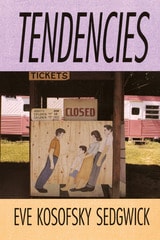
Tendencies
Eve Kosofsky Sedgwick
Duke University Press, 1983
The essays range from Diderot, Oscar Wilde, and Henry James to queer kids and twelve-step programs; from "Jane Austen and the Masturbating Girl" to a performance piece on Divine written with Michael Moon; from political correctness and the poetics of spanking to the experience of breast cancer in a world ravaged and reshaped by AIDS. What unites Tendencies is a vision of a new queer politics and thought that, however demanding and dangerous, can also be intent, inclusive, writerly, physical, and sometimes giddily fun.
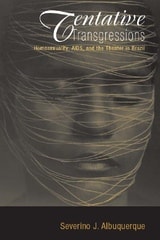
Tentative Transgressions
Homosexuality, AIDS, and the Theater in BrazilSeverino J. Albuquerque
University of Wisconsin Press, 2004
Starting at the beginning of the twentieth century, Albuquerque examines the way the Modernist movement both fueled and inhibited the use of gay imagery in Brazilian drama. This elegant and fluid study ultimately becomes an examination of a whole Latin society, and the ways in which Latin theatre has absorbed and reflected the culture's own changing sensibilities, that will intrigue anyone interested in Latin American culture, literature, or theater.
Winner, 2008 Elizabeth A. Steinberg Prize
The Kingdom of Insignificance
Miron Bialoszewski and the Quotidian, the Queer, and the TraumaticJoanna Nizynska
Northwestern University Press, 2012
In one of the first scholarly book in English on Miron Białoszewski (1922–1983), Joanna Niżyńska illuminates the elusive prose of one of the most compelling and challenging postwar Polish writers. Niżyńska’s study, exemplary in its use of theoretical concepts, introduces English-language readers to a preeminent voice of Polish literature. Niżyńska explores how a fusion of seemingly irreconcilable qualities, such as the traumatic and the everyday, imbues Białoszewski’s writing with its idiosyncratic appeal.
Białoszewski’s A Memoir of the Warsaw Uprising (1977, revised 1991) describes the Poles’ heroic struggle to liberate Warsaw from Nazi occupation in 1944 as harrowing yet ordinary. His later prose represents everyday life permeated by traces of the traumatic. Niżyńska closely examines the topic of autobiography and homosexuality, showing how Białoszewski discloses his homosexuality but, paradoxically, renders it inconspicuous by hiding it in plain sight.
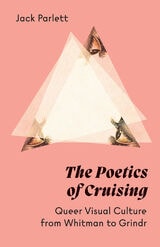
The Poetics of Cruising
Queer Visual Culture from Whitman to GrindrJack Parlett
University of Minnesota Press, 2022
The Poetics of Cruising explores the relationship between cruising, photography, and the visual in the work of leading poets, from Walt Whitman in the nineteenth century to Eileen Myles in the twenty-first. What is it that happens, asks Jack Parlett, and what is it that is sought, in this often transient moment of perception we call cruising, this perceptual arena where acts of looking between strangers are intensified and eroticized? Parlett believes that this moment is not only optical in nature but visual: a mode of looking that warrants comparison with the ways in which we behold still and moving images.
Whether it’s Whitman’s fixation with daguerreotypes, Langston Hughes’s hybrid photographic works, or Frank O’Hara’s love of Hollywood movie stars, argues Parlett, the history of poets cruising abounds with this intermingling between the verbal and the visual, the passing and the fixed. To look at someone in the act of cruising, this history suggests, is to capture, consider, and aestheticize, amid the flux and instantaneity of urban time. But it is also to reveal the ambivalence at the heart of this erotic search, where power may be unevenly distributed across glances, and gendered and racialized bodies are marked. Thus, in identifying for the first time this confluence of cruising, poetry, and visual culture, Parlett concludes that the visual erotic economy associated with gay cruising today, exemplified by the photographic grid of an app like Grindr, is not a uniquely contemporary phenomenon.
Innovative, astute, and highly readable, and drawing on compelling archival material, The Poetics of Cruising is a must for scholars of queer and LGBTQ literature and culture, modern and contemporary poetry, visual studies, and the history of sexuality.