Results by title
425 books match the query 'Human rights' and 85 start with t

Tatars of the Crimea
Duke University Press, 1988
Technologies of Suspicion and the Ethics of Obligation in Political Asylum
Bridget M. Haas
Ohio University Press, 2019
Across the globe, migration has been met with intensifying modes of criminalization and securitization, and claims for political asylum are increasingly met with suspicion. Asylum seekers have become the focus of global debates surrounding humanitarian obligations, on the one hand, and concerns surrounding national security and border control, on the other. In Technologies of Suspicion and the Ethics of Obligation in Political Asylum, contributors provide fine-tuned analyses of political asylum systems and the adjudication of asylum claims across a range of sociocultural and geopolitical contexts.
The contributors to this timely volume, drawing on a variety of theoretical perspectives, offer critical insights into the processes by which tensions between humanitarianism and security are negotiated at the local level, often with negative consequences for asylum seekers. By investigating how a politics of suspicion within asylum systems is enacted in everyday practices and interactions, the authors illustrate how asylum seekers are often produced as suspicious subjects by the very systems to which they appeal for protection.
Contributors: Ilil Benjamin, Carol Bohmer, Nadia El-Shaarawi, Bridget M. Haas, John Beard Haviland, Marco Jacquemet, Benjamin N. Lawrance, Rachel Lewis, Sara McKinnon, Amy Shuman, Charles Watters
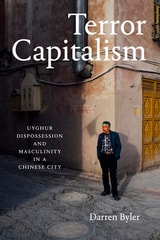
Terror Capitalism
Uyghur Dispossession and Masculinity in a Chinese CityDarren Byler
Duke University Press, 2021

Testimony
Found Poems from the Special Court for Sierra LeoneShanee Stepakoff
Bucknell University Press, 2021
Sierra Leone’s devastating civil war barely caught the attention of Western media, but it raged on for over a decade, bringing misery to millions of people in West Africa from 1991 to 2002. The atrocities committed in this war and the accounts of its survivors were duly recorded by international organizations, but they run the risk of being consigned to dusty historical archives.
Derived from public testimonies at a UN-backed war crimes tribunal in Freetown, this remarkable poetry collection aims to breathe new life into the records of Sierra Leone’s civil war, delicately extracting heartbreaking human stories from the morass of legal jargon. By rendering selected trial transcripts in poetic form, Shanee Stepakoff finds a novel way to communicate not only the suffering of Sierra Leone’s people, but also their courage, dignity, and resilience. Her use of innovative literary techniques helps to ensure that the voices of survivors are not forgotten, but rather heard across the world.
This volume also includes an introduction that explores how the genre of “found poetry” can serve as a uniquely powerful means through which writers may bear witness to atrocity. This book’s unforgettable excavation and shaping of survivor testimonies opens new possibilities for speaking about the unspeakable.
The Ancient Greek Roots of Human Rights
By Rachel Hall Sternberg
University of Texas Press, 2021
2022 PROSE Award Finalist in Classics
Although the era of the Enlightenment witnessed the rise of philosophical debates around benevolent social practice, the origins of European humane discourse date further back, to Classical Athens. The Ancient Greek Roots of Human Rights analyzes the parallel confluences of cultural factors facing ancient Greeks and eighteenth-century Europeans that facilitated the creation and transmission of humane values across history. Rachel Hall Sternberg argues that precursors to the concept of human rights exist in the ancient articulation of emotion, though the ancient Greeks, much like eighteenth-century European societies, often failed to live up to those values.
Merging the history of ideas with cultural history, Sternberg examines literary themes upholding empathy and human dignity from Thucydides’s and Xenophon’s histories to Voltaire’s Candide, and from Greek tragic drama to the eighteenth-century novel. She describes shared impacts of the trauma of war, the appeal to reason, and the public acceptance of emotion that encouraged the birth and rebirth of humane values.
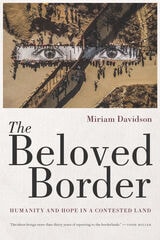
The Beloved Border
Humanity and Hope in a Contested LandMiriam Davidson
University of Arizona Press, 2021
The book draws on a variety of sources to explain how border issues intersect and how the current situation, while made worse under the Trump administration, is in fact the result of decades of prohibition, crackdowns, and wall building on the border. Davidson addresses subjects such as violence in Mexico, particularly against the press; cross-border gun smuggling and legal gun sales; the rise in migrant detentions, deportations, and deaths since the crackdown began; controversy over humanitarian aid in the desert; border patrol crimes and abuses; and the legal, ethical, and moral issues raised by increased police presence and militarization on the border. The book also looks at the environmental impact of wall building and construction of a planned copper mine near Tucson, especially on the jaguar and other endangered species.
Davidson shares the history of sanctuary and argues that this social movement and others that have originated on the border are vanguards of larger global movements against the mistreatment of migrant workers and refugees, police brutality, and other abuses of human and natural rights. She gives concrete examples of positive ways in which border people are promoting local culture and cross-border solidarity through health care, commerce, food, art, and music. While death and suffering continue to occur, The Beloved Border shows us how the U.S.-Mexico border could be, and in many ways already is, a model for peaceful coexistence worldwide.

The Beneficiary
Bruce Robbins
Duke University Press, 2017
The Borders of Responsibility
Migration Control in the Mediterranean SeaKiri Olivia Santer
Duke University Press, 2026
The Community of Rights
Alan Gewirth
University of Chicago Press, 1997
The Complexity of Evil
Perpetration and GenocideTimothy Williams
Rutgers University Press, 2021
Download the open access ebook here.

The Courage to Welcome
Between principles and pragmatism in international affairsCatherine Ashton and Filippo Grandi
Haus Publishing, 2026
A timeless call amid the challenging nature of public service to find the familiar in the foreign.
What does it mean to lead with compassion in a world riven by fear, at a time when the responses to forced displacement hold the power to reshape communities? How can institutions and individuals sustain solidarity amid rising division?
This moving reflection of Filippo Grandi’s ten years as United Nations High Commissioner for Refugees and four decades spent working in humanitarian crises across the world addresses the growing complexity of forced displacement, its repercussions for international relations, and the challenges it poses for governments. Grandi calls for greater cooperation between nations and considers measures—along displacement routes and in host countries—which would provide lifesaving assistance to refugees as well as preserve international cooperation and goodwill. He suggests a universal responsibility not to exacerbate division but to work diligently on the space between pragmatism and principle.
Taking up this challenge, Catherine Ashton’s response to Grandi draws on her own distinguished leadership during some of the most important moments that have shaped contemporary diplomacy and suggests how enduring principles can be retained within the realities of public life.

The Coveted Westside
How the Black Homeowners' Rights Movement Shaped Modern Los AngelesJennifer Mandel
University of Nevada Press, 2022
Mandel exposes the enduring struggle between Whites determined to establish their hegemony and create residential heterogeneity in the growing city, and people of color equally determined to obtain full access to the city and the opportunities, including residential, that it offered. Not only does this book document the Black homeowners’ fight against housing discrimination, it shares personal accounts of Blacks’ efforts to settle in the highly desirable Westside of Los Angeles. Mandel explores the White-derived social and legal mechanisms that created this segregated city and the African American-led movement that challenged efforts to block access to fair housing.
The Cunning of Gender Violence
Geopolitics and FeminismLila Abu-Lughod, Rema Hammami, and Nadera Shalhoub-Kevorkian, editors
Duke University Press, 2023
Contributors. Lila Abu-Lughod, Nina Berman, Inderpal Grewal, Rema Hammami, Janet R. Jakobsen, Shenila Khoja-Moolji, Vasuki Nesiah, Samira Shackle, Sima Shakhsari, Nadera Shalhoub-Kevorkian, Dina M Siddiqi, Shahla Talebi, Leti Volpp, Rafia Zakaria
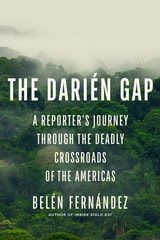
The Darién Gap
A Reporter's Journey through the Deadly Crossroads of the AmericasBelén Fernández
Rutgers University Press, 2025
The narrow Darién Gap, the only land bridge connecting South and Central America, encompasses a spectacularly hostile jungle, covered in steep mountains, dense rainforests, and flood-prone marshes. Known in Spanish as el infierno verde, or “the green hell,” it is one of the most inhospitable places in the world. Its terrain is too treacherous for roads, yet hundreds of thousands of refuge seekers contend with its horrors every year in the hopes of reaching the United States, still some three thousand miles away. And of the countless who set out for the border, an untold number never arrive.
In this book, journalist Belén Fernández travels through the Darién Gap to report on the dehumanizing and deadly stretch of land that has become a mass graveyard for migrants. Fernández’s journey brings her into contact with refuge seekers, people smugglers, law enforcement officials, and many more whose stories bring life to a place overwhelmingly associated with death. Combining history, on-the-ground reporting, travelogue, memoir, and searing politico-economic analysis, she shines light on a largely made-in-the-USA crisis that has come to define our modern era.
Engrossing and heartrending, The Darién Gap is a poignant and compassionate indictment of structural inequality and institutionalized inhumanity in a world where the have-nots must risk death for a chance at a better life—or any life at all.

The Deoliwallahs
The True Story of the 1962 Chinese Indian InternmentJoy Ma
Rutgers University Press, 2026
The Deoliwallahs sheds light on a lesser-known chapter of Indian history—the internment of Chinese Indians following the 1962 Sino-Indian War. During the war, around 3,000 Indians of Chinese descent were detained in a camp in Deoli, Rajasthan, under suspicion of espionage. Many of these individuals had deep roots in India, with families that had lived there for generations. The book recounts their harrowing experiences, including abrupt arrests, harsh conditions in the camp, and the emotional toll of being ostracized by their own country.
Alternating between historical context and the personal stories of survivors, authors Joy Ma and Dilip D'Souza weave together a compelling and emotional account of a nearly forgotten community of people interned against their will. The book draws parallels with other instances of internment, such as the Japanese American experience during World War II, highlighting the universal themes of identity, citizenship, and the consequences of fear-driven policies.
A documentary, Voices of Deoli (2025), directed by Lulu Men with author Joy Ma serving as executive producer, along with Michael Cheng and Neela D’Souza, also shares the stories of survivors and, like the book, serves as a powerful reminder of the fragility of rights and the impact of prejudice.
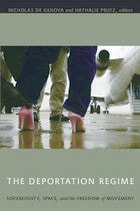
The Deportation Regime
Sovereignty, Space, and the Freedom of MovementNicholas De Genova and Nathalie Peutz, eds.
Duke University Press, 2010
Whether investigating the power that individual and corporate sponsors have over the fate of foreign laborers in Bahrain, the implications of Germany’s temporary suspension of deportation orders for pregnant and ill migrants, or the significance of the detention camp, the contributors reveal how deportation reflects and reproduces notions about public health, racial purity, and class privilege. They also provide insight into how deportation and deportability are experienced by individuals, including Arabs, South Asians, and Muslims in the United States. One contributor looks at asylum claims in light of an unusual anti-deportation campaign mounted by Algerian refugees in Montreal; others analyze the European Union as an entity specifically dedicated to governing mobility inside and across its official borders. The Deportation Regime addresses urgent issues related to human rights, international migration, and the extensive security measures implemented by nation-states since September 11, 2001.
Contributors: Rutvica Andrijasevic, Aashti Bhartia, Heide Castañeda , Galina Cornelisse , Susan Bibler Coutin, Nicholas De Genova, Andrew M. Gardner, Josiah Heyman, Serhat Karakayali, Sunaina Marr Maira, Guillermina Gina Nuñez, Peter Nyers, Nathalie Peutz, Enrica Rigo, Victor Talavera, William Walters, Hans-Rudolf Wicker, Sarah S. Willen
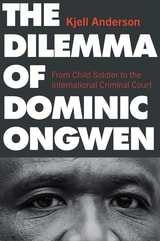
The Dilemma of Dominic Ongwen
From Child Soldier to the International Criminal CourtKjell Anderson
Rutgers University Press, 2027
Dominic Ongwen was abducted by Joseph Kony's Lord's Resistance Army while walking to school at the age of nine. He later rose through its ranks committing, and ultimately being convicted by the International Criminal Court (ICC) of, many of the same crimes of which he was once a victim. The Dilemma of Dominic Ongwen tells this extraordinary story through the voices of those who knew him best: family members, fighters, commanders, “wives,” victims, and trial participants. Their testimonies, gathered in Uganda and The Hague, form the backbone of a narrative that interlaces survivor accounts with legal analysis and vivid excerpts from the ICC trial. The book offers a rare, human-centered lens on international justice, illuminating the dilemmas of prosecuting a former child soldier for mass atrocities. It provides indispensable insights for scholars of international criminal law, transitional justice, political violence, trauma, and human rights.
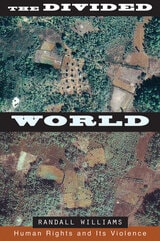
The Divided World
Human Rights and Its ViolenceRandall Williams
University of Minnesota Press, 2010
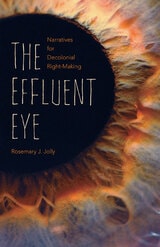
The Effluent Eye
Narratives for Decolonial Right-MakingRosemary J. Jolly
University of Minnesota Press, 2024
Why human rights don’t work
In The Effluent Eye, Rosemary J. Jolly argues for the decolonization of human rights, attributing their failure not simply to state and institutional malfeasance but to the very concept of human rights as anthropocentric—and, therefore, fatally shortsighted. In an engaging mix of literary and cultural criticism, Indigenous and Black critique, and substantive forays into the medical humanities, Jolly proposes right-making in the demise of human rights.
Using what she calls an “effluent eye,” Jolly draws on “Fifth Wave” structural public health to confront the concept of human rights—one of the most powerful and widely entrenched liberal ideas. She builds on Indigenous sovereignty work from authors such as Robin Wall Kimmerer, Leanne Betasamosake Simpson, and Mark Rifkin as well as the littoral development in Black studies from Christine Sharpe, Saidiya Hartman, and Tiffany Lethabo King to engage decolonial thinking on a range of urgent topics such as pandemic history and grief; gender-based violence and sexual assault; and the connections between colonial capitalism and substance abuse, the Anthropocene, and climate change.
Combining witnessed experience with an array of decolonial texts, Jolly argues for an effluent form of reading that begins with the understanding that the granting of “rights” to individuals is meaningless in a world compromised by pollution, poverty, and successive pandemics.
Retail e-book files for this title are screen-reader friendly.

The El Mozote Massacre
Anthropology and Human RightsLeigh Binford
University of Arizona Press, 1996
Such reportage, argues anthropologist Leigh Binford, sustains the perception that the lives of Third World people are only newsworthy when some great tragedy strikes. He critiques the practices of journalists and human rights organizations for their dehumanizing studies of "subjects" and "victims." Binford suggests that such accounts objectify the people involved through statistical analyses and bureaucratic body counts while the news media sensationalize the motives and personalities of the perpetrators.
In relating the story of this tragic event, Binford restores a sense of history and social identity to the fallen people of this Salvadoran village. Drawing on interviews he conducted with El Mozote-area residents, he offers a rich ethnographic and personal account of their lives prior to the tragedy. He provides an overview of the history and culture of the area and tells how such a massacre could have happened, why it was covered up, and why it could happen again.
The El Mozote Massacre
Human Rights and Global Implications Revised and Expanded EditionLeigh Binford
University of Arizona Press, 2016
Almost two decades later, the consequences of the massacre continue to reverberate through the country’s legal and socioeconomic systems. The El Mozote Massacre, 2nd Edition brings together new evidence to address reconstruction, historical memory, and human rights issues resulting from what may be the largest massacre in modern Latin American history.
With a multitude of additions, including three new chapters, an extended chronology, discussion of the hearing and ruling of the Inter-American Court of Human Rights in 2012, and evidence gathered throughout half a dozen field trips made by the author, Binford presents a current perspective on the effects of this tragic moment in history. Thanks to geographically expanded fieldwork, Binford offers critical discussion of postwar social, economic, religious, and social justice in El Mozote, and adds important new regional, national, and global contexts.
The El Mozote Massacre, 2nd Edition maintains the crucial presence of the massacre in human rights discussions for El Salvador, Latin America, and the world.
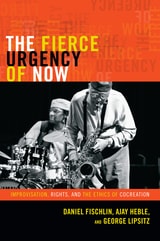
The Fierce Urgency of Now
Improvisation, Rights, and the Ethics of CocreationDaniel Fischlin, Ajay Heble, and George Lipsitz
Duke University Press, 2013
Improvisation is the creation and development of new, unexpected, and productive cocreative relations among people. It cultivates the capacity to discern elements of possibility, potential, hope, and promise where none are readily apparent. Improvisers work with the tools they have in the arenas that are open to them. Proceeding without a written score or script, they collaborate to envision and enact something new, to enrich their experience in the world by acting on it and changing it. By analyzing the dynamics of particular artistic improvisations, mostly by contemporary American jazz musicians, the authors reveal improvisation as a viable and urgently needed model for social change. In the process, they rethink politics, music, and the connections between them.
The Futures of Reparations in Latin America
Imagination, Translation, and BelongingPiergiorgio Di Giminiani
Rutgers University Press, 2026
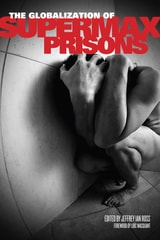
The Globalization of Supermax Prisons
Ross, Jeffrey Ian
Rutgers University Press, 2013
2013 Choice Outstanding Academic Title
“Supermax” prisons, conceived by the United States in the early 1980s, are typically reserved for convicted political criminals such as terrorists and spies and for other inmates who are considered to pose a serious ongoing threat to the wider community, to the security of correctional institutions, or to the safety of other inmates. Prisoners are usually restricted to their cells for up to twenty-three hours a day and typically have minimal contact with other inmates and correctional staff. Not only does the Federal Bureau of Prisons operate one of these facilities, but almost every state has either a supermax wing or stand-alone supermax prison.
The Globalization of Supermax Prisons examines why nine advanced industrialized countries have adopted the supermax prototype, paying particular attention to the economic, social, and political processes that have affected each state. Featuring essays that look at the U.S.-run prisons of Abu Ghraib and Guantanemo, this collection seeks to determine if the American model is the basis for the establishment of these facilities and considers such issues as the support or opposition to the building of a supermax and why opposition efforts failed; the allegation of human rights abuses within these prisons; and the extent to which the decision to build a supermax was influenced by developments in the United States. Additionally, contributors address such domestic matters as the role of crime rates, media sensationalism, and terrorism in each country’s decision to build a supermax prison.

The Guantanamo Files
The Stories of the 774 Detainees in America's Illegal PrisonAndy Worthington
Pluto Press, 2007
Deprived of the safeguards of the Geneva Conventions, and, for the most part, sold to the Americans by their allies in Afghanistan and Pakistan, the detainees have struggled for five years to have their stories heard. Looking in detail at the circumstances of their capture, and at the coercive interrogations and unsubstantiated allegations that have been used to justify their detention. Stories of torture in Afghanistan and Guantanamo are uncovered, as well as new information about the process of 'extraordinary rendition' that underpins the US administration's 'war on terror'.
Who will speak for the 773 men who have been held in Guantanamo? This passionate and brilliantly detailed book brings their stories to the world for the first time.
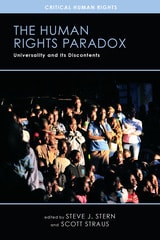
The Human Rights Paradox
Universality and Its DiscontentsEdited by Steve J. Stern and Scott Straus
University of Wisconsin Press, 2014
The Human Rights Paradox is the first book to fully embrace this contradiction and reframe human rights as history, contemporary social advocacy, and future prospect. In case studies that span Africa, Latin America, South and Southeast Asia, and the United States, contributors carefully illuminate how social actors create the imperative of human rights through relationships whose entanglements of the global and the local are so profound that one cannot exist apart from the other. These chapters provocatively analyze emerging twenty-first-century horizons of human rights—on one hand, the simultaneous promise and peril of global rights activism through social media, and on the other, the force of intergenerational rights linked to environmental concerns that are both local and global. Taken together, they demonstrate how local struggles and realities transform classic human rights concepts, including “victim,” “truth,” and “justice.”
Edited by Steve J. Stern and Scott Straus, The Human Rights Paradox enables us to consider the consequences—for history, social analysis, politics, and advocacy—of understanding that human rights belong both to “humanity” as abstraction as well as to specific people rooted in particular locales.
The Idea of a Human Rights Museum
Karen Busby
University of Manitoba Press, 2015
The Impossible Machine
A Genealogy of South Africa's Truth and Reconciliation CommissionAdam Sitze
University of Michigan Press, 2016
Adam Sitze meticulously traces the origins of South Africa’s Truth and Reconciliation Commission back to two well-established instruments of colonial and imperial governance: the jurisprudence of indemnity and the commission of inquiry. This genealogy provides a fresh, though counterintuitive, understanding of the TRC’s legal, political, and cultural importance. The TRC’s genius, Sitze contends, is not the substitution of “forgiving” restorative justice for “strict” legal justice but rather the innovative adaptation of colonial law, sovereignty, and government. However, this approach also contains a potential liability: if the TRC’s origins are forgotten, the very enterprise intended to overturn the jurisprudence of colonial rule may perpetuate it. In sum, Sitze proposes a provocative new means by which South Africa’s Truth and Reconciliation Commission should be understood and evaluated.
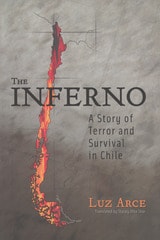
The Inferno
A Story of Terror and Survival in ChileLuz Arce; Translated by Stacey Alba Skar
University of Wisconsin Press, 2004
As a member of Salvador Allende’s Personal Guards (GAP), Luz Arce worked with leaders of the Socialist Party during the Popular Unity Government from 1971 to1973. In the months following the coup, Arce served as a militant with others from the Left who opposed the military junta led by Augusto Pinochet, which controlled the country from 1973 to1990. Along with thousands of others in Chile, Arce was detained and tortured by Chile’s military intelligence service, the DINA, in their attempt to eliminate alternative voices and ideologies in the country. Arce’s testimonial offers the harrowing story of the abuse she suffered and witnessed as a survivor of detention camps, such as the infamous Villa Grimaldi.
But when faced with threats made to her family, including her young son, and with the possibility that she could be murdered as thousands of others had been, Arce began to collaborate with the Chilean military in their repression of national resistance groups and outlawed political parties. Her testimonial thus also offers a unique perspective from within the repressive structures as she tells of her work as a DINA agent whose identifications even lead to the capture of some of her former friends and compañeros.
During Chile’s return to democracy in the early 1990s, Arce experienced two fundamental changes in her life that led to the writing of her story. The first was a deep spiritual renewal through her contacts with the Catholic Church whose Vicariate of Solidarity had fought for human rights in the country during the dictatorship. The second was her decision to participate within the legal system to identify and bring to justice those members of the military who were responsible for the crimes committed from 1973 to1990. Luz Arce’s book invites readers to rethink the definition of testimonial narrative in Latin America through the unique perspective of a survivor-witness-confessor.
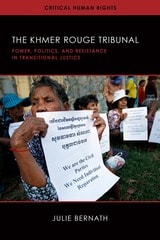
The Khmer Rouge Tribunal
Power, Politics, and Resistance in Transitional JusticeJulie Bernath
University of Wisconsin Press, 2023
Here, Julie Bernath takes a different tack, deliberately decentering the trials in an effort to understand the ECCC in its particular context—and, by extension, the degree to which notions of transitional justice generally must be understood in particular social, cultural, and political contexts. She focuses on “sites of resistance” to the ECCC, including not only members of the elite political class but also citizens who do not, for a variety of tangled reasons, participate in the tribunal—and even resistance from victims of the regime and participants in the trials. Bernath demonstrates that the ECCC both shapes and is shaped by long-term contestation over Cambodia’s social, economic, and political transformations, and thereby argues that transitional justice must be understood locally rather than as a homogenous good that can be implanted by international actors.
The Long Walk to Equality
Perspectives on Racial Inequality, Injustice and the LawAvis Whyte, Patricia Tuitt and Judith Bourne
University of Westminster Press, 2024

The Marrying Kind?
Debating Same-Sex Marriage within the Lesbian and Gay MovementMary Bernstein
University of Minnesota Press, 2013
As the fight for same-sex marriage rages across the United States and lesbian and gay couples rush to marriage license counters, the goal of marriage is still fiercely questioned within the LGBT movement. Rarely has an objective so central to a social movement’s political agenda been so controversial within the movement itself. While antigay forces work to restrict marriage to one man and one woman, lesbian and gay activists are passionately arguing about the desirability, viability, and social consequences of same-sex marriage.
The Marrying Kind? is the first book to draw on empirical research to examine these debates and how they are affecting marriage equality campaigns. The essays in this volume analyze the rhetoric, strategies, and makeup of the LGBT social movement organizations pushing for same-sex marriage, and address the dire predictions of some LGBT commentators that same-sex marriage will spell the end of queer identity and community. Case studies from California, Connecticut, Massachusetts, New Jersey, Oklahoma, Vermont, and Canada illuminate the complicated politics of same-sex marriage, making clear that the current disagreements among LGBT activists over whether marriage is conforming or transformative are far too simplistic. Instead, the impact of the marriage equality movement is complex and often contradictory, neither fully assimilationist nor fully oppositional.
Contributors: Ellen Ann Andersen, U of Vermont; Mary C. Burke, U of Vermont; Adam Isaiah Green, U of Toronto; Melanie Heath, McMaster U, Ontario; Kathleen E. Hull, U of Minnesota; Katrina Kimport, U of California, San Francisco; Jeffrey Kosbie; Katie Oliviero, U of Colorado, Boulder; Kristine A. Olsen; Timothy A. Ortyl; Arlene Stein, Rutgers U; Amy L. Stone, Trinity U; Nella Van Dyke, U of California, Merced.
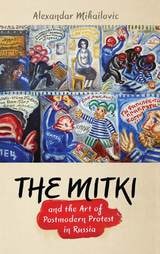
The Mitki and the Art of Postmodern Protest in Russia
Alexandar Mihailovic
University of Wisconsin Press, 2019
More broadly, Alexandar Mihailovic shows, the Mitki pioneered a form of political protest art that has since become a centerpiece of activism in post-Soviet Russia, most visibly today in groups such as Pussy Riot. He draws on extensive interviews with members of the collective and illuminates their critique of the authoritarian state, militarism, and social strictures from the Brezhnev years to the present.
The New Politics of Beijing–Hong Kong Relations
Ideological Conflicts and FactionalismSonny Shiu-Hing Lo
Hong Kong University Press, 2024
The New Politics of Beijing–Hong Kong Relations particularly examines the paternalistic authoritarianism that can be seen in Beijing's policy toward Hong Kong since the promulgation of the national security law in late June 2020. Lo analyzes the ideological shift from liberal nationalism to conservative nationalism on the mainland Chinese side since late 2012. The increasingly radical localism on the Hong Kong side after 2014 altered Beijing-Hong Kong relations and introduced factional struggles. While the imposition of the national security law in Hong Kong in late June 2020 has stabilized the city politically, Beijing's policy toward Hong Kong is now guided by the principles of protecting its national security and maintaining economic pragmatism, with implications for Beijing's relations with Taipei in the coming years.
The Obsolescence of Human Rights
The Alt-Right, the Pandemic and Science as an Emerging Political CleavageFilip Balunovic
Central European University Press, 2026

The Only Woman in the Room
A Memoir of Japan, Human Rights, and the ArtsBeate Sirota Gordon
University of Chicago Press, 2014
Sirota was born in Vienna, but in 1929 her family moved to Japan so that her father, a noted pianist, could teach, and she grew up speaking German, English, and Japanese. Russian, French, Italian, Latin, and Hebrew followed, and at fifteen Sirota was sent to complete her education at Mills College in California. The formal declaration of World War II cut Gordon off from her parents, and she supported herself by working for a CBS listening post in San Francisco that would eventually become part of the FCC. Translating was one of Sirota’s many talents, and when the war ended, she was sent to Japan as a language expert to help the American occupation forces. When General MacArthur suddenly created a team that included Sirota to draft the new Japanese Constitution, he gave them just eight days to accomplish the task. Colonel Roest said to Beate Sirota, “You’re a woman, why don’t you write the women’s rights section?”; and she seized the opportunity to write into law guarantees of equality unparalleled in the US Constitution to this day.
But this was only one episode in an extraordinary life, and when Gordon died in December 2012, words of grief and praise poured from artists, humanitarians, and thinkers the world over. Illustrated with forty-seven photographs, The Only Woman in the Room captures two cultures at a critical moment in history and recounts, after a fifty-year silence, a life lived with purpose and courage. This edition contains a new afterword by Nicole A. Gordon and an elegy by Geoffrey Paul Gordon.

The Other Justice
State Impunity and Maya Re-existence after the Acteal MassacreClaudia Chávez Argüelles
University of Texas Press, 2027
How the Mexican state secured impunity after the 1997 Acteal Massacre in Chiapas, and how Maya survivors reimagine justice through embodied, collective practices of memory, healing, and political autonomy.
In December 1997, forty-five Tsotsil Maya, most of them women and children, were killed in a state-backed paramilitary attack in Acteal, Chiapas––one of the starkest cases of state violence in contemporary Mexico. Yet, as Claudia Chávez Argüelles shows, the counterinsurgent violence unleashed at Acteal did not end with the massacre, but continued in its aftermath as state impunity became a form of governance. Drawing on legal archives and long-term collaborative ethnographic research with survivors and their organization, Las Abejas, Chávez maps the social life of their testimonies across judicial rulings, media narratives, and academic interventions. Her analysis reveals how the state forged a racializing legal truth that discredits Indigenous survivors’ ways of knowing, masks the slaughter’s feminicidal dimensions, and shields state officials from accountability. Against this logic of erasure, the book traces how Las Abejas has cultivated “the Other Justice,” a horizon of re-existence rooted in embodied, collective practices of memory, healing, and autonomy. Exposing the human toll of impunity and the decolonizing force of Las Abejas’ struggle, The Other Justice redefines what justice can mean beyond the confines of law.
The Paradoxes of Unintended Consequences
István Rév
Central European University Press, 2000
The Politics of Genocide
From the Genocide Convention to the Responsibility to ProtectJeffrey S. Bachman
Rutgers University Press, 2022
The Politics of Human Rights
A Global PerspectiveTony Evans
Pluto Press, 2005

The Politics of Intimacy
Rethinking the End-of-Life ControversyAnna Durnová
University of Michigan Press, 2018
Debates on the end-of-life controversy are complex because they seem to highjack national and cultural traditions. Where previous books have focused on ideological grounds, The Politics of Intimacy explores dying as the site where policies are negotiated and implemented. Intimacy comprises the emotional experience of the end of life and how we acknowledge it—or not—through institutions. This process shows that end-of-life controversy relies on the conflict between the individual and these institutions, a relationship that is the cornerstone of Western liberal democracies.
Through interviews with mourners, stakeholders, and medical professionals, examination of media debates in France and the Czech Republic, Durnová shows that liberal institutions, in their attempts to accommodate the emotional experience at the end of life, ultimately fail. She describes this deadlock as the “politics of intimacy,” revealing that political institutions deploy power through collective acknowledgment of individual emotions but fail to maintain this recognition because of this same experience.
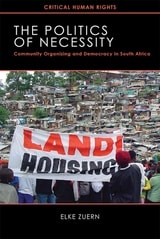
The Politics of Necessity
Community Organizing and Democracy in South AfricaElke Zuern
University of Wisconsin Press, 2011
The end of apartheid in South Africa broke down political barriers, extending to all races the formal rights of citizenship, including the right to participate in free elections and parliamentary democracy. But South Africa remains one of the most economically polarized nations in the world. In The Politics of Necessity Elke Zuern forcefully argues that working toward greater socio-economic equality—access to food, housing, land, jobs—is crucial to achieving a successful and sustainable democracy.
Drawing on interviews with local residents and activists in South Africa’s impoverished townships during more than a decade of dramatic political change, Zuern tracks the development of community organizing and reveals the shifting challenges faced by poor citizens. Under apartheid, township residents began organizing to press the government to address the basic material necessities of the poor and expanded their demands to include full civil and political rights. While the movement succeeded in gaining formal political rights, democratization led to a new government that instituted neo-liberal economic reforms and sought to minimize protest. In discouraging dissent and failing to reduce economic inequality, South Africa’s new democracy has continued to disempower the poor.
By comparing movements in South Africa to those in other African and Latin American states, this book identifies profound challenges to democratization. Zuern asserts the fundamental indivisibility of all human rights, showing how protest movements that call attention to socio-economic demands, though often labeled a threat to democracy, offer significant opportunities for modern democracies to evolve into systems of rule that empower all citizens.
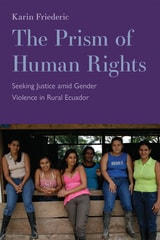
The Prism of Human Rights
Seeking Justice amid Gender Violence in Rural EcuadorKarin Friederic
Rutgers University Press, 2023
The Purple Color of Kurdish Politics
Women Politicians Write from PrisonGultan Kisanak
Pluto Press, 2022
Prison writings from twenty-two Kurdish women who were elected to office in Turkey and then imprisoned by the state on political grounds.
Gültan Kışanak, a Kurdish journalist and former MP, was elected co-mayor of Diyarbakır in 2014. Two years later, the Turkish state arrested and imprisoned her. Her story is remarkable, but not unique. While behind bars, she wrote about her own experiences and collected similar accounts from other Kurdish women, all co-chairs, co-mayors, and MPs in Turkey; all incarcerated on political grounds.
The Purple Colour of Kurdish Politics is a one-of-a-kind collection of prison writings from twenty-two Kurdish women politicians. Here they reflect on their personal and collective struggles against patriarchy and anti-Kurdish repression in Turkey; on the radical feminist principles and practices through which they transformed the political structures and state offices in which they operated. They discuss what worked and what didn’t, and the ways in which Turkey’s anti-capitalist and socialist movements closely informed their political stances and practices.
Demonstrating Kurdish women’s ceaseless political determination and refusal to be silenced – even when behind bars – the book ultimately hopes to inspire women living under even the most unjust conditions to engage in collective resistance.
The Riddled Chain
Chance, Coincidence and Chaos in Human EvolutionMcKee, Jeffrey Kevin
Rutgers University Press, 2000
Did human evolution proceed in an inevitable fashion? Can we attribute our origins solely to natural selection, or were more mischievous forces at work?
These are the questions investigated by anthropologist Jeff McKee. He argues that if we were to wind back the clock to our split from ancestral apes, evolution would proceed differently. Ever since our ancestors first stood up on two feet, natural selection undoubtedly was an important factor in guiding human evolution. But McKee shakes the standard notion that natural selection steered early hominids toward particular environmental adaptations. The fossil remains of our ancestors reveal a different story one of an adaptable hominid with no particular direction. It becomes clear that the evolutionary road to Homo sapiens was not paved solely by natural selection; indeed, there was no road to follow. There was just a dim path cut out by prehistoric coincidences and contingencies. Had any link in the evolutionary chain of events been slightly different, then our species would not be as it is today . . . or our ancestors may not have survived at all.
With equal doses of humor and awe, McKee illustrates how the chain of evolution has been riddled by chance, coincidence, and chaos. He uses familiar examples, noting that many of us exist as individuals because of chance meetings of our parents. From the present back through prehistory, chance is at the heart of our creation is chaos. The classic example of chaos is the butterfly effect: a single butterfly, flapping its wings, causes a tiny change in the atmosphere, which in turn amplifies to affect the course of storms on another continent. McKee ties such examples of unpredictability to fossil evidence and computer simulations, revealing the natural coincidences that shaped our evolution. Although chaos exacted an evolutionary price by limiting the powers of natural selection, it also made us what we are. One can only conclude that human beings were neither inevitable nor probable.
The Right to Difference
Interculturality and Human Rights in Contemporary German LiteratureNicole Coleman
University of Michigan Press, 2021
The Right to Difference examines novels that depict human rights violations in order to explore causes of intergroup violence within diverse societies, using Germany as a test case. In these texts, the book shows that an exaggeration of difference between minority and majority groups leads to violence. Germany has become increasingly diverse over the past decades due to skilled labor migration and refugee movements. In light of this diversity, this book’s approach transcends a divide between migrant and post-migrant German literature on the one hand and a national literature on the other hand. Addressing competing definitions of national identity as well as the contest between cultural homogeneity and diversity, the author redefines the term “intercultural literature.” It becomes not a synonym for authors who do not belong to a national literature, such as migrant writers, but a way of reading literature with an intercultural lens.
This book builds a theory of intercultural literature that focuses on the multifaceted nature of identity, in which ethnicity represents only one of many characteristics defining individuals. To develop intercultural competence, one needs to adopt a complex image of individuals that allows for commonalities and differences by complicating the notion of sharp contrasts between groups. Revealing the affective allegiances formed around other characteristics (gender, profession, personal motivations, relationships, and more) allows for similarities that grouping into large, homogeneous, and seemingly exclusive entities conceals. Eight novels analyzed in this book remember and reveal human rights violations, such as genocide, internment and torture, violent expulsion, the reasons for fleeing a country, dangerous flight routes and the difficulty of settling in a new country. Some of these novels allow for affective identification with diverse characters and cast the protagonists as individuals with plural perspectives and identities rather than monolithic members of one large national or ethnic group, whereas others emphasize the commonalities of all people.
Ultimately, the author makes the case for German Studies to contribute to an antiracist approach to diversity by redefining what it means to be German and establishing difference as a fundamental human right.
The Right to Maim
Debility, Capacity, DisabilityJasbir K. Puar
Duke University Press, 2017

The Rights of Communication
Beyond Free SpeechAmit M. Schejter
University of Westminster Press, 2027
Freedom of expression has long been regarded as the cornerstone of democratic theory, communication law, and human rights. Yet many of the rights that shape contemporary communication, including the right to receive information, the right to be heard, privacy, anonymity, memory, and the governance of digital platforms, sit uneasily within an expression-centred framework. The Rights of Communication: Beyond Free Speech argues that a Right to Communication should instead serve as the normative foundation for rights that sustain communication.
Drawing on philosophy, communication theory, legal scholarship, and media policy, Amit M. Schejter develops a theory of a foundational Right to Communication from which a coherent family of Communication Rights emerges. Rather than treating these rights as isolated doctrines or as extensions of free speech, the book shows how they protect the people, institutions, and conditions that make meaningful human communication possible.
The book examines rights associated with senders, receivers, media and platforms, the integrity of communication, information, privacy, non-communication, and memory, arguing that together they constitute a coherent architecture of Communication Rights. Combining normative theory with constitutional analysis and comparative perspectives from the United States, Europe, and international human rights law, it offers a new way of thinking about the relationship between communication and human rights.
The Rights of Communication: Beyond Free Speech will be of interest to scholars and students of communication, media, law, political science, and human rights, as well as policymakers and legal practitioners concerned with the future of democratic communication.
The Rise and Relapse of European Human Rights in Turkey
The AKP Era of 2002–2024Tugba Bayar
Central European University Press, 2026
The Roma Cafe
Human Rights and the Plight of the Romani PeopleIstvan Pogany
Pluto Press, 2004