65 books match the query 'Imperialism in literature' and 13 start with t
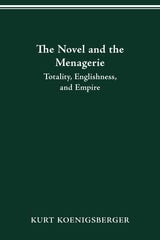
cover of THE NOVEL AND THE MENAGERIE: TOTALITY, ENGLISHNESS, AND EMPIRE

THE NOVEL AND THE MENAGERIE

TOTALITY, ENGLISHNESS, AND EMPIRE

KURT KOENIGSBERGER

The Ohio State University Press, 2007
The first comprehensive account of the relation of collections of imperial beasts to narrative practices in England, The Novel and the Menagerie explores an array of imaginative responses to the empire as a dominant, shaping factor in English daily life. Kurt Koenigsberger argues that domestic English novels and collections of zoological exotica (especially zoos, circuses, traveling menageries, and colonial and imperial exhibitions) share important aesthetic strategies and cultural logics: novels about English daily life and displays featuring collections of exotic animals both strive to relate Englishness to a larger empire conceived as an integrated whole.
 
Koenigsberger’s investigations range from readings of novels by authors such as Charles Dickens, Virginia Woolf, Salman Rushdie, and Angela Carter to analyses of ballads, handbills, broadsides, and memoirs of showmen. Attending closely to the collective English practices of imagining and delineating the empire as a whole, The Novel and the Menagerie works at the juncture of literary criticism, colonial discourse studies, and cultural analysis to historicize the notion of totality in the theory and practice of the English novel. In exploring the shapes of the novel in England and of the English institutions that collected exotic animals, it offers fresh readings of familiar literary texts and opens up new ways of understanding the character of imperial Englishness across the nineteenth and twentieth centuries.
[more]
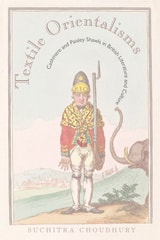
cover of Textile Orientalisms: Cashmere and Paisley Shawls in British Literature and Culture

Textile Orientalisms

Cashmere and Paisley Shawls in British Literature and Culture

Suchitra Choudhury

Ohio University Press, 2023
The first major study of Cashmere and Paisley shawls in nineteenth-century British literature, this book shows how they came to represent both high fashion and the British Empire. During the late eighteenth century, Cashmere shawls from the Indian subcontinent began arriving in Britain. At first, these luxury goods were tokens of wealth and prestige. Subsequently, affordable copies known as “Paisley” shawls were mass-produced in British factories, most notably in the Scottish town of the same name. Textile Orientalisms is the first full-length study of these shawls in British literature of the extended nineteenth century. Attentive to the juxtaposition of objects and their descriptions, the book analyzes the British obsession with Indian shawls through a convergence of postcolonial, literary, and cultural theories. Surveying a wide range of materials—plays, poems, satires, novels, advertisements, and archival sources—Suchitra Choudhury argues that while Cashmere and Paisley shawls were popular accoutrements in Romantic and Victorian Britain, their significance was not limited to fashion. Instead, as visible symbols of British expansion, for many imaginative writers they emerged as metaphorical sites reflecting the pleasures and anxieties of the empire. Attentive to new theorizations of history, fashion, colonialism, and gender, the book offers innovative readings of works by Sir Walter Scott, Wilkie Collins, William Thackeray, Frederick Niven, and Elizabeth Inchbald. In determining a key status for shawls in nineteenth-century literature, Textile Orientalisms reformulates the place of fashion and textiles in imperial studies. The book’s distinction rests primarily on three accounts. First, in presenting an original and extended discussion of Cashmere and Paisley shawls, Choudhury offers a new way of interpreting the British Empire. Second, by tracing how shawls represented the social and imperial experience, she argues for an associative link between popular consumption and the domestic experience of colonialism on the one hand and a broader evocation of texts and textiles on the other. Finally, discussions about global objects during the Victorian period tend to overlook that imperial Britain not only imported goods but also produced their copies and imitations on an industrial scale. By identifying the corporeal tropes of authenticity and imitation that lay at the heart of nineteenth-century imaginative production, Choudhury’s work points to a new direction in critical studies.
[more]
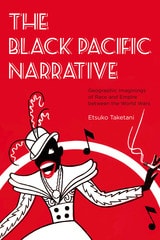
cover of The Black Pacific Narrative: Geographic Imaginings of Race and Empire between the World Wars

The Black Pacific Narrative

Geographic Imaginings of Race and Empire between the World Wars

Etsuko Taketani

Dartmouth College Press, 2014
The Black Pacific Narrative: Geographic Imaginings of Race and Empire between the World Wars chronicles the profound shift in geographic imaginings that occurred in African American culture as the United States evolved into a bioceanic global power. The author examines the narrative of the “black Pacific”?the literary and cultural production of African American narratives in the face of America’s efforts to internationalize the Pacific and to institute a “Pacific Community,” reflecting a vision of a hemispheric regional order initiated and led by the United States. The black Pacific was imagined in counterpoint to this regional order in the making, which would ultimately be challenged by the Pacific War. The principal subjects of study include such literary and cultural figures as James Weldon Johnson, George S. Schuyler, artists of the black Federal Theatre Project, Langston Hughes, W. E. B. Du Bois, and Walter White, all of whom afford significant points of entry to a critical understanding of the stakes of the black Pacific narrative. Adopting an approach that mixes the archival and the interpretive, the author seeks to recover the black Pacific produced by African American narratives, narratives that were significant enough in their time to warrant surveillance and suspicion, and hence are significant enough in our time to warrant scholarly attention and reappraisal. A compelling study that will appeal to a broad, international audience of students and scholars of American studies, African American studies, American literature, and imperialism and colonialism.
[more]
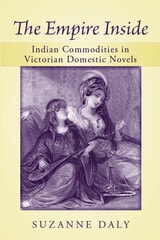
cover of The Empire Inside: Indian Commodities in Victorian Domestic Novels

The Empire Inside

Indian Commodities in Victorian Domestic Novels

Suzanne Daly

University of Michigan Press, 2011

"The Empire Inside is unique in its tight focus on the objects from one geographical location, and their deployment in one genre of fiction. This combination results in a powerful study with a wealth of fine formal analyses of literary texts and a similar trove of marvelous historical data."
---Elaine Freedgood, New York University

"In The Empire Inside, Suzanne Daly does a wonderful job integrating an array of primary materials, especially novels and journal essays, to show the extent to which these ‘foreign’ colonial products of India represented absolutely central aspects of domestic life, at once part of the unremarkable everyday experience of Victorians and rich with meanings."
---Timothy Carens, College of Charleston

By the early nineteenth century, imperial commodities had become commonplace in middle-class English homes. Such Indian goods as tea, textiles, and gemstones led double lives, functioning at once as exotic foreign artifacts and as markers of proper Englishness. The Empire Inside: Indian Commodities in Victorian Domestic Novels reveals how Indian imports encapsulated new ideas about both the home and the world in Victorian literature and culture. In novels by Charlotte Brontë, Charles Dickens, and Anthony Trollope, the regularity with which Indian commodities appear bespeaks their burgeoning importance both ideologically and commercially. Such domestic details as the drinking of tea and the giving of shawls as gifts point us toward suppressed connections between the feminized realm of private life and the militarized realm of foreign commerce.

Tracing the history of Indian imports yields a record of the struggles for territory and political power that marked the coming-into-being of British India; reading the novels of the period for the ways in which they infuse meaning into these imports demonstrates how imperialism was written into the fabric of everyday life in nineteenth-century England. Situated at the intersection of Victorian studies, material cultural studies, gender studies, and British Empire studies, The Empire Inside is written for academics, graduate students, and advanced undergraduates in all of these fields.

Suzanne Daly is Associate Professor of English, University of Massachusetts Amherst.
[more]
cover of The Gothic Family Romance: Heterosexuality, Child Sacrifice, and the Anglo-Irish Colonial Order

The Gothic Family Romance

Heterosexuality, Child Sacrifice, and the Anglo-Irish Colonial Order

Margot Gayle Backus

Duke University Press, 1999

Tales of child sacrifice, demon lovers, incestual relations, and returns from the dead are part of English and Irish gothic literature. Such recurring tropes are examined in this pioneering study by Margot Gayle Backus to show how Anglo-Irish gothic works written from the eighteenth through the twentieth centuries reflect the destructive effects of imperialism on the children and later descendents of Protestant English settlers in Ireland.
Backus uses contemporary theory, including that of Michel Foucault and Eve Kosofsky Sedgwick, to analyze texts by authors ranging from Richardson, Swift, Burke, Edgeworth, Stoker, and Wilde to contemporary Irish novelists and playwrights.
By charting the changing relations between the family and the British state, she shows how these authors dramatized a legacy of violence within the family cell and discusses how disturbing themes of child sacrifice and colonial repression are portrayed through irony, satire, “paranoid” fantasy, and gothic romance. In a reconceptualization of the Freudian family romance, Backus argues that the figures of the Anglo-Irish gothic embody the particular residue of childhood experiences within a settler colonial society in which biological reproduction represented an economic and political imperative.
Backus’s bold positioning of the nuclear family at the center of post-Enlightenment class and colonial power relations in England and Ireland will challenge and provoke scholars in the fields of Irish literature and British and postcolonial studies. The book will also interest students and scholars of women’s studies, and it has important implications for understanding contemporary conflicts in Ireland.
[more]
cover of The Imperialist Imaginary: Visions of Asia and the Pacific in American Culture

The Imperialist Imaginary

Visions of Asia and the Pacific in American Culture

John Eperjesi

Dartmouth College Press, 2014
In a groundbreaking work of “New Americanist” studies, John R. Eperjesi explores the cultural and economic formation of the Unites States relationship to China and the Pacific Rim in the nineteenth and twentieth centuries. Eperjesi examines a variety of texts to explore the emergence of what Rob Wilson has termed the “American Pacific.” Eperjesi shows how works ranging from Frank Norris’ The Octopus to the Journal of the American Asiatic Association, from the Socialist newspaper Appeal to Reason to the travel writings of Jack and Charmain London, and from Maxine Hong Kingston’s China Men to Ang Lee’s Crouching Tiger, Hidden Dragon—and the cultural dynamics that produced them—helped construct the myth of the American Pacific. By construing the Pacific Rim as a unified region binding together the territorial United States with the areas of Asia and the Pacific, he also demonstrates that the logic of the imperialist imaginary suggested it was not only proper but even incumbent upon the United States to exercise both political and economic influence in the region. As Donald E. Pease notes in his foreword, “by reading foreign policy and economic policy as literature, and by reconceptualizing works of American literature as extenuations of foreign policy and economic theory,” Eperjesi makes a significant contribution to studies of American imperialism.
[more]
cover of The Rhetoric of Empire: Colonial Discourse in Journalism, Travel Writing, and Imperial Administration

The Rhetoric of Empire

Colonial Discourse in Journalism, Travel Writing, and Imperial Administration

David Spurr

Duke University Press, 1993

The white man's burden, darkest Africa, the seduction of the primitive: such phrases were widespread in the language Western empires used to talk about their colonial enterprises. How this language itself served imperial purposes--and how it survives today in writing about the Third World--are the subject of David Spurr's book, a revealing account of the rhetorical strategies that have defined Western thinking about the non-Western world.
Despite historical differences among British, French, and American versions of colonialism, their rhetoric had much in common. The Rhetoric of Empire identifies these shared features—images, figures of speech, and characteristic lines of argument—and explores them in a wide variety of sources. A former correspondent for the United Press International, the author is equally at home with journalism or critical theory, travel writing or official documents, and his discussion is remarkably comprehensive. Ranging from T. E. Lawrence and Isak Dineson to Hemingway and Naipaul, from Time and the New Yorker to the National Geographic and Le Monde, from journalists such as Didion and Sontag to colonial administrators such as Frederick Lugard and Albert Sarraut, this analysis suggests the degree to which certain rhetorical tactics penetrate the popular as well as official colonial and postcolonial discourse.
Finally, Spurr considers the question: Can the language itself—and with it, Western forms of interpretation--be freed of the exercise of colonial power? This ambitious book is an answer of sorts. By exposing the rhetoric of empire, Spurr begins to loosen its hold over discourse about—and between—different cultures.
[more]
cover of The Rhetoric of English India

The Rhetoric of English India

Sara Suleri Goodyear

University of Chicago Press, 1992

Tracing a genealogy of colonial discourse, Suleri focuses on paradigmatic moments in the multiple stories generated by the British colonization of the Indian  subcontinent. Both the literature of imperialism and its postcolonial aftermath emerge here as a series of guilty transactions between two cultures that are equally evasive and uncertain of their own authority.

"A dense, witty, and richly allusive book . . . an extremely valuable contribution to postcolonial cultural studies as well as to the whole area of literary criticism."—Jean Sudrann, Choice
[more]
cover of The Ruling Passion: British Colonial Allegory and the Paradox of Homosexual Desire

The Ruling Passion

British Colonial Allegory and the Paradox of Homosexual Desire

Christopher Lane

Duke University Press, 1995

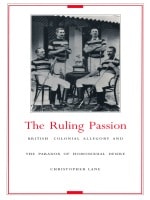
In The Ruling Passion, Christopher Lane examines the relationship between masculinity, homosexual desire, and empire in British colonialist and imperialist fictions at the turn of the twentieth century. Questioning the popular assumption that Britain’s empire functioned with symbolic efficiency on sublimated desire, this book presents a counterhistory of the empire’s many layers of conflict and ambivalence.
Through attentive readings of sexual and political allegory in the work of Kipling, Forster, James, Beerbohm, Firbank, and others—and deft use of psychoanalytic theory—The Ruling Passion interprets turbulent scenes of masculine identification and pleasure, power and mastery, intimacy and antagonism. By foregrounding the shattering effects of male homosexuality and interracial desire, and by insisting on the centrality of unconscious fantasy and the death drive, The Ruling Passion examines the startling recurrence of colonial failure in narratives of symbolic doubt and ontological crisis. Lane argues compellingly that Britain can progress culturally and politically only when it has relinquished its residual fantasies of global mastery.

[more]
cover of The Sign of the Cannibal: Melville and the Making of a Postcolonial Reader

The Sign of the Cannibal

Melville and the Making of a Postcolonial Reader

Geoffrey Sanborn

Duke University Press, 1998

In The Sign of the Cannibal Geoffrey Sanborn offers a major reassessment of the work of Herman Melville, a definitive history of the post-Enlightenment discourse on cannibalism, and a provocative contribution to postcolonial theory. These investigations not only explore mid–nineteenth century resistance to the colonial enterprise but argue that Melville, using the discourse on cannibalism to critique colonialism, contributed to the production of resistance.
Sanborn focuses on the representations of cannibalism in three of Melville’s key texts—Typee, Moby-Dick, and “Benito Cereno.” Drawing on accounts of Pacific voyages from two centuries and virtually the entire corpus of the post-Enlightenment discourse on cannibalism, he shows how Melville used his narratives to work through the ways in which cannibalism had been understood. In so doing, argues Sanborn, Melville sought to move his readers through stages of possible responses to the phenomenon in order to lead them to consider alternatives to established assumptions and conventions—to understand that in the savage they see primarily their own fear and fascination. Melville thus becomes a narrator of the postcolonial encounter as he uncovers the dynamic of dread and menace that marks the Western construction of the “non-savage” human.
Extending the work of Slavoj Zizek and Homi Bhabha while providing significant new insights into the work of Melville, The Sign of the Cannibal represents a breakthrough for students and scholars of postcolonial theory, American literary history, critical anthropology, race, and masculinity.
[more]
cover of The Triumph of Human Empire: Verne, Morris, and Stevenson at the End of the World

The Triumph of Human Empire

Verne, Morris, and Stevenson at the End of the World

Rosalind Williams

University of Chicago Press, 2013
In the early 1600s, in a haunting tale titled New Atlantis, Sir Francis Bacon imagined the discovery of an uncharted island. This island was home to the descendants of the lost realm of Atlantis, who had organized themselves to seek “the knowledge of Causes, and secret motions of things; and the enlarging of the bounds of Human Empire, to the effecting of all things possible.” Bacon’s make-believe island was not an empire in the usual sense, marked by territorial control; instead, it was the center of a vast general expansion of human knowledge and power.  
           
Rosalind Williams uses Bacon’s island as a jumping-off point to explore the overarching historical event of our time: the rise and triumph of human empire, the apotheosis of the modern ambition to increase knowledge and power in order to achieve world domination. Confronting an intensely humanized world was a singular event of consciousness, which Williams explores through the lives and works of three writers of the late nineteenth century: Jules Verne, William Morris, and Robert Louis Stevenson. As the century drew to a close, these writers were unhappy with the direction in which their world seemed to be headed and worried that organized humanity would use knowledge and power for unworthy ends. In response, Williams shows, each engaged in a lifelong quest to make a home in the midst of human empire, to transcend it, and most of all to understand it. They accomplished this first by taking to the water: in life and in art, the transition from land to water offered them release from the condition of human domination. At the same time, each writer transformed his world by exploring the literary boundary between realism and romance. Williams shows how Verne, Morris, and Stevenson experimented with romance and fantasy and how these traditions allowed them to express their growing awareness of the need for a new relationship between humans and Earth.
           
The Triumph of Human Empire shows that for these writers and their readers romance was an exceptionally powerful way of grappling with the political, technical, and environmental situations of modernity. As environmental consciousness rises in our time, along with evidence that our seeming control over nature is pathological and unpredictable, Williams’s history is one that speaks very much to the present.
[more]
cover of The United States of India: Anticolonial Literature and Transnational Refraction

The United States of India

Anticolonial Literature and Transnational Refraction

Manan Desai

Temple University Press, 2020

The United States of India shows how Indian and American writers in the United States played a key role in the development of anticolonial thought in the years during and immediately following the First World War. For Indians Lajpat Rai and Dhan Gopal Mukerji, and Americans Agnes Smedley, W.E.B. Du Bois, and Katherine Mayo, the social and historical landscape of America and India acted as a reflective surface. Manan Desai considers how their interactions provided a “transnational refraction”—a political optic and discursive strategy that offered ways to imagine how American history could shed light on an anticolonial Indian future.

Desai traces how various expatriate and immigrant Indians formed political movements that rallied for American support for the cause of Indian independence. These intellectuals also developed new forms of writing about subjugation in the U.S. and India. Providing an examination of race, caste, nationhood, and empire, Desai astutely examines this network of Indian and American writers and the genres and social questions that fomented solidarity across borders.
[more]
cover of Tropicopolitans: Colonialism and Agency, 1688–1804

Tropicopolitans

Colonialism and Agency, 1688–1804

Srinivas Aravamudan

Duke University Press, 1999

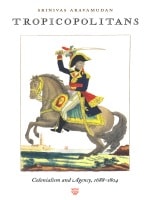
In Tropicopolitans Srinivas Aravamudan reconstructs the colonial imagination of the eighteenth century. By exploring representations of peoples and cultures subjected to colonial discourse, he makes a case for the agency—or the capacity to resist domination—of those oppressed. Aravamudan’s analysis of texts that accompanied European commercial and imperial expansion from the Glorious Revolution through the French Revolution reveals the development of anticolonial consciousness prior to the nineteenth century.
“Tropicalization” is the central metaphor of this analysis, a term that incorporates both the construction of various dynamic tropes by which the colonized are viewed and the site of the study, primarily the tropics. Tropicopolitans, then, are those people who bear and resist the representations of colonialist discourse. In readings that expose new relationships between literary representation and colonialism in the eighteenth century, Aravamudan considers such texts as Behn’s Oroonoko, Defoe’s Robinson Crusoe and Captain Singleton, Addison’s Cato, and Swift’s Gulliver’s Travels and The Drapier’s Letters. He extends his argument to include analyses of Johnson’s Rasselas, Beckford’s Vathek, Montagu’s travel letters, Equiano’s autobiography, Burke’s political and aesthetic writings, and Abbé de Raynal’s Histoire des deux Indes. Offering a radical approach to literary history, this study provides new mechanisms for understanding the development of anticolonial agency.
Introducing eighteenth-century studies to a postcolonial hermeneutics, Tropicopolitans will interest scholars engaged in postcolonial studies, eighteenth-century literature, and literary theory.


[more]