Results by title
83 books match the query 'Inclusive Education' and 14 start with t
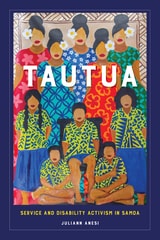
Tautua
Service and Disability Activism in SamoaJuliann Anesi
Temple University Press, 2026
The Sāmoan concept of tautua is the cultural practice of service—to family, village, church, and nation. For Juliann Anesi, tautua includes an ethical responsibility that extends to caring for people living with disabilities. Anesi learned this value from her aunty Sina, who was instrumental in founding two schools for youths in the mid-1970s—Aoga Fiamalamalama and Loto Taumafailike. These schools were designed for students like Sina’s son Gele, students excluded from private and public education because of intellectual or physical disabilities.
Tautua recounts how the Indigenous community organized and resisted ableist paradigms in colonial institutions by changing the education system to a more inclusive environment. Anesi explains how funding was arranged for the schools through NGOs. She also uses oral histories, personal narratives, archival documents, and newspapers to offer insights about how students experienced oppression and erasure as well as shame and sexism in their communities.
Highlighting advocacy and belonging, Tautua argues that these schools for students with disabilities centered Sāmoan concepts of service, advocacy, and self-determination in an attempt to decolonize elementary education. In doing so, Anesi shows what disability activism in Sāmoa can teach us about educability, school inclusion, and collective care.
In the series Dis/color
Teacher Education across Minority-Serving Institutions
Programs, Policies, and Social JusticePetchauer, Emery
Rutgers University Press, 2017
The first of its kind, Teacher Education across Minority-Serving Institutions brings together innovative work from the family of institutions known as minority-serving institutions: Historically Black Colleges and Universities, Tribal Colleges and Universities, Hispanic Serving Institutions, and Asian American and Native American Pacific Islander Serving Institutions. The book moves beyond a singular focus on teacher racial diversity that has characterized scholarship and policy work in this area. Instead, it pushes for scholars to consider that racial diversity in teacher education is not simply an end in itself but is, a means to accomplish other goals, such as developing justice-oriented and asset-based pedagogies.
Teaching Difficult Topics
Reflections from the Undergraduate Music ClassroomOlivia R. Lucas and Laura Moore Pruett
University of Michigan Press, 2024
The teaching reflections in Teaching Difficult Topics examine difficult themes that fall into three primary categories: subjects that instructors sense to be controversial or emotionally challenging to discuss, those that derive from or intersect with real-world events that are difficult to process, and bigger-picture discussions of how music studies often focuses on dominant narratives while overlooking other perspectives. Some chapters offer practical guidance, lesson plans, and teaching materials to enable instructors to build discussions of race, gender, sexuality, and traumatic histories into their own classrooms; others take a more global view, reflecting on the importance and relevance of teaching these difficult topics and on how to respond in the music classroom when external events disrupt daily life.
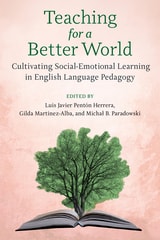
Teaching for a Better World
Cultivating Social-Emotional Learning in English Language PedagogyEdited by Luis Javier Pentón Herrera, Gilda Martínez-Alba, and Michal B. Paradowski
University of Michigan Press, 2026
In a world where language connects people across cultures, Teaching for a Better World invites readers to imagine classrooms where words do more than teach grammar; they build empathy, resilience, and understanding. This groundbreaking volume is the first to focus on the integration of social-emotional learning (SEL) into English language teaching from a global perspective, bringing together educators and researchers from diverse cultural and educational contexts. Through conceptual discussions, research, and practical examples, the authors demonstrate how English lessons can also be lessons in compassion, collaboration, and global citizenship.
Organized into three sections—Conceptual Pieces, Empirical Studies, and Practical Examples—the book offers a comprehensive examination of SEL’s theoretical foundations, evidence-based practices, and real-world classroom applications. Contributors explore SEL through lenses such as culturally responsive pedagogy, trauma-sensitive practices, teacher and student well-being, ecolinguistics, and intercultural dialogue. Readers will find innovative and practical ways to create inclusive, culturally responsive classrooms; support student and teacher well-being; and use English as a bridge for intercultural dialogue. Accessible and inspiring, this book’s combination of conceptual depth, empirical rigor, and applied strategies position it as a foundational resource for advancing research and practice in SEL-informed English language pedagogy worldwide.
Readers of Teaching for a Better World will
- Learn pedagogically sound ways to foster empathy and resilience while creating inclusive, culturally responsive classrooms.
- Find ready-to-use lesson plans and activities.
- Encounter diverse perspectives of educators from a range of contexts, including conflict-affected regions, refugee resettlement contexts, and higher education.
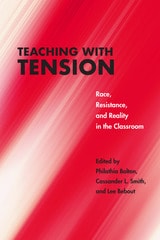
Teaching with Tension
Race, Resistance, and Reality in the ClassroomEdited by Philathia Bolton, Cassander L. Smith, and Lee Bebout
Northwestern University Press, 2019
Drawing together personal reflection, pedagogical strategies, and critical theory, Teaching with Tension offers concrete examinations that will foster student learning. The essays are organized into three thematic sections: "Teaching in Times and Places of Struggle" examines the dynamics of teaching race during the current moment, marked by neoconservative politics and twenty-first century freedom struggles. "Teaching in the Neoliberal University" focuses on how pressures and exigencies of neoliberalism (such as individualism, customer-service models of education, and online courses) impact the way in which race is taught and conceptualized in college classes. The final section, "Teaching How to Read Race and (Counter)Narratives," homes in on direct strategies used to historicize race in classrooms comprised of millennials who grapple with race neutral ideologies. Taken together, these sections and their constitutive essays offer rich and fruitful insight into the complex dynamics of contemporary race and ethnic studies education.

The Benevolent Gaslight
A Technology of Race-MakingLouis M. Maraj
Utah State University Press, 2026
At the intersection of rhetorical studies and critical race/ethnic studies, The Benevolent Gaslight analyzes cultural and political discourses that recharacterize acts of racial violence as teaching moments and learning opportunities. Naming this phenomenon “benevolent gaslighting,” Louis M. Maraj and Pritha Prasad explore its application across academic disciplines/epistemologies, educational history, and university race management, while also diving into how popular culture and political figures use benevolent gaslighting to reinscribe normative operations of race, gender, and sexuality.
Although this rhetoric usually presents as progressive, when used for the purposes of advancing “antiracism,” the benevolent gaslight re-centers the very whiteness it supposedly critiques. It prompts peoples of color to question their histories, memories, and realities by suggesting their pain has been necessary for positive social change and by situating racial trauma as opportunities for public learning. Specific examples include antiracist teaching initiatives and the sudden proliferation of apologies for past acts of racism by public figures. Both trends saw an uptick from 2020 onward as a result of publicity crises and public “reckonings” necessitated by Black Lives Matter protests in response to widely reported, hypervisible anti-Black violences like the murders of George Floyd, Breonna Taylor, and Ahmaud Arbery.
These discourses deflect blame for past or present racial violence by narrating it as an opportunity for “antiracist” growth and intervention. Utilizing conventional academic and creative/narrative methods to examine examples of the benevolent gaslight across US histories of education during the First Reconstruction, the post–Civil Rights management of student activists in the university, and the progressivist discourses of humanities disciplines and popular culture, this book reveals the insidious ways in which peoples of color are routinely (re)traumatized through mechanisms of “pedagogy.”
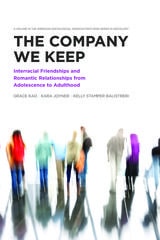
The Company We Keep
Interracial Friendships and Romantic Relationships from Adolescence to AdulthoodGrace Kao
Russell Sage Foundation, 2019
While research on interracial social ties has often focused on whites and blacks, Hispanics are the largest minority group and Asian Americans are the fastest growing racial group in the United States. The Company We Keep examines friendships and romantic relationships among blacks, whites, Hispanics, and Asian Americans to better understand the full spectrum of contemporary race relations. Using data from the National Longitudinal Study of Adolescent to Adult Health, the authors explore the social ties of more than 15,000 individuals from their first survey responses as middle and high school students in the mid-1990s through young adulthood nearly fifteen years later. They find that while approval for interracial marriages has increased and is nearly universal among young people, interracial friendships and romantic relationships remain relatively rare, especially for whites and blacks. Black women are particularly disadvantaged in forming interracial romantic relationships, while Asian men are disadvantaged in the formation of any romantic relationships, both as adolescents and as young adults. They also find that people in same-sex romantic relationships are more likely to have partners from a different racial group than are people in different-sex relationships. The authors pay close attention to how the formation of interracial friendships and romantic relationships depends on opportunities for interracial contact. They find that the number of students choosing different-race friends and romantic partners is greater in schools that are more racially diverse, indicating that school segregation has a profound impact on young people’s social ties.
Kao, Joyner, and Balistreri analyze the ways school diversity and adolescent interracial contact intersect to lay the groundwork for interracial relationships in young adulthood. The Company We Keep provides compelling insights and hope for the future of living and loving across racial divides.
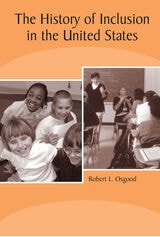
The History of Inclusion in the United States
Robert L. Osgood
Gallaudet University Press, 2005
As a significant term, inclusion came into use relatively recently in the long history of special education in the United States. Since the 1800s, when children with disabilities first were segregated for instruction in public schools, professionals and parents have called for more equitable, “normal” treatment of these students, and for closer contact with their nondisabled peers. Through the years, the central issues of the discussions between educators and parents have focused on who should be considered disabled and who should bear responsibility for planning and providing for their education. The History of Inclusion in the United States traces the antecedents of this ongoing debate to answer questions about what inclusion is, how it came to be, and where it might go.
In this comprehensive study, author Robert L. Osgood reveals how the idea of inclusion has evolved into broader realms of thought and practice. In its earliest manifestations, educators dwelled upon the classroom setting itself, wondering whether “disabled” children belonged there; if not, why not; and if so, how this could be accomplished? By the late 1960s, the scope of the discussion had shifted to assess the comprehensive structures of special education and its relationship with general education. The History of Inclusion seamlessly follows this progression into the present decade, in which current educational policy questions the need for any sort of separate “special education” in principle and structure.
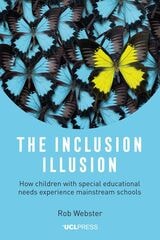
The Inclusion Illusion
How Children with Special Educational Needs Experience Mainstream SchoolsRob Webster
University College London, 2022
Inclusion conjures images of children with special educational needs and disabilities (SEND) learning in classes alongside peers in a mainstream school. For pupils in the UK with high-level SEND, who have an Education, Health and Care Plan (formerly a Statement), this implies an everyday educational experience similar to that of their typically developing classmates. Yet in vital respects, they are worlds apart.
Based on the UK’s largest observation study of pupils with high-level SEND, this book exposes how attendance at a mainstream school is no guarantee of receiving a mainstream education. Observations of nearly 1,500 lessons in English schools show that these students’ everyday experience of school is characterized by separation and segregation. Furthermore, interviews with nearly five hundred pupils, parents, and school staff reveal the effect of this marginalization on the quality of their education. The book argues that inclusion is an illusion. The way schools are organized and how classrooms are composed creates a form of structural exclusion that preserves mainstream education for typically developing pupils and justifies offering a diluted pedagogy for pupils with high-level SEND. Ultimately, the book suggests why a more authentic form of inclusion is needed, and how it might be achieved.
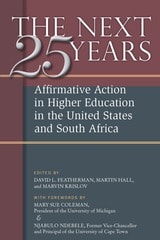
The Next Twenty-five Years
Affirmative Action in Higher Education in the United States and South AfricaDavid L. Featherman, Martin Hall, and Marvin Krislov, editors
University of Michigan Press, 2009
"Ambitious, provocative, and wide-ranging, this rich collection of essays from U.S. and South African perspectives reflects the thinking of thoughtful advocates of affirmative action."
---William G. Bowen, President Emeritus, The Andrew W. Mellon Foundation, and President Emeritus, Princeton University
"Thoughtful commentary from outstanding experts on affirmative action’s future in two countries struggling to overcome a legacy of racial injustice."
---Derek Bok, 300th Anniversary University Research Professor, and President Emeritus, Harvard University
"An enormously important comparative study and reflection on affirmative (U.S.) and corrective (South Africa) action with exhaustive and sensitive treatment of a vital topic."
---Kader Asmal, Professor of Law, University of the Western Cape, Cape Town, and former Minister of Education, South Africa
A penetrating exploration of affirmative action's continued place in 21st-century higher education, The Next Twenty-five Years assembles the viewpoints of some of the most influential scholars, educators, university leaders, and public officials. Its comparative essays span the political spectrum and dissect debates in two nations to elucidate the legal, political, social, economic, and moral dimensions of affirmative action in higher education and its role in contributing to a just, equitable, and vital society.
David L. Featherman is Professor of Sociology and Psychology and Founding Director of the Center for Advancing Research and Solutions for Society at the University of Michigan.
Martin Hall is Vice-Chancellor of the University of Salford, Greater Manchester, and previously was Deputy Vice-Chancellor at the University of Cape Town.
Marvin Krislov is President of Oberlin College and previously was Vice President and General Counsel at the University of Michigan.
Transformative Civic Education in Democratic Societies
Tetyana Hoggan-Kloubert
Michigan State University Press, 2023
Transforming History
A Guide to Effective, Inclusive, and Evidence-Based TeachingMary Jo Festle
University of Wisconsin Press, 2020
Instructors will improve their own conceptual understandings of teaching and learning issues, as well as receive guidance on designing courses and implementing pedagogies consistent with what research tells us about how students learn. The book offers practical illustrations of assignments, goals, questions, grading rubrics, unit plans, and formats for peer observation that are adaptable for courses on any subject and of any size. Transforming History is a critical guide for higher and secondary education faculty—neophytes and longtime professionals alike—working to improve student learning.
Translating Human Rights in Education
The Influence of Article 24 UN CRPD in Nigeria and GermanyJulia Biermann
University of Michigan Press, 2022
The 2006 United Nations Convention on the Rights of Persons with Disabilities (UN CRPD) is the first human rights treaty to explicitly acknowledge the right to education for persons with disabilities. In order to realize this right, the convention’s Article 24 mandates state parties to ensure inclusive education systems that overcome outright exclusion as well as segregation in special education settings. Despite this major global policy change to tackle the discriminations persons with disabilities face in education, this has yet to take effect in most school systems worldwide.
Focusing on the factors undermining the realization of disability rights in education, Julia Biermann probes current meanings of inclusive education in two contrasting yet equally challenged state parties to the UN CRPD: Nigeria, whose school system overtly excludes disabled children, and Germany, where this group primarily learns in special schools. In both countries, policy actors aim to realize the right to inclusive education by segregating students with disabilities into special education settings. In Nigeria, this demand arises from the glaring lack of such a system. In Germany, conversely, from its extraordinary long-term institutionalization. This act of diverting from the principles embodied in Article 24 is based on the steadfast and shared belief that school systems, which place students into special education, have an innate advantage in realizing the right to education for persons with disabilities. Accordingly, inclusion emerges to be an evolutionary and linear process of educational expansion that depends on institutionalized special education, not a right of persons with disabilities to be realized in local schools on an equal basis with others. This book proposes a refined human rights model of disability in education that shifts the analytical focus toward the global politics of formal mass schooling as a space where discrimination is sustained.
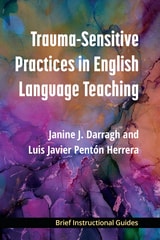
Trauma-Sensitive Practices in English Language Teaching
Janine J. Darragh and Luis Javier Pentón Herrera
University of Michigan Press, 2026