Results by title
63 books match the query 'Indigenous Languages in the Americas' and 8 start with t
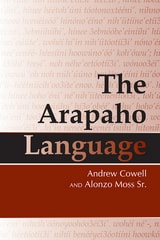
The Arapaho Language
Andrew Cowell
University Press of Colorado, 2015
Cowell and Moss detail strategies used by speakers of this highly polysynthetic language to form complex words and illustrate how word formation interacts with information structure. They discuss word order and discourse-level features, treat the special features of formal discourse style and traditional narratives, and list gender-specific particles, which are widely used in conversation. Appendices include full sets of inflections for a variety of verbs.
Arapaho is spoken primarily in Wyoming, with a few speakers in Oklahoma. The corpus used in The Arapaho Language spans more than a century of documentation, including multiple speakers from Wyoming and Oklahoma, with emphasis on recent recordings from Wyoming. The book cites approximately 2,000 language examples drawn largely from natural discourse - either recorded spoken language or texts written by native speakers.
With The Arapaho Language, Cowell and Moss have produced a comprehensive document of a language that, in its departures from its nearest linguistic neighbors, sheds light on the evolution of grammar.
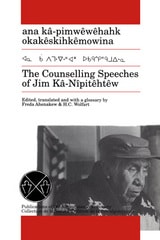
The Counselling Speeches of Jim Ka-Nipitehtew
Freda Ahenakew
University of Manitoba Press, 1998
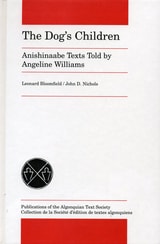
The Dog's Children
Anishinaabe Texts told by Angeline WilliamsLeonard Bloomfield
University of Manitoba Press, 1991
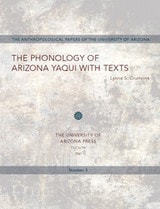
The Phonology of Arizona Yaqui with Texts
Lynne S. Crumrine
University of Arizona Press, 1961
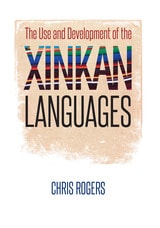
The Use and Development of the Xinkan Languages
By Chris Rogers
University of Texas Press, 2016
Once spoken only in Santa Rosa Department, Guatemala, the Xinkan language family is unique within Mesoamerica, comprising four closely related languages that are unrelated to any of the other language groups used within the region. Descriptions of Xinkan date to 1770 but are typically only sketches or partial word lists. Not even the community of indigenous people who identify as Xinka today—the last speakers—have had access to a reliable descriptive source on their ancestral tongue. Preserving this endangered communication system in accurate, thorough detail, The Use and Development of the Xinkan Languages presents a historical framework, internal classifications, and both synchronic and diachronic descriptions, incorporating all elements of grammar based on extensive unpublished data collected in the 1970s by Lyle Campbell and Terrence Kaufman.
This valuable contribution is enhanced by author Chris Rogers’s emphasis on contextualizing the findings. Introducing the languages, Rogers presents important information regarding the social and cultural milieu of the speakers. He also traces a phonological reconstruction of Proto-Xinkan and reconstructs historical morphology and syntax. These revelations are of particular interest because the development of Xinka and the many aspects of Xinka morphosyntax have not been well understood. A sample text, “Na Mulha Uy,” is included as well. Solving numerous complex, centuries-old linguistic puzzles, The Use and Development of the Xinkan Languages unlocks new potential for the rediscovery of a rich cultural history.
This book is a part of the Recovering Languages and Literacies of the Americas publication initiative, funded by a grant from the Andrew W. Mellon Foundation.
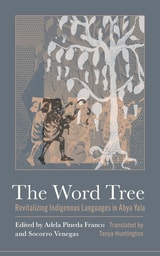
The Word Tree
Revitalizing Indigenous Languages in Abya YalaEdited by Adela Pineda Franco and Socorro VenegasTranslated by Tanya Huntington
University of Texas Press, 2025
A collaborative effort to address some of the chronic issues affecting the preservation and revitalization of indigenous languages.
What does it mean to "revitalize" an indigenous language when approximately 6,700 of the nearly 7,000 left in the world need protection? Where to begin? Each language offers a sense of history, identity, and belonging within society to the people actively using it. The Word Tree begins by hearing directly from those still communicating in some of these less dominant languages, from Achi'es to Zapotec, and offers the metaphor of a tree whose political roots sustain the trunk of education that will bear the fruit of learning languages anew. Whether describing the tension between indigenous and state-recognized languages; the process of linguistics displacement resulting from migration; or the value of locally focused efforts in a cultural cooperative, these nine essays offer fresh and useful perspectives.
The Word Tree is the result of a collaboration between the National Autonomous University of Mexico and the University of Texas at Austin. Gathering diverse concerns, experiences, explorations, proposals, and perspectives on the revitalization of some of the continent's most imperiled indigenous languages, the contributors aim to introduce their struggle for existence to a modern world. From south to north, the Quecha or Runasimi, Maya, Zapotec or Diidxazá, Chatino, Mè'pháá or Tlapaneco, Mixteco, Mixe or Auukj, and Nahuatl languages exist in all their vast complexities and contexts. At its most fundamental level, this book is a call to develop alternative paths for human existence in which caring for one another is the consensus.
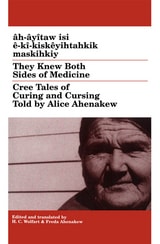
They Knew Both Sides of Medicine
Cree Tales of Curing and Cursing Told by Alice AhenakewH.C. Wolfart
University of Manitoba Press, 2000
Tohono O'odham/Pima to English, English to Tohono O'odham/Pima Dictionary
Dean Saxton, Lucille Saxton, and Susie Enos
University of Arizona Press, 1983