Results by title
50 books match the query 'Industrial Management' and 12 start with t
Technology, Productivity, and Economic Growth
Edited by Susanto Basu, Lucy Eldridge, John Haltiwanger, and Erich Strassner
University of Chicago Press, 2025
A wide-reaching exploration of how technological advancements influence and shape productivity and economic growth.
Current technological developments in several industries, such as the rise of artificial intelligence and innovations associated with the green energy transition, are likely to have significant and wide-ranging effects. This volume explores the implications of rapid changes in advanced technology and considers how to conceptualize and model these advances and improve measures of productivity and economic growth. The study of these issues is facilitated both by new methods for using and integrating disparate data sources and by the availability of new data sources. The chapters in this volume leverage these developments to offer fresh insights into long-standing issues in productivity analysis and technological change.
The American and Japanese Auto Industries in Transition
Report of the Joint U.S.–Japan Automotive StudyRobert E. Cole and Taizo Yakushiji, Editors
University of Michigan Press, 1984

The Culture of Korean Industry
An Ethnography of Poongsan CorporationChoong Soon Kim
University of Arizona Press, 1992

The Digital Factory
The Human Labor of AutomationMoritz Altenried
University of Chicago Press, 2022
The workers of today’s digital factory include those in Amazon warehouses, delivery drivers, Chinese gaming workers, Filipino content moderators, and rural American search engine optimizers. Repetitive yet stressful, boring yet often emotionally demanding, these jobs require little formal qualification, but can demand a large degree of skills and knowledge. This work is often hidden behind the supposed magic of algorithms and thought to be automated, but it is in fact highly dependent on human labor.
The workers of today’s digital factory are not as far removed from a typical auto assembly line as we might think. Moritz Altenried takes us inside today’s digital factories, showing that they take very different forms, including gig economy platforms, video games, and Amazon warehouses. As Altenried shows, these digital factories often share surprising similarities with factories from the industrial age. As globalized capitalism and digital technology continue to transform labor around the world, Altenried offers a timely and poignant exploration of how these changes are restructuring the social division of labor and its geographies as well as the stratifications and lines of struggle.
The Failure of Corporate Law
Fundamental Flaws and Progressive PossibilitiesKent Greenfield
University of Chicago Press, 2007
When used in conjunction with corporations, the term “public” is misleading. Anyone can purchase shares of stock, but public corporations themselves are uninhibited by a sense of societal obligation or strict public oversight. In fact, managers of most large firms are prohibited by law from taking into account the interests of the public in decision making, if doing so hurts shareholders. But this has not always been the case, as until the beginning of the twentieth century, public corporations were deemed to have important civic responsibilities.
With The Failure of Corporate Law, Kent Greenfield hopes to return corporate law to a system in which the public has a greater say in how firms are governed. Greenfield maintains that the laws controlling firms should be much more protective of the public interest and of the corporation’s various stakeholders, such as employees. Only when the law of corporations is evaluated as a branch of public law—as with constitutional law or environmental law—will it be clear what types of changes can be made in corporate governance to improve the common good. Greenfield proposes changes in corporate governance that would enable corporations to meet the progressive goal of creating wealth for society as a whole rather than merely for shareholders and executives.
The Firm, the Market, and the Law
R. H. Coase
University of Chicago Press, 1987
Few other economists have been read and cited as often as R.H. Coase has been, even though, as he admits, "most economists have a different way of looking at economic problems and do not share my conception of the nature of our subject." Coase's particular interest has been that part of economic theory that deals with firms, industries, and markets—what is known as price theory or microeconomics. He has always urged his fellow economists to examine the foundations on which their theory exists, and this volume collects some of his classic articles probing those very foundations. "The Nature of the Firm" (1937) introduced the then-revolutionary concept of transaction costs into economic theory. "The Problem of Social Cost" (1960) further developed this concept, emphasizing the effect of the law on the working of the economic system. The remaining papers and new introductory essay clarify and extend Coarse's arguments and address his critics.
"These essays bear rereading. Coase's careful attention to actual institutions not only offers deep insight into economics but also provides the best argument for Coase's methodological position. The clarity of the exposition and the elegance of the style also make them a pleasure to read and a model worthy of emulation."—Lewis A. Kornhauser, Journal of Economic Literature
Ronald H. Coase was awarded the Nobel Prize in Economic Science in 1991.

The Future of Futurity
Affective Capitalism and Potentiality in a Global CityPurnima Mankekar and Akhil Gupta
Duke University Press, 2025
The Japanese Automotive Industry
Model and Challenge for the Future?Robert E. Cole, Editor
University of Michigan Press, 1981

The Japanese Television Cartel
A Study Based on "Matsushita v. Zenith"David Schwartzman
University of Michigan Press, 1993
The Nonprofit Sector in the Mixed Economy
Avner Ben-Ner and Benedetto Gui, Editors
University of Michigan Press, 1993
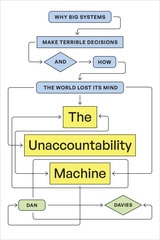
The Unaccountability Machine
Why Big Systems Make Terrible Decisions—and How the World Lost Its MindDan Davies
University of Chicago Press, 2025
Passengers get bumped from flights. Phone menus disconnect. Automated financial trades produce market collapse. Of all the challenges in modern life, some of the most vexing come from our relationships with automation: a large system does us wrong, and there’s nothing we can do about it.
The problem, economist Dan Davies shows, is accountability sinks: systems in which decisions are delegated to a complex rule book or set of standard procedures, making it impossible to identify the source of mistakes when they happen. In our increasingly unhuman world—lives dominated by algorithms, artificial intelligence, and large organizations—these accountability sinks produce more than just aggravation. They make life and economy unknowable—a black box for no reason.
In The Unaccountability Machine, Davies lays bare how markets, institutions, and even governments systematically generate outcomes that no one—not even those involved in making them—seems to want. Since the earliest days of the computer age, theorists have foreseen the dangers of complex systems without personal accountability. In response, British business scholar Stafford Beer developed an accountability-first approach to management called “cybernetics,” which might have taken off had his biggest client (the Chilean government) not fallen to a bloody coup in 1973.
With his signature blend of economic and journalistic rigor, Davies examines what’s gone wrong since Beer, including what might have been had the world embraced cybernetics when it had the chance. The Unaccountability Machine is a revelatory and resonant account of how modern life became predisposed to dysfunction.
Trust and Distrust In Organizations
Dilemmas and ApproachesRoderick M. Kramer
Russell Sage Foundation, 2004