Results by title
124 books match the query 'Information technology' and 29 start with t

Teaching Generation M
A Handbook for Librarians and EducatorsAmerican Library Association, 2009
Technology Disaster Response and Recovery Planning
A LITA GuideMary Mallery
American Library Association, 2015
Technology Training in Libraries
American Library Association, 2010
Technology for Results
American Library Association, 2005
Technology for Small and One-Person Libraries
A LITA GuideRene J. Erlandson
American Library Association, 2013
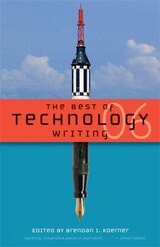
The Best of Technology Writing 2006
Brendan I. Koerner, Editor
University of Michigan Press, 2006
—James Fallows, National Correspondent for Atlantic Monthly
“The human experience is being shaped by our symbiotic relationship to technology. What makes this collection wonderful is that it’s not about the technology, per se, but it’s about this changing human experience. I will look forward to it every year.”
—Po Bronson, author of What Should I Do With My Life?
The Best of Technology Writing 2006 brings together some of the most important, timely, and just plain readable writing in the fast-paced, high-stakes field of technology. The first annual collection to target this vibrant and versatile area, The Best of Technology Writing 2006 features innovative work from an unusually diverse array of writers: best-selling authors, noted academics, and indie journalists and bloggers. The culmination of an open, on-line nominating process, this collection covers topics ranging from jetpacks, to the ethics of genetically cloned pets, to the meaning of life in the information age. By turns epic and intimate, serious and playful, The Best of Technology Writing 2006 captures the vitality, importance, and complexity of technology today. Koerner
Featuring contributions from:
digitalculturebooks is an imprint of the University of Michigan Press and the Scholarly Publishing Office of the University of Michigan Library dedicated to publishing innovative and accessible work exploring new media and their impact on society, culture, and scholarly communication. Visit the website at www.digitalculture.org.
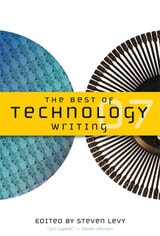
The Best of Technology Writing 2007
Steven Levy, Editor
University of Michigan Press, 2007
The year’s best writing on tech: a collection as imaginative and compelling as its dynamic subject
“This book is not just an illuminating and instructive guide to our high-tech frontier. It’s also a great testimony to the power of that most ancient of technologies, the written word.”
—Steven Johnson, author of Everything Bad is Good for You
Together the essays in The Best of Technology Writing 2007 capture the versatility and verve of technology writing today. Solicited through an open online nominating process, these pieces explore a wide range of intriguing topics—from “crowdsourcing” to the online habits of urban moms to the digital future of movie production. The Best of Technology Writing 2007 will appeal to anyone who enjoys stellar writing.
Steven Levy is a Senior Editor at Newsweek, where he writes the biweekly column “The Technologist.” One of the most acclaimed and versatile technology writers in the country, Levy has written six books, including The Perfect Thing (about Apple’s iPod) and Hackers, which PC Magazine’s readers voted the best sci-tech book written in the last twenty years. He has written for many publications, including the New Yorker, the New York Times Magazine, Rolling Stone, and Wired.
Featuring contributions from
Kevin Berger
Paul Boutin
Kiera Butler
Joshua Davis
Julian Dibbell
Matt Gaffney
Lori Gottlieb
John Gruber
Jeff Howe
Kevin Kelly
Jaron Lanier
Preston Lerner
Farhad Manjoo
Justin McElroy
Ben McGrath
Katharine Mieszkowski
Emily Nussbaum
Jeffrey M. O’Brien
Larry O’Brien
The Onion
Adam L. Penenberg
John Seabrook
Philip Smith
Aaron Swartz
Clive Thompson
Jeffrey R. Young
digitalculturebooks is an imprint of the University of Michigan Press and the Scholarly Publishing Office of the University of Michigan Library dedicated to publishing innovative and accessible work exploring new media and their impact on society, culture, and scholarly communication. Visit the website at www.digitalculture.org.
The Cybernetic Border
Drones, Technology, and IntrusionIván Chaar López
Duke University Press, 2024
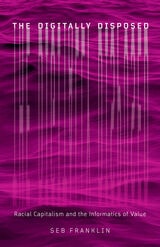
The Digitally Disposed
Racial Capitalism and the Informatics of ValueSeb Franklin
University of Minnesota Press, 2021
Locates the deep history of digitality in the development of racial capitalism
Seb Franklin sets out a media theory of racial capitalism to examine digitality’s racial-capitalist foundations. The Digitally Disposed shows how the promises of boundless connection, flexibility, and prosperity that are often associated with digital technologies are grounded in racialized histories of dispossession and exploitation. Reading archival and published material from the cybernetic sciences alongside nineteenth-century accounts of intellectual labor, twentieth-century sociometric experiments, and a range of literary and visual works, The Digitally Disposed locates the deep history of digitality in the development of racial capitalism.
Franklin makes the groundbreaking argument that capital’s apparently spontaneous synthesis of so-called free individuals into productive circuits represents an “informatics of value.” On the one hand, understanding value as an informatic relation helps to explain why capital was able to graft so seamlessly with digitality at a moment in which it required more granular and distributed control over labor—the moment that is often glossed as the age of logistics. On the other hand, because the informatics of value sort populations into positions of higher and lower capacity, value, and status, understanding their relationship to digitality requires that we see the digital as racialized and gendered in pervasive ways.
Ultimately, The Digitally Disposed questions the universalizing assumptions that are maintained, remade, and intensified by today’s dominant digital technologies. Vital and far-reaching, The Digitally Disposed reshapes such fundamental concepts as cybernetics, informatics, and digitality.
The Disaster Planning Handbook for Libraries
Mary Grace Flaherty
American Library Association, 2021
Your library is a vital information hub and resource provider every single day, and that’s doubly true when calamity strikes. In fact, your library’s role as an “essential community function” during disasters is now encoded in U.S. law. Engaging as a partner in planning and preparedness will build much-needed community support should disaster strike, and even a basic plan will also save you time and stress later on. No matter where your library is in the disaster planning cycle, this handbook will make the process clearer and less daunting. You’ll get tools, activities, easy-to-adapt templates, and hands-on guidance on such topics as
- the six phases of disaster response;
- 15 first-hand accounts of library disaster planning or responses, helping you identify the library services most needed during a disaster;
- three essential factors that will shape the form of your disaster plan;
- preparing for hurricanes, tornadoes, fires, floods, and earthquakes;
- ideas for connecting with your community’s emergency response teams;
- federal government planning resources;
- pointers on working with state and local governments;
- a sample Memorandum of Understanding to outline mutual support for a speedier recovery;
- recommended courses and training, many of which are free;
- targeted advice for archives and special collections;
- sample building inspection checklists; and
- recommended games to help children and families prepare.
The Economics of Attention
Style and Substance in the Age of InformationRichard A. Lanham
University of Chicago Press, 2006
With all the verve and erudition that have established his earlier books as classics, Richard A. Lanham here traces our epochal move from an economy of things and objects to an economy of attention. According to Lanham, the central commodity in our new age of information is not stuff but style, for style is what competes for our attention amidst the din and deluge of new media. In such a world, intellectual property will become more central to the economy than real property, while the arts and letters will grow to be more crucial than engineering, the physical sciences, and indeed economics as conventionally practiced. For Lanham, the arts and letters are the disciplines that study how human attention is allocated and how cultural capital is created and traded. In an economy of attention, style and substance change places. The new attention economy, therefore, will anoint a new set of moguls in the business world—not the CEOs or fund managers of yesteryear, but new masters of attention with a grounding in the humanities and liberal arts.
Lanham’s The Electronic Word was one of the earliest and most influential books on new electronic culture. The Economics of Attention builds on the best insights of that seminal book to map the new frontier that information technologies have created.
The Fight Against Platform Capitalism
An Inquiry into the Global Struggles of the Gig EconomyJamie Woodcock
University of Westminster Press, 2021
“The book rewards readers with interesting first-hand accounts of protests and pickets that are typically absent from academic discussions of the digital economy.” - https://blogs.lse.ac.uk/lsereviewofbooks/2021/03/17/book-review-the-fight-against-platform-capitalism-an-inquiry-into-the-global-struggles-of-the-gig-economy-by-jamie-woodcock/
So far, platform work has been an important laboratory for capital. Management techniques, like the use of algorithms, are being tested with a view to exporting across the global economy and it is argued that automation is undermining workers’ agency. Although the contractual trick of self-employment has allowed platforms to grow quickly and keep their costs down, yet it has also been the case also that workers have also found they can strike without following the existing regulations.
This book develops a critique of platforms and platform capitalism from the perspective of workers and contributes to the ongoing debates about the future of work and worker organising. It presents an alternative portrait returning to a focus on workers’ experience, focusing on solidarity, drawing out a global picture of new forms of agency. In particular, the book focuses on three dynamics that are driving struggles in the platform economy: the increasing connections between workers who are no longer isolated; the lack of communication and negotiation from platforms, leading to escalating worker action around shared issues; and the internationalisation of platforms, which has laid the basis for new transnational solidarity.
Focusing on transport and courier workers, online workers and freelancers author Jamie Woodcock concludes by considering how workers build power in different situations. Rather than undermining worker agency, platforms have instead provided the technical basis for the emergence of new global struggles against capitalism.
The Internet of Elsewhere
The Emergent Effects of a Wired WorldFarivar, Cyrus
Rutgers University Press, 2011
Through the lens of culture, The Internet of Elsewhere looks at the role of the Internet as a catalyst in transforming communications, politics, and economics. Cyrus Farivar explores the Internet's history and effects in four distinct and, to some, surprising societies—Iran, Estonia, South Korea, and Senegal. He profiles Web pioneers in these countries and, at the same time, surveys the environments in which they each work. After all, contends Farivar, despite California's great success in creating the Internet and spawning companies like Apple and Google, in some areas the United States is still years behind other nations.
Surprised? You won't be for long as Farivar proves there are reasons that:
- Skype was invented in Estonia—the same country that developed a digital ID system and e-voting;
- Iran was the first country in the world to arrest a blogger, in 2003;
- South Korea is the most wired country on the planet, with faster and less expensive broadband than anywhere in the United States;
- Senegal may be one of sub-Saharan Africa's best chances for greater Internet access.
The Internet of Elsewhere brings forth a new complex and modern understanding of how the Internet spreads globally, with both good and bad effects.
The Laws of Cool
Knowledge Work and the Culture of InformationAlan Liu
University of Chicago Press, 2004
The Mode of Information
Poststructuralism and Social ContextMark Poster
University of Chicago Press, 1990
The difference, Mark Poster argues, is the profound effect electronic mediation exerts on the very way we perceive ourselves and reality. To help decode the linguistic dimensions of our multiple forms of social interaction, he plays upon Marx's theory of the mode of production—the shift to late capitalism has a parallel in the shift from the mode of production to that of information.
Enlisting poststructuralist theory, he links four modes of communication with four poststructuralists: TV ads with Baudrillard, data bases with Foucault, electronic writing with Derrida, and computer science with Lyotard. Mode of Information points the way to a poststructuralist strategy for writing history, a framework well suited to unearthing structures of domination and the means to their disruption.
"An informed, insightful, provocative account of phenomena that have transformed virtually every area of public and private life on our time."—Robert Anchor, American Historical Review
"The importance of Poster's book is unmistakable for he skillfully negotiates between and juxtaposes two wide theoretical domains—electronically mediated communications and poststructuralist theory—about which much has been written, but hardly with the acumen that he brings to bear in a long-awaited critical rapprochement."—Charles J. Stivale, Criticism
The Neal-Schuman Library Technology Companion
A Basic Guide for Library StaffJohn J. Burke
American Library Association, 2013
The Neal-Schuman Technology Management Handbook for School Library Media Centers
American Library Association, 2010

The Other Side of the Digital
The Sacrificial Economy of New MediaAndrea Righi
University of Minnesota Press, 2021
A necessary, rich new examination of how the wired world affects our humanity
Our tech-fueled economy is often touted as a boon for the development of our fullest human potential. But as our interactions are increasingly turned into mountains of data sifted by algorithms, what impact does this infinite accumulation and circulation of information really have on us? What are the hidden mechanisms that drive our continuous engagement with the digital?
In The Other Side of the Digital, Andrea Righi argues that the Other of the digital acts as a new secular God, exerting its power through endless accountability that forces us to sacrifice ourselves for the digital. Righi deconstructs the contradictions inherent in our digital world, examining how ideas of knowledge, desire, writing, temporality, and the woman are being reconfigured by our sacrificial economy. His analyses include how both our self-image and our perception of reality are skewed by technologies like fitness bands, matchmaking apps, and search engines, among others.
The Other Side of the Digital provides a necessary, in-depth cultural analysis of how the political theology of the new media functions under neoliberalism. Drawing on the work of well-known thinkers like Jacques Derrida, Jacques Lacan, and Ludwig Wittgenstein, as well as Carla Lonzi, Luisa Muraro, and Luciano Parinetto, Righi creates novel appraisals of popular digital tools that we now use routinely to process life experiences. Asking why we must sign up for this sort of regime, The Other Side of the Digital is an important wake-up call to a world deeply entangled with the digital.
The Post-Global City
Theorizing Technology Cultures in Urban AfricaEditors: Katrien Pype, Omolade Adunbi and Michael M.J. Fischer
University of Michigan Press, 2026
The Post-Global City seeks to open a new field of analytical inquiry that examines knowledge production and technological developments in urban Africa rooted in local, historical realities, while also partaking in transnational, global processes. This work explores the ways in which urban residents have utilized technologies and networks to operate around, under, and beyond the state and the international “order,” and challenges the stereotypical images of Africa as a continent either devoid of technology or filled with either broken technologies or technologies from the Global North or Asia. This book focuses on accounts and critiques of new “Rising Africa” ideologies, examining megaprojects such as geothermal and hydroelectric plants with new networked startups that circumvent state and patriarchal hierarchies, women vendors selling online, youths designing and constructing oil refining technologies and tech startups working across diasporas.
Grounded in ethnographic fieldwork carried out in urban spaces in Nigeria, Kenya, the Democratic Republic of Congo, Sudan, Gabon, Cameroon, and Tanzania, The Post-Global City brings together voices from Africa, Europe, and the United States to inquire into the dialectics between technology and the urban on the African continent.
The Prison House of the Circuit
Politics of Control from Analog to DigitalJeremy Packer
University of Minnesota Press, 2023
Has society ceded its self-governance to technogovernance?
The Prison House of the Circuit presents a history of digital media using circuits and circuitry to understand how power operates in the contemporary era. Through the conceptual vocabulary of the circuit, it offers a provocative model for thinking about governance and media.
The authors, writing as a collective, provide a model for collective research and a genealogical framework that interrogates the rise of digital society through the lens of Foucault’s ideas of governance, circulation, and power. The book includes five in-depth case studies investigating the transition from analog media to electronic and digital forms: military telegraphy and human–machine incorporation, the establishment of national electronic biopolitical governance in World War I, media as the means of extending spatial and temporal policing, automobility as the mechanism uniting mobility and media, and visual augmentation from Middle Ages spectacles to digital heads-up displays. The Prison House of the Circuit ultimately demonstrates how contemporary media came to create frictionless circulation to maximize control, efficacy, and state power.
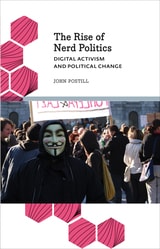
The Rise of Nerd Politics
Digital Activism and Political ChangeJohn Postill
Pluto Press, 2018
Drawing from long-term ethnographic research in Spain, Indonesia and Malaysia--as well as empirical examples from the United States, Iceland, Taiwan and further afield--Postill tracks the rise of technology "nerds" as a new transnational class of political brokers with growing influence. The book identifies and explores four domains of "nerd politics" that have experienced a dramatic expansion since 2010: digital rights, data activism, social protest, and institutional politics.
A lively and engaging intervention at the conjuncture of anthropology, media studies, and sociology, this book offers a pertinent reflection on the future of political change in the digital age.

The Structure of Scientific Articles
Applications to Citation Indexing and SummarizationSimone Teufel
CSLI, 2010
The Top Technologies Every Librarian Needs to Know
Kenneth J. Varnum
American Library Association, 2014
The Transformed Library
Jeannette Woodward
American Library Association, 2013
The Virtual Reference Service
From Competencies to Assessment - Neal-Schuman PublishersAmerican Library Association, 2008
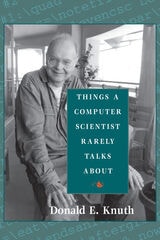
Things a Computer Scientist Rarely Talks About
Donald E. Knuth
CSLI, 2003
Perhaps no one is more qualified to address these questions than Donald E. Knuth, whose massive contributions to computing have led others to nickname him "The Father of Computer Science"—and whose religious faith led him to understand a fascinating analysis of the Bible called the 3:16 project. In this series of six spirited, informal lectures, Knuth explores the relationships between his vocation and his faith, revealing the unique perspective that his work with computing has lent to his understanding of God.
His starting point is the 3:16 project, an application of mathematical "random sampling" to the books of the Bible. The first lectures tell the story of the project's conception and execution, exploring its many dimensions of language translation, aesthetics, and theological history. Along the way, Knuth explains the many insights he gained from such interdisciplinary work. These theological musings culminate in a surprising final lecture tackling the ideas of infinity, free will, and some of the other big questions that lie at the juncture of theology and computation.
Things a Computer Scientist Rarely Talks About, with its charming and user-friendly format—each lecture ends with a question and answer exchange, and the book itself contains more than 100 illustrations—is a readable and intriguing approach to a crucial topic, certain to edify both those who are serious and curious about their faiths and those who look at the science of computation and wonder what it might teach them about their spiritual world.
Includes "Creativity, Spirituality, and Computer Science," a panel discussion featuring Harry Lewis, Guy L. Steele, Jr., Manuela Veloso, Donald E. Knuth, and Mitch Kapor.
Transient Images
Personal Media in Public FrameworksAuthored by Eric Freedman
Temple University Press, 2010
In this probing study, Eric Freedman focuses on what images from photography, mobile communications, and the Internet reveal about looking. Exploring subjectivity by critically examining the look, he elaborates on the nature of the photographic frame and its relation to interpretive practices. Freedman scrutinizes what he calls "technobiography"—a life written through technology, and considers the movement of personal images into public spaces. He also considers authorship that situates the self as inherently engaged with and inscribed by information technology.
All of the chapters in Transient Images explore Freedman's interest in examining how media technologies activate particular notions of self and community. He provides examples that address trauma—pictures of missing children on milk cartons and episodes of the reality series Intervention—as well as the strategies behind creating and distributing personal advertisements on the Internet. Transient Images draws out the tensions that exist in images circulating in the digital era.
Troubled IT Projects
Prevention and turnaroundJohn M. Smith
The Institution of Engineering and Technology, 2001

Tyranny of the Moment
Fast and Slow Time in the Information AgeThomas Hylland Eriksen
Pluto Press, 2001