Results by title
52 books match the query 'International trade' and 15 start with t

The Courts of International Trade
Judicial Specialization, Expertise, and Bureaucratic PolicymakingIsaac Unah
University of Michigan Press, 1998
This book will be of interest to scholars studying the judiciary, bureaucracies, and international trade law and administration.
Isaac Unah is Assistant Professor of Political Science, University of North Carolina.

The Fair Trade Revolution
Edited by John Bowes
Pluto Press, 2011
Fair Trade is now mainstream, with large companies like Cadbury's and supermarkets such as Sainsbury's producing and stocking many Fair Trade products. The authors of this collection, many of whom were responsible for the initial success of Fair Trade, emphasise the importance of ensuring that farmers and other producers remain the main beneficiaries. Punchy chapters, illustrated with many real-world examples, cover all the important issues including the tensions between large and small operators, the impact of recession, environmental policy and the danger of large operators embracing Fair Trade more in word than in practice.
Written by the leading lights of the Fair Trade movement, including Harriet Lamb (Executive Director of the Fairtrade Foundation) and Bruce Crowther (Establisher of the world's first Fair Trade Town) this book will inspire activists and consumers to keep making the right choices.

The Fair Trade Scandal
Marketing Poverty to Benefit the RichNdongo Sylla
Ohio University Press, 2014
This critical account of the fair trade movement explores the vast gap between the rhetoric of fair trade and its practical results for poor countries, particularly those of Africa. In the Global North, fair trade often is described as a revolutionary tool for transforming the lives of millions across the globe. The growth in sales for fair trade products has been dramatic in recent years, but most of the benefit has accrued to the already wealthy merchandisers at the top of the value chain rather than to the poor producers at the bottom.
Ndongo Sylla has worked for Fairtrade International and offers an insider’s view of how fair trade improves—or doesn’t—the lot of the world’s poorest. His methodological framework first describes the hypotheses on which the fair trade movement is grounded before going on to examine critically the claims made by its proponents. By distinguishing local impact from global impact, Sylla exposes the inequity built into the system and the resulting misallocation of the fair trade premium paid by consumers. The Fair Trade Scandal is an empirically based critique of both fair trade and traditional free trade; it is the more important for exploring the problems of both from the perspective of the peoples of the Global South, the ostensible beneficiaries of the fair trade system.
The Impact of International Trade on Wages
Edited by Robert C. Feenstra
University of Chicago Press, 2000
This collection brings together innovative new ideas and data sources in order to provide more satisfying alternatives to the trade versus technology debate and to assess directly the specific impact of international trade on U.S. wages. This timely volume offers a thorough appraisal of the wage distribution predicament, examining the continued effects of technology and globalization on the labor market.
The Liberal Illusion
Does Trade Promote Peace?Katherine Barbieri
University of Michigan Press, 2005
--Nils Petter Gleditsch, Journal of Peace Research
"Barbieri builds on a solid foundation of work on trade and conflict and specifies the conditions under which trade reduces and increases conflict. . . . The bottom line is that this is an important book in the study of trade and conflict because of its comprehensive approach."
--Kathy L. Powers, Perspectives on Politics
"Barbieri's analysis reveals the fundamental and intellectual weaknesses of the various arguments on this topic. [A] solid and timely contribution to the literature"
--Choice
The Liberal Illusion sheds light on an increasingly important question in international relations scholarship and the domain of policy making-whether international trade promotes peace. By examining a broad range of theories about trade's impact on interstate relations and undertaking a set of empirical analyses of the trade-conflict puzzle, Katherine Barbieri provides a comprehensive assessment of the liberal view that trade promotes peace. Barbieri's stunning conclusions depart from conventional wisdom in international relations. Consequently, The Liberal Illusion serves as an important counterargument and a warning call to policymakers who rely upon trade-based strategies to promote peace, strategies that appear to offer little hope of achieving their goals.
The Multilateral Trading System
Analysis and Options for ChangeRobert M. Stern, Editor
University of Michigan Press, 1993
The Post-Cold War Trading System
Who's on First?Sylvia Ostry
University of Chicago Press, 1997
With keen historical awareness, Ostry examines the role of key economic power brokers, particularly the United States, in the reconstruction and reconfiguration of an international economy after World War II. She argues that U.S. policy efforts were so successful that they led to an unprecedented renewal of economic growth, living standards, and education levels in postwar Europe and Japan. Ironically, those same policy successes unintentionally fostered the relative decline of U.S. dominance on the world trade scene as the reduction of trade and investment barriers prompted friction and conflict between different kinds of capitalist systems.
Identifying the historical and legal issues key to postwar trade policy, Ostry has commandingly charted our economic course through the last half of this century and, perhaps, into the next.
"Sylvia Ostry knows this subject as few others do, both as a scholar of international trade issues and a major player in the ongoing negotiations that have created the rules of the trade game. The Post-Cold War Trading System is a fine summary of where we've been and where we ought to be going."—Peter Passell, economic scene columnist for The New York Times
The Regionalization of the World Economy
Edited by Jeffrey A. Frankel
University of Chicago Press, 1997
Including both empirical and theoretical studies, this volume addresses several important questions: Why do countries adopt FTAs and other regional trading arrangements? To what extent have existing regional arrangements actually affected patterns of trade? What are the welfare effects of such arrangements? Several chapters explore the economic effects of regional arrangements on patterns of trade, either on price differentials or via the gravity model on bilateral trade flows. In addition, this book examines the theoretical foundation of the gravity model. Making extensive use of the gravity model of bilateral trade, several chapters explore the economic effects of regional arrangements. In addition, this book examines the theoretical foundation of the gravity model.
The Rules of the Global Game
A New Look at US International Economic PolicymakingKenneth W. Dam
University of Chicago Press, 2001
In The Rules of the Global Game, Dam first lays out what US international economic policies are and compares them to what they should be based on how they affect US per capita income. With this foundation in place, Dam then develops and applies principles for elucidating the major components of economic policy, such as foreign trade and investment, international monetary and financial systems, and current controversial issues, including intellectual property and immigration. Underlying his explanations is a belief in the importance of worldwide free trade and open markets as well as a crucial understanding of the political forces that shape decision making. Because economic policy is not created in a political vacuum, Dam argues, sound policymaking requires an understanding of "statecraft"-the creation and use of institutions that channel the efforts of interest groups and political forces in directions that encourage good economic outcomes.
Dam's vast experience with the politics and practicalities of economic policy translates into a view of policy that is neither academic nor abstract. Rather, Dam shows us how policy is actually made, who makes it, and why, using examples such as GATT, NAFTA, the US-Japan semiconductor agreement, and the Asian financial crisis. A rare book that can be read with pleasure and profit by layperson and economist alike, The Rules of the Global Game allows readers to understand the policies that shape our economy and our lives.
The Sugar Act and the American Revolution
Ken Shumate
Westholme Publishing, 2022
The Sugar Act and the American Revolution by Ken Shumate is the only book-length treatment of this first great challenge of the revolutionary era. For each of the three incarnations of the act, the author provides a clause-by-clause description, including the British reasoning behind the duties and trade restrictions, and a summary of the resulting American grievance. Following the explanation of each act are chapters describing the protests of American merchants and popular leaders, and the British response to those protests. As a consequence of further parliamentary acts of taxation, the story ends with the demand in 1774 by the First Continental Congress for Parliament to repeal the Sugar Act as being “essentially necessary in order to restore harmony between Great Britain and the American colonies.”
The WTO as an International Organization
Edited by Anne O. Krueger
University of Chicago Press, 1997
"[T]his book is a tour de force, with consistently fine papers by leading experts, and it is worthy of any bookshelf." —Joel P. Trachtman, American Journal of International Law
"This latest conference volume from the National Bureau of Economic Research is likely to be the definitive reference work on the WTO for years to come. . . . Specialists and non-specialists alike will gain a great deal from a careful reading of this impressive volume." —John Ravenhill, Australian Journal of Political Science
"For anyone who is interested in the further development of the rule system for the world economy, this book is a must." —Horst Siebert, Review of World Economics
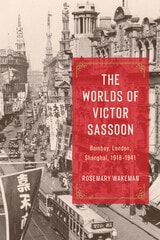
The Worlds of Victor Sassoon
Bombay, London, Shanghai, 1918–1941Rosemary Wakeman
University of Chicago Press, 2024
In this book, historian Rosemary Wakeman brings to life the frenzied, crowded streets, markets, ports, and banks of Bombay, London, and Shanghai. In the early twentieth century, these cities were at the forefront of the sweeping changes taking the world by storm as it entered an era of globalized commerce and the unprecedented circulation of goods, people, and ideas. Wakeman explores these cities and the world they helped transform through the life of Victor Sassoon, who in 1924 gained control of his powerful family’s trading and banking empire. She tracks his movements between these three cities as he grows his family’s fortune and transforms its holdings into a global juggernaut. Using his life as its point of entry, The Worlds of Victor Sassoon paints a broad portrait not just of wealth, cosmopolitanism, and leisure but also of the discrimination, exploitation, and violence wreaked by a world increasingly driven by the demands of capital.
Topics in Empirical International Economics
A Festschrift in Honor of Robert E. LipseyEdited by Magnus Blomström and Linda S. Goldberg
University of Chicago Press, 2001

Traders in a Brave New World
The Uruguay Round and the Future of the International Trading SystemErnest H. Preeg
University of Chicago Press, 1995
Preeg places the Uruguay Round in the broader context of global politics and economics, showing how changes in the world order—from the collapse of communism to dramatic economic reforms in developing countries—influenced both the topics of negotiations and their outcome. He then assesses the final GATT agreement as a case study in international negotiations and evaluates its probable effects on income and trade.
Finally, Preeg looks to the short- and long-term issues confronting future trade-policy negotiators. He shows that the international trade agenda will consist of three evolving types of agreement—further multilateral commitments, regional free-trade agreements, and selective bilateral accords. Going to the heart of current debates on the "new world order," an important final chapter evaluates the political and economic relationships that will result from the international trading system.
Tungsten in Peace and War, 1918–1946
Ronald H. Limbaugh
University of Nevada Press, 2011