Results by title
123 books match the query 'Internet' and 23 start with t
The Afterlife of Data
What Happens to Your Information When You Die and Why You Should CareCarl Öhman
University of Chicago Press, 2024
A short, thought-provoking book about what happens to our online identities after we die.
These days, so much of our lives takes place online—but what about our afterlives? Thanks to the digital trails that we leave behind, our identities can now be reconstructed after our death. In fact, AI technology is already enabling us to “interact” with the departed. Sooner than we think, the dead will outnumber the living on Facebook. In this thought-provoking book, Carl Öhman explores the increasingly urgent question of what we should do with all this data and whether our digital afterlives are really our own—and if not, who should have the right to decide what happens to our data.
The stakes could hardly be higher. In the next thirty years alone, about two billion people will die. Those of us who remain will inherit the digital remains of an entire generation of humanity—the first digital citizens. Whoever ends up controlling these archives will also effectively control future access to our collective digital past, and this power will have vast political consequences. The fate of our digital remains should be of concern to everyone—past, present, and future. Rising to these challenges, Öhman explains, will require a collective reshaping of our economic and technical systems to reflect more than just the monetary value of digital remains.
As we stand before a period of deep civilizational change, The Afterlife of Data will be an essential guide to understanding why and how we as a human race must gain control of our collective digital past—before it is too late.

The Cinema Dreams Its Rivals
Media Fantasy Films from Radio to the InternetPaul Young
University of Minnesota Press, 2006
Paul Young looks at the American cinema’s imaginative constructions of three electronic media—radio, television, and the Internet—at the times when these media seemed to hold limitless possibilities. In doing so, he demonstrates that Hollywood is indelibly marked by the advent of each new medium, from the inclusion of sound in motion pictures to the use of digital graphics. But conversely, Young argues, the identities of the new media are themselves changed as Hollywood turns them to its own purposes and its own dreams.
Paul Young is professor of English and director of the film studies program at Vanderbilt University.

The Economics of Privacy
Edited by Avi Goldfarb and Catherine E. Tucker
University of Chicago Press, 2024
A foundational new collection examining the mechanics of privacy in the digital age.
The falling costs of collecting, storing, and processing data have allowed firms and governments to improve their products and services, but have also created databases with detailed individual-level data that raise privacy concerns. This volume summarizes the research on the economics of privacy and identifies open questions on the value of privacy, the roles of property rights and markets for privacy and data, the relationship between privacy and inequality, and the political economy of privacy regulation.
Several themes emerge across the chapters. One is that it may not be possible to solve privacy concerns by creating a market for the right to privacy, even if property rights are well-defined and transaction costs are low. Another is that it is difficult to measure and value the benefits of privacy, particularly when individuals have an intrinsic preference for privacy. Most previous attempts at valuation have focused only on quantifiable economic outcomes, such as innovation. Finally, defining privacy through an economic lens is challenging. The broader academic and legal literature includes many distinct definitions of privacy, and different definitions may be appropriate in different contexts. The chapters explore a variety of frameworks for examining these questions and provide a range of new perspectives on the role of economics research in understanding the benefits and costs of privacy and of data flows. As the digital economy continues to expand the scope of economic theory and research, The Economics of Privacy provides the most comprehensive survey to date of this field and its next steps.
The Encyclopedia of Native Music
More Than a Century of Recordings from Wax Cylinder to the InternetBrian Wright-McLeod
University of Arizona Press, 2005
In addition to the widely heard sounds of Carlos Nakai’s flute, Native music embraces a wide range of forms: country and folk, jazz and swing, reggae and rap. Brian Wright-McLeod, producer/host of Canada’s longest-running Native radio program, has gathered the musicians and their music into this comprehensive reference, an authoritative source for biographies and discographies of hundreds of Native artists.
The Encyclopedia of Native Music recognizes the multifaceted contributions made by Native recording artists by tracing the history of their commercially released music. It provides an overview of the surprising abundance of recorded Native music while underlining its historical value.
With almost 1,800 entries spanning more than 100 years, this book leads readers from early performers of traditional songs like William Horncloud to artists of the new millennium such as Zotigh. Along the way, it includes entries for jazz and blues artists never widely acknowledged for their Native roots—Oscar Pettiford, Mildred Bailey, and Keely Smith—and traces the recording histories of contemporary performers like Rita Coolidge and Jimmy Carl Black, “the Indian of the group” in the original Mothers of Invention. It also includes film soundtracks and compilation albums that have been instrumental in bringing many artists to popular attention. In addition to music, it lists spoken-word recordings, including audio books, comedy, interviews, poetry, and more.
With this unprecedented breadth of coverage and extensively cross-referenced, The Encyclopedia of Native Music is an essential guide for enthusiasts and collectors. More than that, it is a gateway to the authentic music of North America—music of the people who have known this land from time immemorial and continue to celebrate it in sound.
The Hyperlinked Society
Questioning Connections in the Digital AgeJoseph Turow and Lokman Tsui, Editors
University of Michigan Press, 2008
"Links" are among the most basic---and most unexamined---features of online life. Bringing together a prominent array of thinkers from industry and the academy, The Hyperlinked Society addresses a provocative series of questions about the ways in which hyperlinks organize behavior online. How do media producers' considerations of links change the way they approach their work, and how do these considerations in turn affect the ways that audiences consume news and entertainment? What role do economic and political considerations play in information producers' creation of links? How do links shape the size and scope of the public sphere in the digital age? Are hyperlinks "bridging" mechanisms that encourage people to see beyond their personal beliefs to a broader and more diverse world? Or do they simply reinforce existing bonds by encouraging people to ignore social and political perspectives that conflict with their existing interests and beliefs?
This pathbreaking collection of essays will be valuable to anyone interested in the now taken for granted connections that structure communication, commerce, and civic discourse in the world of digital media.
"This collection provides a broad and deep examination of the social, political, and economic implications of the evolving, web-based media environment. The Hyperlinked Society will be a very useful contribution to the scholarly debate about the role of the internet in modern society, and especially about the interaction between the internet and other media systems in modern society."
---Charles Steinfield, Professor and Chairperson, Department of Telecommunication, Information Studies, and Media, Michigan State University
Joseph Turow is Robert Lewis Shayon Professor at the Annenberg School for Communication, University of Pennsylvania. He was named a Distinguished Scholar by the National Communication Association and a Fellow of the International Communication Association in 2010. He has authored eight books, edited five, and written more than 100 articles on mass media industries. His books include Niche Envy: Marketing Discrimination in the Digital Age and Breaking up America: Advertisers and the New Media World.
Lokman Tsui is a doctoral candidate at the Annenberg School for Communication, University of Pennsylvania. His research interests center on new media and global communication.
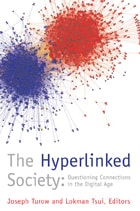
Cover image: This graph from Lada Adamic's chapter depicts the link structure of political blogs in the United States. The shapes reflect the blogs, and the colors of the shapes reflect political orientation---red for conservative blogs, blue for liberal ones. The size of each blog reflects the number of blogs that link to it.
digitalculturebooks is an imprint of the University of Michigan Press and the Scholarly Publishing Office of the University of Michigan Library dedicated to publishing innovative and accessible work exploring new media and their impact on society, culture, and scholarly communication. Visit the website at www.digitalculture.org.

The Idols of ISIS
From Assyria to the InternetAaron Tugendhaft
University of Chicago Press, 2020
Beginning with the Islamic State’s claim that the smashed objects were idols of the “age of ignorance,” Aaron Tugendhaft questions whether there can be any political life without idolatry. He then explores the various roles Mesopotamian sculpture has played in European imperial competition, the development of artistic modernism, and the formation of Iraqi national identity, showing how this history reverberates in the choice of the Mosul Museum as performance stage. Finally, he compares the Islamic State’s production of images to the ways in which images circulated in ancient Assyria and asks how digitization has transformed politics in the age of social media. An elegant and accessibly written introduction to the complexities of such events, The Idols of ISIS is ideal for students and readers seeking a richer cultural perspective than the media usually provides.
The Inattention Economy
How Women of Color Built the InternetLisa Nakamura
University of Minnesota Press, 2026
Revealing the unheralded contributions of women of color to the foundation and development of the digital economy
The Inattention Economy challenges the widespread myth that the internet was born from the labor of a handful of white male entrepreneurs, recovering the uncredited and unpaid contributions of women of color. Focusing on three key inflection points in computing—the microchip era of the 1960s and ’70s, the rise of social media in the 2000s, and A.I.-fueled virtual reality in the 2020s—Lisa Nakamura illuminates these women’s instrumental roles in building new technologies and making them coherent to users.
From the Navajo women who manufactured the first semiconductor circuits in New Mexico to Tila Tequila, the queer Vietnamese American refugee who became the first true internet influencer in the MySpace age, to Black virtual reality creators, Nakamura highlights how women’s gendered and racialized identities have uniquely positioned them to mediate the development and proliferation of new technologies. She exposes how these women have been structurally excluded from racial capitalism’s benefits while their labor is considered as exploitable and inexhaustible as that of machines. Confronting this injustice, she focuses our attention on their work, which undergirds and makes possible the platforms ingrained in our daily lives.
Arguing for both recognition and material compensation for these women’s labor, The Inattention Economy is a powerful counterhistory of Silicon Valley and a persuasive call to imagine a different kind of internet.
Retail e-book files for this title are screen-reader friendly with images accompanied by short alt text and/or extended descriptions.

The Internet Is for Cats
How Animal Images Shape Our Digital LivesJessica Maddox
Rutgers University Press, 2023
The Internet is for Cats examines how animal images are employed to create a lighter, more playful mood, uniting users within online spaces that can otherwise easily become fractious and toxic. Placing today’s pet videos, photos, and memes within a longer history of mediated animal images, communication scholar Jessica Maddox also considers the factors that make them unique. She explores the roles that animals play within online economies of cuteness and attention, as well as the ways that animal memes and videos respond to common experiences of life under neoliberalism.
Conducting a rich digital ethnography, Maddox combines observations and textual analysis with extensive interviews of the people who create, post and share animal media, including TikTok influencers seeking to make their pets famous, activists tweeting about wildlife conservation, and Redditors upvoting every cute cat photo. The Internet is for Cats will leave you with a new appreciation for the human social practices behind the animal images you encounter online.
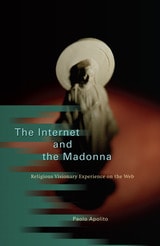
The Internet and the Madonna
Religious Visionary Experience on the WebPaolo Apolito
University of Chicago Press, 2005
But how has this potent new mix of technology and religiosity changed the way Catholics view their faith? And what challenges do the autonomous qualities of the Internet pose to the broader authority of Catholicism? Does the democratic nature of access to digital technologies constitute a return to a more archaic and mystical form of Catholicism that predates the modernizing reforms of the Second Vatican Council?
In working through these questions, Apolito considers visions of Mary on the Web over the past two decades, revealing a great deal about religion as it is now experienced through new information technologies. The Internet, he explains, has made possible a decentralized community of the devoted, even as it has absorbed God into the shifts and complexities of electronic circuitry. And this profound development in religious life will only accelerate as use of the Internet spreads around the world.
An indispensable guide to the future of Catholicism, The Internet and the Madonna offers a compelling glimpse into the spiritual life of the connected soul.
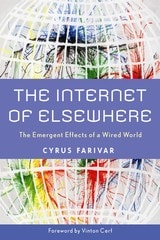
The Internet of Elsewhere
The Emergent Effects of a Wired WorldFarivar, Cyrus
Rutgers University Press, 2011
Through the lens of culture, The Internet of Elsewhere looks at the role of the Internet as a catalyst in transforming communications, politics, and economics. Cyrus Farivar explores the Internet's history and effects in four distinct and, to some, surprising societies—Iran, Estonia, South Korea, and Senegal. He profiles Web pioneers in these countries and, at the same time, surveys the environments in which they each work. After all, contends Farivar, despite California's great success in creating the Internet and spawning companies like Apple and Google, in some areas the United States is still years behind other nations.
Surprised? You won't be for long as Farivar proves there are reasons that:
- Skype was invented in Estonia—the same country that developed a digital ID system and e-voting;
- Iran was the first country in the world to arrest a blogger, in 2003;
- South Korea is the most wired country on the planet, with faster and less expensive broadband than anywhere in the United States;
- Senegal may be one of sub-Saharan Africa's best chances for greater Internet access.
The Internet of Elsewhere brings forth a new complex and modern understanding of how the Internet spreads globally, with both good and bad effects.

The Internet of Medical Things
Enabling technologies and emerging applicationsSubhendu Kumar Pani
The Institution of Engineering and Technology, 2022

The Labor of Care
Filipina Migrants and Transnational Families in the Digital AgeValerie Francisco-Menchavez
University of Illinois Press, 2018
The Laws of Cool
Knowledge Work and the Culture of InformationAlan Liu
University of Chicago Press, 2004

The Marvelous Clouds
Toward a Philosophy of Elemental MediaJohn Durham Peters
University of Chicago Press, 2015
When we speak of clouds these days, it is as likely that we mean data clouds or network clouds as cumulus or stratus. In their sharing of the term, both kinds of clouds reveal an essential truth: that the natural world and the technological world are not so distinct. In The Marvelous Clouds, John Durham Peters argues that though we often think of media as environments, the reverse is just as true—environments are media.
Peters defines media expansively as elements that compose the human world. Drawing from ideas implicit in media philosophy, Peters argues that media are more than carriers of messages: they are the very infrastructures combining nature and culture that allow human life to thrive. Through an encyclopedic array of examples from the oceans to the skies, The Marvelous Clouds reveals the long prehistory of so-called new media. Digital media, Peters argues, are an extension of early practices tied to the establishment of civilization such as mastering fire, building calendars, reading the stars, creating language, and establishing religions. New media do not take us into uncharted waters, but rather confront us with the deepest and oldest questions of society and ecology: how to manage the relations people have with themselves, others, and the natural world.
A wide-ranging meditation on the many means we have employed to cope with the struggles of existence—from navigation to farming, meteorology to Google—The Marvelous Clouds shows how media lie at the very heart of our interactions with the world around us. Peters’s book will not only change how we think about media but provide a new appreciation for the day-to-day foundations of life on earth that we so often take for granted.
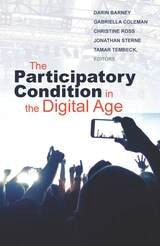
The Participatory Condition in the Digital Age
Darin Barney
University of Minnesota Press, 2016
Just what is the “participatory condition”? It is the situation in which taking part in something with others has become both environmental and normative. The fact that we have always participated does not mean we have always lived under the participatory condition. What is distinctive about the present is the extent to which the everyday social, economic, cultural, and political activities that comprise simply being in the world have been thematized and organized around the priority of participation.
Structured along four axes investigating the relations between participation and politics, surveillance, openness, and aesthetics, The Participatory Condition in the Digital Age comprises fifteen essays that explore the promises, possibilities, and failures of contemporary participatory media practices as related to power, Occupy Wall Street, the Arab Spring uprisings, worker-owned cooperatives for the post-Internet age; paradoxes of participation, media activism, open source projects; participatory civic life; commercial surveillance; contemporary art and design; and education.
This book represents the most comprehensive and transdisciplinary endeavor to date to examine the nature, place, and value of participation in the digital age. Just as in 1979, when Jean-François Lyotard proposed that “the postmodern condition” was characterized by the questioning of historical grand narratives, The Participatory Condition in the Digital Age investigates how participation has become a central preoccupation of our time.
Contributors: Mark Andrejevic, Pomona College; Bart Cammaerts, London School of Economics and Political Science (LSE); Nico Carpentier, Vrije Universiteit Brussel (VUB – Free University of Brussels) and Charles University in Prague; Julie E. Cohen, Georgetown University; Kate Crawford, MIT; Alessandro Delfanti, University of Toronto; Christina Dunbar-Hester, University of Southern California; Rudolf Frieling, California College of Arts and the San Francisco Art Institute; Salvatore Iaconesi, La Sapienza University of Rome and ISIA Design Florence; Jason Edward Lewis, Concordia University; Rafael Lozano-Hemmer; Graham Pullin, University of Dundee; Trebor Scholz, The New School in New York City; Cayley Sorochan, McGill University; Bernard Stiegler, Institute for Research and Innovation in Paris; Krzysztof Wodiczko, Harvard Graduate School of Design; Jillian C. York.
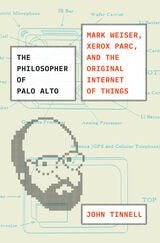
The Philosopher of Palo Alto
Mark Weiser, Xerox PARC, and the Original Internet of ThingsJohn Tinnell
University of Chicago Press, 2023
When developers and critics trace the roots of today’s Internet of Things—our smart gadgets and smart cities—they may single out the same creative source: Mark Weiser (1952–99), the first chief technology officer at Xerox PARC and the so-called “father of ubiquitous computing.” But Weiser, who died young at age 46 in 1999, would be heartbroken if he had lived to see the ways we use technology today. As John Tinnell shows in this thought-provoking narrative, Weiser was an outlier in Silicon Valley. A computer scientist whose first love was philosophy, he relished debates about the machine’s ultimate purpose. Good technology, Weiser argued, should not mine our experiences for saleable data or demand our attention; rather, it should quietly boost our intuition as we move through the world.
Informed by deep archival research and interviews with Weiser’s family and colleagues, The Philosopher of Palo Alto chronicles Weiser’s struggle to initiate a new era of computing. Working in the shadows of the dot-com boom, Weiser and his collaborators made Xerox PARC headquarters the site of a grand experiment. Throughout the building, they embedded software into all sorts of objects—coffeepots, pens, energy systems, ID badges—imbuing them with interactive features. Their push to integrate the digital and the physical soon caught on. Microsoft’s Bill Gates flagged Weiser’s Scientific American article “The Computer for the 21st Century” as a must-read. Yet, as more tech leaders warmed to his vision, Weiser grew alarmed about where they wished to take it.
In this fascinating story of an innovator and a big idea, Tinnell crafts a poignant and critical history of today’s Internet of Things. At the heart of the narrative is Weiser’s desire for deeper connection, which animated his life and inspired his notion of what technology at its best could be.
The Political Mapping of Cyberspace
Jeremy W. Crampton
University of Chicago Press, 2003
Using concepts and methods derived from the work of Michel Foucault, Crampton outlines a new mapping of cyberspace to help define the role of space in virtual worlds and to provide constructive ways in which humans can exist in another spatial dimension. He delineates the critical role maps play in constructing the medium as an object of knowledge and demonstrates that by processes of mapping we come to understand cyberspace. Maps, he argues, shape political thinking about cyberspace, and he deploys in-depth case studies of crime mapping, security maintenance, and geo-surveillance to show how we map ourselves onto cyberspace, inexorably, and indelibly.
Offering a powerful reinterpretation of technology and contemporary life, this innovative book will be an essential touchstone for the study of cartography and cyberspace in the twenty-first century.
The Real Cyber War
The Political Economy of Internet FreedomShawn M. Powers and Michael Jablonski
University of Illinois Press, 2015
Moving beyond debates on the democratic value of new and emerging information technologies, The Real Cyber War focuses on political, economic, and geopolitical factors driving internet freedom policies, in particular the U.S. State Department's emerging doctrine in support of a universal freedom to connect. They argue that efforts to create a universal internet built upon Western legal, political, and social preferences is driven by economic and geopolitical motivations rather than the humanitarian and democratic ideals that typically accompany related policy discourse. In fact, the freedom-to-connect movement is intertwined with broader efforts to structure global society in ways that favor American and Western cultures, economies, and governments.
Thought-provoking and far-seeing, The Real Cyber War reveals how internet policies and governance have emerged as critical sites of geopolitical contestation, with results certain to shape statecraft, diplomacy, and conflict in the twenty-first century.

The Rise of Nerd Politics
Digital Activism and Political ChangeJohn Postill
Pluto Press, 2018
Drawing from long-term ethnographic research in Spain, Indonesia and Malaysia--as well as empirical examples from the United States, Iceland, Taiwan and further afield--Postill tracks the rise of technology "nerds" as a new transnational class of political brokers with growing influence. The book identifies and explores four domains of "nerd politics" that have experienced a dramatic expansion since 2010: digital rights, data activism, social protest, and institutional politics.
A lively and engaging intervention at the conjuncture of anthropology, media studies, and sociology, this book offers a pertinent reflection on the future of political change in the digital age.
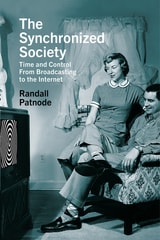
The Synchronized Society
Time and Control From Broadcasting to the InternetRandall Patnode
Rutgers University Press, 2023
The Synchronized Society traces the history of the synchronous broadcast experience of the twentieth century and the transition to the asynchronous media that dominate today. Broadcasting grew out of the latent desire by nineteenth-century industrialists, political thinkers, and social reformers to tame an unruly society by controlling how people used their time. The idea manifested itself in the form of the broadcast schedule, a managed flow of information and entertainment that required audiences to be in a particular place – usually the home – at a particular time and helped to create “water cooler” moments, as audiences reflected on their shared media texts. Audiences began disconnecting from the broadcast schedule at the end of the twentieth century, but promoters of social media and television services still kept audiences under control, replacing the schedule with surveillance of media use. Author Randall Patnode offers compelling new insights into the intermingled roles of broadcasting and industrial/post-industrial work and how Americans spend their time.

The Visibility Bind
Being Seen, Getting Paid, and Paying the Price of Social Media SuccessBrooke Erin Duffy
University of Chicago Press, 0
A revelatory look at the people, platforms, and power struggles shaping work in the creator economy.
More than two decades after YouTube first invited scrappy amateurs to “broadcast yourself,” social media content creation has transformed into one of the fastest growing labor markets. Today, some two hundred million people work as platform-dependent content creators, influencers, or streamers. Social media platforms boldly tout the rewards of the digital creator economy: independence, flexibility, and the chance to convert one’s ingenuity into cash. Yet the image of work in this entrepreneurial Promised Land conceals a starker reality—one marked by labor precarity, exploitation, and entrenched structural inequalities.
In this essential work, award-winning communication scholar Brooke Erin Duffy analyzes the paradox of the “visibility bind.” On the one hand, labor devaluation and algorithmic suppression—where unseen forces and so-called “shadowbans” bury worker output—threaten to render creators invisible. On the other, excessive visibility introduces harms of its own, from scrutiny and surveillance to networked harassment. For creators at the margins—among them, creators of color, LGBTQ+ voices, and disability advocates—the bind is especially pronounced, belying the promise of a talent meritocracy.
Drawing on extensive, in-depth interviews and more than a decade of insight, Duffy situates creators’ experiences within the broader landscapes of self-commodification and platform capitalism. But while platforms hold immense power to structure the pathways to success, creators and influencers wield newfound sway in this high-stakes visibility game. They are organizing, building solidarity, and experimenting with new forms of labor consciousness.
Refuting conventional wisdom about creator careers, Duffy illuminates the hidden labor dynamics for a class of workers shaping everything from culture and commerce to civil liberties and geopolitical conflict. The Visibility Bind reveals the price and perils for anyone who “puts themselves out there.”
Toward a Conceptual Framework for the Study of Folklore and the Internet
Trevor J. Blank
Utah State University Press, 2009
Utah State University Press’s Current Arguments in Folklore is a series of thought-provoking, short-form, digital publications made up of provocative original material and selections from foundational titles by leading thinkers in the field. Perfect for the folklore classroom as well as the professional collection, this series provides access to important introductory content as well as innovative new work intended to stimulate scholarly conversation.

Turntables and Tropes
A Rhetoric of RemixScott Haden Church
Michigan State University Press, 2022