Results by title
89 books match the query 'Interpersonal relations' and 17 start with t
TOKYO
Michael Mejia
University of Alabama Press, 2018
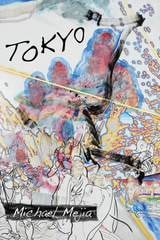
TOKYO is an incisive, shape-shifting tour de force, a genre-bending mix of lyric prose, science fiction, horror, and visual collage exploring the erotic undercurrents of American perceptions of Japanese culture and identity.
By turns noir, surreal, and clinical in its language and style, TOKYO employs metaphors of consumption, disease, theater, gender fluidity, monstrousness, and ecological disaster in intertwined accounts touching on matters of cultural appropriation, fiction's powerful capacity to produce immersive realities, and the culturally corrupting late capitalist excesses that entangle both the United States and Japan.
The novel opens with a fantastic, slyly comic report written by a Japanese executive, describing the anomalous bluefin tuna his company purchased at Tokyo’s iconic fish market, as well as the dissolution of the executive’s marriage to his Japanese-American, or Sansei, wife. But when an American writer—whose own Sansei wife was previously married to a Japanese executive—begins investigating the report’s author and his claims, assisted by a mysterious Japanese correspondent the American suspects may once have been his wife’s lover, identities begin to scramble until it’s uncertain who is imagining who, and who is and isn’t Japanese. Meanwhile, a secret plot to establish pure Japaneseness through the global distribution of genetically engineered bluefin tuna seems to be rushing toward its conclusion like a great wave.
Talk of Love
How Culture MattersAnn Swidler
University of Chicago Press, 2001
Tell Your Life Story
Creating Dialogue among Jews and Germans, Israelis and PalestiniansDan Bar-On
Central European University Press, 2006
The Affective Turn
Theorizing the SocialPatricia Ticineto Clough, ed.
Duke University Press, 2007
In the mid-1990s, scholars turned their attention toward the ways that ongoing political, economic, and cultural transformations were changing the realm of the social, specifically that aspect of it described by the notion of affect: pre-individual bodily forces, linked to autonomic responses, which augment or diminish a body’s capacity to act or engage with others. This “affective turn” and the new configurations of bodies, technology, and matter that it reveals, is the subject of this collection of essays. Scholars based in sociology, cultural studies, science studies, and women’s studies illuminate the movement in thought from a psychoanalytically informed criticism of subject identity, representation, and trauma to an engagement with information and affect; from a privileging of the organic body to an exploration of nonorganic life; and from the presumption of equilibrium-seeking closed systems to an engagement with the complexity of open systems under far-from-equilibrium conditions. Taken together, these essays suggest that attending to the affective turn is necessary to theorizing the social.
Contributors. Jamie “Skye” Bianco, Grace M. Cho, Patricia Ticineto Clough, Melissa Ditmore, Ariel Ducey, Deborah Gambs, Karen Wendy Gilbert, Greg Goldberg, Jean Halley, Hosu Kim, David Staples, Craig Willse , Elizabeth Wissinger , Jonathan R. Wynn
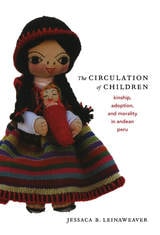
The Circulation of Children
Kinship, Adoption, and Morality in Andean PeruJessaca B. Leinaweaver
Duke University Press, 2008
Leinaweaver provides insight into the emotional and material factors that bring together and separate indigenous Andean families in the highland city of Ayacucho. She describes how child circulation is intimately linked to survival in the city, which has had to withstand colonialism, economic isolation, and the devastating civil war unleashed by the Shining Path. Leinaweaver examines the practice from the perspective of parents who send their children to live in other households, the adults who receive them, and the children themselves. She relates child circulation to international laws and norms regarding children’s rights, adoptions, and orphans, and to Peru’s history of racial conflict and violence. Given that history, Leinaweaver maintains that it is not surprising that child circulation, a practice associated with Peru’s impoverished indigenous community, is alternately ignored, tolerated, or condemned by the state.
The Color of Rock
A NovelSandra Cavallo Miller
University of Nevada Press, 2019
A young physician, Dr. Abby Wilmore, attempts to escape her past by starting over at the Grand Canyon Clinic. Silently battling her own health issues, Abby struggles with adjusting to the demands of this unique rural location. She encounters everything from squirrel bites to suicides to an office plagued by strong personalities. While tending to unprepared tourists, underserved locals, and her own mental trials, Abby finds herself entangled in an unexpected romance and trapped amidst a danger even more treacherous than the foreboding desert landscape.
Sandra Cavallo Miller’s debut novel transports readers to the beautiful depths of Arizona and weaves an adventurous and heartwarming tale of the courage and strength it takes to overcome personal demons and to find love.
The Deaf Heart
A NovelWilly Conley
Gallaudet University Press, 2015
At the hospital, Max has to contend with hearing doctors, nurses, scientists, and teachers. While struggling through the rigors of his residency and running into bad luck in meeting women, Max discovers an ally in his hearing housemate Zag, a fellow resident who is also vying for certification. Toward the end of his residency, Max meets Maddy, a Deaf woman who helps bring balance to his life.
Author Willy Conley’s stories, some humorous, some poignant, reveal Max’s struggles and triumphs as he attempts to succeed in the hearing world while at the same time navigating the multicultural and linguistic diversity within the Deaf world.
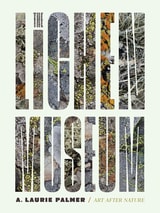
The Lichen Museum
Laurie A. Palmer
University of Minnesota Press, 2023
A radical proposal for how a tiny organism can transform our understanding of human relations
Serving as both a guide and companion publication to the conceptual art project of the same name, The Lichen Museum explores how the physiological characteristics of lichens provide a valuable template for reimagining human relations in an age of ecological and social precarity. Channeling between the personal, the scientific, the philosophical, and the poetic, A. Laurie Palmer employs a cross-disciplinary framework that artfully mirrors the collective relations of lichens, imploring us to envision alternative ways of living based on interdependence rather than individualism and competition.
Lichens are composite organisms made up of a fungus and an alga or cyanobacteria thriving in a mutually beneficial relationship. The Lichen Museum looks to these complex organisms, remarkable for their symbiosis, diversity, longevity, and adaptability, as models for relations rooted in collaboration and nonhierarchical structures. In their resistance to fast-paced growth and commodification, lichens also offer possibilities for humans to reconfigure their relationship to time and attention outside of the accelerated pace of capitalist accumulation.
Drawing together a diverse set of voices, including personal encounters with lichenologists and lichens themselves, Palmer both imagines and embodies a radical new approach to human interconnection. Using this tiny organism as an emblem through which to navigate environmental and social concerns, this work narrows the gap between the human and natural worlds, emphasizing the notion of mutual dependence as a necessary means of survival and prosperity.
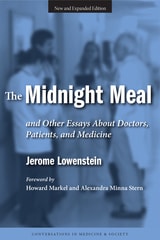
The Midnight Meal and Other Essays About Doctors, Patients, and Medicine
Jerome Lowenstein
University of Michigan Press, 2005
In this expanded edition, an accomplished physician and teacher of medicine discusses the importance of being a caring doctor, especially now that the focus of medicine is increasingly on technological innovation and health care costs.
With wisdom and compassion, Dr. Jerome Lowenstein tells stories about relationships between medical students and their teachers, physicians and their patients. He reflects on what doctors learn from treating chronic illness; how they respond to patients' needs for reassurance; how they bear the burden of treating patients with life-threatening or degenerative disease; whether the distinction between traditional and "alternative" medical treatment is ultimately beneficial or destructive; and many other issues. Dr. Lowenstein's ruminations on humanistic approaches to learning and practicing medicine will be treasured by physicians, medical students, and patients alike.
The Power of Forgiving
Everett L. Worthington Jr.
Templeton Press, 2005
Forgiveness is a virtue that author Everett L.Worthington Jr. has advocated throughout his career as a counselor and psychologist. In this book, he explains the paradoxical power of forgiveness through his personal and professional experiences andthrough the wisdom of others. The paradox is that in forgiving for the well-being of others, we actually receive tremendous benefits for ourselves in terms of physical and mental health.
This book treats forgiveness as a quest to find the treasure of restored relationships, personal peace, and even health, which has often become buried in relational harms, betrayals, and injustices. Worthington shows how one begins the quest, prepares the self for the rigors of the search, and makes the journey.
In the process, he describes the resources and supports needed. He also discusses how enemies can continue to betray and how unruly angry emotions can arise but can be tamed by forgiving. Worthington shows readers the map to forgiveness using methods such as his time-tested and research-supported method of REACH, a five-step process of forgiving.
The Power of Forgiving will inspire people to use forgiveness. It will show how forgiving is a transforming process that will enrich relationships and empower people to improve their own lives.
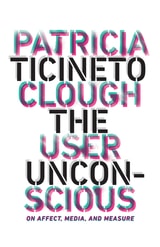
The User Unconscious
On Affect, Media, and MeasurePatricia Ticineto Clough
University of Minnesota Press, 2018
Wide-ranging essays and experimental prose forcefully demonstrate how digital media and computational technologies have redefined what it is to be human
Over the past decade, digital media has expanded exponentially, becoming an essential part of daily life. The stimulating essays and experimental compositions in The User Unconscious delve into the ways digital media and computational technologies fundamentally affect our sense of self and the world we live in, from both human and other-than-human perspectives.
Critical theorist Patricia Ticineto Clough’s provocative essays center around the motif of the “user unconscious” to advance the challenging thesis that that we are both human and other-than-human: we now live, think, and dream within multiple layers of computational networks that are constantly present, radically transforming subjectivity, sociality, and unconscious processes.
Drawing together rising strains of philosophy, critical theory, and media studies, as well as the political, social, and economic transformations that are shaping the twenty-first-century world, The User Unconscious points toward emergent crises and potentialities in both human subjectivity and sociality. Moving from affect to data, Clough forces us to see that digital media and computational technologies are not merely controlling us—they have already altered what it means to be human.

The Web of Violence
From Interpersonal to GlobalEdited by Jennifer Turpin and Lester Kurtz
University of Illinois Press, 1996
Violence is a topic of concern everywhere--in the media, in churches, in the halls of governments. In every land and in every culture violence is considered by most to be taboo, a last resort. Yet under certain conditions, from the level of the family to the level of nations, violence is used as a mechanism of social control. Various rationalizations thus emerge to distinguish between legitimate and illegitimate violence.
The Web of Violence explores the interrelationship among personal, collective, national, and global levels of violence. This unique collection brings together a number of internationally known contributors to address the genesis and manifestations of violence in the search for a remedy for this confounding social problem.
As the global community becomes more intimate, we must better understand the nature of violence. The Web of Violence supports this aim by examining the dangerous human phenomenon from many perspectives, at different levels, and using multiple methodologies.
Contributors: Robert Jay Lifton, Christopher G. Ellison, John P. Bartkowski, Yuan-Horng Chu, Philip Smith, Robert Elias, Birgit Brock-Utne, Riane Eisler, Johan Galtung
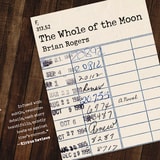
The Whole of the Moon
A NovelBrian Rogers
University of Nevada Press, 2017
An actor sits poolside waiting to hear whether he has been cast in a television pilot. Two kids ditch school in 1964 and go for a hike in the woods that turns dangerous. A woman named Dot remembers her husband who spent years working on a musical adaptation of The Great Gatsby. A young woman Felicity deals with the consequences of an unexpected pregnancy. Mike, a former high school star, attends an open tryout for the California Angels baseball team. And a boarding school teacher tells the story of his cousin, a social climber who has disappeared in the wake of a murder. These are the characters that populate The Whole of the Moon. Brian Rogers’ novel is about determination and failure and life in Southern California away from the red carpet.

There Is Only Us
Zoe Ballering
University of North Texas Press, 2022

Took House
Lauren Camp
Tupelo Press, 2020
Trust and Trustworthiness
Russell Hardin
Russell Sage Foundation, 2002
Trust in Society
Karen Cook
Russell Sage Foundation, 2001