Results by title
73 books match the query 'Jazz musicians' and 10 start with t
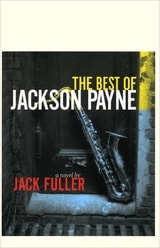
The Best of Jackson Payne
A NovelJack Fuller
University of Chicago Press, 2001
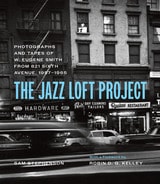
The Jazz Loft Project
Photographs and Tapes of W. Eugene Smith from 821 Sixth Avenue, 1957–1965W. Eugene Smith and Sam Stephenson
University of Chicago Press, 2023
In 1957, Eugene Smith walked away from his longtime job at Life and the home he shared with his wife and four children to move into a dilapidated, five-story loft building at 821 Sixth Avenue in New York City’s wholesale flower district. The loft was the late-night haunt of musicians, including some of the biggest names in jazz—Charles Mingus, Zoot Sims, Bill Evans, and Thelonious Monk among them. Here, from 1957 to 1965, he made nearly 40,000 photographs and approximately 4,000 hours of recordings of musicians. Smith found solace in the chaotic, somnambulistic world of the loft and its artists, and he turned his documentary impulses away from work on his major Pittsburg photo essay and toward his new surroundings.
Smith’s Jazz Loft Project has been legendary in the worlds of art, photography, and music for more than forty years, but until the publication of this book, no one had seen his extraordinary photographs or read any of the firsthand accounts of those who were there and lived to tell the tales.
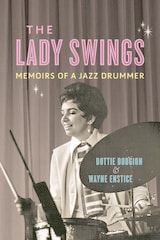
The Lady Swings
Memoirs of a Jazz DrummerDottie Dodgion and Wayne Enstice
University of Illinois Press, 2021
Vivid and always entertaining, The Lady Swings tells Dottie Dodgion's story with the same verve and straight-ahead honesty that powered her playing.
A Variety Best Music Book of 2021
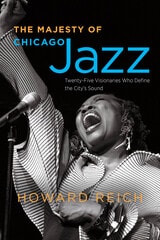
The Majesty of Chicago Jazz
Twenty-Five Visionaries Who Define the City's SoundHoward Reich
University of Chicago Press, 2026
The first book to trace the vast influence of Chicago jazz from its origins to today—from Louis Armstrong and Jelly Roll Morton to Anita O’Day, Herbie Hancock, and the AACM.
Author and Chicago native Howard Reich gives readers a front-row seat to the history of Chicago jazz as it roared forth in jazz clubs, concert halls, and festivals. Reich covered Chicago jazz for more than thirty years as the Chicago Tribune’s staff critic, and in this collection, he argues that jazz as an art form is inconceivable without Chicago. Carefully choosing from among his thousands of articles on jazz, Reich highlights twenty-five of the most important Chicago jazz artists who pushed the art form forward.
The Majesty of Chicago Jazz begins with two New Orleans visionaries who achieved their artistic pinnacles in Chicago in the Roaring Twenties: Jelly Roll Morton and Louis Armstrong. In the decades that followed, Chicago produced an uninterrupted line of innovators: revolutionaries Ahmad Jamal and Sun Ra, iconoclasts Von Freeman and Fred Anderson, populists Herbie Hancock and Ramsey Lewis, chameleons Patricia Barber and Kurt Elling, and the breakthrough band of the Association for the Advancement of Creative Musicians (AACM), among others. Reich offers two pieces on each of the book’s twenty-five visionaries, including profiles, reviews, appreciations, and obituaries. The book concludes with a beginner-friendly discography, perfect for those looking to listen along.
The Majesty of Chicago Jazz is captivating for jazz newcomers and aficionados alike—all are guaranteed to learn something surprising here. With a musician’s ear and a journalist’s expertise, Reich offers listeners a valuable guide to the groundbreaking jazz that has come out of Chicago, a city that remains a fertile breeding ground for musical experimentation.
The Miles Davis Lost Quintet and Other Revolutionary Ensembles
Bob Gluck
University of Chicago Press, 2015
Gluck listens deeply to the uneasy tension between this group’s driving rhythmic groove and the sonic and structural openness, surprise, and experimentation they were always pushing toward. There he hears—and outlines—a fascinating web of musical interconnection that brings Davis’s funk-inflected sensibilities into conversation with the avant-garde worlds that players like Ornette Coleman and John Coltrane were developing. Going on to analyze the little-known experimental groups Circle and the Revolutionary Ensemble, Gluck traces deep resonances across a commercial gap between the celebrity Miles Davis and his less famous but profoundly innovative peers. The result is a deeply attuned look at a pivotal moment when once-disparate worlds of American music came together in explosively creative combinations.
The Song of the Hawk
The Life and Recordings of Coleman HawkinsJohn Chilton
University of Michigan Press, 1993
The View from the Back of the Band
Chris Smith
University of North Texas Press, 2014
Thinking in Jazz
The Infinite Art of ImprovisationPaul F. Berliner
University of Chicago Press, 1994
The product of more than fifteen years of immersion in the jazz world, Thinking in Jazz combines participant observation with detailed musicological analysis, the author's experience as a jazz trumpeter, interpretations of published material by scholars and performers, and, above all, original data from interviews with more than fifty professional musicians: bassists George Duvivier and Rufus Reid; drummers Max Roach, Ronald Shannon Jackson, and Akira Tana; guitarist Emily Remler; pianists Tommy Flanagan and Barry Harris; saxophonists Lou Donaldson, Lee Konitz, and James Moody; trombonist Curtis Fuller; trumpeters Doc Cheatham, Art Farmer, Wynton Marsalis, and Red Rodney; vocalists Carmen Lundy and Vea Williams; and others. Together, the interviews provide insight into the production of jazz by great artists like Betty Carter, Miles Davis, Dizzy Gillespie, Coleman Hawkins, and Charlie Parker.
Thinking in Jazz overflows with musical examples from the 1920s to the present, including original transcriptions (keyed to commercial recordings) of collective improvisations by Miles Davis's and John Coltrane's groups. These transcriptions provide additional insight into the structure and creativity of jazz improvisation and represent a remarkable resource for jazz musicians as well as students and educators.
Berliner explores the alternative ways—aural, visual, kinetic, verbal, emotional, theoretical, associative—in which these performers conceptualize their music and describes the delicate interplay of soloist and ensemble in collective improvisation. Berliner's skillful integration of data concerning musical development, the rigorous practice and thought artists devote to jazz outside of performance, and the complexities of composing in the moment leads to a new understanding of jazz improvisation as a language, an aesthetic, and a tradition. This unprecedented journey to the heart of the jazz tradition will fascinate and enlighten musicians, musicologists, and jazz fans alike.
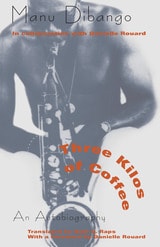
Three Kilos of Coffee
An AutobiographyManu Dibango and Danielle Rouard
University of Chicago Press, 1994
Composer, producer, performer, film score writer and humanitarian for the poor, Manu Dibango defines the "African sound" of modern world music. He has worked with and influenced such artists as Art Blakey, Don Cherry, Herbie Hancock, Harry Belafonte, Paul Simon, and Johnny Clegg. In Africa, he has helped younger musicians, performed benefit concerts, and transcribed for the first time the scores and lyrics of African musicians.
The product of a "mixed marriage" (of different tribes and religions) who owes allegiances to both Africa and Europe, Dibango has always been aware of the ambiguities of his identity. This awareness has informed all of the important events of his life, from his marriage to a white Frenchwoman in 1957, to his creation of an "Afro-music" which joyfully blends blues, jazz, reggae, traditional European and African serenades, highlife, Caribbean and Arabic music. This music addresses the meaning of "Africanness" and what it means to be a Black artist and citizen of the world.
This lively and thoughtful memoir is based on an extensive set of interviews in 1989 with French journalist Danielle Rouard. Richly illustrated with photographs, this book will be a must for readers of jazz biographies, students of African music and ethnomusicology, and all those who are lovers of Manu Dibango's unique artistry and accomplishments.

Times Remembered
The Final Years of the Bill Evans TrioJoe La Barbera
University of North Texas Press, 2021