Results by title
56 books match the query 'Judicial Branch' and 17 start with t
The American Supreme Court, Sixth Edition
Robert G. McCloskey and Sanford Levinson
University of Chicago Press, 2016
As in prior editions, McCloskey’s original text remains unchanged. In his historical interpretation, he argues that the strength of the Court has always been its sensitivity to the changing political scene, as well as its reluctance to stray too far from the main currents of public sentiment. In this new edition, Sanford Levinson extends McCloskey’s magisterial treatment to address developments since the 2010 election, including the Supreme Court’s decisions regarding the Defense of Marriage Act, the Affordable Care Act, and gay marriage.
The best and most concise account of the Supreme Court and its place in American politics, McCloskey's wonderfully readable book is an essential guide to the past, present, and future prospects of this institution.
The American Supreme Court, Sixth Edition
Robert G. McCloskey and Sanford Levinson
University of Chicago Press, 2016
For more than fifty years, Robert G. McCloskey’s classic work on the Supreme Court’s role in constructing the US Constitution has introduced generations of students to the workings of our nation’s highest court.
As in prior editions, McCloskey’s original text remains unchanged. In his historical interpretation, he argues that the strength of the Court has always been its sensitivity to the changing political scene, as well as its reluctance to stray too far from the main currents of public sentiment. In this new edition, Sanford Levinson extends McCloskey’s magisterial treatment to address developments since the 2010 election, including the Supreme Court’s decisions regarding the Defense of Marriage Act, the Affordable Care Act, and gay marriage.
The best and most concise account of the Supreme Court and its place in American politics, McCloskey's wonderfully readable book is an essential guide to the past, present, and future prospects of this institution.
The American Supreme Court
Fifth EditionRobert G. McCloskey
University of Chicago Press, 2010
Celebrating its fiftieth anniversary, Robert McCloskey’s classic work on the Supreme Court’s role in constructing the U.S. Constitution has introduced generations of students to the workings of our nation’s highest court. For this new fifth edition, Sanford Levinson extends McCloskey’s magisterial treatment to address the Court’s most recent decisions.
As in prior editions, McCloskey’s original text remains unchanged. In his historical interpretation, he argues that the strength of the Court has always been its sensitivity to the changing political scene, as well as its reluctance to stray too far from the main currents of public sentiments. In two revised chapters, Levinson shows how McCloskey’s approach continues to illuminate developments since 2005, including the Court’s decisions in cases arising out of the War on Terror, which range from issues of civil liberty to tests of executive power. He also discusses the Court’s skepticism regarding campaign finance regulation; its affirmation of the right to bear arms; and the increasingly important nomination and confirmation process of Supreme Court justices, including that of the first Hispanic justice, Sonia Sotomayor.
The best and most concise account of the Supreme Court and its place in American politics, McCloskey's wonderfully readable book is an essential guide to the past, present, and future prospects of this institution.
The Assault on American Labor Law
Unions Before the Supreme Court, 1965–2025Roger C. Hartley
University of Massachusetts Press, 2025
Reviewing the dismantling of American labor law in more than 100 Supreme Court cases
The National Labor Relations Act (NLRA), signed into law by Franklin Delano Roosevelt in 1935, guarantees the right of private sector employees to organize into trade unions, engage in collective bargaining, and take collective action such as strikes. Since its passage, the NLRA has functioned as the foundational statute of United States labor law. Opposed by conservatives and members of the Republican Party from the beginning, its provisions were largely upheld by the Supreme Court until the 1960s. In the latter part of the twentieth century and into the twenty-first, however, the Court began to erode the protections of the NLRA. While some cases have received widespread attention from commentators and scholars, such as Starbucks Corp. v. McKinney (2024), there have been numerous detrimental rulings that are little discussed. Taken as a whole, the Supreme Court’s efforts to undermine the NLRA appear sustained and systematic.
In The Assault on American Labor Law, distinguished labor law professor Roger C. Hartley collects and carefully reviews every Supreme Court decision concerning the NLRA over the past sixty years. By examining approximately 100 cases, Hartley demonstrates that the Court has often operated more like a legislature than a judicial body, effectively amending the NLRA’s collectivist policy underpinnings in favor of the interests of individuals and businesses. These judicial decisions create staggering obstacles for American workers to collectively organize and force them to face globalization, deindustrialization, and technological change individually, without the negotiating leverage provided by union representation. While scholars have suggested individual reforms to re-establish the efficacy of the NLRA, Hartley’s thorough study illuminates how the current crisis in US labor law evolved—a comprehensive view that is necessary to help restore the rights of workers to unionize.
The Chief Justice
Appointment and InfluenceDavid J. Danelski and Artemus Ward, editors
University of Michigan Press, 2016
The Common Flaw
Needless Complexity in the Courts and 50 Ways to Reduce ItThomas Moukawsher
Brandeis University Press, 2023
Americans are losing faith in their courts. After long delays, judges often get rid of cases for technical reasons, or force litigants to settle rather than issue a decision. When they do decide cases, we can't understand why.
The Common Flaw seeks to rid the American lawsuit of this needless complexity. The book proposes fifty changes from the filing of a complaint in court to the drafting of appellate decisions to replace the legal system’s formalism with a kind of humanism. Thomas G. Moukawsher calls for courts that decide cases promptly based more on the facts than the law, that prioritize the parties involved over lawyers, that consider the consequences for the people and the public, and that use words we can all understand. Sure to spark an important conversation about court reform, The Common Flaw makes the case for a more effective and credible legal system with warmth and humor, incorporating cartoons alongside insightful reflection.
The Court vs. Congress
Prayer, Busing, and AbortionEdward Keynes and Randall Miller
Duke University Press, 1989
Edward Keynes and Randall Miller argue that Congress lacks the constitutional power to legislate away the powers of the federal courts and to prevent individuals from seeking redress for presumed infringements of their constitutional rights in these areas. They demonstrate that neither the framers nor ratifiers of the Constitution intended the Congress to exercise plenary power over the appellate jurisdiction of the Supreme Court. Throughout its history the Court has never conceded unlimited powers to Congress; and until the late 1950s Congress had not attempted to gerrymander the Court’s jurisdiction in response to specific decisions. But the authors contend this is just what the sponsors of recent legislative attacks on the Court intend, and they see such efforts as threatening the Court’s independence and authority as defined in the separation of powers clauses of the Constitution.
The Cult Of The Court
John Brigham
Temple University Press, 1991
In recent years widespread attention has been focused on decisions handed down by the Supreme Court that grapple with passionate issues: integration, school prayer, abortion, affirmative action. The appointment of new justices is a highly charged political event although the Court is supposed to be "above" politics. Amidst the bicentennial celebration of the Constitution and almost daily reports of major confrontations awaiting the highest court’s judicial review, John Brigham presents a fresh and innovative examination of the U.S. Supreme Court as the final arbiter of constitutional interpretation.
Drawing on philosophy and anthropology, The Cult of the Court offers a social scientific investigation of an institution whose authority has come to be taken for granted. The author emphasizes that the Court is an institution and that its authority is founded less in the claim of legal expertise than in hierarchical finality—the assertion of political will, not of legal judgment. He shows how the Court has supplanted the Constitution as the authority in our political world and that what makes legal "sense" is affected by these factors of institutionalization, bureaucratization, and court-dominated constitutionalism.
The Judicial Power of the Purse
How Courts Fund National Defense in Times of CrisisNancy Staudt
University of Chicago Press, 2011
Congress and the president are not the only branches that deal with fiscal issues in times of war. In this innovative book, Nancy Staudt focuses on the role of federal courts in fiscal matters during warfare and high-cost national defense emergencies. There is, she argues, a judicial power of the purse that becomes evident upon examining the budgetary effects of judicial decision making. The book provides substantial evidence that judges are willing—maybe even eager—to redirect private monies into government hands when the country is in peril, but when the judges receive convincing cues that ongoing wartime activities undermine the nation’s interests, they are more likely to withhold funds from the government by deciding cases in favor of private individuals and entities who show up in court.
In stark contrast with conventional legal, political, and institutional thought that privileges factors associated with individual preferences, The Judicial Power of the Purse sheds light on environmental factors in judicial decision making and will be an excellent read for students of judicial behavior in political science and law.
The Limits of Legitimacy
Dissenting Opinions, Media Coverage, and Public Responses to Supreme Court DecisionsMichael A. Zilis
University of Michigan Press, 2015
Zilis finds that the media tends not to quote from majority opinions. However, the greater the division over a particular ruling among the justices themselves, the greater the likelihood that the media will criticize that ruling, characterize it as "activist," and employ inflammatory rhetoric. Hethen demonstrates that the media’s portrayal of a decision, as much as the substance of the decision itself, influences citizens’ reactions to and acceptance of it.
This meticulously constructed study and its persuasively argued conclusion advance the understanding of the media, judicial politics, political institutions, and political behavior.

The Presidency in the Courts
Glendon A. Schubert, Jr.
University of Minnesota Press, 1957
The Presidency in the Courts was first published in 1957. Minnesota Archive Editions uses digital technology to make long-unavailable books once again accessible, and are published unaltered from the original University of Minnesota Press editions.
Do the American courts restrain the President from committing illegal and unconstitutional acts? If so, how? These are the fundamental questions which are answered here through a systematic and comprehensive analysis of the opinions and decisions of the courts themselves. As Clinton Rossiter, author of "The American Presidency," points out, "Too many books on the Presidency deal with the powers of this great office, too few with the restraints that fix its place in our system of government. Students of the system will be grateful to Professor Schubert for this tough-minded, even-tempered, exhaustive study of a neglected aspect of the Presidency."
Professor Schubert analyzes hundreds of judicial cases, both federal and state, involving challenges to the legality of presidential action. The period covered is the entire lifetime of the republic and the material is arranged according to the President's major institutional roles, those of chief administrator, chief of state, commander in chief, and chief magistrate.
There are chapters on presidential management of public personnel and the public domain, his control of foreign relations and the tariff, his military powers, enemy aliens, the presidential seizure power and other emergency powers, legal sources of presidential power, due process in presidential lawmaking, and the scope of judicial review of presidential action. Both the theory and practice of presidential rule making and adjudication are examined in detail.
The book, the first of its kind, reveals how far from actuality are the generally held beliefs regarding the power of the courts versus the power of the Presidency. The significance of such a study is readily apparent in view of the fact that the fate not only of the United States but of Western civilization will hang in the balance of the President's exercise of his official powers during the next decade.
The Prohibition Era and Policing
A Legacy of MisregulationWesley M. Oliver
Vanderbilt University Press, 2018
Intrusive searches for alcohol during Prohibition destroyed middle-class Americans' faith in police and ushered in a new basis for controlling police conduct. State courts in the 1920s began to exclude perfectly reliable evidence obtained in an illegal search. Then, as Prohibition drew to a close, a presidential commission awakened the public to torture in interrogation rooms, prompting courts to exclude coerced confessions irrespective of whether the technique had produced a reliable statement.
Prohibition's scheme lingered long past the Roaring '20s. Racial tensions and police brutality were bigger concerns in the 1960s than illegal searches, yet when the Supreme Court imposed limits on officers' conduct in 1961, searches alone were regulated. Interrogation law during the 1960s, fundamentally reshaped by the Miranda ruling, ensured that suspects who invoked their rights would not be subject to coercive tactics, but did nothing to ensure reliable confessions by those who were questioned. Explicitly recognizing that its decisions excluding evidence had not been well-received, the Court in the 1970s refused to exclude identifications merely because they were made in suggestive lineups. Perhaps a larger project awaits—refocusing our rules of criminal procedure on those concerns from which Prohibition distracted us: conviction accuracy and the use of force by police.
The Supreme Court and the NCAA
The Case for Less Commercialism and More Due Process in College SportsBrian L. Porto
University of Michigan Press, 2013
Two Supreme Court decisions, NCAA v. Board of Regents (1984) and NCAA v. Tarkanian (1988), have shaped college sports by permitting the emergence of a supercharged commercial enterprise with high financial stakes for institutions and individuals, while failing to guarantee adequate procedural protections for persons charged with wrongdoing within that enterprise. Brian L. Porto examines the conditions that led to the cases, the reasoning behind the justices' rulings, and the consequences of those rulings.
Arguing that commercialized college sports should be compatible with the goals of higher education and fair to all participants, Porto suggests that the remedy is a federal statute. His proposed College Sports Legal Reform Act would grant the NCAA a limited "educational exemption" from the antitrust laws, enabling it to enhance academic opportunities for athletes. The Act would also afford greater procedural protections to accused parties in NCAA disciplinary proceedings. Porto's prescription for reform in college sports makes a significant contribution to the debate about how best to address perennial problems in college sports such as cost containment, access to a meaningful education for athletes, and fairness in rule enforcement.
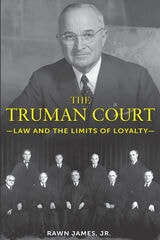
The Truman Court
Law and the Limits of LoyaltyRawn James
University of Missouri Press, 2021
The Truman Court: Law and the Limits of Loyalty argues that the years between FDR’s death in 1945 and Chief Justice Earl Warren’s confirmation in 1953—the dawn of the Cold War—were, contrary to widespread belief, important years in Supreme Court history. Never before or since has a president so quickly and completely changed the ideological and temperamental composition of the Court. With remarkable swiftness and certainty, Truman constructed a Court on which he relied to lend constitutional credence to his political agenda.
Trial Courts as Organizations
Brian J Ostrom, Charles W Ostrom, Jr., Roger A Hanson and Matthew Kleiman
Temple University Press, 2007
Court administrators and judges have long acknowledged that culture plays an important role in the function of trial courts. Trial Courts as Organizations provides a comprehensive framework for understanding this organizational culture, along with a set of steps and tools to assess and measure the current and preferred culture.
The authors examine how courts operate, what characteristics they may display, and how they function as a unit to preserve judicial independence, strengthen organizational leadership, and influence court performance. They identify four different types of institutional cultures using a systematic analysis of alternative values on how work is done. Each culture is shown to have its own strengths and weaknesses in achieving values, such as timely case resolution, access to court services, and procedural justice. Accordingly, the authors find judges and administrators prefer a definite pattern of different cultures, called a "mosaic," to guide how their courts operate in the future.
Trumping Religion
The New Christian Right, the Free Speech Clause, and the CourtsSteven P. Brown
University of Alabama Press, 2004
The first scholarly treatment of the strategies employed by the New Christian Right in redefining religious freedom in the courtroom.
Trumping Religion provides a detailed analysis of the five major public-interest law firms that have litigated religion cases in the federal courts between 1980 and 2000. Allied with several highly vocal, evangelical ministries, such as those of Jerry Falwell and Pat Robinson, these legal organizations argue that religious expression is a form of protected speech and thereby gain a greater latitude of interpretation in the courts. The long-term agenda of the New Christian Right as illuminated by this study is to shape church-state jurisprudence in a way that permits free course for the Christian gospel.
Steven P. Brown presents his research and conclusions from a balanced viewpoint. In filling a distinct void in the literature, this book will be of considerable interest to political scientists, legal scholars, law schools and seminaries, and anyone concerned with the intersection of religion and judicial politics.