Results by title
56 books match the query 'Jurisprudence' and 18 start with t
TASTE
Andrea Pavoni, Danilo Mandic, Caterina Nirta and Andreas Philippopoulos-Mihalopoulos
University of Westminster Press, 2018
TOUCH
Caterina Nirta, Danilo Mandic, Andrea Pavoni and Andreas Philippopoulos-Mihalopoulos
University of Westminster Press, 2020
Described by Aristotle as the most vital of senses, touch contains both the physical and the metaphysical in its ability to express the determination of being. To manifest itself, touch makes a movement outwards, beyond the body, and relies on a specific physical involvement other senses do not require: to touch is already to be active and to activate. This fundamental ontology makes touch the most essential of all senses.
This volume of ‘Law and the Senses’ attempts to illuminate and reconsider the complex and interflowing relations and contradictions between the tactful intrusion of the law and the untactful movement of touch. Compelling contributors from arts, literature and social science disciplines alongside artist presentations explore touch’s boundaries and formal and informal ‘laws’ of the senses. Each contribution unveils a multi-faceted new dimension to the force of touch, its ability to form, deform and reform what it touches. In unique ways, each of the several contributions to this volume recognises the trans-corporeality of touch to traverse the boundaries on the body and entangle other bodies and spaces, thus challenging the very notion of corporeal integrity and human being.
The Cloaking of Power
Montesquieu, Blackstone, and the Rise of Judicial ActivismPaul O. Carrese
University of Chicago Press, 2003
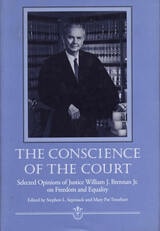
The Conscience of the Court
Selected Opinions of Justice William J. Brennan Jr. on Freedom and EqualityEdited by Stephen L. Sepinuck and Mary Pat Treuthart
Southern Illinois University Press, 1999
The Conscience of the Court celebrates the work of Justice William J. Brennan Jr., who served on the United States Supreme Court for thirty-four years (1956–1990).
Stephen L. Sepinuck and Mary Pat Treuthart introduce and present selected judicial opinions written by Justice Brennan on issues involving personal freedom, civil liberties, and equality. Brennan is ranked by many as the best writer ever to have served on the Supreme Court, and his written opinions depict real people, often in desperate, emotional situations. Remarkable for their clarity of analysis, for their eloquence, and for their forcefulness and persuasiveness, his opinions demonstrate that judicial thought need not be a proprietary enclave of lawyers or the intellectual elite.
The extended excerpts selected by Sepinuck and Treuthart highlight Brennan's approach to judicial decision making. Concerned always with how each decision would actually affect people's lives, Brennan possessed a rare quality of empathy. In Brennan, the editors note, "people and groups who lacked influence in society—Communists and flag burners, children and foreigners, criminal defendants and racial minorities"—found a champion they could count on "to listen to their causes and judge them unmoved by the passions of the politically powerful."
In their introduction to each opinion, the editors provide background facts, discuss how the excerpted opinion transformed the law or otherwise fit into the realm of constitutional jurisprudence, and delve into Justice Brennan's judicial philosophy, his method of constitutional interpretation, and the language he used.
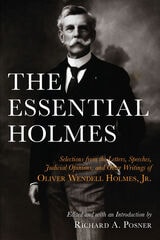
The Essential Holmes
Selections from the Letters, Speeches, Judicial Opinions, and Other Writings of Oliver Wendell Holmes, Jr.Oliver Wendell Holmes
University of Chicago Press, 1992
"A first-rate prose stylist, [Holmes] was perhaps the most quotable of all judges, as this ably edited volume shows."—Washington Post Book World
"Brilliantly edited, lucidly organized, and equipped with a compelling introduction by Judge Posner, [this book] is one of the finest single-volume samplers of any author's work I have seen. . . . Posner has fully captured the acrid tang of him in this masterly anthology."—Terry Teachout, National Review
"Excellent. . . . A worthwhile contribution to current American political/legal discussions."—Library Journal
"The best source for the reader who wants a first serious acquaintance with Holmes."—Thomas C. Grey, New York Review of Books
The Fate of Law
Austin Sarat and Thomas R. Kearns, Editors
University of Michigan Press, 1993
For law and legal theory the end of the twentieth century is a time of contradiction; while the newly emerging politics of Eastern Europe seek to establish a new rule of law, voices in this country proclaim the "death of law." For the former, law provides hope for stability and fairness. For the latter, the fundamental values that provide a grounding for legality seem no longer secure or satisfying. The Fate of Law is a collection of five original essays, each of which discusses the problems and prospects of law in the late twentieth century. The essays pay particular attention to the impact of broad intellectual and political movements, especially feminism and postmodernism, on law and legal theory.
The Fate of Law investigates what happens under the critical scrutiny of those movements and in an era of growing skepticism about law's central claim to objectivity, neutrality, and reason. It describes the struggles that ensue and the responses that are made. Each of the essays that comprise this books is written in its own style and voice; each makes it own judgments and assessments.
The Hunters or the Hunted?
An Introduction to African Cave TaphonomyC. K. Brain
University of Chicago Press, 1981
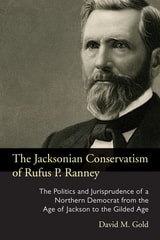
The Jacksonian Conservatism of Rufus P. Ranney
The Politics and Jurisprudence of a Northern Democrat from the Age of Jackson to the Gilded AgeDavid M. Gold
Ohio University Press, 2016
Ohio’s Rufus P. Ranney embodied many of the most intriguing social and political tensions of his time. He was an anticorporate campaigner who became John D. Rockefeller’s favorite lawyer. A student and law partner of abolitionist Benjamin F. Wade, Ranney acquired an antislavery reputation and recruited troops for the Union army; but as a Democratic candidate for governor he denied the power of Congress to restrict slavery in the territories, and during the Civil War and Reconstruction he condemned Republican policies.
Ranney was a key delegate at Ohio’s second constitutional convention and a two-time justice of the Ohio Supreme Court. He advocated equality and limited government as understood by radical Jacksonian Democrats. Scholarly discussions of Jacksonian jurisprudence have primarily focused on a handful of United States Supreme Court cases, but Ranney’s opinions, taken as a whole, outline a broader approach to judicial decision making.
A founder of the Ohio State Bar Association, Ranney was immensely influential but has been understudied until now. He left no private papers, even destroying his own correspondence. In The Jacksonian Conservatism of Rufus P. Ranney, David M. Gold works with the public record to reveal the contours of Ranney’s life and work. The result is a new look at how Jacksonian principles crossed the divide of the Civil War and became part of the fabric of American law and at how radical antebellum Democrats transformed themselves into Gilded Age conservatives.
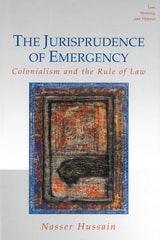
The Jurisprudence of Emergency
Colonialism and the Rule of LawNasser Hussain
University of Michigan Press, 2003
Ever-more-frequent calls for the establishment of a rule of law in the developing world have been oddly paralleled by the increasing use of "exceptional" measures to deal with political crises. To untangle this apparent contradiction, The Jurisprudence of Emergency analyzes the historical uses of a range of emergency powers, such as the suspension of habeas corpus and the use of military tribunals. Nasser Hussain focuses on the relationship between "emergency" and the law to develop a subtle new theory of those moments in which the normative rule of law is suspended.
The Jurisprudence of Emergency examines British colonial rule in India from the late eighteenth to the early twentieth century in order to trace tensions between the ideology of liberty and government by law, which was used to justify the British presence, and the colonizing power's concurrent insistence on a regime of conquest. Hussain argues that the interaction of these competing ideologies exemplifies a conflict central to all Western legal systems—between the universal, rational operation of law on the one hand and the absolute sovereignty of the state on the other. The author uses an impressive array of historical evidence to demonstrate how questions of law and emergency shaped colonial rule, which in turn affected the development of Western legality.
The pathbreaking insights developed in The Jurisprudence of Emergency reevaluate the place of colonialism in modern law by depicting the colonies as influential agents in the interpretation and delineation of Western ideas and practices. Hussain's interdisciplinary approach and subtly shaded revelations will be of interest to historians as well as scholars of legal and political theory.
The Jurisprudence of Emergency
Colonialism and the Rule of LawNasser Hussain
University of Michigan Press, 2019
The Jurisprudence of Emergency examines British rule in India from the late eighteenth to the early twentieth century, tracing tensions between the ideology of liberty and government by law used to justify the colonizing power's insistence on a regime of conquest. Nasser Hussain argues that the interaction of these competing ideologies exemplifies a conflict central to all Western legal systems—between the universal, rational operation of law on the one hand and the absolute sovereignty of the state on the other. The author uses an impressive array of historical evidence to demonstrate how questions of law and emergency shaped colonial rule, which in turn affected the development of Western legality.
The pathbreaking insights developed in The Jurisprudence of Emergency reevaluate the place of colonialism in modern law by depicting the colonies as influential agents in the interpretation of Western ideas and practices. Hussain's interdisciplinary approach and subtly shaded revelations will be of interest to historians as well as scholars of legal and political theory.

The Medical Malpractice Myth
Tom Baker
University of Chicago Press, 2005
This, according to Tom Baker, is the myth of medical malpractice, and as a reality check he offers The Medical Malpractice Myth, a stunning dismantling of this familiar, but inaccurate, picture of the health care industry. Are there too many medical malpractice suits? No, according to Baker; there is actually a great deal more medical malpractice, with only a fraction of the cases ever seeing the inside of a courtroom. Is too much litigation to blame for the malpractice insurance crisis? No, for that we can look to financial trends and competitive behavior in the insurance industry. Are these lawsuits frivolous? Very rarely. Point by point, Baker—a leading authority on insurance and law—pulls together the research that demolishes the myths that have taken hold about medical malpractice and suggests a series of legal reforms that would help doctors manage malpractice insurance while also improving patient safety and medical accountability.
President Bush has made medical malpractice reform a priority in his last term in office, but if history is any indication, legislative reform would only worsen the situation and perpetuate the gross misunderstanding of it. The debate surely will be transformed by The Medical Malpractice Myth, a book aimed squarely at general readers but with radical conclusions that speak to the highest level of domestic policymaking.
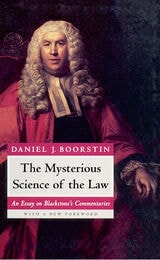
The Mysterious Science of the Law
An Essay on Blackstone's CommentariesDaniel J. Boorstin
University of Chicago Press, 1996
The Rhetoric of Law
Austin Sarat and Thomas R. Kearns, Editors
University of Michigan Press, 1996
The Rule of Law After Artificial Intelligence
Automated NarrativesKatie Szilagyi
University of Chicago Press, 2026
A timely investigation of what is at stake when AI takes legal decision-making out of human hands.
Artificial intelligence is proliferating in many professions, and the legal field is no exception. In The Rule of Law After Artificial Intelligence, Katie Szilagyi investigates the philosophical and practical implications of using AI in legal spaces, beginning with several fundamental questions: What is the law supposed to do, and from where does it derive its authority? Would law still achieve these aims if automated? How might automation affect the rule of law’s integrity and democratic institutions’ operations?
Blending legal philosophy, applied case studies, and insights from both critical legal scholarship and science and technology studies, Szilagyi argues that law and storytelling are deeply connected. Through creating and contesting the law, we make sense of the information around us and generate narratives about our collective world. These narratives are not static: legal precedent evolves, and legal deliberation on hard cases can help to resolve unclear or unprecedented social issues.
Szilagyi demonstrates that technological innovations make the rule of law vulnerable because large language models and machine learning undermine the visioning function of legal narratives, collapsing exercises of legal interpretation into mere administration. Datafication of law—built on the biased data of our cultural past—threatens longstanding legal ideals, lessens the constraints against abuses of power by private actors, and hamstrings society’s ability to reach a more egalitarian future. Szilagyi argues instead for centering narratives within the law and, in turn, rediscovering the tales the law tells us about who we are.
The Rule of Rules
Morality, Rules, and the Dilemmas of LawLarry Alexander and Emily Sherwin
Duke University Press, 2001
Once the importance of this moral and practical conflict is acknowledged, the authors argue, authoritative rules become the central problems of jurisprudence. The inevitable gap between rules and background morality cannot be bridged, they claim, although many contemporary jurisprudential schools of thought are misguided attempts to do so. Alexander and Sherwin work through this dilemma, which lies at the heart of such ongoing jurisprudential controversies as how judges should reason in deciding cases, what effect should be given to legal precedent, and what status, if any, should be accorded to “legal principles.” In the end, their rigorous discussion sheds light on such topics as the nature of interpretation, the ancient dispute among legal theorists over natural law versus positivism, the obligation to obey law, constitutionalism, and the relation between law and coercion.
Those interested in jurisprudence, legal theory, and political philosophy will benefit from the edifying discussion in The Rule of Rules.
The Supreme Court Review, 2021
Edited by David A. Strauss, Geoffrey R. Stone, Justin Driver, and William Baude
University of Chicago Press Journals, 2022
Since it first appeared in 1960, the Supreme Court Review has won acclaim for providing a sustained and authoritative survey of the implications of the Court's most significant decisions. SCR is an in-depth annual critique of the Supreme Court and its work, analyzing the origins, reforms, and modern interpretations of American law. SCR is written by and for legal academics, judges, political scientists, journalists, historians, economists, policy planners, and sociologists.
The Supreme Court on Trial
How the American Justice System Sacrifices Innocent DefendantsGeorge C. Thomas III
University of Michigan Press, 2011
The chief mandate of the criminal justice system is not to prosecute the guilty but to safeguard the innocent from wrongful convictions; with this startling assertion, legal scholar George Thomas launches his critique of the U.S. system and its emphasis on procedure at the expense of true justice.
Thomas traces the history of jury trials, an important component of the U.S. justice system, since the American Founding. In the mid-twentieth century, when it became evident that racism and other forms of discrimination were corrupting the system, the Warren Court established procedure as the most important element of criminal justice. As a result, police, prosecutors, and judges have become more concerned about following rules than about ensuring that the defendant is indeed guilty as charged. Recent cases of prisoners convicted of crimes they didn't commit demonstrate that such procedural justice cannot substitute for substantive justice.
American justices, Thomas concludes, should take a lesson from the French, who have instituted, among other measures, the creation of an independent court to review claims of innocence based on new evidence. Similar reforms in the United States would better enable the criminal justice system to fulfill its moral and legal obligation to prevent wrongful convictions.
"Thomas draws on his extensive knowledge of the field to elaborate his elegant and important thesis---that the American system of justice has lost sight of what ought to be its central purpose---protection of the innocent."
—Susan Bandes, Distinguished Research Professor of Law, DePaul University College of Law
"Thomas explores how America's adversary system evolved into one obsessed with procedure for its own sake or in the cause of restraining government power, giving short shrift to getting only the right guy. His stunning, thought-provoking, and unexpected recommendations should be of interest to every citizen who cares about justice."
—Andrew E. Taslitz, Professor of Law, Howard University School of Law
"An unflinching, insightful, and powerful critique of American criminal justice---and its deficiencies. George Thomas demonstrates once again why he is one of the nation's leading criminal procedure scholars. His knowledge of criminal law history and comparative criminal law is most impressive."
—Yale Kamisar, Distinguished Professor of Law, University of San Diego and Clarence Darrow Distinguished University Professor Emeritus of Law, University of Michigan
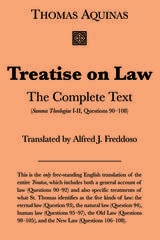
Treatise on Law
The Complete TextThomas Aquinas
St. Augustine's Press, 2009
St. Thomas’s account of law is firmly embedded within a general moral theory that begins with a rich conception of human flourishing, i.e., the good for human beings (Questions 1–5). This good consists, first and foremost, in our ultimate and intimate union with the Persons of the Blessed Trinity – a union that in our present state we can grasp intellectively and pursue affectively only with God’s supernatural assistance. It is within this framework that we order our loves and pursue the more proximate goals they open up to us as human beings in this life. Given the appropriate goals, the next question is how we can get from where we are, in the grips of the consequences of Original Sin, to where we want to be. The answer is: by means of (a) human actions that are good, i.e., rightly ordered toward our ultimate end and (b) the habits that these actions either engender or flow from. In analyzing human actions (Questions 6–21) and their relation to the passions (Questions 22–48), St. Thomas gives a general account of what he calls the ‘intrinsic principles’ of human actions and their associated habits – both virtues (Questions 49–70) and vices (Questions 71–89). It is only then that he turns to what he calls the ‘extrinsic principles’ of good human actions, viz., law (Questions 90–108) and grace (Questions 109–114).
According to St. Thomas, law, far from supplanting virtue as a basic principle of action, serves as an independent principle of action that complements virtue and is itself capable of being factored into practical deliberation. The reason is that all of God’s
precepts, prohibitions, and punishments are aimed at promoting the good of the whole universe and, more particularly, the good for human beings, both individually and within the various forms of social life. Because of this, law serves as both a restraint on bad actions and a spur to good action, i.e., a restraint on actions that take us away from virtue and genuine human flourishing and a spur to actions that promote virtue and flourishing.
There are many benefits of having the whole treatise rather than just the first few questions, as has been the standard practice in previous editions of the Treatise on Law. To mention just a few of these benefits, the question on the moral precepts of the Old Law (question 100) helps to illuminate in many different ways the earlier questions on natural law and human law (questions 94–97). Again, the questions on the ceremonial and judicial precepts of the Old Law (questions 101–105) demon-strate in depth the symbiotic relationship that St. Thomas takes to obtain between the Old Testament and the New Testament. The questions on the New Law provide an introduction to the Christian way of life that will be described in incomparable detail in the Second Part of the Second Part, the bulk of which is structured around the treatment of the three theological virtues and the four cardinal virtues.