Results by title
71 books match the query 'Language and culture' and 7 start with t

The Acoustic World of Early Modern England
Attending to the O-FactorBruce R. Smith
University of Chicago Press, 1999
In this ear-opening journey into the sound-worlds of Shakespeare's contemporaries, Bruce R. Smith explores both the physical aspects of human speech (ears, lungs, tongue) and the surrounding environment (buildings, landscape, climate), as well as social and political structures. Drawing on a staggeringly wide range of evidence, he crafts a historical phenomenology of sound, from reconstructions of the "soundscapes" of city, country, and court to detailed accounts of the acoustic properties of the Globe and Blackfriars theaters and how scripts designed for the two spaces exploited sound very differently.
Critical for anyone who wants to understand the world of early modern England, Smith's pathbreaking "ecology" of voice and listening also has much to offer musicologists and acoustic ecologists.
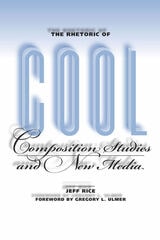
The Rhetoric of Cool
Composition Studies and New MediaJeff Rice
Southern Illinois University Press, 2007
The Rhetoric of Cool addresses the disciplinary claim that composition studies underwent a rebirth in 1963. At that time, three writers reviewed technology, cultural studies, and visual writing outside composition studies and independently used the word cool to describe each position. Starting from these three positions, Rice focuses on chora, appropriation, commutation, juxtaposition, nonlinearity, and imagery—rhetorical gestures conducive to new media work-- to construct the rhetoric of cool.
An innovative work that approaches computers and writing issues from historical, critical, theoretical, and practical perspectives, The Rhetoric of Cool challenges current understandings of writing and new media and proposes a rhetorical rather than an instrumental response for teaching writing in new media contexts.
The Writer as Migrant
Ha Jin
University of Chicago Press, 2008
Consisting of three interconnected essays, The Writer as Migrant sets Ha Jin’s own work and life alongside those of other literary exiles, creating a conversation across cultures and between eras. He employs the cases of Alexander Solzhenitsyn and Chinese novelist Lin Yutang to illustrate the obligation a writer feels to the land of their birth, while Joseph Conrad and Vladimir Nabokov—who, like Ha Jin, adopted English for their writing—are enlisted to explore a migrant author’s conscious choice of a literary language. A final essay draws on V. S. Naipaul and Milan Kundera to consider the ways in which our era of perpetual change forces a migrant writer to reconceptualize the very idea of home. Throughout, Jin brings other celebrated writers into the conversation as well, including W. G. Sebald, C. P. Cavafy, and Salman Rushdie—refracting and refining the very idea of a literature of migration.
Simultaneously a reflection on a crucial theme and a fascinating glimpse at the writers who compose Ha Jin’s mental library, The Writer as Migrant is a work of passionately engaged criticism, one rooted in departures but feeling like a new arrival.
Theaters of Translation
Cosmopolitan Vernaculars in Shakespeare's EnglandAndrew S. Keener
University of Alabama Press, 2025
Explores the profound influence of multilingual dictionaries, dialogues, and grammars on English Renaissance playwrights
In Theaters of Translation, Andrew S. Keener offers a fascinating account of the ways that plays by Thomas Kyd, Mary Sidney Herbert, Ben Jonson, and their fellow English contemporaries were shaped by and part of a multilingual Europe where dictionaries, grammars, and language-learning materials circulated widely. He proposes a fresh, multilingual approach to English Renaissance drama that challenges the histories of early modern European languages as sites of national and linguistic cohesion.
Covering the period between 1570 and 1640, when England’s drama and the English language itself were evolving, Keener uses the term “cosmopolitan vernaculars” to examine how nonclassical European languages modeled transnational forms of belonging for playgoers, readers, and authors in Renaissance England. Combining recent contributions to cosmopolitan theory and transnational studies of early modern literature and culture, Keener highlights both the ways in which cosmopolitanism manifests through Europe’s vernacular languages—in print and performance—and the ways languages themselves can exhibit cosmopolitanism for those who encounter them on the page or on the stage.
Theaters of Translation opens up new transnational interpretations of English Renaissance plays and casts fresh light on historical anecdotes, such as Jonson inscribing a copy of Pietro Aretino’s scandalous Italian dialogues or Shakespeare’s First Folio being advertised for sale in Germany before its London publication. It offers much of interest to readers and scholars of Renaissance Europe, early modern drama, and the development of national European languages.
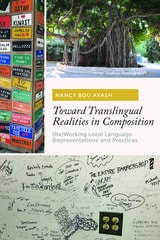
Toward Translingual Realities in Composition
(Re)Working Local Language Representations and PracticesNancy Bou Ayash
Utah State University Press, 2019
Translingualism work has concentrated on critiquing monolingual and multilingual notions of language, but it is only beginning to examine translingual enactments in writing programs and classrooms. Focusing on language representations and practices at both the macro and micro levels, author Nancy Bou Ayash places the study and teaching of university-level writing in the context of the globalization and pluralization of English(es) and other languages. Individual chapters feature various studies that Bou Ayash brings together to address how students act as agents in marshaling their language practices and resources and shows a deliberate translingual intervention that complicates and enriches students’ assumptions about language and writing. Her findings about writing programs, instructors, and students are detailed, multidimensional, and complex.
A substantial contribution to growing translingual scholarship in the field of composition studies, Toward Translingual Realities in Composition offers insights into how writing teacher-scholars and writing program administrators can more productively intervene in local postmonolingual tensions and contradictions at the level of language representations and practices through actively and persistently reworking the design and enactment of their curricula, pedagogies, assessments, teacher training programs, and campus-wide partnerships.
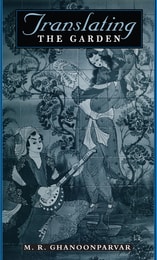
Translating the Garden
By M. R. Ghanoonparvar
University of Texas Press, 2002
Translating a work of literature from one language to another is an art form, in which the translated work becomes a "conduit" through which the reader of one language may pass into the cultural world of another. For the translator, the process of translation offers an intimate experience of the text that is perhaps unavailable even to the author. And yet, as M. R. Ghanoonparvar observes at the outset of this book, "every translation is inevitably a failure, with occasional moments of success."
In Translating the Garden, Ghanoonparvar allows readers to watch him in the process of translating Shahrokh Meskub's Goftogu dar Bagh(Dialogue in the Garden) from Persian into English. This short philosophical work uses a conversation between a writer and a painter to explore Persian perceptions of art, literature, nature, identity, and spirituality. As he translates the text, Ghanoonparvar discusses the myriad decisions that a literary translator faces, from word choices to the problems of conveying cultural concepts and deciphering authorial intent. He also compares some of his translated passages with those of other translators to highlight the uniqueness of each act of translation. The complete English translation of Dialogue in the Garden rounds out the volume.
Translation and Power
Maria Tymoczko
University of Massachusetts Press, 2002
Although governments, churches, publishing firms, and other powerful institutions may influence the translation process, many translators have found ways to resist that influence and have used translation to introduce new ideas and modes of expression. Exploring the nexus of translation and power, the essays in this volume offer a wide variety of examples, across multiple languages and societies. They range from case studies of historical episodes in which translation has played a role in the assertion of political and military power, such as an 1840 treaty between the British and Maori that continues to be a source of conflict in present-day New Zealand, to analyses of the work of specific translators, such as Germaine de Staël and Gayatri Spivak. Along with examining how translation contributes to ideological negotiations and cultural struggles, the essays reveal the dimensions of power inherent in the translation process itself—in the relationship of translator to author, source text, and translated text.
In addition to the editors, contributors include Rosemary Arrojo, Michael Cronin, Sabine Fenton, Camino Gutiérrez Lanza, Christopher Larkosh, Alexandra Lianeri, Lin Kenan, Carol Maier, Paul Moon, Adriana S. Pagano, and Sherry Simon.