Results by title
57 books match the query 'Literature and science' and 10 start with t
Technomodern Poetics
The American Literary Avant-Garde at the Start of the Information AgeTodd F. Tietchen
University of Iowa Press, 2018
After the second World War, the term “technology” came to signify both the anxieties of possible annihilation in a rapidly changing world and the exhilaration of accelerating cultural change. Technomodern Poetics examines how some of the most well-known writers of the era described the tensions between technical, literary, and media cultures at the dawn of the Digital Age. Poets and writers such as Allen Ginsberg, Charles Olson, Jack Kerouac, and Frank O’Hara, among others, anthologized in Donald Allen’s iconic The New American Poetry, 1945–1960, provided a canon of work that has proven increasingly relevant to our technological present. Elaborating on the theories of contemporaneous technologists such as Norbert Wiener, Claude Shannon, J. C. R. Licklider, and a host of noteworthy others, these artists express the anxieties and avant-garde impulses they wrestled with as they came to terms with a complex array of issues raised by the dawning of the nuclear age, computer-based automation, and the expansive reach of electronic media. As author Todd Tietchen reveals, even as these writers were generating novel forms and concerns, they often continued to question whether such technological changes were inherently progressive or destructive.
With an undeniable timeliness, Tietchen’s book is sure to appeal to courses in modern English literature and American studies, as well as among fans of Beat writers and early Cold War culture.
Textual Contraception
Birth Control and Modern American FictionBeth Widmaier Capo
The Ohio State University Press, 2007
Merging cultural analysis and literary scholarship, this compelling work moves from a consideration of how cultural forces shaped literary production and political activism to a close examination of how fictional representations of contraception influenced the terms of public discourse on marriage, motherhood, economics, and eugenics.
By analyzing popular fiction such as Mother by Kathleen Norris, radical periodicals such as The Masses and Birth Control Review, and literature by authors from Theodore Dreiser to William Faulkner, and Nella Larsen to Mary McCarthy, Beth Widmaier Capo reveals the rich cross-influence of contraceptive and literary history.
The Afterlives of Specimens
Science, Mourning, and Whitman's Civil WarLindsay Tuggle
University of Iowa Press, 2017
Grounded in archival discoveries, Afterlives traces the origins of nineteenth-century America’s preservation compulsion, illuminating the influences of botanical, medical, spiritualist, and sentimental discourses on Whitman’s work. Tuggle unveils previously unrecognized connections between Whitman and the leading “medical men” of his era, such as the surgeon John H. Brinton, founding curator of the Army Medical Museum, and Silas Weir Mitchell, the neurologist who discovered phantom limb syndrome. Remains from several amputee soldiers whom Whitman nursed in the Washington hospitals became specimens in the Army Medical Museum.
Tuggle is the first scholar to analyze Whitman’s role in medically memorializing the human cadaver and its abandoned parts.
The Biopolitics of Feeling
Race, Sex, and Science in the Nineteenth CenturyKyla Schuller
Duke University Press, 2018
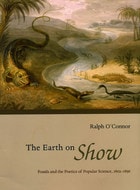
The Earth on Show
Fossils and the Poetics of Popular Science, 1802-1856Ralph O'Connor
University of Chicago Press, 2007
Shrewd science-writers, O’Connor shows, marketed spectacular visions of past worlds, piquing the public imagination with glimpses of man-eating mammoths, talking dinosaurs, and sea-dragons spawned by Satan himself. These authors—including men of science, women, clergymen, biblical literalists, hack writers, blackmailers, and prophets—borrowed freely from the Bible, modern poetry, and the urban entertainment industry, creating new forms of literature in order to transport their readers into a vanished and alien past.
In exploring the use of poetry and spectacle in the promotion of popular science, O’Connor proves that geology’s success owed much to the literary techniques of its authors. An innovative blend of the history of science, literary criticism, book history, and visual culture, The Earth on Show rethinks the relationship between science and literature in the nineteenth century.
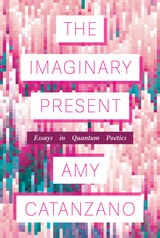
The Imaginary Present
Essays in Quantum PoeticsAmy Catanzano
University of Michigan Press, 2025
19th Annual National Indie Excellence Awards Poetry Finalist
The Imaginary Present by award-winning poet and professor Amy Catanzano explores cutting-edge scientific fields such as particle physics and astrophysics, and branches of physics such as quantum theory and relativity, through a poetic vision equally loyal to the imagination and rationality. Drawing upon her groundbreaking research and artist residencies at major scientific research centers like CERN and the U.S. National Science Foundation’s NOIRLab, as well as talks and poetry readings at esteemed institutions, Catanzano invites enthusiasts of poetry and science to consider what can be achieved through greater collaboration between these fields.
In linked chapters that fluidly blend lyric essay, literary and scientific analysis, poetry, theory, and memoir, The Imaginary Present offers refreshing new insights on a wide range of thinkers over the past 100 years, including poets Rae Armantrout and M. NourbeSe Philip, novelists Alfred Jarry and Virginia Woolf, comic book writer Grant Morrison, and physicists Albert Einstein and Werner Heisenberg. The introduction explores why poetry and physics are capable of jointly investigating our most fundamental questions about the universe and discusses the history of the art-science connection in addition to the author’s own journey. In searching for the groundbreaking ways that artists and scientists can collaborate, The Imaginary Present offers readers both reasoned grounding and poetic framing for an interdisciplinary poetics and praxis based on science.
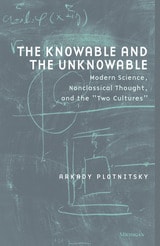
The Knowable and the Unknowable
Modern Science, Nonclassical Thought, and the "Two Cultures"Arkady Plotnitsky
University of Michigan Press, 2002
Plotnitsky highlights those points at which the known gives way to the unknown (and unknowable). These points are significant, he argues, because they push the boundaries of thought and challenge the boundaries of disciplinarity. One of the book's most interesting observations is that key figures in science, in order to push toward a framing of the unknown, actually retreated into a conservative disciplinarity. Plotnitsky's informed, interdisciplinary approach is more productive than the disparaging attacks on postmodernism or scientism that have hitherto characterized this discourse.
Arkady Plotnitsky is Professor of English and Director, Theory and Cultural Studies Program, Purdue University. Trained in both mathematics and literary theory, he is author of several books, including In the Shadow of Hegel: Complementarity, History and the Unconscious and Reconfigurations: Critical Theory and General Economy.
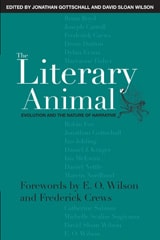
The Literary Animal
Evolution and the Nature of NarrativeJonathan Gottschall and David Sloan Wilson
Northwestern University Press, 2005
The goal of this book is to overcome some of the widespread misunderstandings about the meaning of a Darwinian approach to the human mind generally, and literature specifically. The volume brings together scholars from the forefront of the new field of evolutionary literary analysis-both literary analysts who have made evolution their explanatory framework and evolutionist scientists who have taken a serious interest in literature-to show how the human propensity for literature and art can be properly framed as a true evolutionary problem. Their work is an important step toward the long-prophesied synthesis of the humanities and what Steven Pinker calls "the new sciences of human nature."
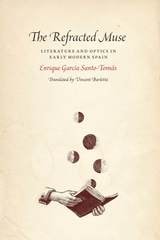
The Refracted Muse
Literature and Optics in Early Modern SpainEnrique Garcia Santo-Tomas
University of Chicago Press, 2017
While Spain is often thought to have taken little notice of the Scientific Revolution, García Santo-Tomás tells a different story, one that reveals Golden Age Spanish literature to be in close dialogue with the New Science. Drawing on the work of writers such as Cervantes, Lope de Vega, Calderón de la Barca, and Quevedo, he helps us trace the influence of science and discovery on the rapidly developing and highly playful genre of the novel. Indeed, García Santo-Tomás makes a strong case that the rise of the novel cannot be fully understood without taking into account its relationship to the scientific discoveries of the period.
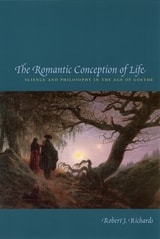
The Romantic Conception of Life
Science and Philosophy in the Age of GoetheRobert J. Richards
University of Chicago Press, 2002
Integrating Romantic literature, science, and philosophy with an intimate knowledge of the individuals involved—from Goethe and the brothers Schlegel to Humboldt and Friedrich and Caroline Schelling—Richards demonstrates how their tempestuous lives shaped their ideas as profoundly as their intellectual and cultural heritage. He focuses especially on how Romantic concepts of the self, as well as aesthetic and moral considerations—all tempered by personal relationships—altered scientific representations of nature. Although historians have long considered Romanticism at best a minor tributary to scientific thought, Richards moves it to the center of the main currents of nineteenth-century biology, culminating in the conception of nature that underlies Darwin's evolutionary theory.
Uniting the personal and poetic aspects of philosophy and science in a way that the German Romantics themselves would have honored, The Romantic Conception of Life alters how we look at Romanticism and nineteenth-century biology.