Results by title
86 books match the query 'Lives' and 16 start with t
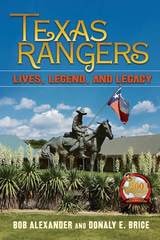
Texas Rangers
Lives, Legend, and LegacyBob Alexander
University of North Texas Press, 2017
The Black Cow's Footprint
Time, Space and Music in the Lives of the Kotas of South IndiaRichard K. Wolf
University of Illinois Press, 2006
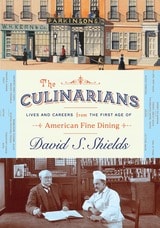
The Culinarians
Lives and Careers from the First Age of American Fine DiningDavid S. Shields
University of Chicago Press, 2017
This fascinating culinarian is John Dabney (1821–1900), who was born a slave, but later built an enterprising catering business. Dabney is just one of 175 influential cooks and restaurateurs profiled by David S. Shields in The Culinarians, a beautifully produced encyclopedic history of the rise of professional cooking in America from the early republic to Prohibition.
Shields’s concise biographies include the legendary Julien, founder in 1793 of America’s first restaurant, Boston’s Restorator; and Louis Diat and Oscar of the Waldorf, the men most responsible for keeping the ideal of fine dining alive between the World Wars. Though many of the gastronomic pioneers gathered here are less well known, their diverse influence on American dining should not be overlooked—plus, their stories are truly entertaining. We meet an African American oyster dealer who became the Congressional caterer, and, thus, a powerful broker of political patronage; a French chef who was a culinary savant of vegetables and drove the rise of California cuisine in the 1870s; and a rotund Philadelphia confectioner who prevailed in a culinary contest with a rival in New York by staging what many believed to be the greatest American meal of the nineteenth century. He later grew wealthy selling ice cream to the masses. Shields also introduces us to a French chef who brought haute cuisine to wealthy prospectors and a black restaurateur who hosted a reconciliation dinner for black and white citizens at the close of the Civil War in Charleston.
Altogether, Culinarians is a delightful compendium of charcuterie-makers, pastry-pipers, caterers, railroad chefs, and cooking school matrons—not to mention drunks, temperance converts, and gangsters—who all had a hand in creating the first age of American fine dining and its legacy of conviviality and innovation that continues today.
The Cult of Statistical Significance
How the Standard Error Costs Us Jobs, Justice, and LivesStephen T. Ziliak and Deirdre N. McCloskey
University of Michigan Press, 2010
“McCloskey and Ziliak have been pushing this very elementary, very correct, very important argument through several articles over several years and for reasons I cannot fathom it is still resisted. If it takes a book to get it across, I hope this book will do it. It ought to.”
—Thomas Schelling, Distinguished University Professor, School of Public Policy, University of Maryland, and 2005 Nobel Prize Laureate in Economics
“With humor, insight, piercing logic and a nod to history, Ziliak and McCloskey show how economists—and other scientists—suffer from a mass delusion about statistical analysis. The quest for statistical significance that pervades science today is a deeply flawed substitute for thoughtful analysis. . . . Yet few participants in the scientific bureaucracy have been willing to admit what Ziliak and McCloskey make clear: the emperor has no clothes.”
—Kenneth Rothman, Professor of Epidemiology, Boston University School of Health
The Cult of Statistical Significance shows, field by field, how “statistical significance,” a technique that dominates many sciences, has been a huge mistake. The authors find that researchers in a broad spectrum of fields, from agronomy to zoology, employ “testing” that doesn’t test and “estimating” that doesn’t estimate. The facts will startle the outside reader: how could a group of brilliant scientists wander so far from scientific magnitudes? This study will encourage scientists who want to know how to get the statistical sciences back on track and fulfill their quantitative promise. The book shows for the first time how wide the disaster is, and how bad for science, and it traces the problem to its historical, sociological, and philosophical roots.
Stephen T. Ziliak is the author or editor of many articles and two books. He currently lives in Chicago, where he is Professor of Economics at Roosevelt University. Deirdre N. McCloskey, Distinguished Professor of Economics, History, English, and Communication at the University of Illinois at Chicago, is the author of twenty books and three hundred scholarly articles. She has held Guggenheim and National Humanities Fellowships. She is best known for How to Be Human* Though an Economist (University of Michigan Press, 2000) and her most recent book, The Bourgeois Virtues: Ethics for an Age of Commerce (2006).
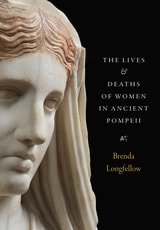
The Lives and Deaths of Women in Ancient Pompeii
Brenda Longfellow
University of Texas Press, 2025
A study of women’s lives in the public sphere of the ancient city of Pompeii.
Pompeii’s well-preserved remains provide a unique opportunity for the close study of ancient lives. Drawing on statues, inscriptions, graffiti, wall paintings, and the architecture of tombs, sanctuaries, houses, and public spaces, The Lives and Deaths of Women in Ancient Pompeii examines the public lives of women in Pompeii. Art historian Brenda Longfellow explores how historical women of all social backgrounds acted in public and exerted agency on behalf of themselves and others, ultimately finding that female initiatives in Pompeii were not only accepted but desired by the community to a greater extent than has previously been recognized.
Longfellow centers her study on a few key women—including the city’s most notable female patron, Eumachia—and uses them to examine female roles in postmortem commemorations, civic patronage and benefactions, commerce, the priesthood, and the home. By following these individuals, Longfellow examines women’s lives in Pompeii in both abstract and concrete ways, allowing readers to better understand their importance to the city and society. The result is a groundbreaking book that foregrounds the agency of women in everyday Pompeii.
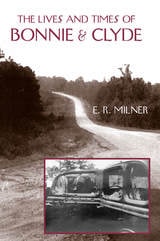
The Lives and Times of Bonnie & Clyde
E. R. Milner
Southern Illinois University Press, 2003
Although the mythology surrounding Bonnie and Clyde is charged with drama and fascination, Milner reveals the truth behind the bloody legend, carefully gleaning materials from obscure locally published accounts, previously untapped court records, and archived but unpublished oral history accounts from some sixty victims, neighbors, relatives, and police who were involved in the exploits of the infamous duo. And the truth proves to be sufficiently exciting. Romance aside, the Barrow gang carved a grisly swath through Texas, Arkansas, Oklahoma, and Missouri. The string of deaths was long— and real: Akota, Oklahoma, sheriff severely wounded, deputy killed; Sherman, Texas, grocery clerk killed; Temple, Texas, man killed as gang attempts to steal his car; Joplin, Missouri, two officers killed; Alma, Arkansas, police officer killed; Crockette, Texas, prison guard killed; Miami, Oklahoma, police officer killed.
Milner traces this violent path until 23 May 1934, when Bonnie and Clyde die in an ambush. Even dead, they draw crowds and are buried in a circus-like atmosphere. In death they continue to intrigue us in ways few criminals had before or have since.
The Lives of Cato the Younger from Ancient Rome to Modern America
Thomas E. Strunk
University of Michigan Press, 2026
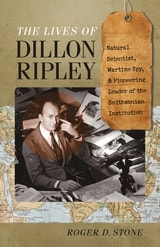
The Lives of Dillon Ripley
Natural Scientist, Wartime Spy, and Pioneering Leader of the Smithsonian InstitutionRoger D. Stone
University Press of New England, 2017

The Lives of Jessie Sampter
Queer, Disabled, ZionistSarah Imhoff
Duke University Press, 2022
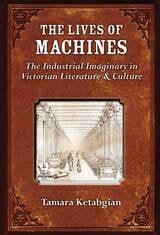
The Lives of Machines
The Industrial Imaginary in Victorian Literature and CultureTamara Ketabgian
University of Michigan Press, 2011
"The Lives of Machines is intelligent, closely argued, and persuasive, and puts forth a contention that will unsettle the current consensus about Victorian attitudes toward the machine."
---Jay Clayton, Vanderbilt University
Today we commonly describe ourselves as machines that "let off steam" or feel "under pressure." The Lives of Machines investigates how Victorian technoculture came to shape this language of human emotion so pervasively and irrevocably and argues that nothing is more intensely human and affecting than the nonhuman. Tamara Ketabgian explores the emergence of a modern and more mechanical view of human nature in Victorian literature and culture.
Treating British literature from the 1830s to the 1870s, this study examines forms of feeling and community that combine the vital and the mechanical, the human and the nonhuman, in surprisingly hybrid and productive alliances. Challenging accounts of industrial alienation that still persist, the author defines mechanical character and feeling not as erasures or negations of self, but as robust and nuanced entities in their own right. The Lives of Machines thus offers an alternate cultural history that traces sympathies between humans, animals, and machines in novels and nonfiction about factory work as well as in other unexpected literary sites and genres, whether domestic, scientific, musical, or philosophical. Ketabgian historicizes a model of affect and community that continues to inform recent theories of technology, psychology, and the posthuman.
The Lives of Machines will be of interest to students of British literature and history, history of science and of technology, novel studies, psychoanalysis, and postmodern cultural studies.
Cover image: "Power Loom Factory of Thomas Robinson," from Andrew Ure, The Philosophy of Manufactures (London: Charles Knight, 1835), frontispiece.
DIGITALCULTUREBOOKS: a collaborative imprint of the University of Michigan Press and the University of Michigan Library
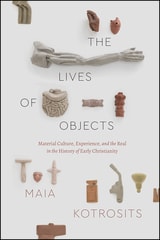
The Lives of Objects
Material Culture, Experience, and the Real in the History of Early ChristianityMaia Kotrosits
University of Chicago Press, 2020
Maia Kotrosits offers a fresh perspective on objects, looking beyond physical material to consider how collective imagination shapes the formation of objects and the experience of reality. Bringing a psychoanalytic approach to the analysis of material culture, she examines objects of attachment—relationships, ideas, and beliefs that live on in the psyche—and illustrates how people across time have anchored value systems to the materiality of life. Engaging with classical studies, history, anthropology, and literary, gender, and queer studies, Kotrosits shows how these disciplines address historical knowledge and how an expanded definition of materiality can help us make connections between antiquity and the contemporary world.
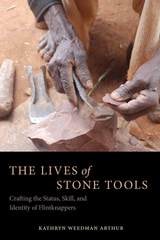
The Lives of Stone Tools
Crafting the Status, Skill, and Identity of FlintknappersKathryn Weedman Arthur
University of Arizona Press, 2018
Anthropologist Kathryn Weedman Arthur offers insights from her more than twenty years working with the Gamo. She deftly addresses historical and present-day experiences and practices, privileging the Gamo’s perspectives. Providing a rich, detailed look into the world of lithic technology, Arthur urges us to follow her into a world that recognizes Indigenous theories of material culture as valid alternatives to academic theories. In so doing, she subverts long-held Western perspectives concerning gender, skill, and lifeless status of inorganic matter.
The book offers the perspectives that, contrary to long-held Western views, stone tools are living beings with a life course, and lithic technology is a reproductive process that should ideally include both male and female participation. Only individuals of particular lineages knowledgeable in the lives of stones may work with stone technology. Knappers acquire skill and status through incremental guided instruction corresponding to their own phases of maturation. The tools’ lives parallel those of their knappers from birth (procurement), circumcision (knapping), maturation (use), seclusion (storage), and death (discardment).
Given current expectations that the Gamo’s lithic technology may disappear with the next generation, The Lives of Stone Tools is a work of vital importance and possibly one of the last contemporaneous books about a population that engages with the craft daily.
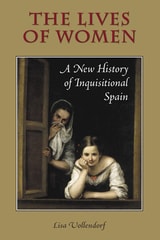
The Lives of Women
A New History of Inquisitional SpainLisa Vollendorf
Vanderbilt University Press, 2007
During this period, more women wrote for the public book market and participated in literary culture than ever before. In addition, the rise in convents and female education contributed to a marked increase in texts produced by and about women in religious orders. Vollendorf argues that, in conjunction with Inquisition and legal documents, this wealth of writing offers unprecedented access to women's perspectives on life in early modern Spain, and that those perspectives encompass diverse ethnic backgrounds and class differences. Many of the documents touch on issues of sex and intimacy; others provide new ways of understanding religious practice in the period. Perhaps most important, these writings give a richly textured view of how women reacted to the dominant culture's attempts to define, limit, and contain femininity. Vollendorf shows that the texts reflect a shared preoccupation with redefining gender and creating legitimate spaces for women.
As The Lives of Women vividly illustrates, hundreds, if not thousands, of women's stories await rediscovery in archives. The book provides a roadmap for understanding the experiences and concerns of wives, widows, sisters, and daughters who lived in a key moment in the development of the Spanish nation and the Hispanic world. At its core, The Lives of Women argues for a reconceptualization of history, one that will rely on the experiences of women and minorities as much as on the words and actions of kings and conquistadors.
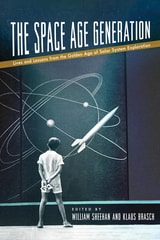
The Space Age Generation
Lives and Lessons from the Golden Age of Solar System ExplorationWilliam Sheehan and Klaus Brasch
University of Arizona Press, 2024
At the heart of this momentous time were the men and women working behind the scenes. Scientists, historians, and astronomers share their memories and contributions from this unparalleled era in essays told in their own words. They are the remarkable generation who witnessed and contributed to some of space science’s most stunning achievements. Here they have recorded their memories—their childhood inspirations, their challenges, failures, and triumphs—for future generations.
A unique and authoritative record of a momentous period in human history, The Space Age Generation highlights the golden age of space exploration and the people who made it happen.
Contributors
Leo Aerts
Alexander Basilevsky
Klaus Brasch
Clark R. Chapman
Dale P. Cruikshank
William K. Hartmann
William Leatherbarrow
Baerbel Koesters Lucchitta
Yvonne Pendleton
Peter H. Schultz
William Sheehan
Paolo Tanga
Charles A. Wood
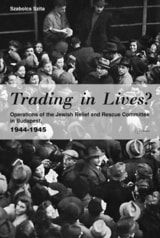
Trading in Lives?
Operations of the Jewish Relief and Rescue Committee in Budapest, 1944-1945Szabolcs Szita
Central European University Press, 2005
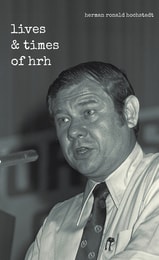
the lives & times of hrh
Herman Hochstadt
National University of Singapore Press, 2020