Results by title
79 books match the query 'Media & Communications' and 23 start with t

Taking the Risk Out of Democracy
Corporate Propaganda versus Freedom and LibertyAlex Carey
University of Illinois Press, 1995
Technological Sovereignty
Resisting Racial and Informational CapitalismSara Schoonmaker
University of Illinois Press, 2027
Sara Schoonmaker illuminates the system’s inner workings by examining technology-related struggles in global trade, COVID-19 vaccines, the Internet, and use of personal data. The World Trade Organization and other neoliberal institutions protect corporate power while limiting access to important tools. Schoonmaker’s analysis explores a hopeful alternative that allows communities and nations to assert more control over the technologies they need. As she shows, state-centered policies have the potential to improve access to technology by challenging corporate power. At the same time, nonproprietary approaches like free software and community broadband encourage the knowledge-sharing needed to create fair systems that resist ongoing exploitation.
Ambitious and timely, Technological Sovereignty draws on a wide-ranging group of voices to offer a roadmap for a more just digital future.
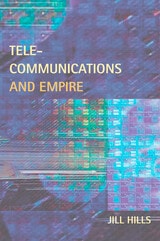
Telecommunications and Empire
Jill Hills
University of Illinois Press, 2007
Jill Hills picks up from her pathbreaking study The Struggle for Control of Global Communication: The Formative Century to continue her examination of the political, technological, and economic forces at work in the global telecommunications market from World War II to the World Trade Organization agreement of 1997. In the late twentieth century, focus shifted from the creation and development of global communication markets to their intense regulation. The historical framework behind this control--where the market was regulated, by what institution, controlled by what power, and to whose benefit--masterfully complements Hills's analysis of power relations within the global communications arena.
Hills documents attempts by governments to direct, replace, and bypass international telecommunications institutions. As she shows, the results have offered indirect control over foreign domestic markets, government management of private corporations, and government protection of its own domestic communication market. Hills reveals that the motivation behind these powerful, regulatory efforts on person-to-person communication lies in the unmatched importance of communication in the world economy.
As ownership of communications infrastructure becomes more valuable, governments have scrambled to shape international guidelines. Hills provides insight into struggles between U.S. policymakers and the rest of the world, illustrating the conflict between a growing telecommunications empire and sovereign states that are free to implement policy changes. Freshly detailing the interplay between U.S. federal regulation and economic power, Hills fosters a deep understanding of contemporary systems of power in global communications.
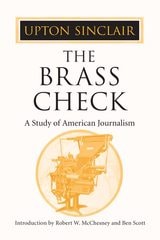
The Brass Check
A STUDY OF AMERICAN JOURNALISMUpton Sinclair
University of Illinois Press, 2002
Fueled by mounting disdain for newspapers run by business tycoons and conservative editors, Sinclair self-published The Brass Check in the years after The Jungle had made him a household name. Despite Sinclair’s claim that this was his most important book, it was dismissed by critics and shunned by reviewers. Yet it sold over 150,000 copies and enjoyed numerous printings.
A substantial introduction to this paperback edition by Robert W. McChesney and Ben Scott asserts the book’s importance as a cornerstone critique of commercial journalism and a priceless resource for understanding the political turbulence of the Progressive Era.
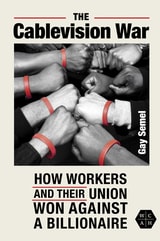
The Cablevision War
How Workers and Their Union Won Against a BillionaireGay Semel
University of Illinois Press, 2027
Gay Semel draws on her front-line experiences to provide an insider’s look at this bitter labor fight and its implications for unionization across the country. Unwilling to accept the vote, Cablevision, and its CEO James Dolan, used aggressive and illegal tactics like harassing and firing the Brooklyn workers to weaken support for the union. The CWA responded by mobilizing public pressure to push back. As the conflict unfolded, the union found support among community leaders, politicians, and activists. Semel traces the slow and difficult process of winning a first contract and details how courage, unity, and perseverance triumphed over a powerful company.
Dramatic and compelling, The Cablevision War tells the inspiring story of an important victory for workers and the lessons it offers for a revitalized labor movement.
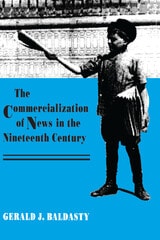
The Commercialization of News in the Nineteenth Century
Gerald J. Baldasty
University of Wisconsin Press, 1992
The Commercialization of News in the Nineteenth Century traces the major transformation of newspapers from a politically based press to a commercially based press in the nineteenth century. Gerald J. Baldasty argues that broad changes in American society, the national economy, and the newspaper industry brought about this dramatic shift.
Increasingly in the nineteenth century, news became a commodity valued more for its profitablility than for its role in informing or persuading the public on political issues. Newspapers started out as highly partisan adjuncts of political parties. As advertisers replaced political parties as the chief financial support of the press, they influenced newspapers in directing their content toward consumers, especially women. The results were recipes, fiction, contests, and features on everything from sports to fashion alongside more standard news about politics.
Baldasty makes use of nineteenth-century materials—newspapers from throughout the era, manuscript letters from journalists and politicians, journalism and advertising trade publications, government reports—to document the changing role of the press during the period. He identifies three important phases: the partisan newspapers of the Jacksonian era (1825-1835), the transition of the press in the middle of the century, and the influence of commercialization of the news in the last two decades of the century.
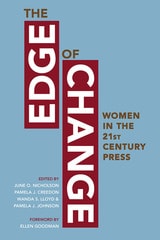
The Edge of Change
Women in the Twenty-First-Century PressEdited by June O. Nicholson, Pamela J. Creedon, Wanda S. Lloyd, and Pamela J. Jo: Foreword by Ellen Goodman
University of Illinois Press, 2008
Prominent female voices in journalism provide critical perspectives on the challenges women face in today's news organizations, such as connecting with diverse audiences, educating readers about international issues and cultures, maintaining credibility, negotiating media consolidation and corporate pressures, and overcoming the persistent barriers to professional advancement. A powerful and complex assessment of how women are transforming the news industry, The Edge of Change explores how the news industry might implement further reforms aimed at creating a more inclusive journalistic community.
Contributors are Catalina Camia, Kathleen Carroll, Pamela J. Creedon, Paula Lynn Ellis, Helen E. Fisher, Dorothy Butler Gilliam, Ellen Goodman, Sharon Grigsby, Carol Guzy, Kirsten Scharnberg Hampton, Cathy Henkel, Pamela J. Johnson, Jane Kirtley, Jan Leach, Caroline Little, Wanda S. Lloyd, Arlene Notoro Morgan, June O. Nicholson, Geneva Overholser, Marty Petty, Deb Price, Donna M. Reed, Sandra Mims Rowe, Peggy Simpson, Margaret Sullivan, Julia Wallace, and Keven Ann Willey.
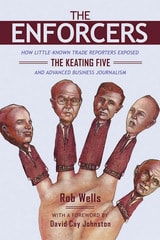
The Enforcers
How Little-Known Trade Reporters Exposed the Keating Five and Advanced Business JournalismRob Wells with a foreword by David Cay Johnston
University of Illinois Press, 2019
The Future of Memory
A History of Lossless Format Standards in the Moving Image ArchiveJimi Jones and Marek Jancovic
University of Illinois Press, 2025
Drawing on interviews with archivists and developers, Jones and Jancovic reveal the archive as a dynamic space where deeply entrenched social practices produce disagreements but also resourceful collaborations. They contrast the unprecedented rise of archivist-driven standardization and controversies around non-standard technology with the historical dominance of the film and broadcast industries. Throughout, the authors clarify the role of tech companies, software developers, film pirates, hackers, and other players with poorly understood roles in the process.
A timely look at the state of audiovisual preservation, The Future of Memory provides a history of recent innovations alongside a snapshot of a field in the midst of profound technological change.
The Great Television Race
A History of the American Television Industry, 1925-1941Joseph H. Udelson
University of Alabama Press, 1989
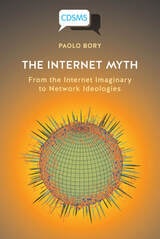
The Internet Myth
From the Internet Imaginary to Network IdeologiesPaolo Bory
University of Westminster Press, 2020
‘The Internet is broken and Paolo Bory knows how we got here. In a powerful book based on original research, Bory carefully documents the myths, imaginaries, and ideologies that shaped the material and cultural history of the Internet. As important as this book is to understand our shattered digital world, it is essential for those who would fix it.’ — Vincent Mosco, author of The Smart City in a Digital World
The Internet Myth retraces and challenges the myth laying at the foundations of the network ideologies – the idea that networks, by themselves, are the main agents of social, economic, political and cultural change. By comparing and integrating different sources related to network histories, this book emphasizes how a dominant narrative has extensively contributed to the construction of the Internet myth while other visions of the networked society have been erased from the collective imaginary. The book decodes, analyzes and challenges the foundations of the network ideologies looking at how networks have been imagined, designed and promoted during the crucial phase of the 1990s.
Three case studies are scrutinized so as to reveal the complexity of network imaginaries in this decade: the birth of the Web and the mythopoesis of its inventor; and the histories of two Italian networking projects, the infrastructural plan Socrate and the civic network Iperbole, the first to give free Internet access to citizens.
The Internet Myth thereby provides a compelling and hidden sociohistorical narrative in order to challenge one of the most powerful myths of our time.
This title has been published with the financial assistance of the Fondazione Hilda e Felice Vitali, Lugano, Switzerland.

The Left Behind
Reimagining Britain's Socially ExcludedJames
Pluto Press, 2022
Examines the ways in which the 'Left Behind' have been used to symbolize and foment social divisions in contemporary Britain.
'The Left Behind' is a defining motif of contemporary British political discourse. It is the thread that knits together the 2016 Brexit referendum, the crumbling of the fabled 'Red Wall' in the North, and the pernicious culture war being waged today. But who are the Left Behind?
James Morrison goes in search of the reality behind the rhetoric, offering the first comprehensive, historical analysis of the origins, uses and meanings of the term. He interrogates the popular archetype of the Left Behind - as a working-class, Leave-voting white male from a former industrial heartland - and situates the concept in the context of longstanding, demonizing discourses aimed at communities seen as backward and 'undeserving'.
Analyzing national newspaper coverage and parliamentary discussions, and drawing on interviews with MPs, community leaders, charities, and people with direct lived experiences of poverty and precarity, The Left Behind grapples with the real human cost of austerity for neglected post-industrial communities and other marginalized groups across the world, and the stigmatizing discourse that does little to serve them.
The Newspaper Indian
Native American Identity in the Press, 1820-90John M. Coward
University of Illinois Press, 1999
How newspapers shaped the image of Native Americans
John M. Coward looks at how nineteenth-century newspapers and news making practices shaped the contradictory and still persistent representation of Native Americans. As Coward reveals, journalism failed to describe Indigenous people on their own terms. Instead, reporters chose portrayals that adhered to the norms of the majority white, Anglo-Saxon, Protestant society that read their papers. In addition, Coward shows how journalists turned Native Americans into symbolic and ambiguous figures used to measure American progress.
An in-depth look at the power of the press, The Newspaper Indian provides insight into how journalism wove a skewed idea of Native Americans into the fabric of American life.
The Organization of Journalism
Market Models and Practice in a Fraying ProfessionPatrick Ferrucci
University of Illinois Press, 2024
Using rich interviews and participant observation, Patrick Ferrucci examines institutions with funding mechanisms that range from traditional mogul ownership and online-only nonprofits to staff-owned cooperatives and hedge fund control. The variations in market models have frayed the tenets of professionalization, with unique work cultures emerging from each organization’s focus on its mission and the implantation of its own processes and ethical guidelines. As a result, the field of American journalism no longer shares uniform newsgathering practices and a common identity, a break with the past that affects what information we consume today and what the press will become tomorrow.
An inside look at a fracturing profession, The Organization of Journalism illuminates the institution’s expanding impact on newsgathering and the people who practice it.
The Paradox of Connection
How Digital Media Is Transforming Journalistic LaborDiana Bossio, Valérie Bélair-Gagnon, Avery Holton, and Logan Molyneux
University of Illinois Press, 2024
Using a framework of online connection and disconnection, The Paradox of Connection examines how journalists’ practices are formed, negotiated, and maintained in dynamic social media environments. The interactions of journalists with the technological, social, and cultural features of online and social media environments have shaped new values and competencies--and the combination of these factors influence online work practices. Merging case studies with analysis, the authors show how the tactics of online connection and disconnection interact with the complex realities of working in today’s media environments. The result is an insightful portrait of fast-changing journalistic practices and their implications for both audiences and professional identities and norms.
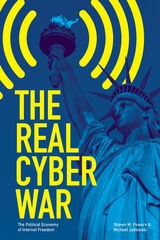
The Real Cyber War
The Political Economy of Internet FreedomShawn M. Powers and Michael Jablonski
University of Illinois Press, 2015
Moving beyond debates on the democratic value of new and emerging information technologies, The Real Cyber War focuses on political, economic, and geopolitical factors driving internet freedom policies, in particular the U.S. State Department's emerging doctrine in support of a universal freedom to connect. They argue that efforts to create a universal internet built upon Western legal, political, and social preferences is driven by economic and geopolitical motivations rather than the humanitarian and democratic ideals that typically accompany related policy discourse. In fact, the freedom-to-connect movement is intertwined with broader efforts to structure global society in ways that favor American and Western cultures, economies, and governments.
Thought-provoking and far-seeing, The Real Cyber War reveals how internet policies and governance have emerged as critical sites of geopolitical contestation, with results certain to shape statecraft, diplomacy, and conflict in the twenty-first century.
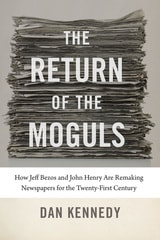
The Return of the Moguls
How Jeff Bezos and John Henry Are Remaking Newspapers for the Twenty-First CenturyDan Kennedy
University Press of New England, 2018
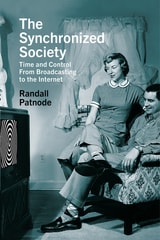
The Synchronized Society
Time and Control From Broadcasting to the InternetRandall Patnode
Rutgers University Press, 2023
The Synchronized Society traces the history of the synchronous broadcast experience of the twentieth century and the transition to the asynchronous media that dominate today. Broadcasting grew out of the latent desire by nineteenth-century industrialists, political thinkers, and social reformers to tame an unruly society by controlling how people used their time. The idea manifested itself in the form of the broadcast schedule, a managed flow of information and entertainment that required audiences to be in a particular place – usually the home – at a particular time and helped to create “water cooler” moments, as audiences reflected on their shared media texts. Audiences began disconnecting from the broadcast schedule at the end of the twentieth century, but promoters of social media and television services still kept audiences under control, replacing the schedule with surveillance of media use. Author Randall Patnode offers compelling new insights into the intermingled roles of broadcasting and industrial/post-industrial work and how Americans spend their time.
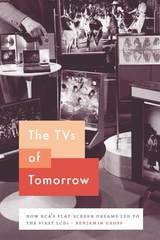
The TVs of Tomorrow
How RCA’s Flat-Screen Dreams Led to the First LCDsBenjamin Gross
University of Chicago Press, 2018
Half a century later, RCA’s dreams have become a reality, and liquid crystals are the basis of a multibillion-dollar global industry. Yet the company responsible for producing the first LCDs was unable to capitalize upon its invention. In The TVs of Tomorrow, Benjamin Gross explains this contradiction by examining the history of flat-panel display research at RCA from the perspective of the chemists, physicists, electrical engineers, and technicians at the company’s central laboratory in Princeton, New Jersey.
Drawing upon laboratory notebooks, internal reports, and interviews with key participants, Gross reconstructs the development of the LCD and situates it alongside other efforts to create a thin, lightweight replacement for the television picture tube. He shows how RCA researchers mobilized their technical expertise to secure support for their projects. He also highlights the challenges associated with the commercialization of liquid crystals at RCA and Optel—the RCA spin-off that ultimately manufactured the first LCD wristwatch. The TVs of Tomorrow is a detailed portrait of American innovation during the Cold War, which confirms that success in the electronics industry hinges upon input from both the laboratory and the boardroom.

The Transsion Approach
Translating Chinese Mobile Technology in AfricaMiao Lu
University of Illinois Press, 2025
The Universal Journalist
David Randall
Pluto Press, 2021

Thinker, Faker, Spinner, Spy
Corporate PR and the Assault on DemocracyEdited by David Miller and William Dinan
Pluto Press, 2007
Written by leading activists and writers, this book reveals the secrets of the PR trade including deception, the use of fake 'institutes', spying and dirty tricks. The impact can be devastating -- when the public is denied access to the truth, the results are rising inequality and environmental catastrophe.
Exposing the misdeeds of famous companies including Coca Cola, British Aerospace, Exxon and Monsanto, and revealing information about the covert funding of various apparently independent thinks tanks and institutes, the authors offer a guide to campaigns that can help us roll back corporate power and resist deceptive PR.

Transnational Korean Cinema
Cultural Politics, Film Genres, and Digital TechnologiesDal Yong Jin
Rutgers University Press, 2020
The book emphasizes the economic and industrial aspects of the story, looking at questions on the interaction of politics and economics, including censorship and public funding, and provides a better view of the big picture by laying bare the relationship between film industries, the global market, and government. Jin also sheds light on the operations and globalization strategies of Korean film industries alongside changing cultural policies in tandem with Hollywood’s continuing influences in order to comprehend the power relations within cultural politics, nationally and globally. This is the first book to offer a full overview of the nascent development of Korean cinema.