Results by title
55 books match the query 'Memories' and 8 start with t
Tattered Kimonos in Japan
Remaking Lives from Memories of World War IIRobert Rand
University of Alabama Press, 2024
Examines Japan’s war generation—Japanese men and women who survived World War Two and rebuilt their lives from memories of that conflict.
Since John Hersey’s Hiroshima—the classic account, published in 1946, of the aftermath of the atomic bombing of that city—very few books have examined the meaning and impact of World War II through the eyes of Japanese men and women who survived that conflict. Tattered Kimonos in Japan does just that: It is an intimate journey into contemporary Japan from the perspective of the generation of Japanese soldiers and civilians who survived World War II, by a writer whose American father and Japanese father-in-law fought on opposite sides of the conflict.
The author, a former NPR senior editor, is Jewish, and he approaches the subject with the sensibilities of having grown up in a community of Holocaust survivors. Mindful of the power of victimhood, memory, and shared suffering, he travels across Japan, including Hiroshima and Nagasaki, meeting a compelling group of men and women whose lives, even now, are defined by the trauma of war, and by lingering questions of responsibility and repentance for Japan’s wartime aggression.
The image of a tattered kimono from Hiroshima is the thread that drives the narrative arc of this emotional story about a writer’s encounter with history, inside the Japan of his father’s generation, on the other side of his father’s war. This is a book about history with elements of family memoir. It offers a fresh and truly unique perspective for readers interested in World War II, Japan, or Judaica; readers seeking cross-cultural journeys; and readers intrigued by Japanese culture, particularly the kimono.
The Cross Timbers
Memories of a North Texas BoyhoodBy Edward Everett Dale
University of Texas Press, 1966
The activities of a young boy on a small farm in the Texas Cross Timbers during the 1880s seem especially distant today. No one can remember the adventure of a sixteen-and-a-half-mile journey, which consumed the greater part of a day; or hurried predawn dressing in a frosty cold loft while the fragrance of a hearty breakfast wafted upward through the floor cracks; or a two-room schoolhouse, where the last half of Friday afternoon was given over to “speaking pieces” or to spelling and ciphering matches.
Through the recollections of Edward Everett Dale we are able to view a pattern of life in rural America now gone forever. For The Cross Timbers is a story which, with but a few minor variations, could have been told about a vast number of small boys on farms cleared from the virgin forests in the timbered regions of many states.
After presenting a brief introduction to the members of the Dale family and the plant, animal, and bird life of the Lower Cross Timbers countryside, the author describes his boyhood of a past century. He tells of his home, its furnishings, and the food served there, as well as the neighbors and relatives who come to visit. We learn of the superstitions, the humorous homespun expressions, the mores of early rural Texans. We hunt and fish with young Master Dale in the thick woods and along the clear creeks. Pioneer life demanded much hard work, but not to the exclusion of a diverting social life—both of which included the youngsters, as the author so graphically relates. Dale tells us also of the religious and secular education of the era, showing the significance of the home in supplementing these two influences.
Anyone reading this volume must be impressed by the great differences in the lifeways of rural children today and of those of the end of the nineteenth century.
The Farm on Badger Creek
Memories of a Midwest GirlhoodPeggy Prilaman Marxen
Wisconsin Historical Society Press, 2021
The Land of Milk and Uncle Honey
Memories from the Farm of My YouthAlan Guebert with Mary Grace Foxwell
University of Illinois Press, 2015
Here are Guebert's tireless parents, measuring the year not in months but in seasons for sewing, haying, and doing the books; Jackie the farmhand, needing ninety minutes to do sixty minutes' work and cussing the entire time; Hoard the dairyman, sore fingers wrapped in electrician's tape, sharing wine and the prettiest Christmas tree ever; and the unflappable Uncle Honey, spreading mayhem via mistreated machinery, flipped wagons, and the careless union of diesel fuel and fire.
Guebert's heartfelt and humorous reminiscences depict the hard labor and simple pleasures to be found in ennobling work, and show that in life, as in farming, Uncle Honey had it right with his succinct philosophy for overcoming adversity: "the secret's not to stop."
https://www.youtube.com/watch?v=DooGQqUlXI4&index=1&list=FLPxtuez-lmHxi5zpooYEnBg
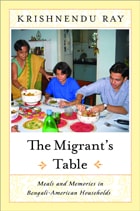
The Migrants Table
Meals And Memories InKrishnendu Ray
Temple University Press, 2004
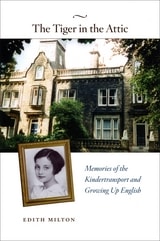
The Tiger in the Attic
Memories of the Kindertransport and Growing Up EnglishEdith Milton
University of Chicago Press, 2006
In this illuminating chronicle, Edith describes how she struggled to fit in and to conquer self-doubts about her German identity. Her realistic portrayal of the seemingly mundane yet historically momentous details of daily life during World War II slowly reveals istelf as a hopeful story about the kindness and generosity of strangers. She paints an account rich with colorful characters and intense relationships, uncanny close calls and unnerving bouts of luck that led to survival. Edith's journey between cultures continues with her final passage to America—yet another chapter in her life that required adjustment to a new world—allowing her, as she narrates it here, to visit her past as an exile all over again.
The Tiger in the Attic is a literary gem from a skilled fiction writer, the story of a thoughtful and observant child growing up against the backdrop of the most dangerous and decisive moment in modern European history. Offering a unique perspective on Holocaust studies, this book is both an exceptional and universal story of a young German-Jewish girl caught between worlds.
“Milton is brilliant at the small stroke . . . as well as broader ones.”—Alana Newhouse, New York Times Book Review
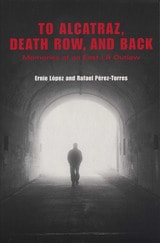
To Alcatraz, Death Row, and Back
Memories of an East LA OutlawBy Ernie López and Rafael Pérez-Torres
University of Texas Press, 2005
When Ernie López was a boy selling newspapers in Depression-era Los Angeles, his father beat him when he failed to bring home the expected eighty to ninety cents a day. When the beatings became unbearable, he took to petty stealing to make up the difference. As his thefts succeeded, Ernie's sense of necessity got tangled up with ambition and adventure. At thirteen, a joyride in a stolen car led to a sentence in California's harshest juvenile reformatory. The system's failure to show any mercy soon propelled López into a cycle of crime and incarceration that resulted in his spending decades in some of America's most notorious prisons, including four and a half years on death row for a murder López insists he did not commit.
To Alcatraz, Death Row, and Back is the personal life story of a man who refused to be broken by either an abusive father or an equally abusive criminal justice system. While López freely admits that "I've been no angel," his insider's account of daily life in Alcatraz and San Quentin graphically reveals the violence, arbitrary infliction of excessive punishment, and unending monotony that give rise to gang cultures within the prisons and practically insure that parolees will commit far worse crimes when they return to the streets. Rafael Pérez-Torres discusses how Ernie López's experiences typify the harsher treatment that ethnic and minority suspects often receive in the American criminal justice system, as well as how they reveal the indomitable resilience of Chicanos/as and their culture. As Pérez-Torres concludes, "López's story presents us with the voice of one who—though subjected to a system meant to destroy his soul—not only endured but survived, and in surviving prevailed."

To Lose a War
Memories of a German GirlRegina Maria Shelton
Southern Illinois University Press, 1982
Martin Blumenson refers to this book as a “sensitive, beautifully written personal memoir,” and calls it a contribution to understanding, “particularly to Americans who know little of how World War II and its immediate aftermath disrupted the lives of those who survived the defeat of Germany.”
Vividly, humanly, Shelton tells her story from the point of view of a teen-age German girl, one who witnessed her country’s surge to power and who felt the ignominy of both Germany and Germans after the fall. She reaches a point during the war when “Sometimes the way we now live seems unreal, as if we were marionettes, with orders and permits and schedules attached to us instead of strings.”
But after the defeat of Germany life gets considerably worse. The victorious Russians evict the natives from their homes. They sneer and leer at the women who must venture forth for food. In this defeated land “the nights become unbearably long; without any physical activity by day, sleep refuses to come. I yearn for sleep, be it temporary or eternal. Death is becoming a friend; the enemy has a new name now: Rape.”
Then comes the dreaded order to evacuate all Germans from Lower Silesia: “How can a whole people be uprooted, disowned, tossed aside like useless flotsam—how? With the stroke of a pen, with a new line drawn on a map, we are sentenced to homelessness.” Not knowing where they will be sent, they plod out into darkness and cold with the other Germans, their worldly goods reduced to what they can carry. Embittered, they are herded into vermin-infested freight cars, still unaware of their destination.