Results by title
51 books match the query 'Methods & Strategies' and 10 start with t
Teaching "Race" with a Gendered Edge
Brigitte Hipfl
Central European University Press, 2012
Teaching with Digital Humanities
Tools and Methods for Nineteenth-Century American LiteratureJennifer Travis, Jessica DeSpain
University of Illinois Press, 2018
Travis and DeSpain curate conversations on the value of project-based, collaborative learning; examples of real-world assignments where students combine close, collaborative, and computational reading; how digital humanities aids in the consideration of marginal texts; the ways in which an ethics of care can help students organize artifacts; and how an activist approach affects debates central to the study of difference in the nineteenth century.
A supplemental companion website with substantial appendixes of syllabi and assignments is now available for readers of Teaching with Digital Humanities.
Teaching with Tenderness
Toward an Embodied PracticeBecky Thompson
University of Illinois Press, 2017
Teaching with Tenderness follows in the tradition of bell hooks's Teaching to Transgress and Paulo Freire's Pedagogy of the Oppressed, inviting us to draw upon contemplative practices (yoga, meditation, free writing, mindfulness, ritual) to keep our hearts open as we reckon with multiple injustices. Teaching with tenderness makes room for emotion, offers a witness for experiences people have buried, welcomes silence, breath and movement, and sees justice as key to our survival. It allows us to rethink our relationship to grading, office hours, desks, and faculty meetings, sees paradox as a constant companion, moves us beyond binaries; and praises self and community care.
Tenderness examines contemporary challenges to teaching about race, gender, class, nationality, sexuality, religion, and other hierarchies. It examines the ethical, emotional, political, and spiritual challenges of teaching power-laden, charged issues and the consequences of shifting power relations in the classroom and in the community. Attention to current contributions in the areas of contemplative practices, trauma theory, multiracial feminist pedagogy, and activism enable us to envision steps toward a pedagogy of liberation. The book encourages active engagement and makes room for self-reflective learning, teaching, and scholarship.
Technical Theatre Education
A Vehicle for Critical LearningEdward S. Kraus
Southern Illinois University Press, 2027
Technical Theatre Education: A Vehicle for Critical Learning explores how the environment and process of producing theatrical or live entertainment events foster critical thinking and problem-solving skills. As a learning setting, the problem-based and experiential nature of designing and creating the sets, lighting, and costumes that support a production gives students ample opportunities to test theories, evaluate their growth, and experience the real-world consequences of success or failure.
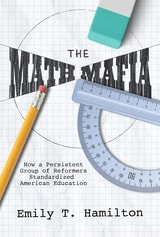
The Math Mafia
How a Persistent Group of Reformers Standardized American EducationEmily T. Hamilton
University of Alabama Press, 2026
How Cold War urgency, academic ambition, and federal power converged to make math the cornerstone of American education policy.
The Math Mafia by Emily T. Hamilton is a historical account of mathematics education reform in twentieth-century America and how that movement played a role in shaping the broader contours of national education policy. Hamilton contends that a cohesive and well-organized community of advocates was instrumental in the rise of standardized testing and curriculum reforms, as well as federal involvement in classrooms, especially during the Cold War. By positioning mathematics as central to national strength and security, these reformers established math education as a key area of federal focus.
The “mafia” at the center of Hamilton’s story includes mathematicians, educators, and researchers from universities, as well as members of government-funded organizations such as the National Science Foundation and various educational psychology circles. Prominent figures such as Edward Begle, who led the School Mathematics Study Group during the “new math” movement, played key roles. Other influential participants include federal education officials, advocates from professional organizations such as the National Council of Teachers of Mathematics, and cognitive scientists, who contributed both research and theoretical frameworks that informed curriculum design and assessment methods.
The Math Mafia offers historians, educators, policymakers, and other interested readers a compelling perspective on the legacy of the math education reforms on federal education policy in the United States and is a welcome contribution to ongoing discourse around “teaching toward the test,” educational equity, school performance, and other hot-button issues in US education today.
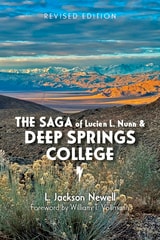
The Saga of Lucien L. Nunn and Deep Springs College
L. Jackson Newell
University of Utah Press, 2025
In 1891, Nunn, working with Tesla and Westinghouse, pioneered the world’s first commercial production of high-tension alternating current (AC) for long-distance transmission—something Thomas Edison deemed dangerous and irresponsible. After creating the Telluride Power Company, Nunn constructed the state-of-the-art Olmsted Power Plant in Provo Canyon and the Ontario Power Works at Niagara Falls. To support this new technology, he developed an imaginative model of industrial training that became so compelling that he ultimately abandoned his entrepreneurial career to devote his wealth and talents to experimenting with a new model of liberal education. In 1917, Nunn founded Deep Springs College in eastern California. The school remains one of the most daring, progressive, and selective institutions of higher learning in America. Newell examines how Nunn’s radical educational ideas have survived internal and external challenges for nearly a century and explores their relevance today.
The Teaching Guide for English for Dispute Resolution
Mastering Negotiation, Mediation, and Alternative Dispute ResolutionBarrie J. Roberts
University of Michigan Press, 2025
Each chapter of the textbook provides a ready-made lesson plan with a sample dispute, warm-up questions, background readings, follow-up questions, activities, and reflections, and The Teaching Guide supplements each chapter with:
- Support in the form of teaching tips, lesson plans, additional activities or role-plays, assessment suggestions, and resources for further exploration.
- Separate guidance for ESL and Legal English/Business English instructors that helps them select the material and activities best suited to their students’ interests and needs.
- Resources such as sample syllabi and activities with step-by-step instructions that make it easy to start teaching the textbook.
- An online companion site where instructors can download and send activities and role-plays directly to their students.
Theater Games for the Classroom
A Teacher's HandbookViola Spolin
Northwestern University Press, 1986
The most comprehensive theater instruction guide for all types of students
This best-selling book by Viola Spolin offers the most comprehensive theater instruction for all types of students, from small children to young adults. It includes over 130 theater games, plus exercises and instructional strategies. First developed by Spolin, the originator of modern improvisational theater techniques, these games have been tried and tested for over fifty years.
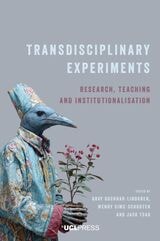
Transdisciplinary Experiments
Research, Teaching and InstitutionalisationEdited by Gray Kochhar-Lindgren, Wendy Sims-Schouten, and Jack Tsao
University College London, 2026
This volume pairs practical and theoretical insights on experimentation while advancing new models of transdisciplinary research, teaching, and institutional transformation.
Transdisciplinary Experiments explores how experimental approaches can reshape research, education, and institutions in higher education to respond to today’s complex and interconnected challenges. Grounded in the idea that experimentation can open up new possibilities, the volume examines how transdisciplinary teaching and learning can inspire change across disciplines, sectors, and cultures.

Translanguaging
What Every Teacher Needs to KnowJacob Huckle
University of Michigan Press, 2027
Multilingual learners bring a wealth of resources to the classroom in the form of their various languages. How can teachers tap into these resources as part of the learning process? How can we intentionally embrace linguistic diversity in our classrooms through the way we design learning? Despite the proliferation of research and writing about pedagogical translanguaging, many teachers do not feel equipped to effectively implement translanguaging approaches in their teaching.
Translanguaging provides a comprehensive introduction to the what, why, and how of translanguaging. The book synthesizes the research literature for a non-specialist audience, and builds on these insights by providing practical guidance for how students can be empowered to use all their linguistic resources—not just English or the language of instruction—to learn and thrive in school or college. Whether teachers of ESL or other subjects, all teachers will benefit from the practical guidance about translanguaging in this book and will be equipped to begin rethinking and redesigning their teaching to make more space for students’ multilingualism.